

Yes даbondjamesbond wrote: Wed Sep 02, 2026 3:57 pmHi !nikivdd wrote: Wed Sep 02, 2026 3:27 pm Campaign Options version 1.
.
001.png
.
Any option ideas or requests?
Suggestions are always welcome.
Will there be a Russian version?
PzC Toolkit v2.0.5.1 - Classic General v0.5.0 RC1 (06/09/26)
Moderators: Slitherine Core, Panzer Corps Design, Panzer Corps Moderators
Re: Panzer Corps Toolkit v2.0.5.1 (22/08/26)
Re: Panzer Corps Toolkit v2.0.5.1 (22/08/26)
- 001.png (28.95 KiB) Viewed 502 times
- 002.png (221.54 KiB) Viewed 502 times
- 003.png (104.23 KiB) Viewed 502 times
-
bondjamesbond
- Lieutenant-General - Do 217E
- Posts: 3164
- Joined: Mon Jun 27, 2022 10:10 pm
Re: Panzer Corps Toolkit v2.0.5.1 (22/08/26)
I really love this language pack with localisation into different languages! When will we be able to play it?
https://mynickname.com/id73473

Re: Panzer Corps Toolkit v2.0.5.1 (22/08/26)
As soon i have covered the basics i will release a beta.bondjamesbond wrote: Wed Sep 02, 2026 5:38 pm
I really love this language pack with localisation into different languages! When will we be able to play it?
-
bondjamesbond
- Lieutenant-General - Do 217E
- Posts: 3164
- Joined: Mon Jun 27, 2022 10:10 pm
Re: Panzer Corps Toolkit v2.0.5.1 (22/08/26)
Окnikivdd wrote: Wed Sep 02, 2026 6:24 pmAs soon i have covered the basics i will release a beta.bondjamesbond wrote: Wed Sep 02, 2026 5:38 pm
I really love this language pack with localisation into different languages! When will we be able to play it?

Will there be a button in the options to disable censorship!? Because I want authenticity and realism, not waffle towels as banners and flags )
- Attachments
-
- Screenshot_2026-09-02-15-11-00-186_org.telegram.messenger_1.jpg (139.75 KiB) Viewed 466 times
-
- Screenshot_2026-09-02-19-18-47-249_org.telegram.messenger_1.jpg (84.57 KiB) Viewed 469 times
-
- Screenshot_2026-09-02-17-23-07-346_org.telegram.messenger_1.jpg (73.42 KiB) Viewed 469 times
https://mynickname.com/id73473
Re: Panzer Corps Toolkit v2.0.5.1 (22/08/26)
No, but flags are modable and easily replaced by the one(s) you want.Will there be a button in the options to disable censorship!? Because I want authenticity and realism, not waffle towels as banners and flags )
-
bondjamesbond
- Lieutenant-General - Do 217E
- Posts: 3164
- Joined: Mon Jun 27, 2022 10:10 pm
Re: Panzer Corps Toolkit v2.0.5.1 (22/08/26)
That’s brilliant news, as there really shouldn’t be any censorship in historical games and films ) Even if they do contain elements of alternative fantasy )nikivdd wrote: Wed Sep 02, 2026 7:42 pmNo, but flags are modable and easily replaced by the one(s) you want.Will there be a button in the options to disable censorship!? Because I want authenticity and realism, not waffle towels as banners and flags )


As you mentioned earlier that there won’t be any battle animations in the circles, I’d like to ask whether there will at least be opening sequences and video clips?
https://mynickname.com/id73473
Re: Panzer Corps Toolkit v2.0.5.1 (22/08/26)
.
A video of Classic General (that is how i call this project), release candidate one test.
UI panel behavior, unit behavior, AI tactical version 2 behavior, AI prestige dumps and AI unit purchases.
.
.The AI is definitely working as an opponent rather than just moving units around, but I’d describe its current level as competent local defender, not yet a really dangerous operational opponent.
The good part is that it does put pressure. By Turn 10 several German units are down to strengths like 7, 6, 5 and even 2, so the Polish AI is inflicting meaningful attrition. It also appears reluctant to throw every unit forward blindly. Some Polish formations remain tied to important areas/objectives, and that matters: i finished with a Minor Victory rather than simply steamrolling the scenario. That suggests the objective-holding behavior is doing useful work.
In the meantime traits were introduced (Overrun, Para, Airlift, BridgeEngineer, IgnoreEntenchment).
A new UI button (air transport)
An intro video (for Bond)
The original Panzer General equipment roster has been expanded with the available stock icons (about 150 units).
.
I need to do a little more polishing before releasing a beta version including a last pass of the UI and AI behavior. I had not much time testing as most of my time went into the construction.
Re: Panzer Corps Toolkit v2.0.5.1 (22/08/26)
- 001.png (1006 KiB) Viewed 373 times
- 002.png (881.98 KiB) Viewed 373 times
- 003.png (299.66 KiB) Viewed 373 times
Prototype award screen, deployment screen, Upgrade screen.
Re: Panzer Corps Toolkit v2.0.5.1 (22/08/26)
Classic General – Game Mechanics, AI, Features and Extras
Classic General is a modern Windows reimplementation and expansion of the classic 1994 turn-based strategy game Panzer General. The goal is not simply to recreate the original game, but to preserve its fast, approachable tactical gameplay while expanding the underlying systems, improving the opponent AI, modernizing the interface, and providing room for the game to grow far beyond the original campaign.
The basic philosophy remains familiar: easy to understand, difficult to master.
TURN-BASED BATTLEFIELD
Classic General uses the traditional hex-based battlefield system. Each unit occupies a hex and has its own movement, combat, spotting, ammunition, fuel, experience and equipment characteristics.
During its turn, a unit may normally perform:
- one movement action
- one attack action
These actions can be performed in either order. A unit can therefore move and attack, or attack first and then reposition if the tactical situation permits.
Movement is affected by terrain, rivers, enemy Zones of Control, available fuel and the movement type of the unit. Tanks behave differently from infantry, reconnaissance vehicles, artillery, aircraft and naval units.
Terrain is much more than decoration. Forests, cities, mountains, rivers, swamps and other terrain types influence movement, initiative, defence, spotting and combat.
COMBAT
Combat follows the familiar Panzer General principle of comparing the attacking weapon against the appropriate defence value of the target.
Units can possess different values for:
- Soft Attack
- Hard Attack
- Air Attack
- Naval Attack
- Ground Defence
- Air Defence
- Close Defence
- Initiative
- Spotting
- Movement
- Fuel
- Ammunition
- Range
Terrain, experience, suppression, entrenchment and other battlefield conditions modify these values.
Initiative determines which side has the opportunity to fire first. Experienced troops and appropriate equipment can gain an important advantage, while difficult terrain can heavily restrict even the most advanced unit.
Restricted terrain such as towns, cities and forests can force units into close combat, where Close Defence becomes particularly important.
ENTRENCHMENT AND RUGGED DEFENCE
Units that remain in favourable defensive positions can gradually become entrenched.
Entrenchment improves their ability to survive an attack and can also produce Rugged Defence.
When Rugged Defence occurs, the attacker can lose its initiative advantage entirely. A seemingly easy assault on entrenched infantry in a city or forest can therefore become extremely costly.
Engineer-type units can possess the ability to ignore enemy entrenchment during attacks, making them particularly valuable during assaults against fortified positions.
SUPPRESSION
Not every successful hit immediately destroys enemy strength.
Combat can also produce suppression.
Suppressed soldiers temporarily stop contributing their full combat strength. A heavily suppressed unit may become incapable of attacking and becomes much easier to defeat.
This makes artillery and other support weapons extremely useful. Instead of simply destroying the enemy themselves, they can prepare a target for a decisive attack by tanks or infantry.
TANK OVERRUN
Armoured units can perform an Overrun under the correct circumstances.
If a vulnerable enemy on open terrain has been sufficiently suppressed and is forced to retreat, surrender or is destroyed, the attacking tank may advance directly into the defeated unit's position.
This makes combined-arms tactics especially effective: artillery suppresses the target, followed by an armoured assault that breaks through the line.
EXPERIENCE AND VETERAN UNITS
Units that survive battles gain experience.
Veteran units become more effective in combat and harder for the enemy to hit. Because campaign units remain with the player from one scenario to another, protecting experienced formations becomes one of the most important strategic decisions in the game.
A highly experienced Panzer, infantry regiment or fighter squadron can eventually become considerably more valuable than a newly purchased replacement.
The result is one of the defining features of Classic General: the player is not merely commanding anonymous counters, but gradually building a personal army.
CORE, AUXILIARY AND RESERVE FORCES
Campaign forces are divided into several categories.
Core Units belong permanently to the player's army. They can survive from scenario to scenario, gain experience and be upgraded with newer equipment.
Auxiliary Units are provided specifically for a scenario. They help complete the mission but normally do not become part of the permanent army.
Reserve Units allow core formations to remain outside the battlefield until needed or until deployment space becomes available.
During the deployment phase the player can reorganize the army, purchase equipment, upgrade existing formations and decide which units will participate in the coming battle.
PRESTIGE
Prestige is the game's primary strategic resource.
It can be gained through successful operations and the capture of important objectives and can be spent on:
- purchasing units
- upgrading equipment
- replacing losses
- reinforcing formations
- elite replacements where appropriate
Spending prestige carelessly can make later scenarios considerably harder.
The player must constantly choose between strengthening the current army and preserving resources for future operations.
CAMPAIGN SYSTEM
Classic General contains a branching campaign structure rather than a simple sequence of missions.
The result of a scenario may be:
Decisive Victory
Minor Victory
or
Loss
The outcome can determine the next scenario, available prestige, special opportunities and even whether the campaign continues.
A decisive victory can open routes that would otherwise remain unavailable.
After a scenario the player first sees the battle result, followed by the appropriate debriefing. Depending on the result, special campaign events may occur before the briefing and deployment phase of the next operation.
The campaign therefore develops according to the player's battlefield performance.
PROTOTYPE UNITS
With the optional Prototypes rule enabled, particularly successful commanders can receive experimental equipment.
A decisive victory during the appropriate period can unlock an advanced Tank, Anti-Tank or Artillery prototype before it becomes normally available.
The prototype is added to the player's Core without purchase cost and thereafter functions as a regular campaign unit.
This gives decisive victories an additional long-term reward.
REFORM UNITS
The optional Reform Units rule provides an alternative campaign style.
When enabled, a destroyed Core unit is not permanently removed. Instead it returns to the Reserve at zero strength and is restored before the next scenario.
Auxiliary units do not receive this protection.
Players can therefore choose between the unforgiving traditional system and a campaign mode that allows favourite formations to remain part of the army throughout the war.
DIFFICULTY SYSTEM
Classic General expands the traditional difficulty system into ten military ranks:
1. Gefreiter
2. Unterfeldwebel
3. Oberfeldwebel
4. Oberleutnant
5. Hauptmann
6. Major
7. Oberst
8. General
9. Generaloberst
10. Generalfeldmarschall
Difficulty affects much more than a simple combat bonus.
Depending on the selected rank, the game can modify:
- player prestige
- AI prestige
- initial Core strength
- AI behaviour and planning level
Lower ranks provide a forgiving introduction, while the highest ranks place significant pressure on both battlefield tactics and long-term campaign management.
OPTIONAL GENERAL MODES
Several additional campaign rules can change how the game is played.
Panzer General Mode prevents the purchase of infantry units.
Infantry General Mode prevents the purchase of tanks.
These modes force the player to approach familiar scenarios with a very different army composition.
Additional combat options include Combat Dice Chess and Combat Chess, allowing players to choose between more traditional combat randomness and increasingly predictable battle results.
FOG OF WAR
Classic General includes a full Fog of War system.
When Hidden Units are enabled, enemy formations are only visible when they have been detected by friendly units.
Every unit has its own spotting range, and occupying important terrain or moving reconnaissance forces forward can reveal previously hidden areas.
Once new enemy forces are discovered, information gained during movement cannot simply be undone without consequence.
Reconnaissance therefore becomes a real tactical role rather than merely another fast unit class.
WEATHER
Weather affects battlefield conditions and can dramatically change an operation.
Poor weather can reduce spotting and restrict initiative, reducing the advantage of highly advanced equipment.
The game also includes weather forecasting. Forecasts are useful but deliberately not completely reliable, forcing the commander to plan around uncertainty rather than perfect information.
SUPPLY
Ammunition and fuel remain important parts of the battlefield system.
Units that repeatedly attack will eventually need ammunition, while motorized and armoured formations consume fuel while moving.
The player must therefore consider when to advance, when to fight and when to stop and resupply.
For players who prefer a more streamlined game, the optional Supply setting can be disabled, keeping ammunition and fuel at maximum levels.
TRANSPORT
Infantry and other appropriate units can use ground transport such as trucks.
Scenario-controlled air and sea transport are handled separately. When suitable transport is available and the unit is positioned at the required airfield or port, the scenario transport pool can provide the necessary aircraft or ship.
These transports are scenario resources rather than equipment purchased with prestige.
MOUNT AND DISMOUNT – GROUND TRANSPORT
Many ground units in Classic General can make use of dedicated ground transport, allowing otherwise slow formations to move rapidly across the battlefield.
Infantry, engineers, anti-tank guns, artillery and other transport-capable units can be assigned vehicles such as trucks or other appropriate transports. When a unit possesses ground transport, the Mount command becomes available in the Unit Menu.
Mount
When the unit mounts its transport, the formation switches from its normal movement characteristics to those of the assigned transport.
This can greatly increase operational mobility and allows infantry or towed weapons to keep pace with faster armoured formations.
Mounted units are especially useful when:
- redeploying between distant sectors
- moving reinforcements toward the front
- following an armoured breakthrough
- retreating from an exposed position
- reaching objectives before the end of the scenario
The tactical unit display changes appropriately so that the player can clearly see that the formation is currently travelling in its transport.
Dismount
A mounted formation can use the corresponding Dismount command to leave its transport and return to its normal combat configuration.
After dismounting, the unit once again uses the movement and combat characteristics of the actual fighting formation rather than those of the transport.
This is particularly important for infantry and heavy weapons. Transport is excellent for moving troops quickly, but the transported unit normally needs to dismount before it can make full use of its battlefield role.
A truck may get an infantry regiment to the battle, but the truck itself is not the infantry regiment.
Transport and Tactical Risk
Ground transport creates an important tactical choice.
Keeping a unit mounted provides mobility, but a transported formation is generally much more vulnerable if caught by enemy forces. Moving trucks directly into an active combat zone can therefore be extremely dangerous.
A good commander will normally use transport behind or between the fighting lines, then dismount the unit before entering a position where serious combat is expected.
Reconnaissance and enemy spotting become particularly important when planning long mounted movements. A seemingly empty road can quickly become a dangerous route if enemy armour, artillery or aircraft are nearby.
Transport Is Part of the Unit
Ground transport belongs to the formation to which it has been assigned. It is not treated as a separate independent battlefield unit.
The player therefore does not need to move a truck and its infantry separately.
Instead, the unit switches between two states:
Dismounted – the actual combat formation is represented and uses its normal characteristics.
Mounted – the formation is travelling using its assigned ground transport.
This keeps the system fast and simple while still creating the operational difference between marching troops and motorized movement.
Purchasing and Upgrading Transport
Suitable ground transport can be assigned to eligible units through the army-management and deployment systems.
Different transports can provide different mobility characteristics, allowing the player to decide whether a formation needs transport and what type is appropriate for its role.
A slow infantry formation that receives an Opel Blitz, for example, becomes considerably easier to reposition during a mobile campaign.
Transport therefore becomes another part of long-term Core army planning rather than merely a temporary battlefield effect.
Combined-Arms Mobility
The Mount/Dismount system is especially important in campaigns where the player's army gradually becomes more mobile.
Tanks and reconnaissance vehicles may be capable of advancing very quickly, but unsupported armour can become vulnerable.
Motorized infantry, engineers, anti-tank weapons and artillery can use their transports to follow the advance, then dismount and establish a new defensive or offensive position.
This creates a natural combined-arms rhythm:
move quickly while mounted → reach the battle area → dismount → fight → remount when it is time to redeploy.
The system preserves the simple unit handling of classic Panzer General while giving transport-capable formations a meaningful operational role on the battlefield.
OBJECTIVES AND BATTLEFIELD CONTROL
Victory is determined by more than destroying enemy formations.
Strategic objectives must be captured and defended.
Control flags display which side currently owns important locations, while objective highlighting makes the operational targets easy to identify.
Unoccupied cities and airfields also provide limited observation, making control of strategic locations useful even when no combat unit is stationed there.
STRATEGIC MAP
In addition to the normal tactical battlefield, the player can open a Strategic Map.
The Strategic Map provides a simplified overview of the entire operation, showing friendly forces, known enemy forces and strategic objectives.
This makes it easier to understand the larger situation without losing the detailed tactical character of the main battlefield.
IMPROVED ARTIFICIAL INTELLIGENCE
One of the largest differences between Classic General and the original game is the AI system.
The AI is designed to behave as a battlefield commander rather than simply moving the nearest unit toward the player.
Its tactical planner evaluates the battlefield and gives different unit classes different responsibilities.
Reconnaissance units scout ahead, search for objectives and attempt to reveal the player's positions.
Artillery attempts to remain behind the front line where it can support other units without unnecessarily exposing itself.
Direct-fire units seek favourable engagements while taking enemy strength, terrain and expected combat results into account.
Units defending important objectives can recognize that remaining in position may be more valuable than pursuing an enemy.
Damaged or vulnerable units can behave more cautiously instead of automatically making suicidal attacks.
The AI also considers objective urgency. As the scenario approaches its final turns, capturing or defending victory locations becomes increasingly important.
The result is an opponent intended to create believable battlefield pressure rather than simply receive hidden combat bonuses.
AI PRESTIGE AND REINFORCEMENT
The computer opponent also operates with its own prestige economy.
Scenario and campaign settings can modify the amount of prestige available to the AI, particularly at higher difficulty levels.
This allows difficulty to increase through stronger operational resources and better decision-making rather than merely giving every enemy unit artificial combat advantages.
DEPLOYMENT PHASE
Before campaign battles the player enters a dedicated deployment phase.
Core formations can be positioned on available deployment hexes, removed again, reorganized or left in Reserve.
This is also the point where the player can inspect the army, purchase new equipment, reinforce weakened units and upgrade obsolete formations.
Deployment therefore acts as the bridge between long-term army management and the tactical battle.
EQUIPMENT DATABASE
Classic General retains the extensive equipment-based approach of the original game.
Every unit is defined through an equipment database containing its combat statistics, movement, range, fuel, ammunition, availability dates and other characteristics.
The original equipment set is preserved, while the game architecture allows additional historically appropriate equipment to be introduced without replacing the original entries.
This makes Classic General suitable not only for recreating the original campaign but also for future campaigns, scenarios and expanded equipment sets.
EQUIPMENT AND UNIT VIEWERS
Players can inspect the equipment database without entering a battle.
The Unit Viewer allows the original tactical unit graphics and equipment information to be examined directly from the front end.
These tools are useful both for players learning the equipment roster and for scenario designers building new content.
SAVE SYSTEM
Classic General uses an expanded native save format capable of preserving the complete battlefield state.
This includes far more than the current turn and unit positions.
Campaign progression, Core and Auxiliary forces, Reserve units, objective control, visibility, prestige, movement and attack status, AI state, captured locations and gameplay options can all be restored.
An optional Iron Man mode removes normal save freedom and provides a dedicated Iron Man save slot for players who want a more demanding campaign.
CASUALTY TRACKING
The game records battlefield losses for both sides.
The Casualties screen provides a direct comparison between Axis and Allied losses and helps show the cost of a victory beyond the simple scenario result.
A decisive victory achieved by destroying half of the player's veteran army may prove much less impressive during the next campaign mission.
MODERN WINDOWS INTERFACE
Classic General runs as a native modern Windows application while deliberately retaining the visual identity and atmosphere of the original Panzer General.
The interface combines recreated classic panels, tactical maps, strategic displays, original-style unit graphics and modern conveniences such as:
- scalable battlefield zoom
- smooth map scrolling
- keyboard movement
- edge scrolling
- improved information panels
- unit hover information
- Go To Unit
- Next Unit
- Undo Move where appropriate
- objective highlighting
- configurable strength plates
- fullscreen support
The intention is to make the original design comfortable on modern computers without turning it into an entirely different type of strategy game.
EIGHT LANGUAGES
Classic General includes a localization framework supporting:
- English
- German
- French
- Polish
- Ukrainian
- Russian
- Spanish
- Turkish
The selected language is remembered automatically.
Menus, campaign screens, options, briefings, debriefings and other game text are progressively being converted to the localization system, with English serving as the fallback whenever a translation is unavailable.
CLASSIC GENERAL FRONT END
Rather than presenting the player with a generic modern launcher, Classic General uses a front end inspired by the presentation style of the original General series.
The long-term Classic General launcher is intended to act as the central home for several related games and content sets, including:
- Panzer
- Allied
- Pacific
- Corps
This allows the project to grow into a larger General-series environment while keeping each game and equipment set independent.
DESIGNED FOR EXPANSION
Classic General is deliberately being built as more than a one-to-one remake.
THE GOAL
Classic General aims to preserve what made Panzer General memorable: clear rules, fast turns, meaningful unit progression and the constant temptation to attempt one more decisive victory.
At the same time, it adds deeper battlefield behaviour, a substantially improved AI opponent, stronger campaign management, modern Windows support, extensive customization and room for future expansion.
It is intended to feel immediately familiar to someone who played Panzer General in the 1990s, while offering enough improvements and additional systems to make the game worth returning to more than thirty years later.
More additional features will be considered, depending on community feedback
Release: a few more things need to be checked, once that is done, a beta release will be made available.
Classic General is a modern Windows reimplementation and expansion of the classic 1994 turn-based strategy game Panzer General. The goal is not simply to recreate the original game, but to preserve its fast, approachable tactical gameplay while expanding the underlying systems, improving the opponent AI, modernizing the interface, and providing room for the game to grow far beyond the original campaign.
The basic philosophy remains familiar: easy to understand, difficult to master.
TURN-BASED BATTLEFIELD
Classic General uses the traditional hex-based battlefield system. Each unit occupies a hex and has its own movement, combat, spotting, ammunition, fuel, experience and equipment characteristics.
During its turn, a unit may normally perform:
- one movement action
- one attack action
These actions can be performed in either order. A unit can therefore move and attack, or attack first and then reposition if the tactical situation permits.
Movement is affected by terrain, rivers, enemy Zones of Control, available fuel and the movement type of the unit. Tanks behave differently from infantry, reconnaissance vehicles, artillery, aircraft and naval units.
Terrain is much more than decoration. Forests, cities, mountains, rivers, swamps and other terrain types influence movement, initiative, defence, spotting and combat.
COMBAT
Combat follows the familiar Panzer General principle of comparing the attacking weapon against the appropriate defence value of the target.
Units can possess different values for:
- Soft Attack
- Hard Attack
- Air Attack
- Naval Attack
- Ground Defence
- Air Defence
- Close Defence
- Initiative
- Spotting
- Movement
- Fuel
- Ammunition
- Range
Terrain, experience, suppression, entrenchment and other battlefield conditions modify these values.
Initiative determines which side has the opportunity to fire first. Experienced troops and appropriate equipment can gain an important advantage, while difficult terrain can heavily restrict even the most advanced unit.
Restricted terrain such as towns, cities and forests can force units into close combat, where Close Defence becomes particularly important.
ENTRENCHMENT AND RUGGED DEFENCE
Units that remain in favourable defensive positions can gradually become entrenched.
Entrenchment improves their ability to survive an attack and can also produce Rugged Defence.
When Rugged Defence occurs, the attacker can lose its initiative advantage entirely. A seemingly easy assault on entrenched infantry in a city or forest can therefore become extremely costly.
Engineer-type units can possess the ability to ignore enemy entrenchment during attacks, making them particularly valuable during assaults against fortified positions.
SUPPRESSION
Not every successful hit immediately destroys enemy strength.
Combat can also produce suppression.
Suppressed soldiers temporarily stop contributing their full combat strength. A heavily suppressed unit may become incapable of attacking and becomes much easier to defeat.
This makes artillery and other support weapons extremely useful. Instead of simply destroying the enemy themselves, they can prepare a target for a decisive attack by tanks or infantry.
TANK OVERRUN
Armoured units can perform an Overrun under the correct circumstances.
If a vulnerable enemy on open terrain has been sufficiently suppressed and is forced to retreat, surrender or is destroyed, the attacking tank may advance directly into the defeated unit's position.
This makes combined-arms tactics especially effective: artillery suppresses the target, followed by an armoured assault that breaks through the line.
EXPERIENCE AND VETERAN UNITS
Units that survive battles gain experience.
Veteran units become more effective in combat and harder for the enemy to hit. Because campaign units remain with the player from one scenario to another, protecting experienced formations becomes one of the most important strategic decisions in the game.
A highly experienced Panzer, infantry regiment or fighter squadron can eventually become considerably more valuable than a newly purchased replacement.
The result is one of the defining features of Classic General: the player is not merely commanding anonymous counters, but gradually building a personal army.
CORE, AUXILIARY AND RESERVE FORCES
Campaign forces are divided into several categories.
Core Units belong permanently to the player's army. They can survive from scenario to scenario, gain experience and be upgraded with newer equipment.
Auxiliary Units are provided specifically for a scenario. They help complete the mission but normally do not become part of the permanent army.
Reserve Units allow core formations to remain outside the battlefield until needed or until deployment space becomes available.
During the deployment phase the player can reorganize the army, purchase equipment, upgrade existing formations and decide which units will participate in the coming battle.
PRESTIGE
Prestige is the game's primary strategic resource.
It can be gained through successful operations and the capture of important objectives and can be spent on:
- purchasing units
- upgrading equipment
- replacing losses
- reinforcing formations
- elite replacements where appropriate
Spending prestige carelessly can make later scenarios considerably harder.
The player must constantly choose between strengthening the current army and preserving resources for future operations.
CAMPAIGN SYSTEM
Classic General contains a branching campaign structure rather than a simple sequence of missions.
The result of a scenario may be:
Decisive Victory
Minor Victory
or
Loss
The outcome can determine the next scenario, available prestige, special opportunities and even whether the campaign continues.
A decisive victory can open routes that would otherwise remain unavailable.
After a scenario the player first sees the battle result, followed by the appropriate debriefing. Depending on the result, special campaign events may occur before the briefing and deployment phase of the next operation.
The campaign therefore develops according to the player's battlefield performance.
PROTOTYPE UNITS
With the optional Prototypes rule enabled, particularly successful commanders can receive experimental equipment.
A decisive victory during the appropriate period can unlock an advanced Tank, Anti-Tank or Artillery prototype before it becomes normally available.
The prototype is added to the player's Core without purchase cost and thereafter functions as a regular campaign unit.
This gives decisive victories an additional long-term reward.
REFORM UNITS
The optional Reform Units rule provides an alternative campaign style.
When enabled, a destroyed Core unit is not permanently removed. Instead it returns to the Reserve at zero strength and is restored before the next scenario.
Auxiliary units do not receive this protection.
Players can therefore choose between the unforgiving traditional system and a campaign mode that allows favourite formations to remain part of the army throughout the war.
DIFFICULTY SYSTEM
Classic General expands the traditional difficulty system into ten military ranks:
1. Gefreiter
2. Unterfeldwebel
3. Oberfeldwebel
4. Oberleutnant
5. Hauptmann
6. Major
7. Oberst
8. General
9. Generaloberst
10. Generalfeldmarschall
Difficulty affects much more than a simple combat bonus.
Depending on the selected rank, the game can modify:
- player prestige
- AI prestige
- initial Core strength
- AI behaviour and planning level
Lower ranks provide a forgiving introduction, while the highest ranks place significant pressure on both battlefield tactics and long-term campaign management.
OPTIONAL GENERAL MODES
Several additional campaign rules can change how the game is played.
Panzer General Mode prevents the purchase of infantry units.
Infantry General Mode prevents the purchase of tanks.
These modes force the player to approach familiar scenarios with a very different army composition.
Additional combat options include Combat Dice Chess and Combat Chess, allowing players to choose between more traditional combat randomness and increasingly predictable battle results.
FOG OF WAR
Classic General includes a full Fog of War system.
When Hidden Units are enabled, enemy formations are only visible when they have been detected by friendly units.
Every unit has its own spotting range, and occupying important terrain or moving reconnaissance forces forward can reveal previously hidden areas.
Once new enemy forces are discovered, information gained during movement cannot simply be undone without consequence.
Reconnaissance therefore becomes a real tactical role rather than merely another fast unit class.
WEATHER
Weather affects battlefield conditions and can dramatically change an operation.
Poor weather can reduce spotting and restrict initiative, reducing the advantage of highly advanced equipment.
The game also includes weather forecasting. Forecasts are useful but deliberately not completely reliable, forcing the commander to plan around uncertainty rather than perfect information.
SUPPLY
Ammunition and fuel remain important parts of the battlefield system.
Units that repeatedly attack will eventually need ammunition, while motorized and armoured formations consume fuel while moving.
The player must therefore consider when to advance, when to fight and when to stop and resupply.
For players who prefer a more streamlined game, the optional Supply setting can be disabled, keeping ammunition and fuel at maximum levels.
TRANSPORT
Infantry and other appropriate units can use ground transport such as trucks.
Scenario-controlled air and sea transport are handled separately. When suitable transport is available and the unit is positioned at the required airfield or port, the scenario transport pool can provide the necessary aircraft or ship.
These transports are scenario resources rather than equipment purchased with prestige.
MOUNT AND DISMOUNT – GROUND TRANSPORT
Many ground units in Classic General can make use of dedicated ground transport, allowing otherwise slow formations to move rapidly across the battlefield.
Infantry, engineers, anti-tank guns, artillery and other transport-capable units can be assigned vehicles such as trucks or other appropriate transports. When a unit possesses ground transport, the Mount command becomes available in the Unit Menu.
Mount
When the unit mounts its transport, the formation switches from its normal movement characteristics to those of the assigned transport.
This can greatly increase operational mobility and allows infantry or towed weapons to keep pace with faster armoured formations.
Mounted units are especially useful when:
- redeploying between distant sectors
- moving reinforcements toward the front
- following an armoured breakthrough
- retreating from an exposed position
- reaching objectives before the end of the scenario
The tactical unit display changes appropriately so that the player can clearly see that the formation is currently travelling in its transport.
Dismount
A mounted formation can use the corresponding Dismount command to leave its transport and return to its normal combat configuration.
After dismounting, the unit once again uses the movement and combat characteristics of the actual fighting formation rather than those of the transport.
This is particularly important for infantry and heavy weapons. Transport is excellent for moving troops quickly, but the transported unit normally needs to dismount before it can make full use of its battlefield role.
A truck may get an infantry regiment to the battle, but the truck itself is not the infantry regiment.
Transport and Tactical Risk
Ground transport creates an important tactical choice.
Keeping a unit mounted provides mobility, but a transported formation is generally much more vulnerable if caught by enemy forces. Moving trucks directly into an active combat zone can therefore be extremely dangerous.
A good commander will normally use transport behind or between the fighting lines, then dismount the unit before entering a position where serious combat is expected.
Reconnaissance and enemy spotting become particularly important when planning long mounted movements. A seemingly empty road can quickly become a dangerous route if enemy armour, artillery or aircraft are nearby.
Transport Is Part of the Unit
Ground transport belongs to the formation to which it has been assigned. It is not treated as a separate independent battlefield unit.
The player therefore does not need to move a truck and its infantry separately.
Instead, the unit switches between two states:
Dismounted – the actual combat formation is represented and uses its normal characteristics.
Mounted – the formation is travelling using its assigned ground transport.
This keeps the system fast and simple while still creating the operational difference between marching troops and motorized movement.
Purchasing and Upgrading Transport
Suitable ground transport can be assigned to eligible units through the army-management and deployment systems.
Different transports can provide different mobility characteristics, allowing the player to decide whether a formation needs transport and what type is appropriate for its role.
A slow infantry formation that receives an Opel Blitz, for example, becomes considerably easier to reposition during a mobile campaign.
Transport therefore becomes another part of long-term Core army planning rather than merely a temporary battlefield effect.
Combined-Arms Mobility
The Mount/Dismount system is especially important in campaigns where the player's army gradually becomes more mobile.
Tanks and reconnaissance vehicles may be capable of advancing very quickly, but unsupported armour can become vulnerable.
Motorized infantry, engineers, anti-tank weapons and artillery can use their transports to follow the advance, then dismount and establish a new defensive or offensive position.
This creates a natural combined-arms rhythm:
move quickly while mounted → reach the battle area → dismount → fight → remount when it is time to redeploy.
The system preserves the simple unit handling of classic Panzer General while giving transport-capable formations a meaningful operational role on the battlefield.
OBJECTIVES AND BATTLEFIELD CONTROL
Victory is determined by more than destroying enemy formations.
Strategic objectives must be captured and defended.
Control flags display which side currently owns important locations, while objective highlighting makes the operational targets easy to identify.
Unoccupied cities and airfields also provide limited observation, making control of strategic locations useful even when no combat unit is stationed there.
STRATEGIC MAP
In addition to the normal tactical battlefield, the player can open a Strategic Map.
The Strategic Map provides a simplified overview of the entire operation, showing friendly forces, known enemy forces and strategic objectives.
This makes it easier to understand the larger situation without losing the detailed tactical character of the main battlefield.
IMPROVED ARTIFICIAL INTELLIGENCE
One of the largest differences between Classic General and the original game is the AI system.
The AI is designed to behave as a battlefield commander rather than simply moving the nearest unit toward the player.
Its tactical planner evaluates the battlefield and gives different unit classes different responsibilities.
Reconnaissance units scout ahead, search for objectives and attempt to reveal the player's positions.
Artillery attempts to remain behind the front line where it can support other units without unnecessarily exposing itself.
Direct-fire units seek favourable engagements while taking enemy strength, terrain and expected combat results into account.
Units defending important objectives can recognize that remaining in position may be more valuable than pursuing an enemy.
Damaged or vulnerable units can behave more cautiously instead of automatically making suicidal attacks.
The AI also considers objective urgency. As the scenario approaches its final turns, capturing or defending victory locations becomes increasingly important.
The result is an opponent intended to create believable battlefield pressure rather than simply receive hidden combat bonuses.
AI PRESTIGE AND REINFORCEMENT
The computer opponent also operates with its own prestige economy.
Scenario and campaign settings can modify the amount of prestige available to the AI, particularly at higher difficulty levels.
This allows difficulty to increase through stronger operational resources and better decision-making rather than merely giving every enemy unit artificial combat advantages.
DEPLOYMENT PHASE
Before campaign battles the player enters a dedicated deployment phase.
Core formations can be positioned on available deployment hexes, removed again, reorganized or left in Reserve.
This is also the point where the player can inspect the army, purchase new equipment, reinforce weakened units and upgrade obsolete formations.
Deployment therefore acts as the bridge between long-term army management and the tactical battle.
EQUIPMENT DATABASE
Classic General retains the extensive equipment-based approach of the original game.
Every unit is defined through an equipment database containing its combat statistics, movement, range, fuel, ammunition, availability dates and other characteristics.
The original equipment set is preserved, while the game architecture allows additional historically appropriate equipment to be introduced without replacing the original entries.
This makes Classic General suitable not only for recreating the original campaign but also for future campaigns, scenarios and expanded equipment sets.
EQUIPMENT AND UNIT VIEWERS
Players can inspect the equipment database without entering a battle.
The Unit Viewer allows the original tactical unit graphics and equipment information to be examined directly from the front end.
These tools are useful both for players learning the equipment roster and for scenario designers building new content.
SAVE SYSTEM
Classic General uses an expanded native save format capable of preserving the complete battlefield state.
This includes far more than the current turn and unit positions.
Campaign progression, Core and Auxiliary forces, Reserve units, objective control, visibility, prestige, movement and attack status, AI state, captured locations and gameplay options can all be restored.
An optional Iron Man mode removes normal save freedom and provides a dedicated Iron Man save slot for players who want a more demanding campaign.
CASUALTY TRACKING
The game records battlefield losses for both sides.
The Casualties screen provides a direct comparison between Axis and Allied losses and helps show the cost of a victory beyond the simple scenario result.
A decisive victory achieved by destroying half of the player's veteran army may prove much less impressive during the next campaign mission.
MODERN WINDOWS INTERFACE
Classic General runs as a native modern Windows application while deliberately retaining the visual identity and atmosphere of the original Panzer General.
The interface combines recreated classic panels, tactical maps, strategic displays, original-style unit graphics and modern conveniences such as:
- scalable battlefield zoom
- smooth map scrolling
- keyboard movement
- edge scrolling
- improved information panels
- unit hover information
- Go To Unit
- Next Unit
- Undo Move where appropriate
- objective highlighting
- configurable strength plates
- fullscreen support
The intention is to make the original design comfortable on modern computers without turning it into an entirely different type of strategy game.
EIGHT LANGUAGES
Classic General includes a localization framework supporting:
- English
- German
- French
- Polish
- Ukrainian
- Russian
- Spanish
- Turkish
The selected language is remembered automatically.
Menus, campaign screens, options, briefings, debriefings and other game text are progressively being converted to the localization system, with English serving as the fallback whenever a translation is unavailable.
CLASSIC GENERAL FRONT END
Rather than presenting the player with a generic modern launcher, Classic General uses a front end inspired by the presentation style of the original General series.
The long-term Classic General launcher is intended to act as the central home for several related games and content sets, including:
- Panzer
- Allied
- Pacific
- Corps
This allows the project to grow into a larger General-series environment while keeping each game and equipment set independent.
DESIGNED FOR EXPANSION
Classic General is deliberately being built as more than a one-to-one remake.
The original Panzer General remains the foundation, but the architecture is being prepared for a much larger collection of historical turn-based campaigns.Its internal systems are designed so that new equipment, scenarios, campaigns, nations, rules and even additional General-series games can be added without rewriting the entire engine.
THE GOAL
Classic General aims to preserve what made Panzer General memorable: clear rules, fast turns, meaningful unit progression and the constant temptation to attempt one more decisive victory.
At the same time, it adds deeper battlefield behaviour, a substantially improved AI opponent, stronger campaign management, modern Windows support, extensive customization and room for future expansion.
It is intended to feel immediately familiar to someone who played Panzer General in the 1990s, while offering enough improvements and additional systems to make the game worth returning to more than thirty years later.
More additional features will be considered, depending on community feedback
Release: a few more things need to be checked, once that is done, a beta release will be made available.
Re: Panzer Corps Toolkit v2.0.5.1 (22/08/26)
Great, and thanks, Niko! That was one of those games that completely fascinated me back then. After several days of playing, I probably had grey skin and red eyes — but it was absolutely worth it. 
Adding the Overrun (Panzer General II) feature was a really good idea. There were moments when you’d grit your teeth and have a very satisfying “Take that!” running through your head.That was actually one of the mechanics I truly missed in Panzer Corps 1.
Adding the Overrun (Panzer General II) feature was a really good idea. There were moments when you’d grit your teeth and have a very satisfying “Take that!”
running through your head.That was actually one of the mechanics I truly missed in Panzer Corps 1.-
bondjamesbond
- Lieutenant-General - Do 217E
- Posts: 3164
- Joined: Mon Jun 27, 2022 10:10 pm
Re: Panzer Corps Toolkit v2.0.5.1 (22/08/26)
nikivdd wrote: Fri Sep 04, 2026 8:24 am Classic General – Game Mechanics, AI, Features and Extras
Classic General is a modern Windows reimplementation and expansion of the classic 1994 turn-based strategy game Panzer General. The goal is not simply to recreate the original game, but to preserve its fast, approachable tactical gameplay while expanding the underlying systems, improving the opponent AI, modernizing the interface, and providing room for the game to grow far beyond the original campaign.
The basic philosophy remains familiar: easy to understand, difficult to master.
TURN-BASED BATTLEFIELD
Classic General uses the traditional hex-based battlefield system. Each unit occupies a hex and has its own movement, combat, spotting, ammunition, fuel, experience and equipment characteristics.
During its turn, a unit may normally perform:
- one movement action
- one attack action
These actions can be performed in either order. A unit can therefore move and attack, or attack first and then reposition if the tactical situation permits.
Movement is affected by terrain, rivers, enemy Zones of Control, available fuel and the movement type of the unit. Tanks behave differently from infantry, reconnaissance vehicles, artillery, aircraft and naval units.
Terrain is much more than decoration. Forests, cities, mountains, rivers, swamps and other terrain types influence movement, initiative, defence, spotting and combat.
COMBAT
Combat follows the familiar Panzer General principle of comparing the attacking weapon against the appropriate defence value of the target.
Units can possess different values for:
- Soft Attack
- Hard Attack
- Air Attack
- Naval Attack
- Ground Defence
- Air Defence
- Close Defence
- Initiative
- Spotting
- Movement
- Fuel
- Ammunition
- Range
Terrain, experience, suppression, entrenchment and other battlefield conditions modify these values.
Initiative determines which side has the opportunity to fire first. Experienced troops and appropriate equipment can gain an important advantage, while difficult terrain can heavily restrict even the most advanced unit.
Restricted terrain such as towns, cities and forests can force units into close combat, where Close Defence becomes particularly important.
ENTRENCHMENT AND RUGGED DEFENCE
Units that remain in favourable defensive positions can gradually become entrenched.
Entrenchment improves their ability to survive an attack and can also produce Rugged Defence.
When Rugged Defence occurs, the attacker can lose its initiative advantage entirely. A seemingly easy assault on entrenched infantry in a city or forest can therefore become extremely costly.
Engineer-type units can possess the ability to ignore enemy entrenchment during attacks, making them particularly valuable during assaults against fortified positions.
SUPPRESSION
Not every successful hit immediately destroys enemy strength.
Combat can also produce suppression.
Suppressed soldiers temporarily stop contributing their full combat strength. A heavily suppressed unit may become incapable of attacking and becomes much easier to defeat.
This makes artillery and other support weapons extremely useful. Instead of simply destroying the enemy themselves, they can prepare a target for a decisive attack by tanks or infantry.
TANK OVERRUN
Armoured units can perform an Overrun under the correct circumstances.
If a vulnerable enemy on open terrain has been sufficiently suppressed and is forced to retreat, surrender or is destroyed, the attacking tank may advance directly into the defeated unit's position.
This makes combined-arms tactics especially effective: artillery suppresses the target, followed by an armoured assault that breaks through the line.
EXPERIENCE AND VETERAN UNITS
Units that survive battles gain experience.
Veteran units become more effective in combat and harder for the enemy to hit. Because campaign units remain with the player from one scenario to another, protecting experienced formations becomes one of the most important strategic decisions in the game.
A highly experienced Panzer, infantry regiment or fighter squadron can eventually become considerably more valuable than a newly purchased replacement.
The result is one of the defining features of Classic General: the player is not merely commanding anonymous counters, but gradually building a personal army.
CORE, AUXILIARY AND RESERVE FORCES
Campaign forces are divided into several categories.
Core Units belong permanently to the player's army. They can survive from scenario to scenario, gain experience and be upgraded with newer equipment.
Auxiliary Units are provided specifically for a scenario. They help complete the mission but normally do not become part of the permanent army.
Reserve Units allow core formations to remain outside the battlefield until needed or until deployment space becomes available.
During the deployment phase the player can reorganize the army, purchase equipment, upgrade existing formations and decide which units will participate in the coming battle.
PRESTIGE
Prestige is the game's primary strategic resource.
It can be gained through successful operations and the capture of important objectives and can be spent on:
- purchasing units
- upgrading equipment
- replacing losses
- reinforcing formations
- elite replacements where appropriate
Spending prestige carelessly can make later scenarios considerably harder.
The player must constantly choose between strengthening the current army and preserving resources for future operations.
CAMPAIGN SYSTEM
Classic General contains a branching campaign structure rather than a simple sequence of missions.
The result of a scenario may be:
Decisive Victory
Minor Victory
or
Loss
The outcome can determine the next scenario, available prestige, special opportunities and even whether the campaign continues.
A decisive victory can open routes that would otherwise remain unavailable.
After a scenario the player first sees the battle result, followed by the appropriate debriefing. Depending on the result, special campaign events may occur before the briefing and deployment phase of the next operation.
The campaign therefore develops according to the player's battlefield performance.
PROTOTYPE UNITS
With the optional Prototypes rule enabled, particularly successful commanders can receive experimental equipment.
A decisive victory during the appropriate period can unlock an advanced Tank, Anti-Tank or Artillery prototype before it becomes normally available.
The prototype is added to the player's Core without purchase cost and thereafter functions as a regular campaign unit.
This gives decisive victories an additional long-term reward.
REFORM UNITS
The optional Reform Units rule provides an alternative campaign style.
When enabled, a destroyed Core unit is not permanently removed. Instead it returns to the Reserve at zero strength and is restored before the next scenario.
Auxiliary units do not receive this protection.
Players can therefore choose between the unforgiving traditional system and a campaign mode that allows favourite formations to remain part of the army throughout the war.
DIFFICULTY SYSTEM
Classic General expands the traditional difficulty system into ten military ranks:
1. Gefreiter
2. Unterfeldwebel
3. Oberfeldwebel
4. Oberleutnant
5. Hauptmann
6. Major
7. Oberst
8. General
9. Generaloberst
10. Generalfeldmarschall
Difficulty affects much more than a simple combat bonus.
Depending on the selected rank, the game can modify:
- player prestige
- AI prestige
- initial Core strength
- AI behaviour and planning level
Lower ranks provide a forgiving introduction, while the highest ranks place significant pressure on both battlefield tactics and long-term campaign management.
OPTIONAL GENERAL MODES
Several additional campaign rules can change how the game is played.
Panzer General Mode prevents the purchase of infantry units.
Infantry General Mode prevents the purchase of tanks.
These modes force the player to approach familiar scenarios with a very different army composition.
Additional combat options include Combat Dice Chess and Combat Chess, allowing players to choose between more traditional combat randomness and increasingly predictable battle results.
FOG OF WAR
Classic General includes a full Fog of War system.
When Hidden Units are enabled, enemy formations are only visible when they have been detected by friendly units.
Every unit has its own spotting range, and occupying important terrain or moving reconnaissance forces forward can reveal previously hidden areas.
Once new enemy forces are discovered, information gained during movement cannot simply be undone without consequence.
Reconnaissance therefore becomes a real tactical role rather than merely another fast unit class.
WEATHER
Weather affects battlefield conditions and can dramatically change an operation.
Poor weather can reduce spotting and restrict initiative, reducing the advantage of highly advanced equipment.
The game also includes weather forecasting. Forecasts are useful but deliberately not completely reliable, forcing the commander to plan around uncertainty rather than perfect information.
SUPPLY
Ammunition and fuel remain important parts of the battlefield system.
Units that repeatedly attack will eventually need ammunition, while motorized and armoured formations consume fuel while moving.
The player must therefore consider when to advance, when to fight and when to stop and resupply.
For players who prefer a more streamlined game, the optional Supply setting can be disabled, keeping ammunition and fuel at maximum levels.
TRANSPORT
Infantry and other appropriate units can use ground transport such as trucks.
Scenario-controlled air and sea transport are handled separately. When suitable transport is available and the unit is positioned at the required airfield or port, the scenario transport pool can provide the necessary aircraft or ship.
These transports are scenario resources rather than equipment purchased with prestige.
MOUNT AND DISMOUNT – GROUND TRANSPORT
Many ground units in Classic General can make use of dedicated ground transport, allowing otherwise slow formations to move rapidly across the battlefield.
Infantry, engineers, anti-tank guns, artillery and other transport-capable units can be assigned vehicles such as trucks or other appropriate transports. When a unit possesses ground transport, the Mount command becomes available in the Unit Menu.
Mount
When the unit mounts its transport, the formation switches from its normal movement characteristics to those of the assigned transport.
This can greatly increase operational mobility and allows infantry or towed weapons to keep pace with faster armoured formations.
Mounted units are especially useful when:
- redeploying between distant sectors
- moving reinforcements toward the front
- following an armoured breakthrough
- retreating from an exposed position
- reaching objectives before the end of the scenario
The tactical unit display changes appropriately so that the player can clearly see that the formation is currently travelling in its transport.
Dismount
A mounted formation can use the corresponding Dismount command to leave its transport and return to its normal combat configuration.
After dismounting, the unit once again uses the movement and combat characteristics of the actual fighting formation rather than those of the transport.
This is particularly important for infantry and heavy weapons. Transport is excellent for moving troops quickly, but the transported unit normally needs to dismount before it can make full use of its battlefield role.
A truck may get an infantry regiment to the battle, but the truck itself is not the infantry regiment.
Transport and Tactical Risk
Ground transport creates an important tactical choice.
Keeping a unit mounted provides mobility, but a transported formation is generally much more vulnerable if caught by enemy forces. Moving trucks directly into an active combat zone can therefore be extremely dangerous.
A good commander will normally use transport behind or between the fighting lines, then dismount the unit before entering a position where serious combat is expected.
Reconnaissance and enemy spotting become particularly important when planning long mounted movements. A seemingly empty road can quickly become a dangerous route if enemy armour, artillery or aircraft are nearby.
Transport Is Part of the Unit
Ground transport belongs to the formation to which it has been assigned. It is not treated as a separate independent battlefield unit.
The player therefore does not need to move a truck and its infantry separately.
Instead, the unit switches between two states:
Dismounted – the actual combat formation is represented and uses its normal characteristics.
Mounted – the formation is travelling using its assigned ground transport.
This keeps the system fast and simple while still creating the operational difference between marching troops and motorized movement.
Purchasing and Upgrading Transport
Suitable ground transport can be assigned to eligible units through the army-management and deployment systems.
Different transports can provide different mobility characteristics, allowing the player to decide whether a formation needs transport and what type is appropriate for its role.
A slow infantry formation that receives an Opel Blitz, for example, becomes considerably easier to reposition during a mobile campaign.
Transport therefore becomes another part of long-term Core army planning rather than merely a temporary battlefield effect.
Combined-Arms Mobility
The Mount/Dismount system is especially important in campaigns where the player's army gradually becomes more mobile.
Tanks and reconnaissance vehicles may be capable of advancing very quickly, but unsupported armour can become vulnerable.
Motorized infantry, engineers, anti-tank weapons and artillery can use their transports to follow the advance, then dismount and establish a new defensive or offensive position.
This creates a natural combined-arms rhythm:
move quickly while mounted → reach the battle area → dismount → fight → remount when it is time to redeploy.
The system preserves the simple unit handling of classic Panzer General while giving transport-capable formations a meaningful operational role on the battlefield.
OBJECTIVES AND BATTLEFIELD CONTROL
Victory is determined by more than destroying enemy formations.
Strategic objectives must be captured and defended.
Control flags display which side currently owns important locations, while objective highlighting makes the operational targets easy to identify.
Unoccupied cities and airfields also provide limited observation, making control of strategic locations useful even when no combat unit is stationed there.
STRATEGIC MAP
In addition to the normal tactical battlefield, the player can open a Strategic Map.
The Strategic Map provides a simplified overview of the entire operation, showing friendly forces, known enemy forces and strategic objectives.
This makes it easier to understand the larger situation without losing the detailed tactical character of the main battlefield.
IMPROVED ARTIFICIAL INTELLIGENCE
One of the largest differences between Classic General and the original game is the AI system.
The AI is designed to behave as a battlefield commander rather than simply moving the nearest unit toward the player.
Its tactical planner evaluates the battlefield and gives different unit classes different responsibilities.
Reconnaissance units scout ahead, search for objectives and attempt to reveal the player's positions.
Artillery attempts to remain behind the front line where it can support other units without unnecessarily exposing itself.
Direct-fire units seek favourable engagements while taking enemy strength, terrain and expected combat results into account.
Units defending important objectives can recognize that remaining in position may be more valuable than pursuing an enemy.
Damaged or vulnerable units can behave more cautiously instead of automatically making suicidal attacks.
The AI also considers objective urgency. As the scenario approaches its final turns, capturing or defending victory locations becomes increasingly important.
The result is an opponent intended to create believable battlefield pressure rather than simply receive hidden combat bonuses.
AI PRESTIGE AND REINFORCEMENT
The computer opponent also operates with its own prestige economy.
Scenario and campaign settings can modify the amount of prestige available to the AI, particularly at higher difficulty levels.
This allows difficulty to increase through stronger operational resources and better decision-making rather than merely giving every enemy unit artificial combat advantages.
DEPLOYMENT PHASE
Before campaign battles the player enters a dedicated deployment phase.
Core formations can be positioned on available deployment hexes, removed again, reorganized or left in Reserve.
This is also the point where the player can inspect the army, purchase new equipment, reinforce weakened units and upgrade obsolete formations.
Deployment therefore acts as the bridge between long-term army management and the tactical battle.
EQUIPMENT DATABASE
Classic General retains the extensive equipment-based approach of the original game.
Every unit is defined through an equipment database containing its combat statistics, movement, range, fuel, ammunition, availability dates and other characteristics.
The original equipment set is preserved, while the game architecture allows additional historically appropriate equipment to be introduced without replacing the original entries.
This makes Classic General suitable not only for recreating the original campaign but also for future campaigns, scenarios and expanded equipment sets.
EQUIPMENT AND UNIT VIEWERS
Players can inspect the equipment database without entering a battle.
The Unit Viewer allows the original tactical unit graphics and equipment information to be examined directly from the front end.
These tools are useful both for players learning the equipment roster and for scenario designers building new content.
SAVE SYSTEM
Classic General uses an expanded native save format capable of preserving the complete battlefield state.
This includes far more than the current turn and unit positions.
Campaign progression, Core and Auxiliary forces, Reserve units, objective control, visibility, prestige, movement and attack status, AI state, captured locations and gameplay options can all be restored.
An optional Iron Man mode removes normal save freedom and provides a dedicated Iron Man save slot for players who want a more demanding campaign.
CASUALTY TRACKING
The game records battlefield losses for both sides.
The Casualties screen provides a direct comparison between Axis and Allied losses and helps show the cost of a victory beyond the simple scenario result.
A decisive victory achieved by destroying half of the player's veteran army may prove much less impressive during the next campaign mission.
MODERN WINDOWS INTERFACE
Classic General runs as a native modern Windows application while deliberately retaining the visual identity and atmosphere of the original Panzer General.
The interface combines recreated classic panels, tactical maps, strategic displays, original-style unit graphics and modern conveniences such as:
- scalable battlefield zoom
- smooth map scrolling
- keyboard movement
- edge scrolling
- improved information panels
- unit hover information
- Go To Unit
- Next Unit
- Undo Move where appropriate
- objective highlighting
- configurable strength plates
- fullscreen support
The intention is to make the original design comfortable on modern computers without turning it into an entirely different type of strategy game.
EIGHT LANGUAGES
Classic General includes a localization framework supporting:
- English
- German
- French
- Polish
- Ukrainian
- Russian
- Spanish
- Turkish
The selected language is remembered automatically.
Menus, campaign screens, options, briefings, debriefings and other game text are progressively being converted to the localization system, with English serving as the fallback whenever a translation is unavailable.
CLASSIC GENERAL FRONT END
Rather than presenting the player with a generic modern launcher, Classic General uses a front end inspired by the presentation style of the original General series.
The long-term Classic General launcher is intended to act as the central home for several related games and content sets, including:
- Panzer
- Allied
- Pacific
- Corps
This allows the project to grow into a larger General-series environment while keeping each game and equipment set independent.
DESIGNED FOR EXPANSION
Classic General is deliberately being built as more than a one-to-one remake.
The original Panzer General remains the foundation, but the architecture is being prepared for a much larger collection of historical turn-based campaigns.Its internal systems are designed so that new equipment, scenarios, campaigns, nations, rules and even additional General-series games can be added without rewriting the entire engine.
THE GOAL
Classic General aims to preserve what made Panzer General memorable: clear rules, fast turns, meaningful unit progression and the constant temptation to attempt one more decisive victory.
At the same time, it adds deeper battlefield behaviour, a substantially improved AI opponent, stronger campaign management, modern Windows support, extensive customization and room for future expansion.
It is intended to feel immediately familiar to someone who played Panzer General in the 1990s, while offering enough improvements and additional systems to make the game worth returning to more than thirty years later.
More additional features will be considered, depending on community feedback
Release: a few more things need to be checked, once that is done, a beta release will be made available.
 Great news! And the fact that *Pacific General* is included is something I’d like to say a special thank you for! Back in the day, I never actually managed to finish it because there wasn’t a Russian version! There’s the GOG version, of course, but I already know where I’ll start playing the classic as soon as it’s ready.)
Panzer General
https://www.zoneofgames.ru/games/panzer ... /2792.html
Полная русская версия
https://www.wio.ru/strat/kmhpg.htm
https://www.wio.ru/strat/strat.htm

https://panzergeneraldownload.com/pacific-general.html
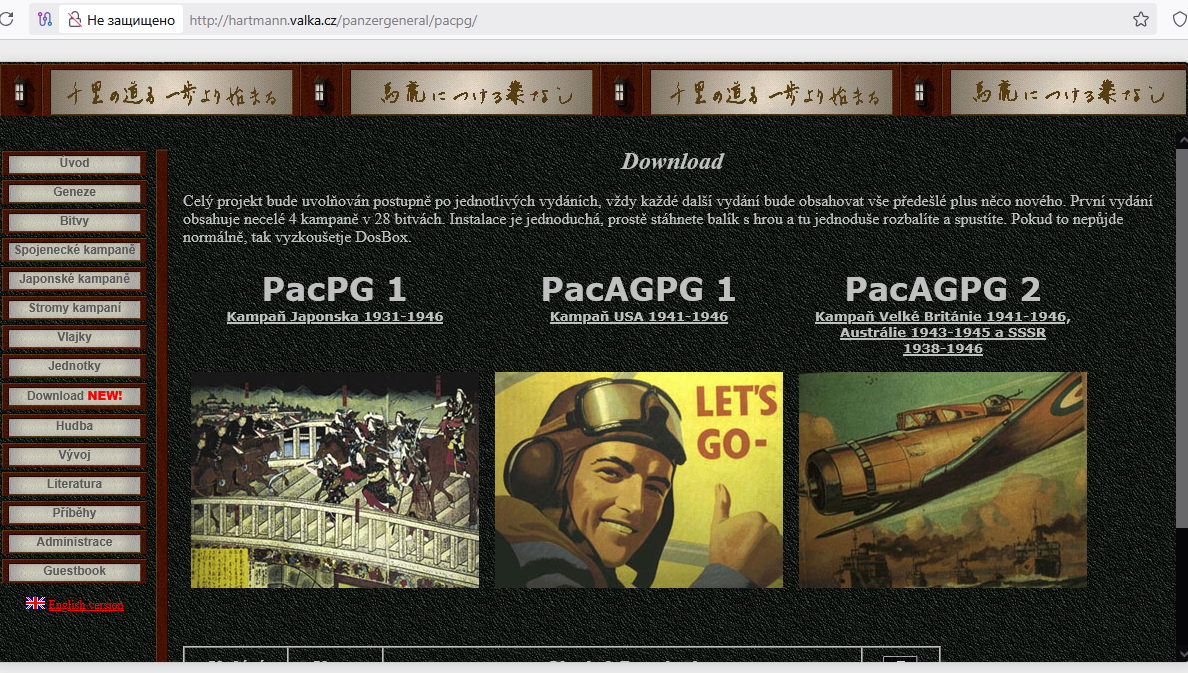
http://hartmann.valka.cz/panzergeneral/pacpg/
Last edited by bondjamesbond on Fri Sep 04, 2026 6:43 pm, edited 1 time in total.
https://mynickname.com/id73473
Re: Panzer Corps Toolkit v2.0.5.1 (22/08/26)
In case I missed this, please ignore the question: are you incorporating a hero system similar to Panzer Corps?
Re: Panzer Corps Toolkit v2.0.5.1 (22/08/26)
Not immediately but it is on the to-do list.Tobi72 wrote: Fri Sep 04, 2026 2:58 pm In case I missed this, please ignore the question: are you incorporating a hero system similar to Panzer Corps?
-
rubyjuno
- Master Sergeant - Bf 109E
- Posts: 468
- Joined: Mon Sep 21, 2015 1:18 pm
- Location: Northumberland
Re: Panzer Corps Toolkit v2.0.5.1 (22/08/26)
Wow! Thanks for the detailed information about Classic General. Fascinating AND exciting!
Re: Panzer Corps Toolkit v2.0.5.1 (22/08/26)
Development update.
.
I was hoping to have a first public beta available this weekend, but it might take a bit longer.
.
What i am currently still working on:
1) A new UI, the PG UI was cause for lagging and unwanted UI redraws. A quick test of the new UI shows that things are running smoother but icons inside the buttons are subject to improvement.
2) Integration of the 13 extra units introduced in Allied General, merging the equipment files of PG and AG besides the 198 new entries entered with the stock icons. It will make things easier to integrate AG in a future release.
3) Three layered battlefield renderer, also to make things run smoother.
Layer 1: cached terrain, roads/rivers, hex grid and location names.
Layer 2: fog, flags/objectives, units, stack markers and strength/ammo/fuel plates.
Layer 3: movement highlights, selected-unit outline, crosshair, explosions and combat banners.
4) Addressing the ground/air layer visually and behavior of a ground/air unit in the same hex.
.
I also added an eighth option in the main game screen, an option i always wanted.
.
.
I was hoping to have a first public beta available this weekend, but it might take a bit longer.
.
What i am currently still working on:
1) A new UI, the PG UI was cause for lagging and unwanted UI redraws. A quick test of the new UI shows that things are running smoother but icons inside the buttons are subject to improvement.
2) Integration of the 13 extra units introduced in Allied General, merging the equipment files of PG and AG besides the 198 new entries entered with the stock icons. It will make things easier to integrate AG in a future release.
3) Three layered battlefield renderer, also to make things run smoother.
Layer 1: cached terrain, roads/rivers, hex grid and location names.
Layer 2: fog, flags/objectives, units, stack markers and strength/ammo/fuel plates.
Layer 3: movement highlights, selected-unit outline, crosshair, explosions and combat banners.
4) Addressing the ground/air layer visually and behavior of a ground/air unit in the same hex.
.
I also added an eighth option in the main game screen, an option i always wanted.
.
- 001.png (12.94 KiB) Viewed 158 times
Re: Panzer Corps Toolkit v2.0.5.1 (22/08/26)
This is what i came up with for the AI opponent:
.
| Behaviour | Noob | Tactical v2 | Tactical v3 |
| --------------------------- | -------------- | ----------- | -------------------------- |
| Understands Fog uncertainty | Barely | Yes | **Strongly** |
| Prefers known-clear route | No | Moderate | **Strong** |
| Uses Recon before advance | Coincidental | Often | **Deliberately** |
| Will enter unknown hex | **Frequently** | Sometimes | Selectively |
| Protects artillery/support | Poorly | Yes | **Strongly** |
| Calculates combat exchanges | Minimal | Good | **Very good** |
| Concentrates attacks | Poor | Local | **Sector-level** |
| Maintains reserve | No | Minimal | **Yes** |
| Objective focus | Basic | Good | **Strong** |
| Late-game risk taking | Random | Increased | **Deliberately increased** |
| Can be ambushed | **Yes** | **Yes** | **Yes** |
| Knows hidden units | **Never** | **Never** | **Never** |
.
We all know games where we had the impression that the AI was "cheating". In Classic General i hope to avoid that at all costs, even for the "smartest" AI opponent.
.
| Behaviour | Noob | Tactical v2 | Tactical v3 |
| --------------------------- | -------------- | ----------- | -------------------------- |
| Understands Fog uncertainty | Barely | Yes | **Strongly** |
| Prefers known-clear route | No | Moderate | **Strong** |
| Uses Recon before advance | Coincidental | Often | **Deliberately** |
| Will enter unknown hex | **Frequently** | Sometimes | Selectively |
| Protects artillery/support | Poorly | Yes | **Strongly** |
| Calculates combat exchanges | Minimal | Good | **Very good** |
| Concentrates attacks | Poor | Local | **Sector-level** |
| Maintains reserve | No | Minimal | **Yes** |
| Objective focus | Basic | Good | **Strong** |
| Late-game risk taking | Random | Increased | **Deliberately increased** |
| Can be ambushed | **Yes** | **Yes** | **Yes** |
| Knows hidden units | **Never** | **Never** | **Never** |
.
We all know games where we had the impression that the AI was "cheating". In Classic General i hope to avoid that at all costs, even for the "smartest" AI opponent.
-
terminator
- Field Marshal - Gustav
- Posts: 6177
- Joined: Mon Aug 15, 2011 12:48 pm
- Location: the land of freedom
Re: Panzer Corps Toolkit v2.0.5.1 (22/08/26)
Is there, or will there be, a Scenario/Campaign Editor ?
Re: Panzer Corps Toolkit v2.0.5.1 (22/08/26)
Not immediately, i want to cover the basics first. Create a stable running environment, UI, tactical map, strategic map, campaign game, matrices for movement, attack, upgrade, purchase, ambush, rugged defense,... for both sides.
In short, an editor is on the to-do list.
In the meantime of what i wrote earlier today, three to-does have been ticked off the list. Additionally, a movement arrow has been added; movement and ZOC into fog of war further refined. Now i need to "play" scenario 1 of the campaign, move to scenario 2 to address the visually produced ground+air sprites.
Re: Panzer Corps Toolkit v2.0.5.1 (22/08/26)
.
This short video demonstrates what a freshly deployed artillery unit can do. This video also includes the newly added movement arrow and a new left and right UI bar.