

Hi! I've been playing the game for the last couple of days and have enjoyed it so far.
But I wonder, don't you think you went too far when reducing the importance of armour in the melee phase? (Shooting phase PoAs seem to be on point)
In FoG1 any armour advantage granted 1 PoA, which was admittedly too much of an advantage when the difference between the units was only 1 armour level. But in FoG2 armour grants only 25% of the advantage it did in FoG1! (up to 50% if the difference is greater)
Do you truly believe that protective equipment advantages in ancient melee combat were so trivial? I do not. Body armour and large shields could provide substantial protection against most types of weapons.
Thus, I ask you to consider increasing the PoAs for armour in melee combat. Perhaps 50 per level, up to 100 at 2 levels difference? With the new FoG2 system you can even have smaller jumps, allowing you to better fine-tune the units (like the "Some Armour" of the Hastati/Principes). Naturally, unit costs would need to be changed.
Armour POAs
-
rbodleyscott
- Field of Glory 2

- Posts: 28440
- Joined: Sun Dec 04, 2005 6:25 pm
Re: Armour POAs
Thank you for your suggestion, but we are happy with the way this currently works. Generally speaking both Protected and Armoured troops have large shield and often also helmets and greaves, as well as linen or leather body armour. This setup gives almost as much protection for most purposes as the same outfit with metal body armour as well.
Richard Bodley Scott

-
Cumandante
- Senior Corporal - Destroyer
- Posts: 117
- Joined: Wed Sep 29, 2010 5:53 pm
Re: Armour POAs
Most do, but some units, like Javelinmen (eastern MF) and Nomad Horse Archers, clearly do not. Also, don't you think Gallic Superior Warband would be better represented as Armoured?rbodleyscott wrote:Generally speaking both Protected and Armoured troops have large shield and often also helmets and greaves, as well as linen or leather body armour. This setup gives almost as much protection for most purposes as the same outfit with metal body armour as well.
I may be nitpicking, it is in my nature, but I'm only trying to improve the game as much as possible.
Cheers.
Last edited by Cumandante on Mon Oct 16, 2017 5:42 pm, edited 1 time in total.
Re: Armour POAs
From realism point of perspective - legionary in his mail shirt, helmet and shield, would be extremely hard to kill frontally with any ranged weapon, and even more problematically with melee weapon.. Mail shirt itself was capable stopping any one-handed melee weapon of ancient era, it was humanly impossible to penetrate mail with either slash or stab/thrust. Only chance to get killed in it, would be if you got hit in unprotected areas, but those would be usually arms or legs, or if enemy managed to thrust his weapon in neck or armpit area..
With ranged attacks, its even harder - shield would block/deflect most of projectiles. That's why Romans and Iberians developed precursor-javelins, which could penetrate shield, and deal damage behind it. Anybody hit with such javelin would get at least wounded, unless wearing Mail or Bronze breastplate. Both Velites and Caetrati used similar type of light precursor javelin. And these were so popular, that some Roman infantry fighting at Pydna, was actually using Iberian type javelins (Soliferum) together with their pila/veruta.
But of course, if such javelin hit you from behind - armor alone would not help you survive. direct hit would go through mail or bronze plate. Epirote King Alexander was killed through his breastplate when fighting Italians for example and king's armor would be of the highest quality...
Arrows and Slings would have no chance to go through armor. Even quilted/padded vests, or felt+vinegar organic armor (linothorax) would be enough to stop them. Arrows of ancient time were very light, therefore had low kinetic energy. they were useful against light infantry, but armored heavy infantry with large shields was practically immune (unless you fired like 4 milion arrows at them from all sides, like Parthians did at Carrhae, yet still dealing just 500 kills and 2000 wounded) even side or rear hits would have problem getting through body armor..
Slingshots were projectiles with least kinetic energy. yet they had their advantages - they were hard to spot, which means soldiers had hard time to block initial salvo (rise shields in time) - of course, again, any hits against armor would not do much. yet sometimes they could produce internal damage by breaking bones or causing some blunt damage or even concussions. Yet where they rein supreme, was at supressing other light infantry - nobody would be able to use his ranged weapon, when there are rocks falling around you... skirmishers would immediately run for cover, hide behind their shields.. Roman General Publius Ventidius Bassus used detachment of Slingers to effectively disable Parthian horse archers in his campaign.. Of course, he did not march on Parthians through desert like Crassus, but used terrain to his advantage, anyway horse archers were dealt with and Bassus forced Parthians to ask for peace.
So, with slingers, i would give them ability to deal more morale damage to light infantry..
Personally, i feel like Field of Glory 2 could show the ancient military technology a bit more accurately.. currently, there is no difference between pilum and ordinary javelin thrown by Gallic infantry, yet ancient texts tell different story. Flanking/Rear hits with ranged weapons would definitely held with strategy approaches, letting enemy skirmishers overwhelming you on one side would be extremely painful as it should be... having own strong skirmisher screen would be a lot more important...
With ranged attacks, its even harder - shield would block/deflect most of projectiles. That's why Romans and Iberians developed precursor-javelins, which could penetrate shield, and deal damage behind it. Anybody hit with such javelin would get at least wounded, unless wearing Mail or Bronze breastplate. Both Velites and Caetrati used similar type of light precursor javelin. And these were so popular, that some Roman infantry fighting at Pydna, was actually using Iberian type javelins (Soliferum) together with their pila/veruta.
But of course, if such javelin hit you from behind - armor alone would not help you survive. direct hit would go through mail or bronze plate. Epirote King Alexander was killed through his breastplate when fighting Italians for example and king's armor would be of the highest quality...
Arrows and Slings would have no chance to go through armor. Even quilted/padded vests, or felt+vinegar organic armor (linothorax) would be enough to stop them. Arrows of ancient time were very light, therefore had low kinetic energy. they were useful against light infantry, but armored heavy infantry with large shields was practically immune (unless you fired like 4 milion arrows at them from all sides, like Parthians did at Carrhae, yet still dealing just 500 kills and 2000 wounded) even side or rear hits would have problem getting through body armor..
Slingshots were projectiles with least kinetic energy. yet they had their advantages - they were hard to spot, which means soldiers had hard time to block initial salvo (rise shields in time) - of course, again, any hits against armor would not do much. yet sometimes they could produce internal damage by breaking bones or causing some blunt damage or even concussions. Yet where they rein supreme, was at supressing other light infantry - nobody would be able to use his ranged weapon, when there are rocks falling around you... skirmishers would immediately run for cover, hide behind their shields.. Roman General Publius Ventidius Bassus used detachment of Slingers to effectively disable Parthian horse archers in his campaign.. Of course, he did not march on Parthians through desert like Crassus, but used terrain to his advantage, anyway horse archers were dealt with and Bassus forced Parthians to ask for peace.
So, with slingers, i would give them ability to deal more morale damage to light infantry..
Personally, i feel like Field of Glory 2 could show the ancient military technology a bit more accurately.. currently, there is no difference between pilum and ordinary javelin thrown by Gallic infantry, yet ancient texts tell different story. Flanking/Rear hits with ranged weapons would definitely held with strategy approaches, letting enemy skirmishers overwhelming you on one side would be extremely painful as it should be... having own strong skirmisher screen would be a lot more important...

-
rbodleyscott
- Field of Glory 2
- Posts: 28440
- Joined: Sun Dec 04, 2005 6:25 pm
Re: Armour POAs
You have to consider that the armour POAs are not the only difference between these troop types. For example, Javelinmen have been given no melee capability which means they are dog's meat against legionaries. The difference does not need to be made greater. Likewise most Unprotected troops are lacking in any impact or melee capability so that same thing applies. Even thureophoroi will nearly always lose quite quickly in open ground vs legions.Cumandante wrote:Most do, but some units, like Javelinmen (eastern MF) and Nomad Horse Archers, clearly do not. Also, don't you think Gallic Superior Warband would be better represented as Armoured?rbodleyscott wrote:Generally speaking both Protected and Armoured troops have large shield and often also helmets and greaves, as well as linen or leather body armour. This setup gives almost as much protection for most purposes as the same outfit with metal body armour as well.
I may be nitpicking, it is in my nature, but I'm only trying to improve the game as much as possible.
Cheers.
Adding to the armour effect would make these interactions less realistic, not more, unless something else was changed to compensate. This is the problem with "bottom up" rules design, it nearly always results in the effect of some things being over-represented and unbalancing the overall interaction.
This is a "top down" set of rules, not a "bottom up" set of rules, and what we consider is the overall interaction between archetypal troop types, not theoretical considerations about equipment-based advantages.
It is a different sort of design philosophy, but one to which we are firmly wedded.
And we don't want super-troops.
Richard Bodley Scott
-
Cumandante
- Senior Corporal - Destroyer
- Posts: 117
- Joined: Wed Sep 29, 2010 5:53 pm
Re: Armour POAs
They are both classed as Impact Foot, and while the Gallic javelins were probably lighter, they were followed up with a fierce charge, which probably made up for it.JaM2013 wrote:currently, there is no difference between pilum and ordinary javelin thrown by Gallic infantry, yet ancient texts tell different story.
Last edited by Cumandante on Mon Oct 16, 2017 5:42 pm, edited 1 time in total.
Re: Armour POAs
Ordinary javelin, you would usually shrug off with your shield. Pillum, not so much.. Pillum was well known at stopping Gallic charges. it was a javelin specially developed to do exactly that. They even tried various things to improve its capabilities, like using wooden pins to it couldnt be thrown back, or adding lead weights for more kinetic energy..Cumandante wrote:They are both classed as Impact Foot, and while the Gallic javelins were probably lighter, they were followed up with a fierce charge, which probably made up for it.JaM2013 wrote:currently, there is no difference between pilum and ordinary javelin thrown by Gallic infantry, yet ancient texts tell different story.
Out of all javelins used in ancient era, Pilum was most effective, followed by Iberian Soliferrum. Later, Gallic tribes started using Gaesum/Gaison, which was similar to Pilum but with shorter Iron shank. Gaesum was then used even by Romans, together with heavier Pilum.. Anyway Pilum lived on, and eventually it reappeared after Romans stopped using it - Germanic tribes used very similar design called Angon for quite some time, Germanic tribes that settled in England for example considered bow as unworthy, and every warrior had to learn how to use his angon..
-
Cumandante
- Senior Corporal - Destroyer
- Posts: 117
- Joined: Wed Sep 29, 2010 5:53 pm
Re: Armour POAs
Fair points. You seem to have made a conscious, informed decision on this matter. I guess sometimes strict realism must take a back seat in order to produce battles with realistic results.rbodleyscott wrote:You have to consider that the armour POAs are not the only difference between these troop types. For example, Javelinmen have been given no melee capability which means they are dog's meat against legionaries. The difference does not need to be made greater. Likewise most Unprotected troops are lacking in any impact or melee capability so that same thing applies. Even thureophoroi will nearly always lose quite quickly in open ground vs legions.
Adding to the armour effect would make these interactions less realistic, not more, unless something else was changed to compensate. This is the problem with "bottom up" rules design, it nearly always results in the effect of some things being over-represented and unbalancing the overall interaction.
This is a "top down" set of rules, not a "bottom up" set of rules, and what we consider is the overall interaction between archetypal troop types, not theoretical considerations about equipment-based advantages.
It is a different sort of design philosophy.
And we don't want super-troops.
Last edited by Cumandante on Mon Oct 16, 2017 5:43 pm, edited 1 time in total.

-
Cumandante
- Senior Corporal - Destroyer
- Posts: 117
- Joined: Wed Sep 29, 2010 5:53 pm
Re: Armour POAs
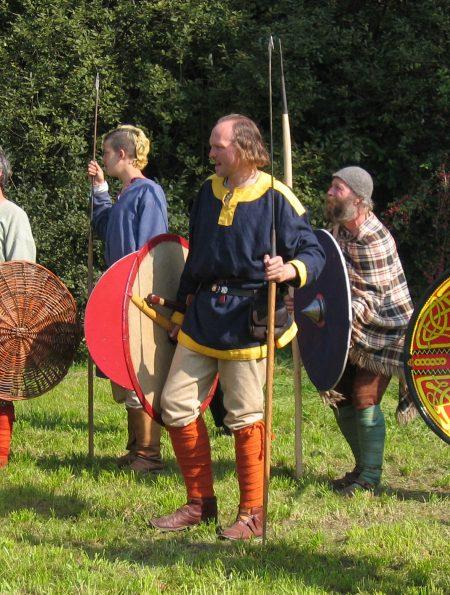
Perhaps you should create a different thread with a greater focus on impact weapons. This thread had a different purpose.JaM2013 wrote:Germanic Angon:
Roman Pilum (socketted):
-
nikgaukroger
- Field of Glory Moderator

- Posts: 10287
- Joined: Tue Aug 22, 2006 9:30 am
- Location: LarryWorld
Re: Armour POAs
Yup, essentially this.Cumandante wrote:They are both classed as Impact Foot, and while the Gallic javelins were probably lighter, they were followed up with a fierce charge, which probably made up for it.JaM2013 wrote:currently, there is no difference between pilum and ordinary javelin thrown by Gallic infantry, yet ancient texts tell different story.
It comes from the top-down approach which emphasises getting the right effect without getting tied up in minutiae. IMO if you look at the interaction between Romans and Gauls FoG II is getting it pretty much right - it is quite a slog (worth reading what Adrian Goldsworthy has written about this as it more or less covers the FoG basis of this interaction).
Nik Gaukroger
"Never ask a man if he comes from Yorkshire. If he does, he will tell you.
If he does not, why humiliate him?" - Canon Sydney Smith
nikgaukroger@blueyonder.co.uk
"Never ask a man if he comes from Yorkshire. If he does, he will tell you.
If he does not, why humiliate him?" - Canon Sydney Smith
nikgaukroger@blueyonder.co.uk
-
Cumandante
- Senior Corporal - Destroyer
- Posts: 117
- Joined: Wed Sep 29, 2010 5:53 pm
Re: Armour POAs
I just noticed something relating to this issue: the impact of armour on a unit's cost.
Let's take a look at two cases:
If we consider Thureophoroi at 42 points, it will cost 12 more points to get Thorakitai at 54, the only difference being Protected->Armoured.
If we consider Mercenary Hoplites at 48 points, it will cost 12 more points to get Veteran Hoplites at 60, the only difference being Average->Superior.
So, the game is assigning the same value to armour and quality upgrades (armour is arguably more expensive in this case as the % increase is greater).
As I've said earlier, in FOG2, having an armour advantage gives 25 POA in melee only, though it provides considerable usefulness when shot at. On the other hand, a quality advantage of the same magnitude provides 50 POA when shooting, as well as in melee AND impact combat, with Superior and above also allowing useful re-rolls on cohesion tests.
Now, I'm aware that comparing these two benefits is inherently subjective, but it seems pretty obvious to me that, in most cases, having a quality advantage is preferable to having an armour advantage. If the developers are happy with the effect armour has in the game, as they appear to be, I at least ask that they consider my points regarding its cost.
Let's take a look at two cases:
If we consider Thureophoroi at 42 points, it will cost 12 more points to get Thorakitai at 54, the only difference being Protected->Armoured.
If we consider Mercenary Hoplites at 48 points, it will cost 12 more points to get Veteran Hoplites at 60, the only difference being Average->Superior.
So, the game is assigning the same value to armour and quality upgrades (armour is arguably more expensive in this case as the % increase is greater).
As I've said earlier, in FOG2, having an armour advantage gives 25 POA in melee only, though it provides considerable usefulness when shot at. On the other hand, a quality advantage of the same magnitude provides 50 POA when shooting, as well as in melee AND impact combat, with Superior and above also allowing useful re-rolls on cohesion tests.
Now, I'm aware that comparing these two benefits is inherently subjective, but it seems pretty obvious to me that, in most cases, having a quality advantage is preferable to having an armour advantage. If the developers are happy with the effect armour has in the game, as they appear to be, I at least ask that they consider my points regarding its cost.
-
rbodleyscott
- Field of Glory 2
- Posts: 28440
- Joined: Sun Dec 04, 2005 6:25 pm
Re: Armour POAs
It is conceivable that points values might need to be adjusted at some point.Cumandante wrote:I just noticed something relating to this issue: the impact of armour on a unit's cost.
Let's take a look at two cases:
If we consider Thureophoroi at 42 points, it will cost 12 more points to get Thorakitai at 54, the only difference being Protected->Armoured.
If we consider Mercenary Hoplites at 48 points, it will cost 12 more points to get Veteran Hoplites at 60, the only difference being Average->Superior.
So, the game is assigning the same value to armour and quality upgrades (armour is arguably more expensive in this case as the % increase is greater).
As I've said earlier, in FOG2, having an armour advantage gives 25 POA in melee only, though it provides considerable usefulness when shot at. On the other hand, a quality advantage of the same magnitude provides 50 POA when shooting, as well as in melee AND impact combat, with Superior and above also allowing useful re-rolls on cohesion tests.
Now, I'm aware that comparing these two benefits is inherently subjective, but it seems pretty obvious to me that, in most cases, having a quality advantage is preferable to having an armour advantage. If the developers are happy with the effect armour has in the game, as they appear to be, I at least ask that they consider my points regarding its cost.
What we mainly wanted to get away from was the situation in FOG1 where it was a no-brainer to always take the armoured option if available, because it was undercosted for its effect, and where huge swathes of staple historical troops were rendered useless in the game as a result of their lack of metal body armour.
It may be that, because the rules are different, armoured troops might now be slightly over-priced, but we don't currently think so.
Richard Bodley Scott
-
Cumandante
- Senior Corporal - Destroyer
- Posts: 117
- Joined: Wed Sep 29, 2010 5:53 pm
Re: Armour POAs
Are you happy with the current power and cost of Heavy Weapon? Right now it appears to be more or less equivalent to Light Spear/Swordsmen, though a bit more expensive.
Their special armour-ignoring effect doesn't really seem useful, negating no more than 25 POA in most cases.
Their special armour-ignoring effect doesn't really seem useful, negating no more than 25 POA in most cases.
-
rbodleyscott
- Field of Glory 2
- Posts: 28440
- Joined: Sun Dec 04, 2005 6:25 pm
Re: Armour POAs
Another thing worth considering, yes. Although they are also better than light spear, swordsmen vs steady spearmen in melee, but worse against mounted troops at impact.Cumandante wrote:Are you happy with the current power and cost of Heavy Weapon? Right now it appears to be more or less equivalent to Light Spear/Swordsmen, though a bit more expensive.
Their special armour-ignoring effect doesn't really seem useful, negating no more than 25 POA in most cases.
Richard Bodley Scott
Re: Armour POAs
One of the issues not addressed in the game is the type of enfilade fire involved when projectile weapons are fired at units sides unprotected by shields. Units like the Thureophoroi should be hideously vulnerable when fired at from an unshielded side. Even well-protected heavy infantry like Legionarys should be more exposed when fired at from a direction not covered by a shield.
I think it would be interesting to take this into account.
I think it would be interesting to take this into account.

Re: Armour POAs
Cumandante wrote:I just noticed something relating to this issue: the impact of armour on a unit's cost.
Let's take a look at two cases:
If we consider Thureophoroi at 42 points, it will cost 12 more points to get Thorakitai at 54, the only difference being Protected->Armoured.
If we consider Mercenary Hoplites at 48 points, it will cost 12 more points to get Veteran Hoplites at 60, the only difference being Average->Superior.
So, the game is assigning the same value to armour and quality upgrades (armour is arguably more expensive in this case as the % increase is greater).
As I've said earlier, in FOG2, having an armour advantage gives 25 POA in melee only, though it provides considerable usefulness when shot at. On the other hand, a quality advantage of the same magnitude provides 50 POA when shooting, as well as in melee AND impact combat, with Superior and above also allowing useful re-rolls on cohesion tests.
Now, I'm aware that comparing these two benefits is inherently subjective, but it seems pretty obvious to me that, in most cases, having a quality advantage is preferable to having an armour advantage. If the developers are happy with the effect armour has in the game, as they appear to be, I at least ask that they consider my points regarding its cost.
From a min-max gamer's perspective, small details like this not really that big of an issue given that most lists have a core unit set and then you fill out with the remaining points available with strong constraints on how many units can be taken of a certain type. Points costs shouldn't just be based on balance in a unit to unit matchup, ie the example you cited where average->superior has a similar point cost to boosting protected-> armored but yield a vastly superior benefit, in real gameplay terms.
Part of army lists from what I gather is to have each force present an authentic styled army based on what was historically fielded by the powers represented in the game. For example some powers historically fielded imitation legionaries and it would make sense for players of that particular power to have access to imitation legionaries. But it does not necessarily follow that these imitators should cost the same as a Roman equivalent simply because Romans should have had a steady supply of raw/slack legionaries (whatever the equivalent is) readily at hand which would fill out most field armies whereas imitation legions would have been a much rarer sight in say a Pontic army which was known to have Roman deserters in its ranks.
It would be a much different story if armies deployed were free form where I get to make a generic unit and just tick off boxes and options to build my units so to speak. If the game was like that then yes, it would be very important to ensure point costs to benefits gained was very well balanced and or uniform but that is not the case here.
I think a much more important question in terms of balance is
a) Do the army lists offer each side a rough equality in terms of purchasing power across a variety points value. Right now there is a thread on how Parthia is underpowered but that is a fundamental problem with the list, not small details like whether a deep pike should be +100 or +150 PoA.
b) Do the army lists enforce a certain flavour of play that should be reflective of how each power historically fielded armies. And do they offer enough options and perks to allow the player tailor the army to his/her particular needs within the bounds of historical authenticity. Romans had ample access to light troops and tribal mercenaries and they should have options to field in their lists but it would not make sense to allow Romans to field warband heavy armies.
If anything points costs should not be tied uniformly across army lists. If a player wants to take a unit that while historically valid, but was of a more exotic nature for any particular army, they should pay a premium for it. Especially if said units offer capabilities that run against the core capabilities of the army in question or covered a known weakness.
I think it is reasonable to expect troops to turn and face their assailants unless otherwise occupied. This is already well modeled by the fact it usually takes multiple units shooting at a single target before cohesion checks are made.shawkhan2 wrote:One of the issues not addressed in the game is the type of enfilade fire involved when projectile weapons are fired at units sides unprotected by shields. Units like the Thureophoroi should be hideously vulnerable when fired at from an unshielded side. Even well-protected heavy infantry like Legionarys should be more exposed when fired at from a direction not covered by a shield.
I think it would be interesting to take this into account.
Stratford Scramble Tournament
http://www.slitherine.com/forum/viewtopic.php?f=494&t=99766&p=861093#p861093
FoG 2 Post Game Analysis Series on Youtube:
https://www.youtube.com/channel/UCKmEROEwX2fgjoQLlQULhPg/
http://www.slitherine.com/forum/viewtopic.php?f=494&t=99766&p=861093#p861093
FoG 2 Post Game Analysis Series on Youtube:
https://www.youtube.com/channel/UCKmEROEwX2fgjoQLlQULhPg/
-
Cumandante
- Senior Corporal - Destroyer
- Posts: 117
- Joined: Wed Sep 29, 2010 5:53 pm
Re: Armour POAs
Fair points, Mike. Let's take a look at them.
If the limits are already constraining your options to what was historically feasible, I believe the point cost should have a different purpose: to provide meaningful choice to the player, within the bounds of that particular army list.
For example: let's imagine that Thorakitai are less cost-effective, in every situation, than Thureophoroi. The player will have very little incentive to ever take them, even if they are present in the list and were historically a small part of some armies. Having balanced point costs allows for more variety and diversity, because you pick what is best in this case, instead of having a unit that is best in every case.
If you knew how expensive or rare it would be to have a certain unit in that specific army. You would also need to model the combat effectiveness and role of that given unit very closely, to provide an accurate simulation of the general's options: "do I hire this unit or that one?"
Also, don't forget that besides open battles, generals had to take into account skirmishes and many strategic and political factors that are not and can not be represented in FOG2, but would nevertheless alter the cost and usefulness of certain units.
What I mean to say is: that can not be done, not properly at least.
Isn't this what minimum and maximum troop numbers are trying to represent? As I see it, simply by looking at the number limits/requirements of an army you can tell if a given unit is core, auxiliary or rare in that particular army.MikeC_81 wrote:From a min-max gamer's perspective, small details like this not really that big of an issue given that most lists have a core unit set and then you fill out with the remaining points available with strong constraints on how many units can be taken of a certain type. Points costs shouldn't just be based on balance in a unit to unit matchup, ie the example you cited where average->superior has a similar point cost to boosting protected-> armored but yield a vastly superior benefit, in real gameplay terms.
Part of army lists from what I gather is to have each force present an authentic styled army based on what was historically fielded by the powers represented in the game. For example some powers historically fielded imitation legionaries and it would make sense for players of that particular power to have access to imitation legionaries. But it does not necessarily follow that these imitators should cost the same as a Roman equivalent simply because Romans should have had a steady supply of raw/slack legionaries (whatever the equivalent is) readily at hand which would fill out most field armies whereas imitation legions would have been a much rarer sight in say a Pontic army which was known to have Roman deserters in its ranks.
It would be a much different story if armies deployed were free form where I get to make a generic unit and just tick off boxes and options to build my units so to speak. If the game was like that then yes, it would be very important to ensure point costs to benefits gained was very well balanced and or uniform but that is not the case here.
If the limits are already constraining your options to what was historically feasible, I believe the point cost should have a different purpose: to provide meaningful choice to the player, within the bounds of that particular army list.
For example: let's imagine that Thorakitai are less cost-effective, in every situation, than Thureophoroi. The player will have very little incentive to ever take them, even if they are present in the list and were historically a small part of some armies. Having balanced point costs allows for more variety and diversity, because you pick what is best in this case, instead of having a unit that is best in every case.
Sure, I agree. Fundamental problems with a given army are of greater concern than fine balance between the units of that army.MikeC_81 wrote:I think a much more important question in terms of balance is
a) Do the army lists offer each side a rough equality in terms of purchasing power across a variety points value. Right now there is a thread on how Parthia is underpowered but that is a fundamental problem with the list, not small details like whether a deep pike should be +100 or +150 PoA.
They already do. Or at the very least they attempt to. As I said, I believe the point cost of a unit should be used for a different purpose.MikeC_81 wrote:b) Do the army lists enforce a certain flavour of play that should be reflective of how each power historically fielded armies. And do they offer enough options and perks to allow the player tailor the army to his/her particular needs within the bounds of historical authenticity. Romans had ample access to light troops and tribal mercenaries and they should have options to field in their lists but it would not make sense to allow Romans to field warband heavy armies.
This would be ideal, in an ideal world.MikeC_81 wrote:If anything points costs should not be tied uniformly across army lists. If a player wants to take a unit that while historically valid, but was of a more exotic nature for any particular army, they should pay a premium for it. Especially if said units offer capabilities that run against the core capabilities of the army in question or covered a known weakness.
If you knew how expensive or rare it would be to have a certain unit in that specific army. You would also need to model the combat effectiveness and role of that given unit very closely, to provide an accurate simulation of the general's options: "do I hire this unit or that one?"
Also, don't forget that besides open battles, generals had to take into account skirmishes and many strategic and political factors that are not and can not be represented in FOG2, but would nevertheless alter the cost and usefulness of certain units.
What I mean to say is: that can not be done, not properly at least.
Re: Armour POAs
That is based on the assumption that you have access to as many Thureophoroi as you want for any given task at hand. Most lists have some severe restrictions. If you are allowed to have 0-4 Thureophoroi but need a 5th, then your only option is to get the Thorakitai which is 12 points more expensive. It may not be a "cost effective" option but if you need that 5th Offensive spear, then you have to bite the bullet and take it.Cumandante wrote:Fair points, Mike. Let's take a look at them.
Isn't this what minimum and maximum troop numbers are trying to represent? As I see it, simply by looking at the number limits/requirements of an army you can tell if a given unit is core, auxiliary or rare in that particular army.
If the limits are already constraining your options to what was historically feasible, I believe the point cost should have a different purpose: to provide meaningful choice to the player, within the bounds of that particular army list.
For example: let's imagine that Thorakitai are less cost-effective, in every situation, than Thureophoroi. The player will have very little incentive to ever take them, even if they are present in the list and were historically a small part of some armies. Having balanced point costs allows for more variety and diversity, because you pick what is best in this case, instead of having a unit that is best in every case.
If you don't want that cost ineffective option, you may be forced to use medium foot of much lesser quality and capability because the list caps you on the number of units you can have. Even for the Roman lists you quite often are limited to in the number of Hastati/Princeps units you can take and then have to ponder hard as to whether you want to super expensive veterans or whether to fill out more mass with lower quality spear or raw legionary units.
The presence of "exotic" troops imo should not simply be an army list restriction. This is an example of false choice or illusory choice in game design. Lets make a hypothetical situation so that I can make the point clearly.Cumandante wrote: They already do. Or at the very least they attempt to. As I said, I believe the point cost of a unit should be used for a different purpose.
Lets assume the following:
a) all army lists point costs are mathematically accurate and balanced meaning every possible option is cost effective against another one.
b) there exists some army which is chiefly made up of Heavy Foot core and the only option available is to either add more heavy foot of identical quality or add some sort of high quality medium foot.
c) the player commanding this hypothetical army is confronted with a random map generated in which there is a significant amount of non-open terrain.
In this scenario the "no brainer" option would be to max out on as many medium foot as the list would allow to cover for the weakness in this map. This is because there is mathematical equivalence in points cost. This is not a real choice, it is simply a straight up knowledge test to see if the player understands that medium foot is the way to go on this map.
If on the other hand, medium foot was not mathematically equivalent in cost for this army to gain access to these units but the player had to pay a premium to gain access to these medium foot. Now all of a sudden there is REAL choice. The player can opt to get none, some, or max amount of medium foot with real choice to be made. How much of a premium is too much? Or does the player still max out on his core strength of heavy foot and formulate a strategy to mitigate his total lack of presence in rough terrain? Maybe 1 or 2 medium foot is all he needs to delay the enemy on rough ground while he seeks to win in open areas available to him? That is real strategic depth.
In no way is this "why" armor seems to be overcosted for the limited benefits or a justification. The point I am making is that mathematical equivalence or the quest to get a perfect mathematical points cost system is a fool's errand. Many times it creates as many problems as it supposedly solves and does not significantly make the game any better, or deeper.
As in the example above, it can at times make the game worse off by creating the illusion of real choice when all you are doing is presenting players with binary checks of whether you know how to game the system to max out the benefits.
This is a game, not a simulation. We do not have enough data to actually simulate ancient warfare. The importance imo of any wargame is to offer a roughly balanced game while honouring the authenticity of the subject matter at hand. I don't think whether up armoring spearmen should be 12 points or 6 points or whatever is really relevant to that issue.Cumandante wrote:This would be ideal, in an ideal world.
If you knew how expensive or rare it would be to have a certain unit in that specific army. You would also need to model the combat effectiveness and role of that given unit very closely, to provide an accurate simulation of the general's options: "do I hire this unit or that one?"
Also, don't forget that besides open battles, generals had to take into account skirmishes and many strategic and political factors that are not and can not be represented in FOG2, but would nevertheless alter the cost and usefulness of certain units.
What I mean to say is: that can not be done, not properly at least.
Stratford Scramble Tournament
http://www.slitherine.com/forum/viewtopic.php?f=494&t=99766&p=861093#p861093
FoG 2 Post Game Analysis Series on Youtube:
https://www.youtube.com/channel/UCKmEROEwX2fgjoQLlQULhPg/
http://www.slitherine.com/forum/viewtopic.php?f=494&t=99766&p=861093#p861093
FoG 2 Post Game Analysis Series on Youtube:
https://www.youtube.com/channel/UCKmEROEwX2fgjoQLlQULhPg/