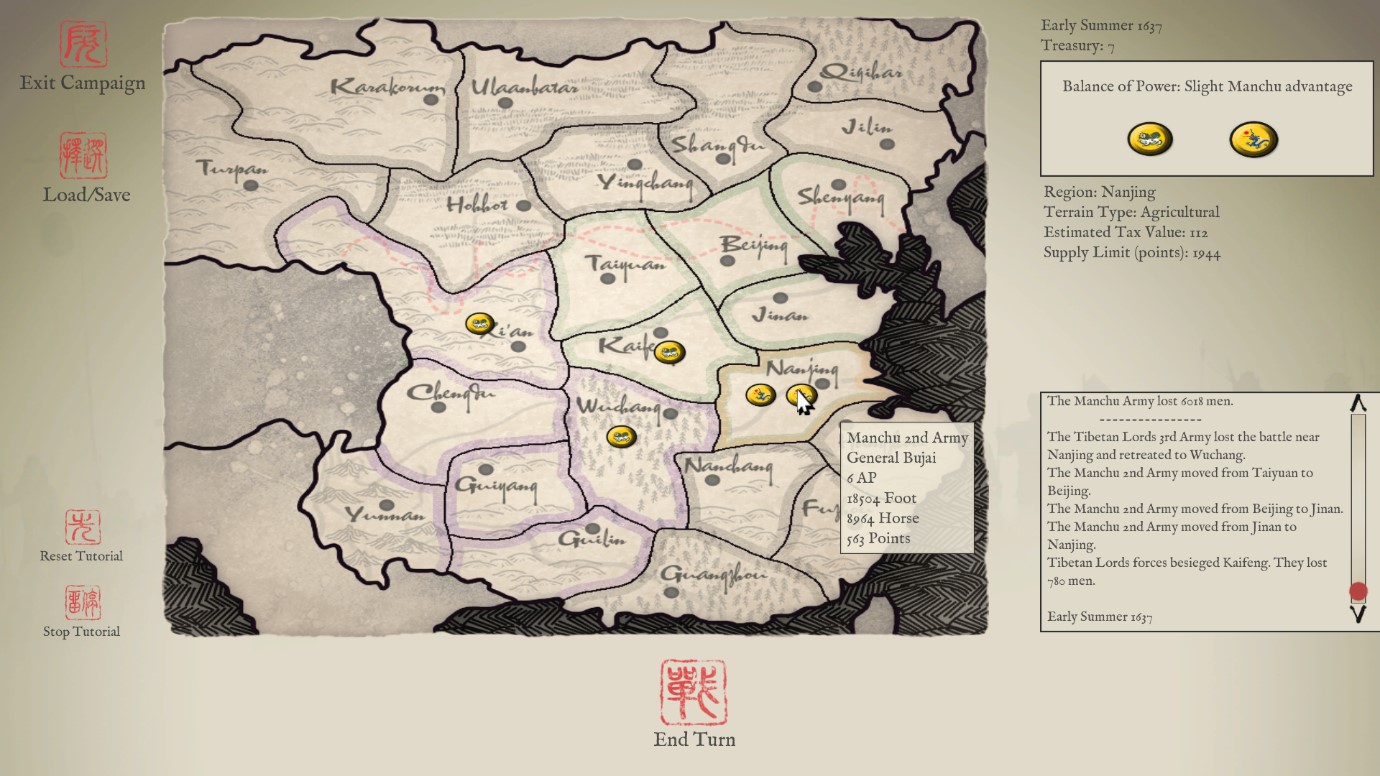
Early Spring to Late Autumn 1638
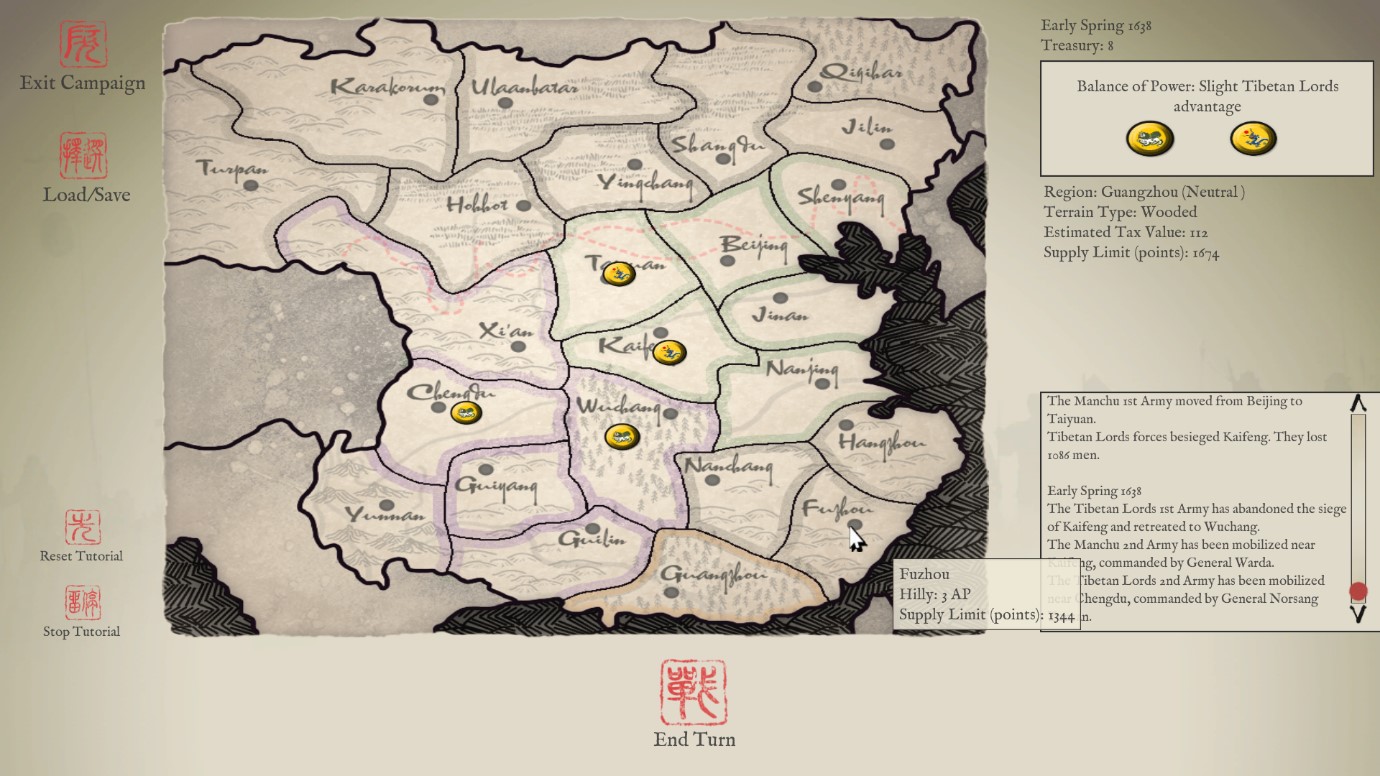
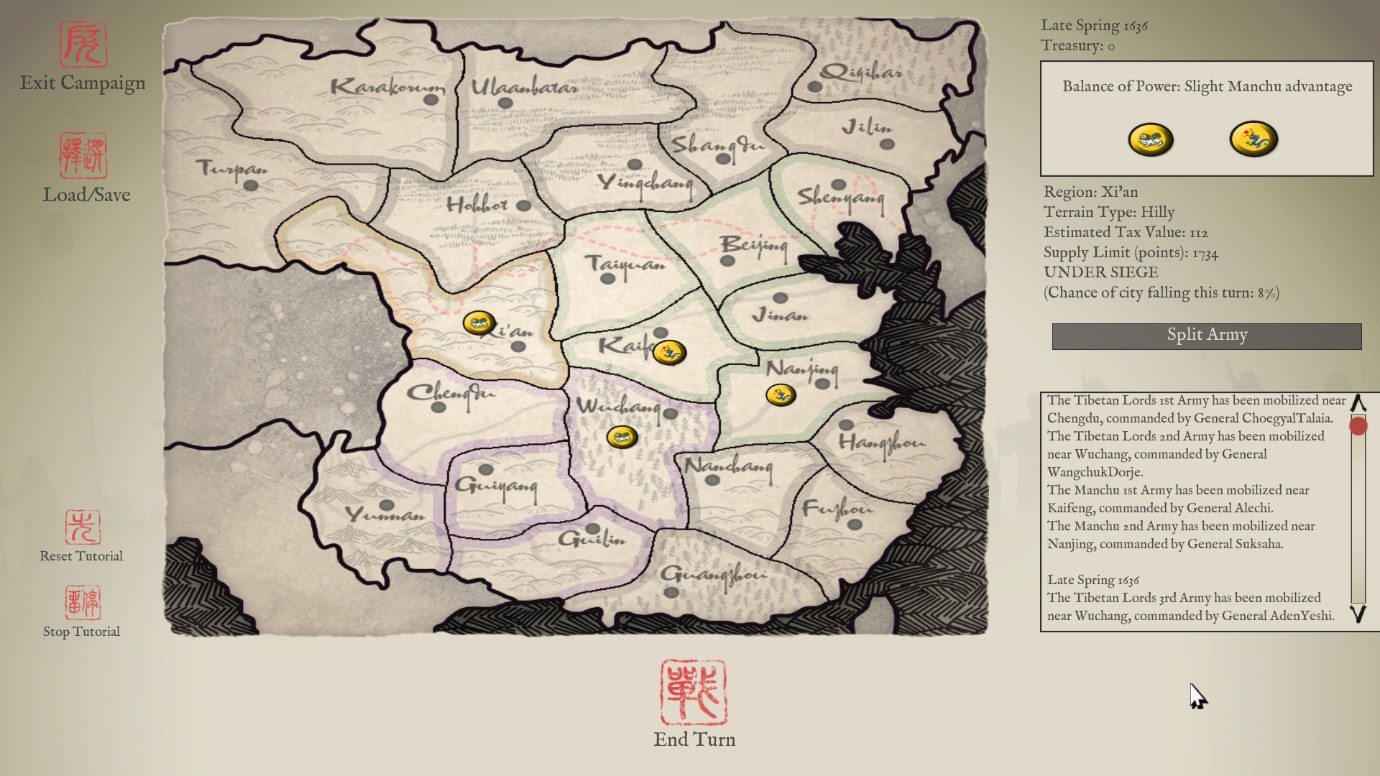
General Norsang Yontan took command of a newly raised army at Chengdu. The force comprised 18,000 foot and 12,000 horse.
After reorganising, Qing General Bujai moved his army from Beijing to Taiyuan. The Qing 2nd army formed at Kaifeng, led by General Warda.
Norsang Yontan moved to Xi’an. Choegyal Talaia attacked Kaifeng but Warda retreated to Taiyuan and met up with Bujai. The consolidated Qing army under Bujai then moved to Kaifeng. Choegyal Talaia refused to fight and moved to Xi’an.
Choegyal Talaia incorporated Norsang Yontan’s troops and marched to Kaifeng. But no battle was fought as the Manchus surprisingly retreated to Taiyuan.
Kaifeng fell to the Tibetan army and Choeyal Talaia then attacked Taiyuan while the Qing were still busy with Xi’an. But winter came too soon and both armies lifted the sieges and returned to friendly territory.
Early Spring 1639
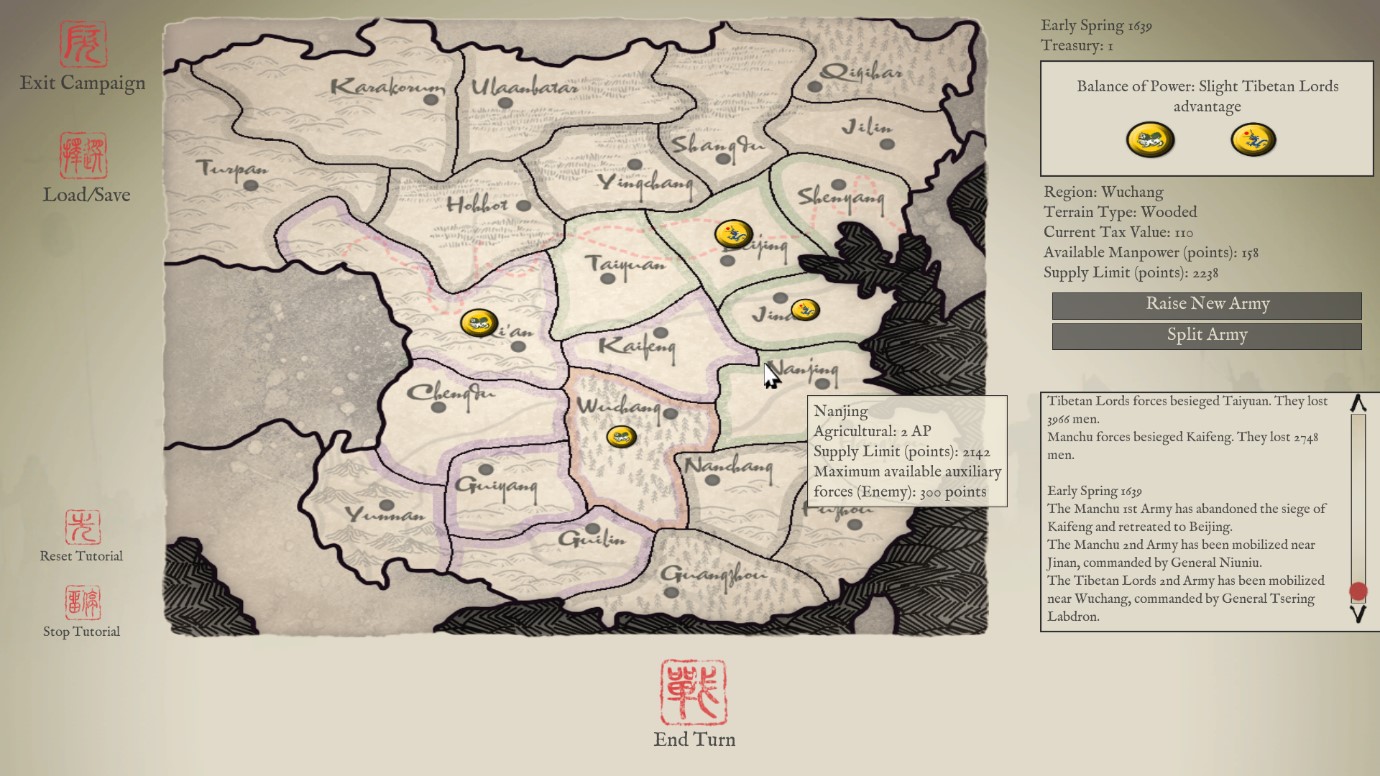
A new Tibetan army, led by Tsering Labdorn, was formed in Wuchang. The Qing general Niuniu raised an army in Jinan.
Late Spring 1639
Choegyal Talaia marched into Taiyuan and captured it while Tsering marched to defend Kaifeng. The two Qing armies then simultaneously attacked Kaifeng. Tsering Labdorn did not put up a fight and retreated to Wuchang. Kaifeng was once again liberated by the Qing.
Early Summer 1639
Choegyal Talaia boldly marched to Beijing hoping that the Qing would finally give battle. But the Qing armies did not come. General Bujai instead attacked Taiyuan hoping to cut off the Tibetan army besieging Beijing. General Niuniu moved to attack Xi’an.
Late Summer 1639
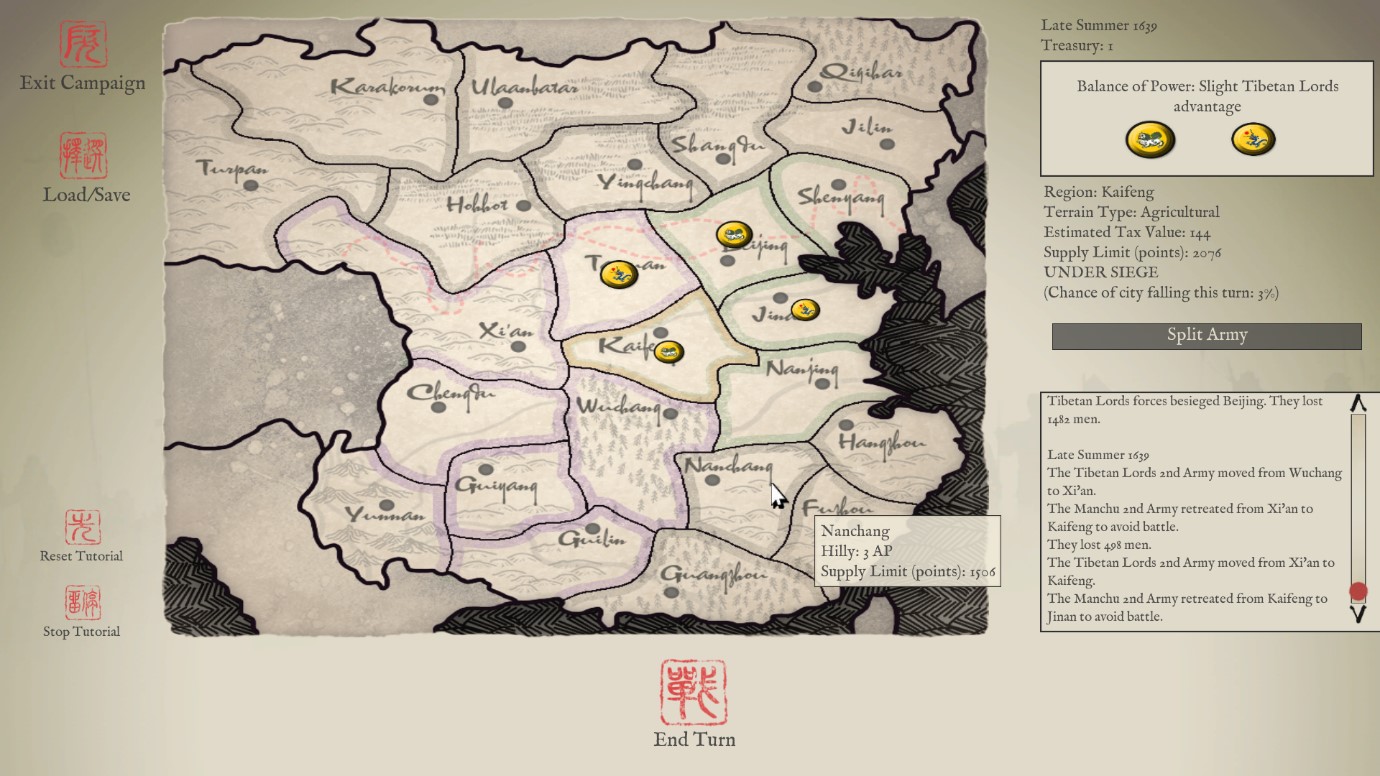
Tsering Labdorn moved to rescue the defenders of Xi’an fortress. Niuniu did not fight and retreated to Kaifeng only to be subsequently chased out of the area by Tsering.
Early Autumn 1639 – Late Autumn 1639
Niuniu raided Wuchang. Knowing that Niuniu’s army was not large enough to quickly secure the city, Tsering Labdorn decided to help Choegyal Talaia in the siege of Beijing. The Tibetans eventually captured the capital and ransacked the palace but the emperor was nowhere to be found.
Qing general Bujai was not able to capture Taiyuan before the winter and moved to meet up with Niuniu in Kaifeng. News of the fall of Beijing reached the generals and they held a war council to decide on what to do when hostilities resumed the following year.
Early Spring 1640 – Late Spring 1640
Tibetan reinforcements, led by Thokmay Nawang marched to Taiyuan and met up with Tsering Labdorn. The two armies merged under the command of Tsering. Choegyal Talaia on the other hand attacked Jinan. Bujai marched into undefended Beijing while Niuniu resumed his raid into Wuchang.
Early Summer 1640
Choegyal Talaia went back to Beijing to confront Bujai. But the Qing army retreated back to Kaifeng. Tsering Labdorn marched to Wuchang and Niuniu retreated without a fight.
Bujai then attacked Tsering in Wuchang and the Tibetans instead retreated to Chengdu. Niuniu then moved north to Taiyuan.
Late Summer 1640
Tsering Labdorn continued to apply pressure on Niuniu, no battle was fought in Taiyuan. Choegyal Talaia confronted Bujai in Wuchang - he retreated. There were still no major battles fought during this period but the constant state of withdrawal of the Manchus was affecting their army strength as they constantly lost men in rear-guard actions.
Early Autumn 1640 – Late Autumn
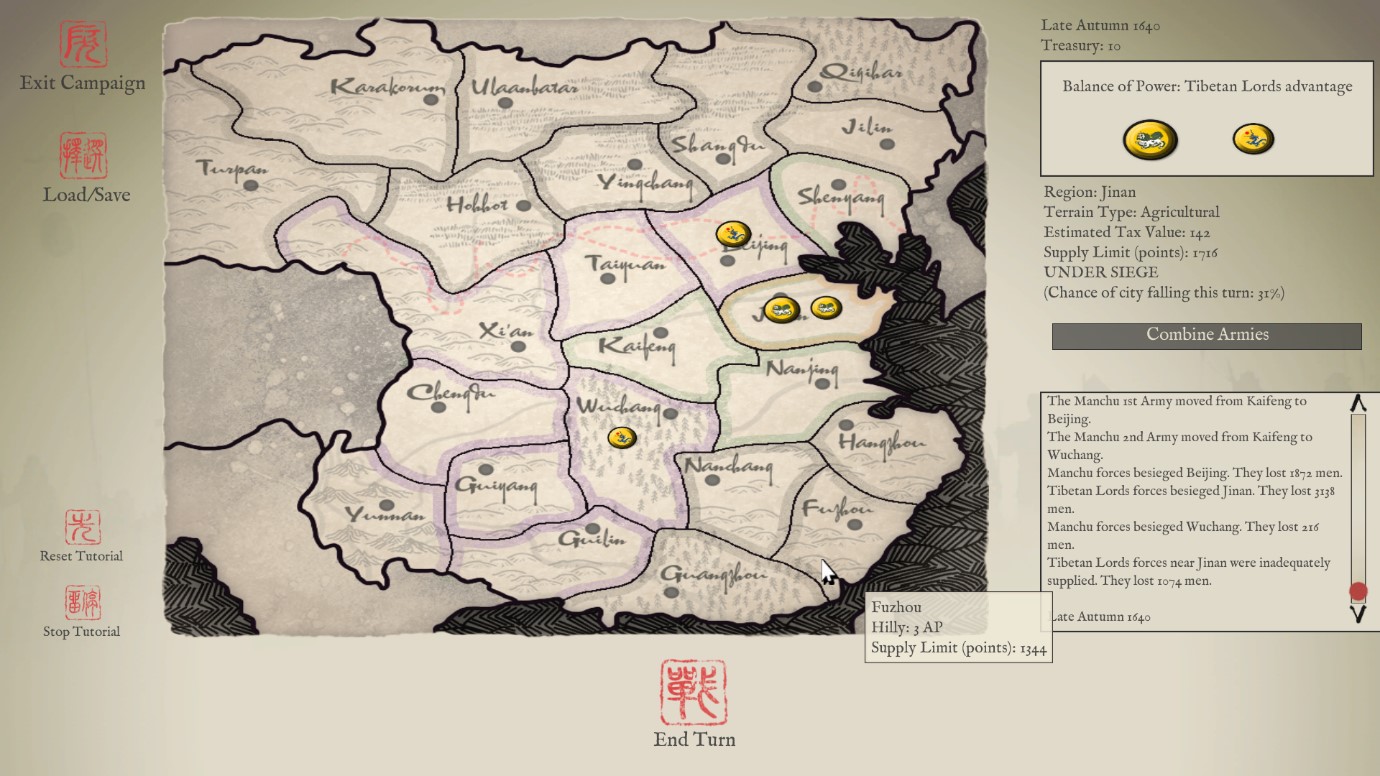
Tsering chased Niuniu out of Beijing and captured Jinan together with Choegyal Talaia. But the Manchus were able to unexpectedly liberate Beijing before winter!
Early Spring 1641 – Late Autumn 1641
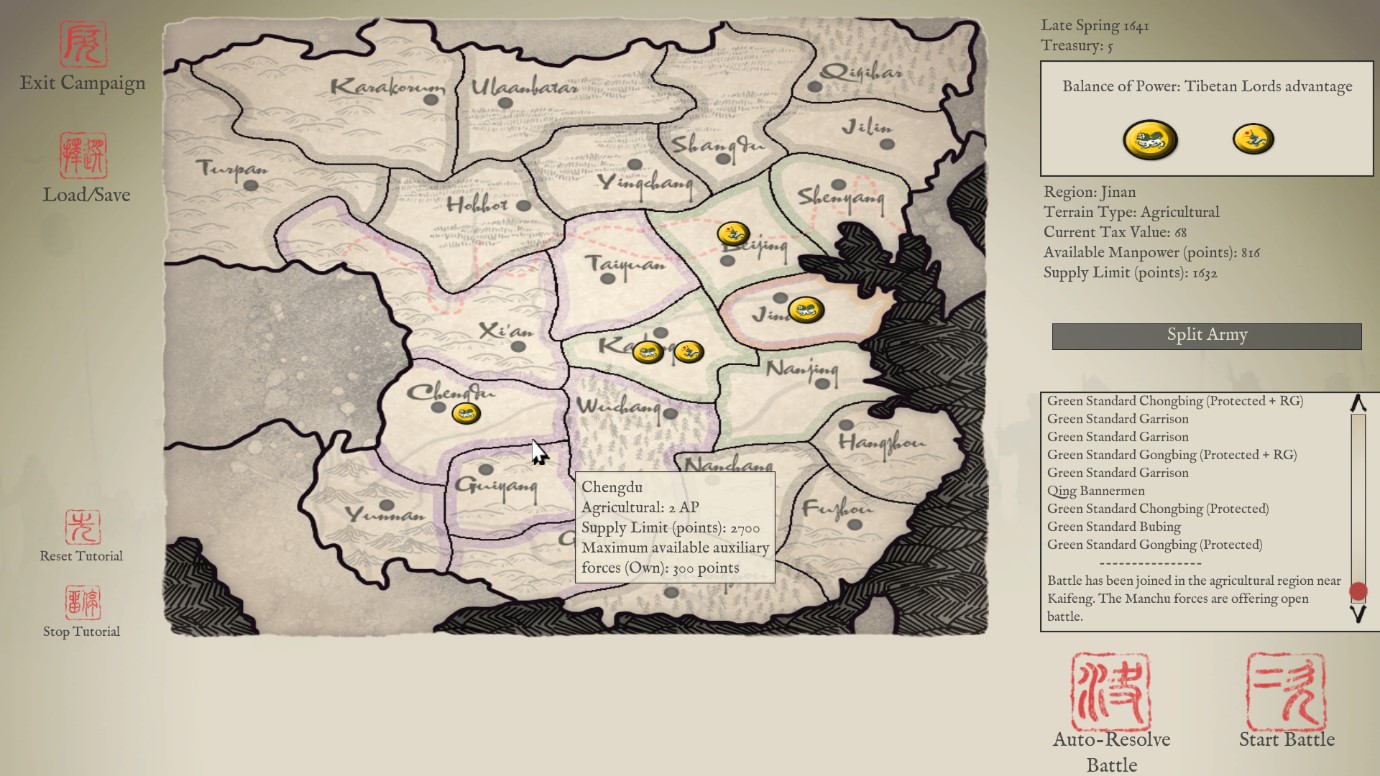
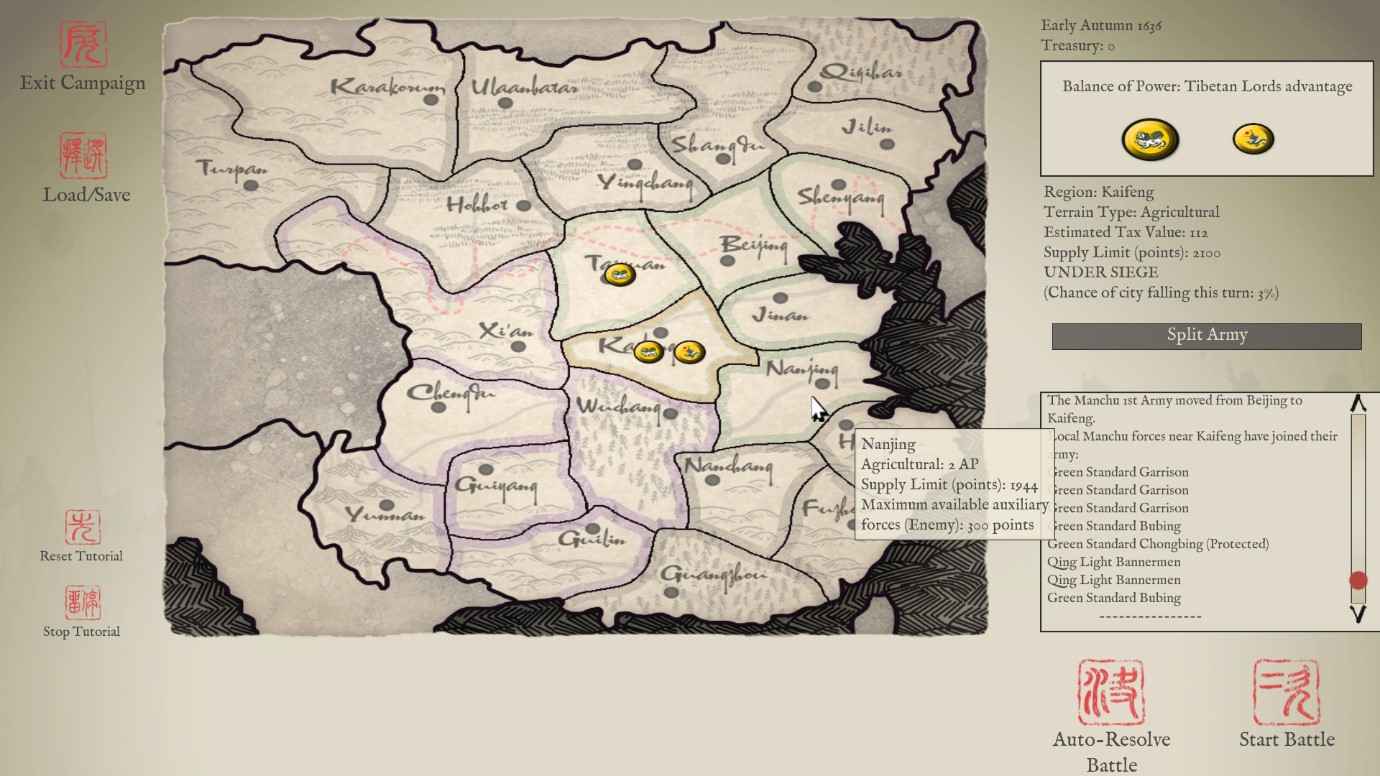
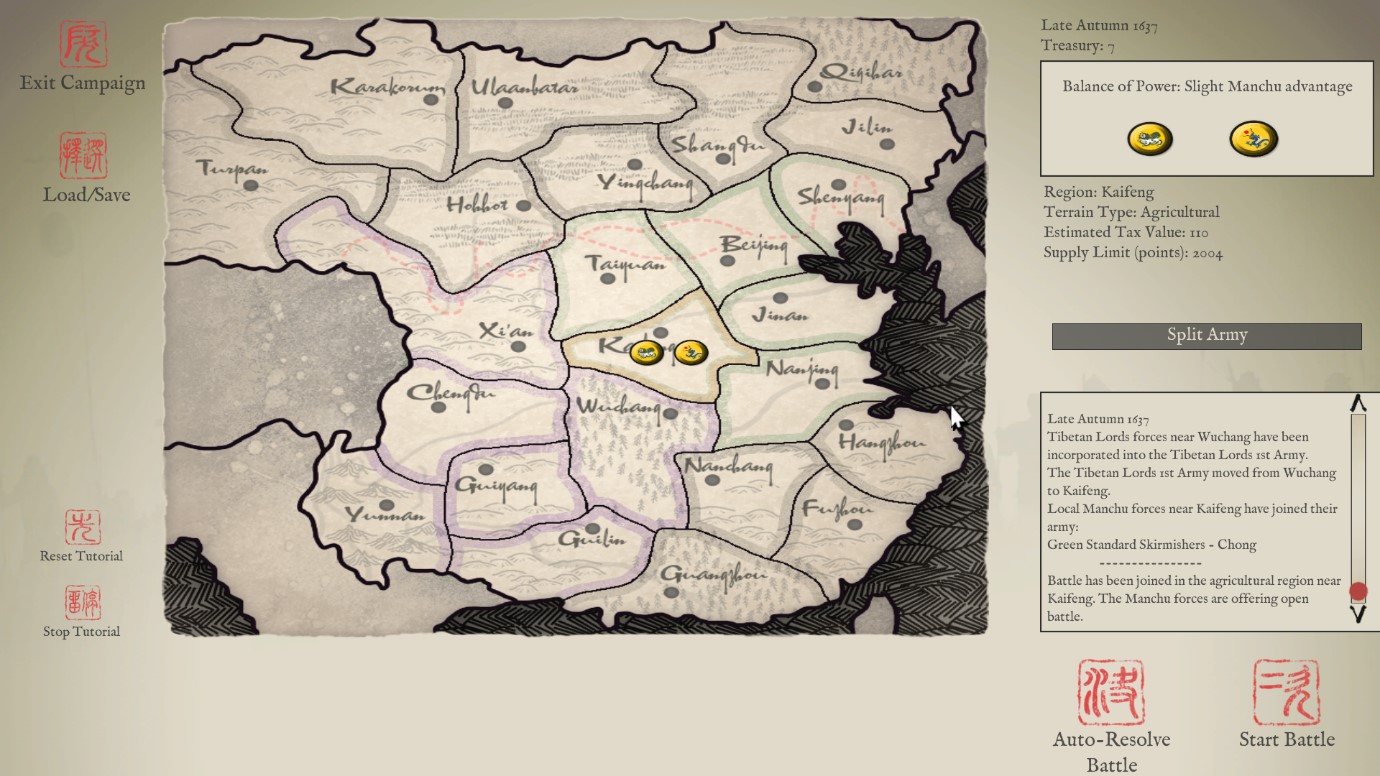
Tibetan General Yonten Norbu arrived in Chengdu. Tsering Labdorn confronted Niuniu in Kaifeng with the hopes of meeting up with Yonten Norbu. But unlike the previous year, the Qing army did not retreat and decided to fight the attacking Tibetan army instead.
3rd Battle of Kaifeng
Tibet 30,000 vs. Qing 47,000
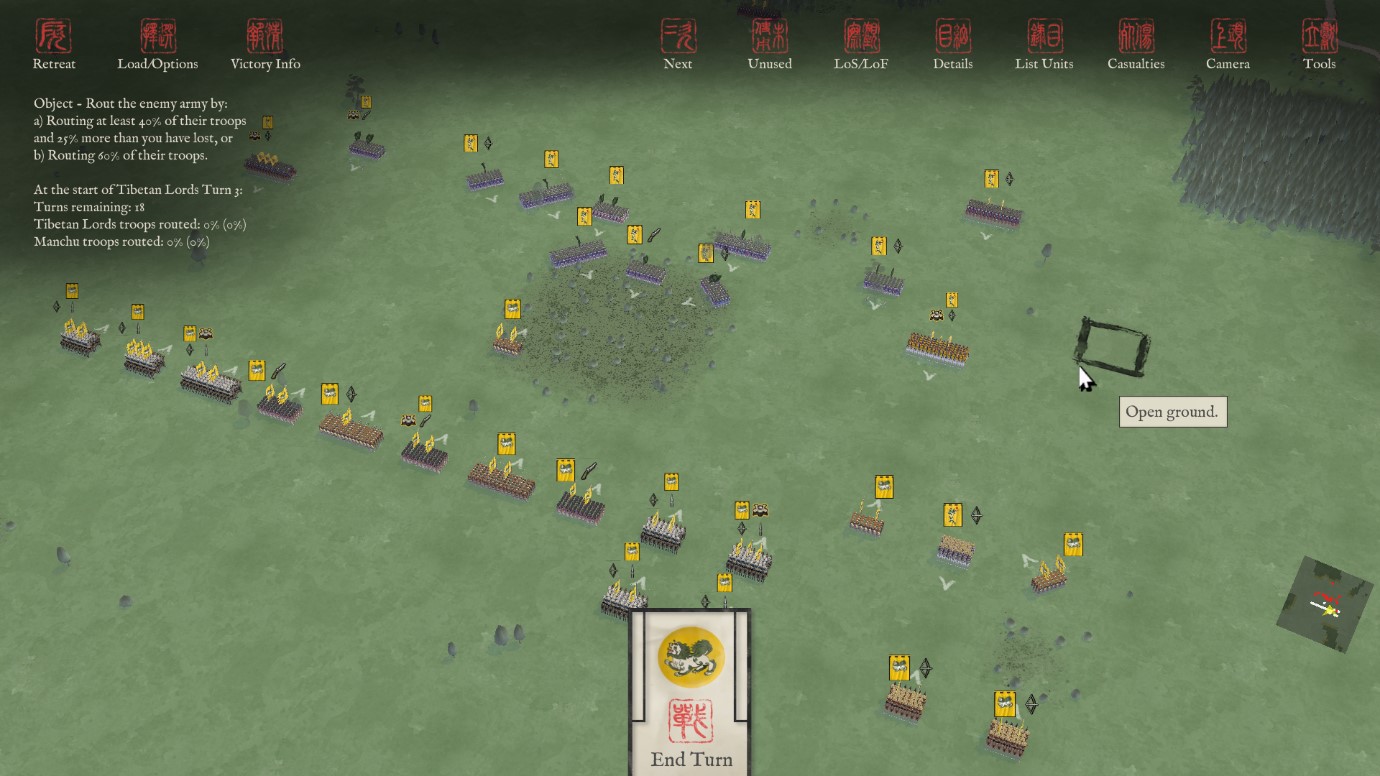
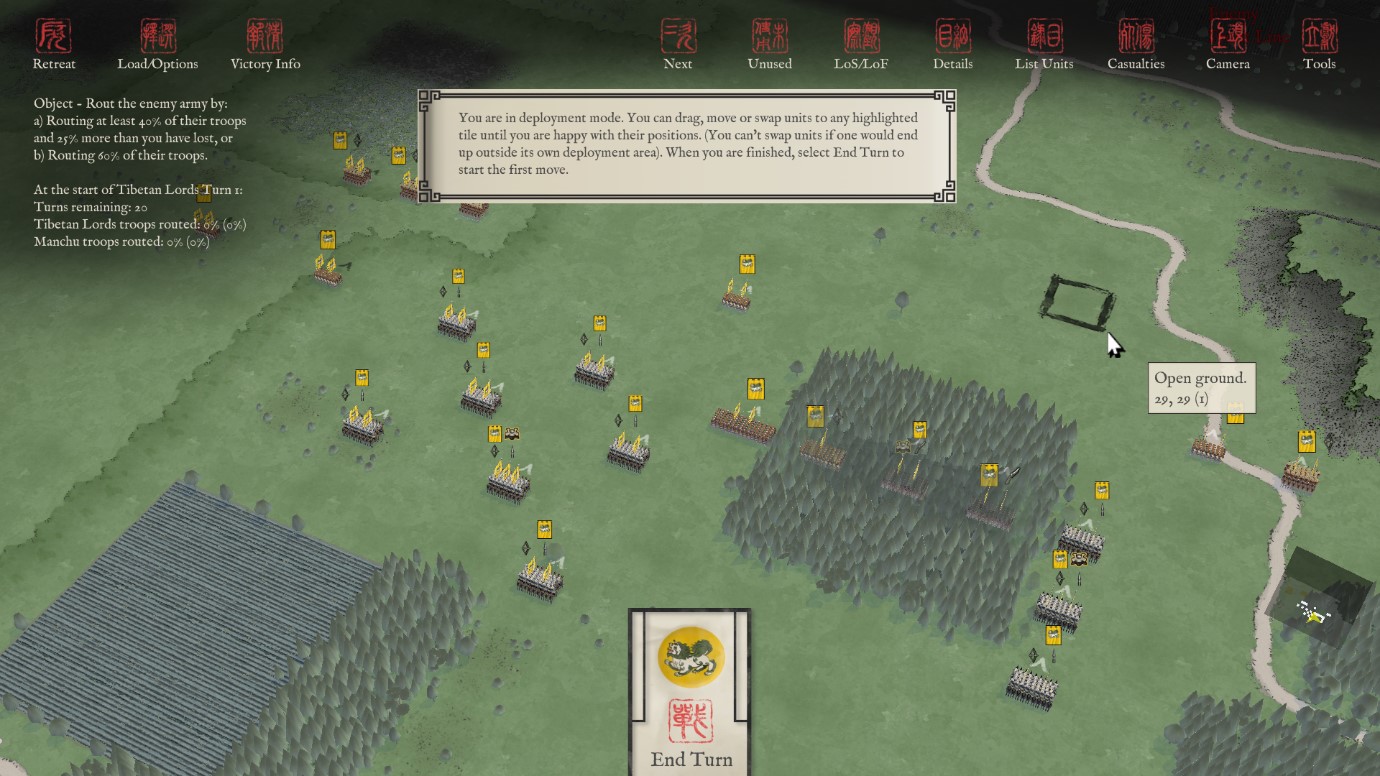
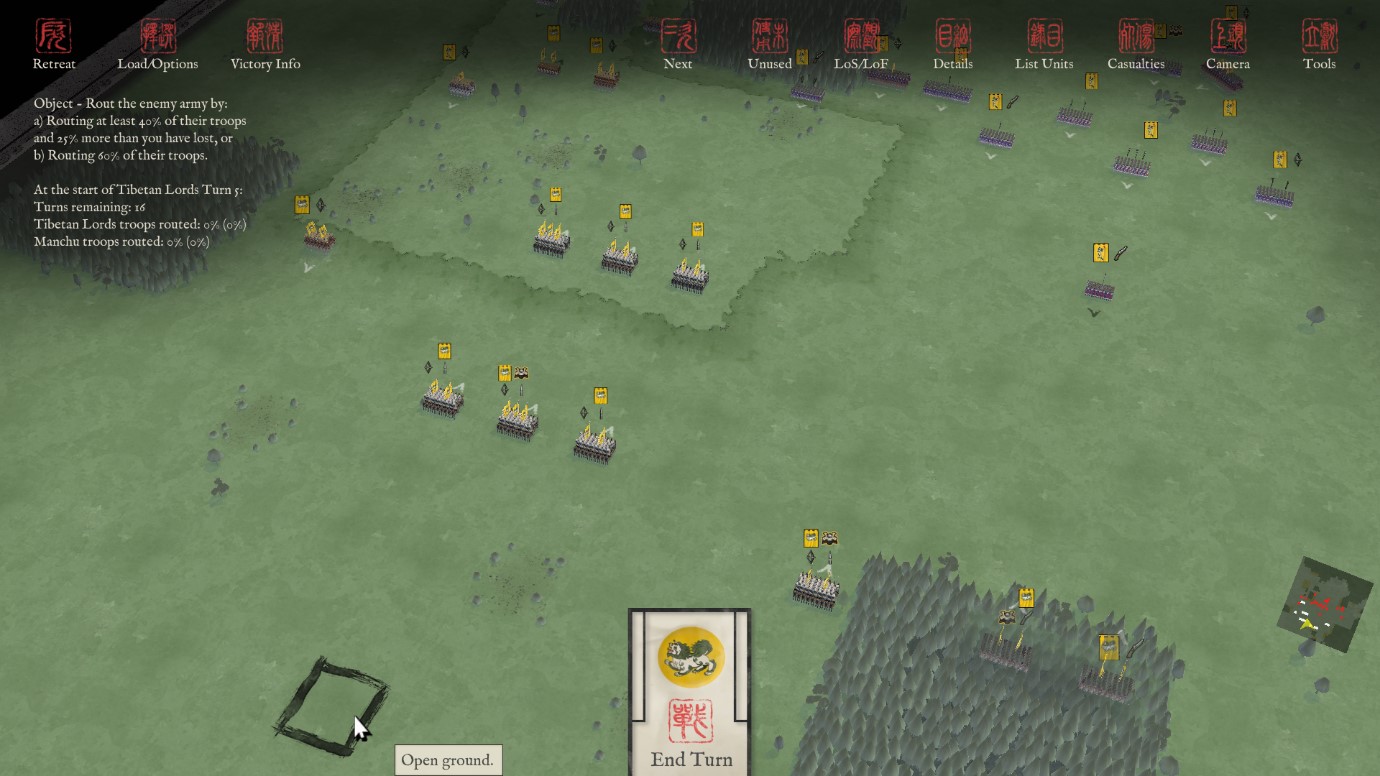
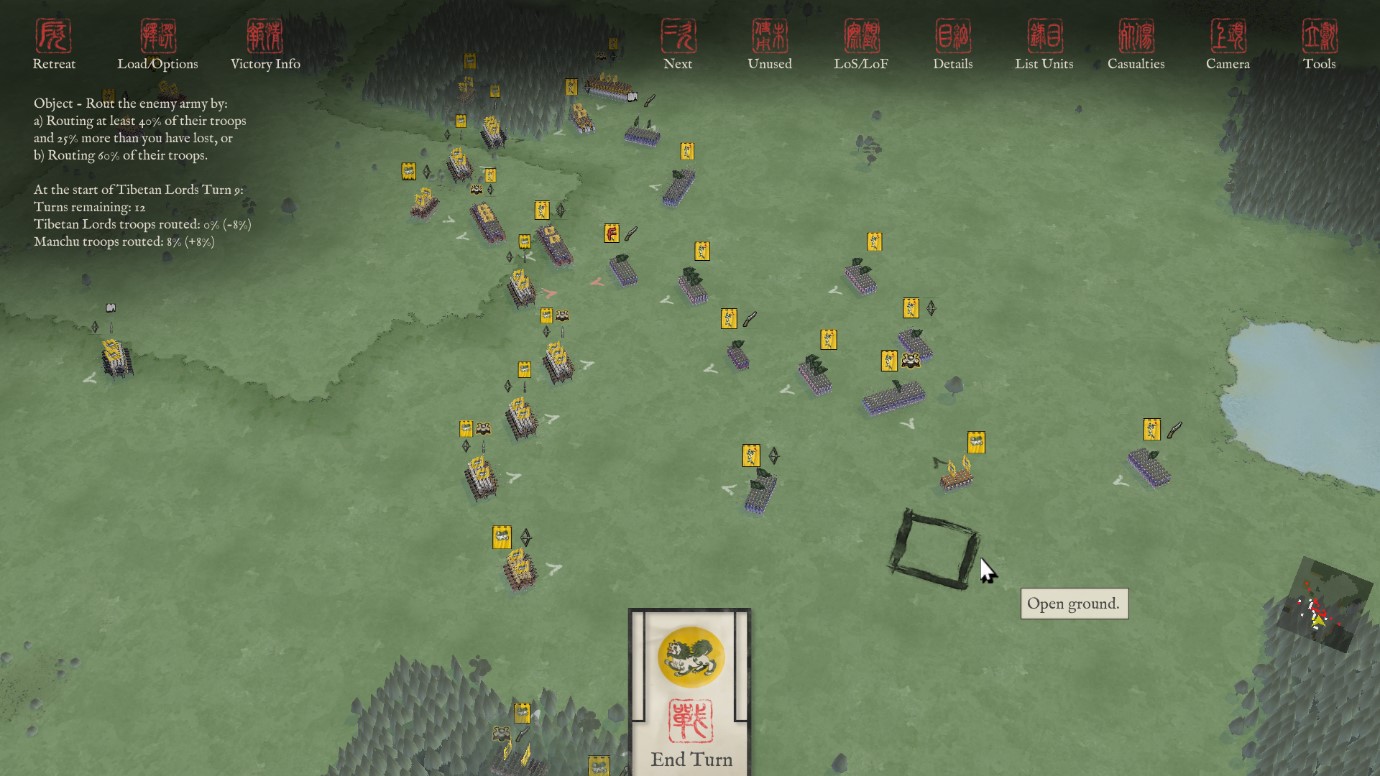
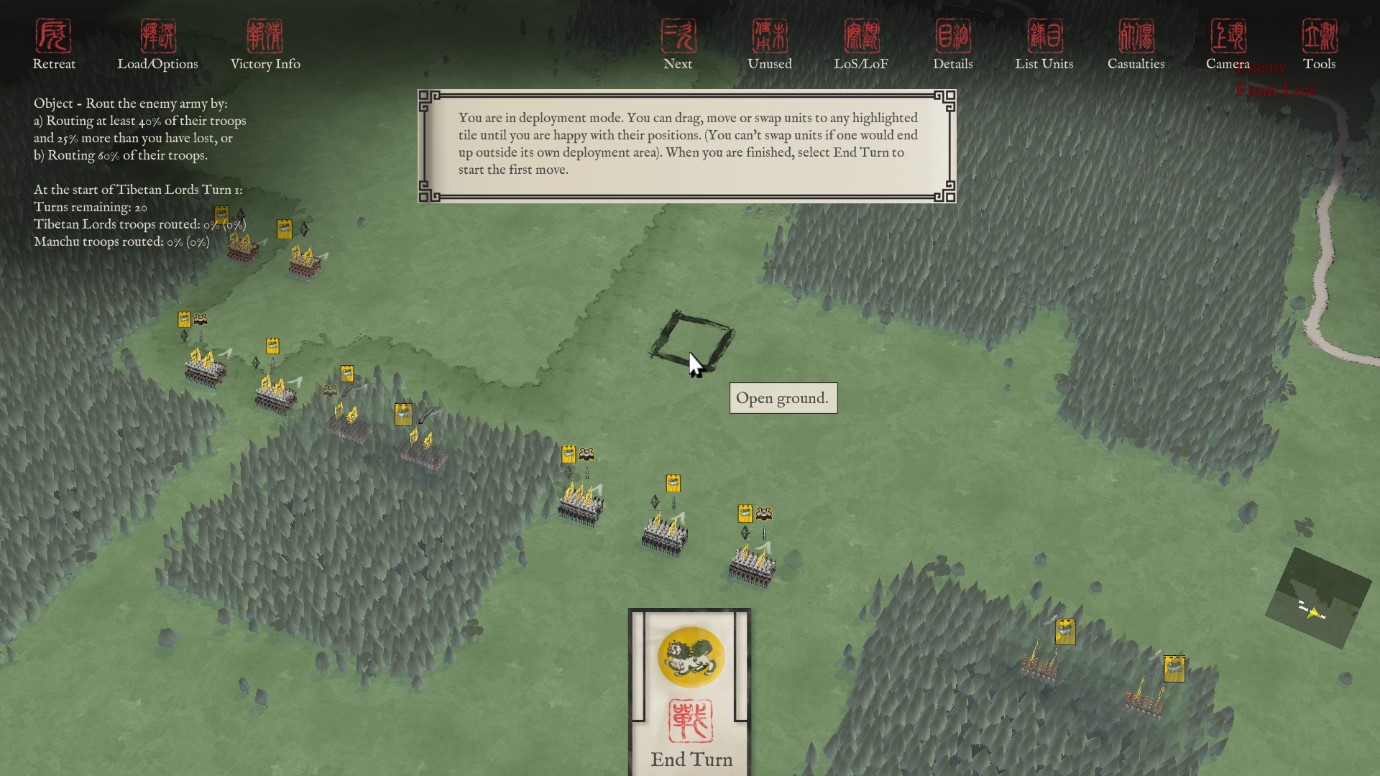
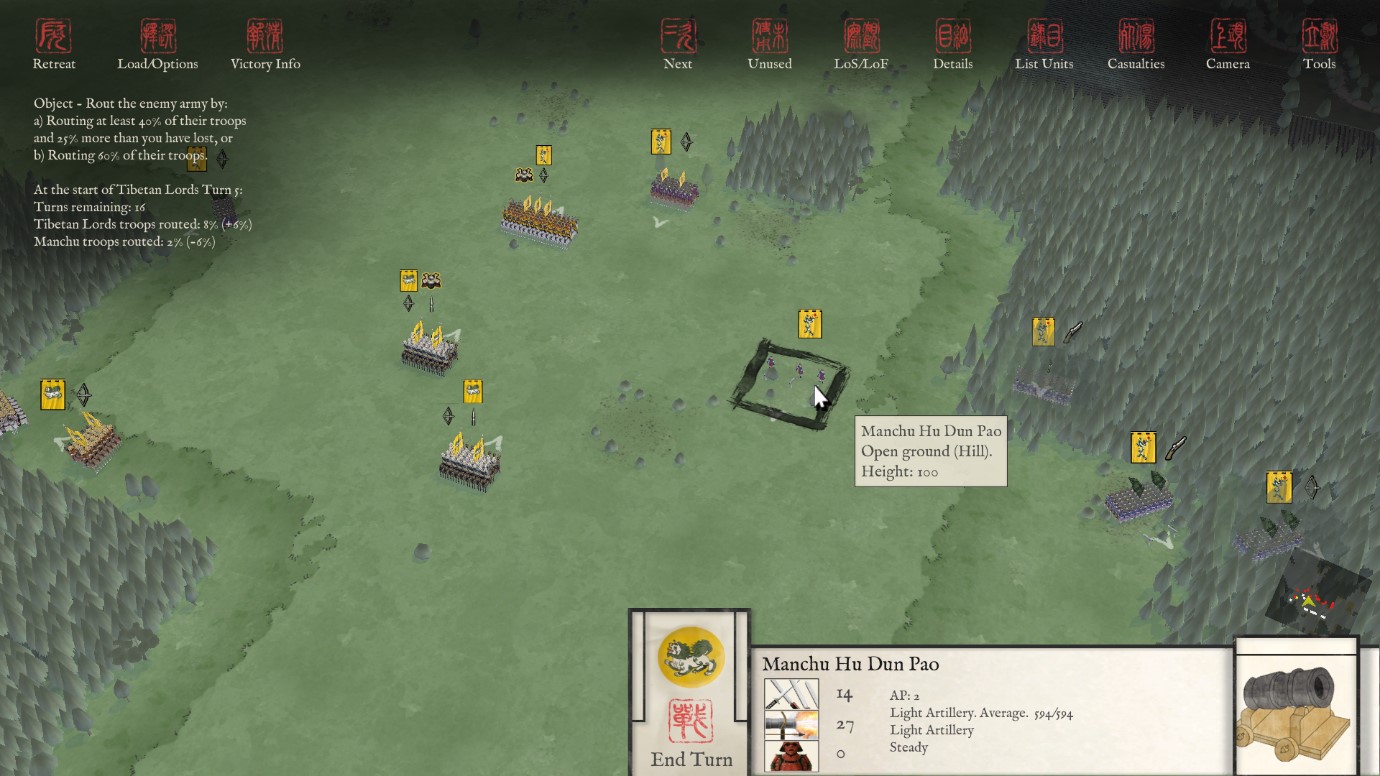
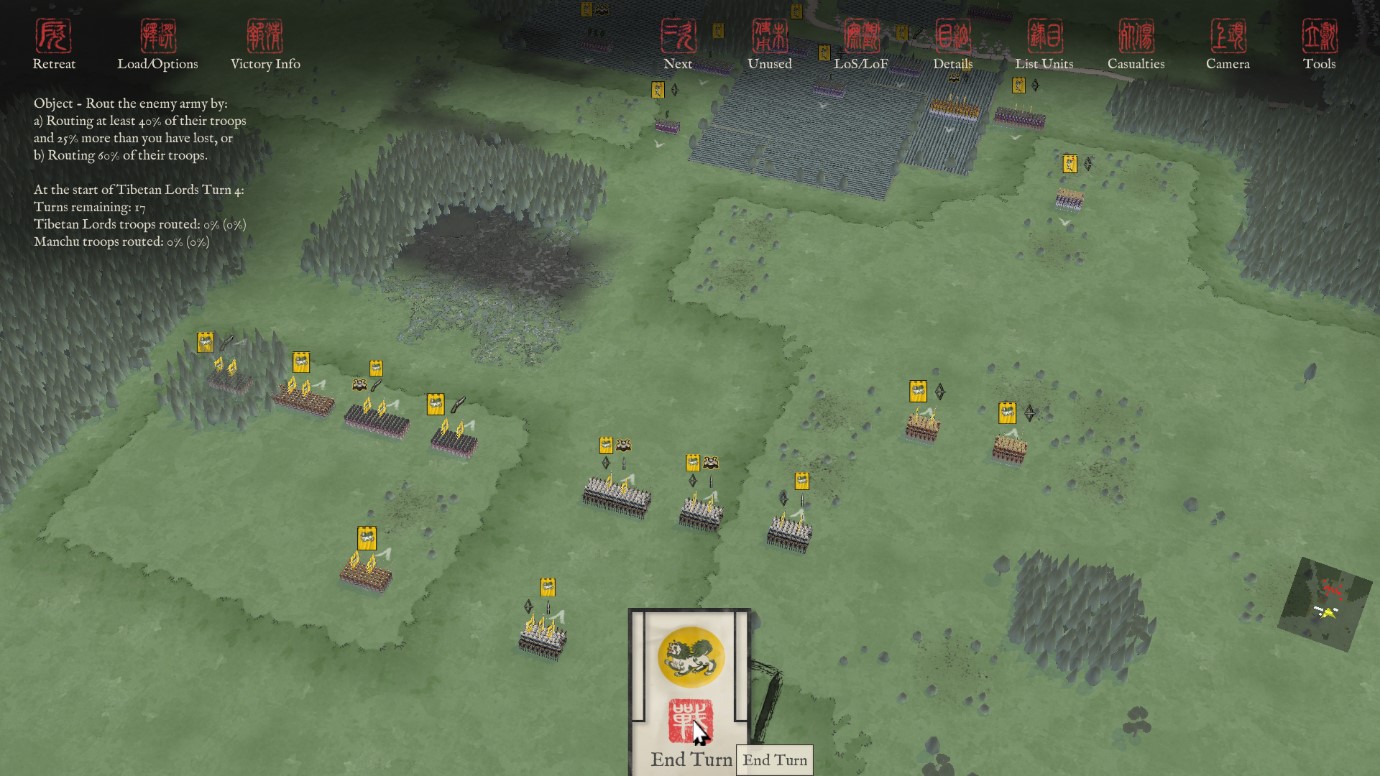
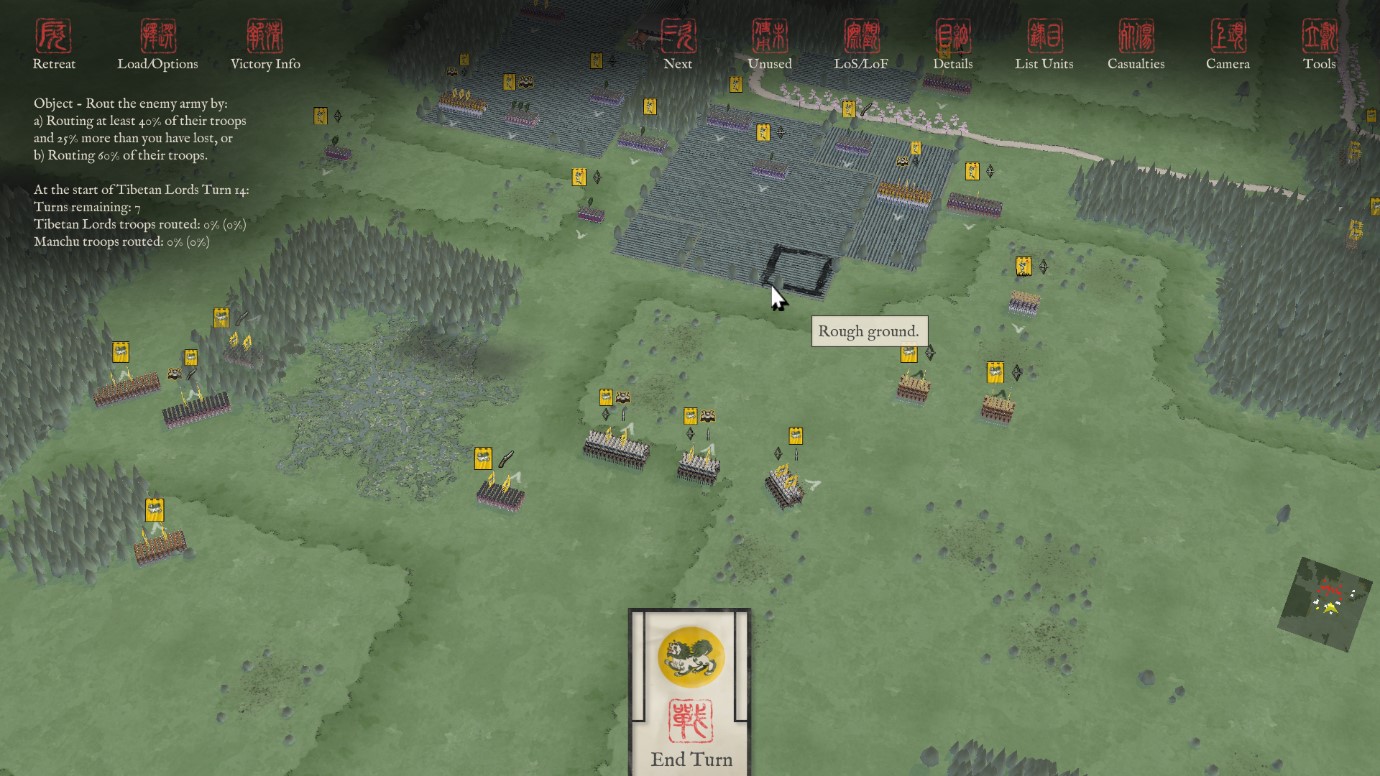
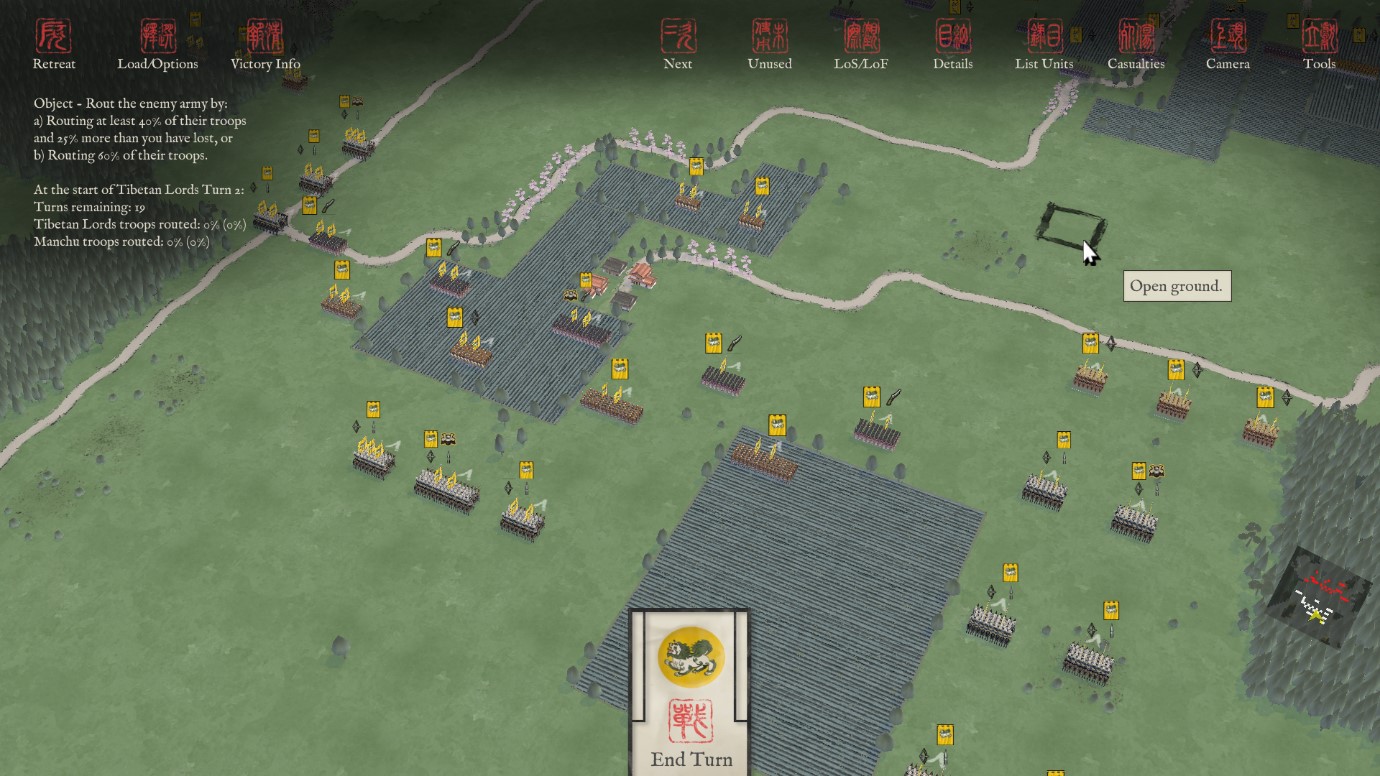
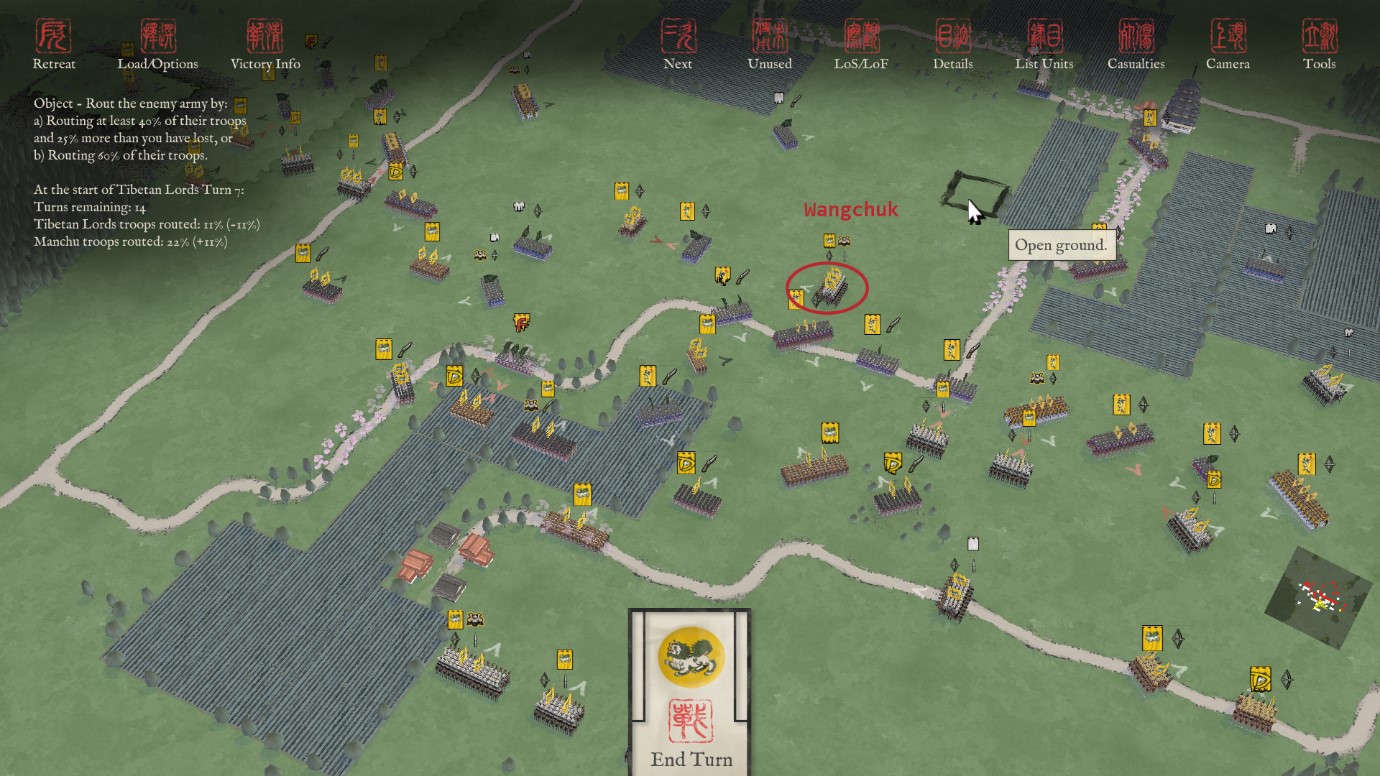
The armies met on an open field which would be good for the Tibetan lancers. But they had underestimated the Qing strength. Fortunately, the majority of the Qing army was poorly trained garrison infantry this time around and there were not enough Bannermen to pose a serious threat.
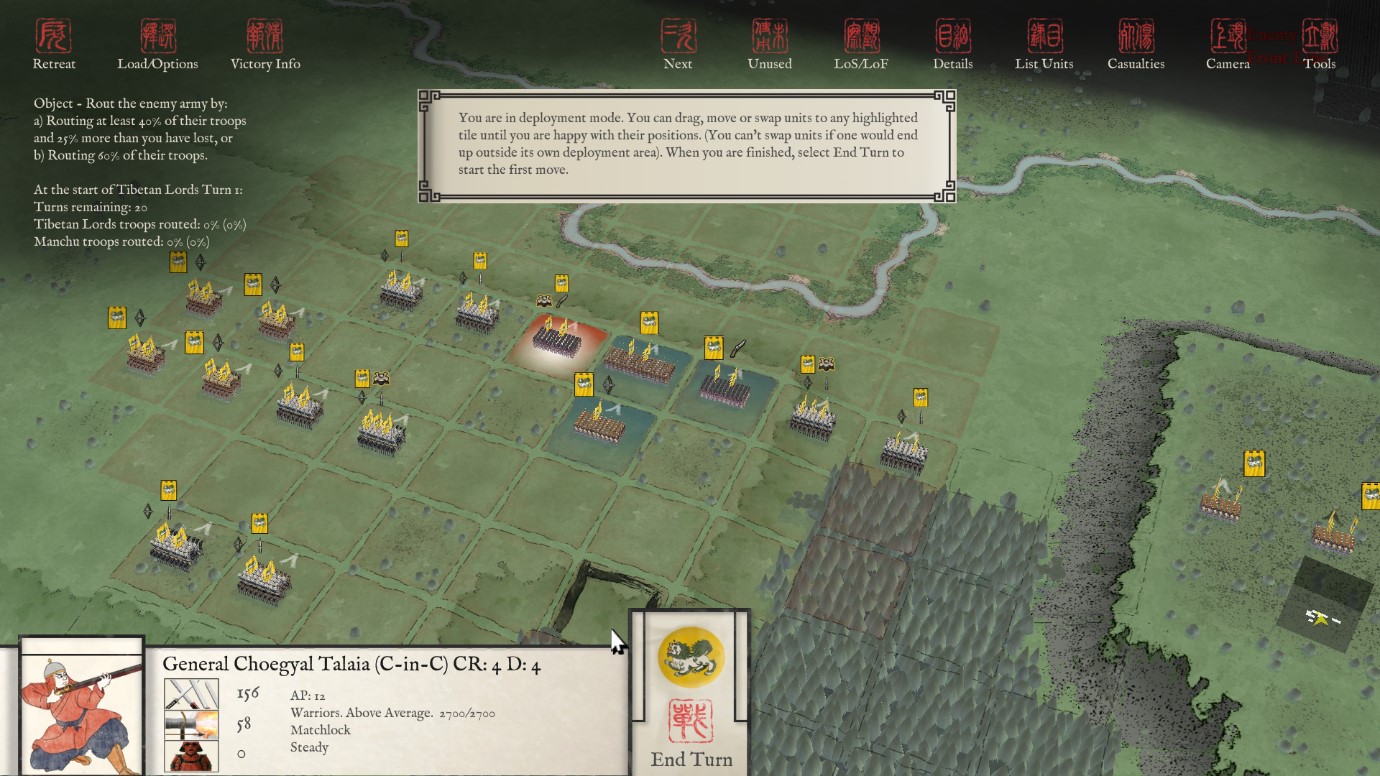
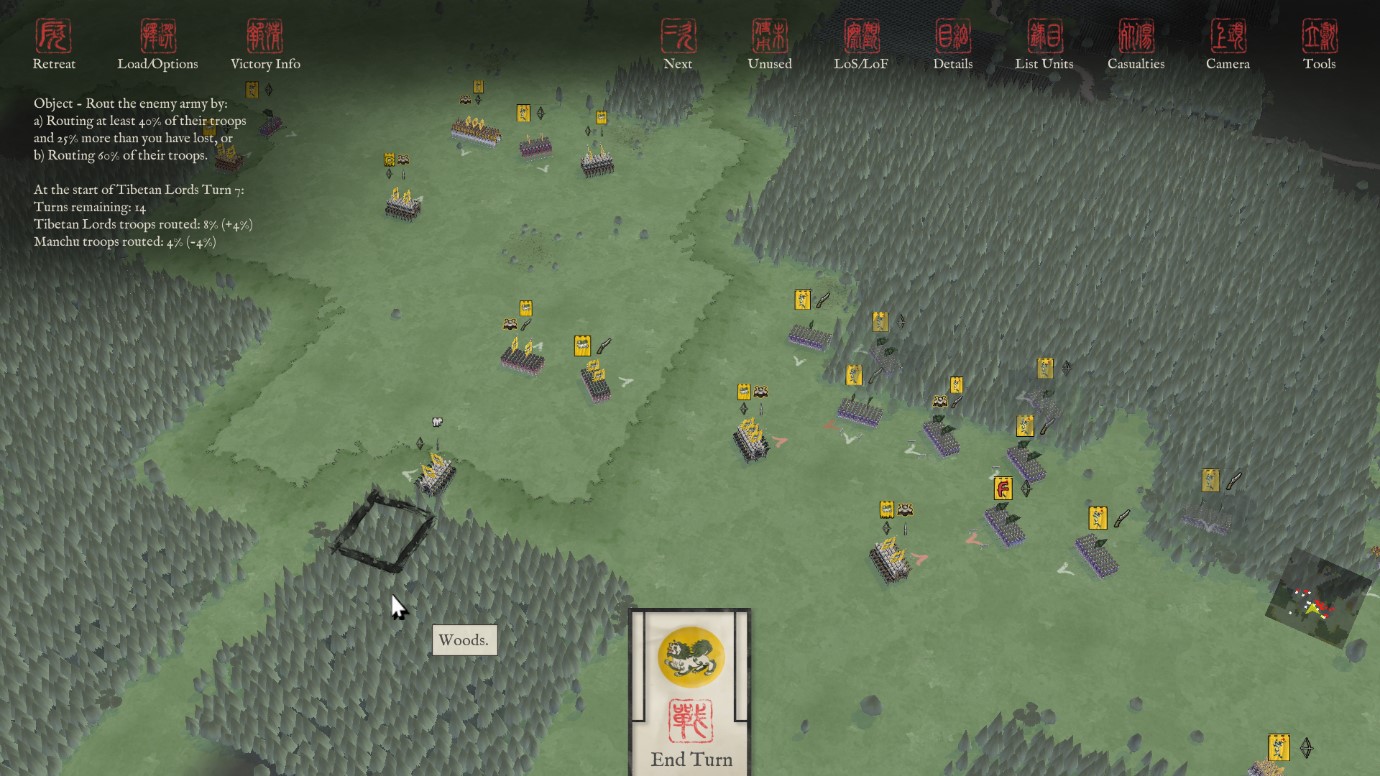
Commander Tsering Labdorn and his infantry were positioned in the centre. To his right were Chokyi Yontan’s lancers. To his left were Thokmay Ngawang’s lancers. Skirmishers were deployed in the front and right.
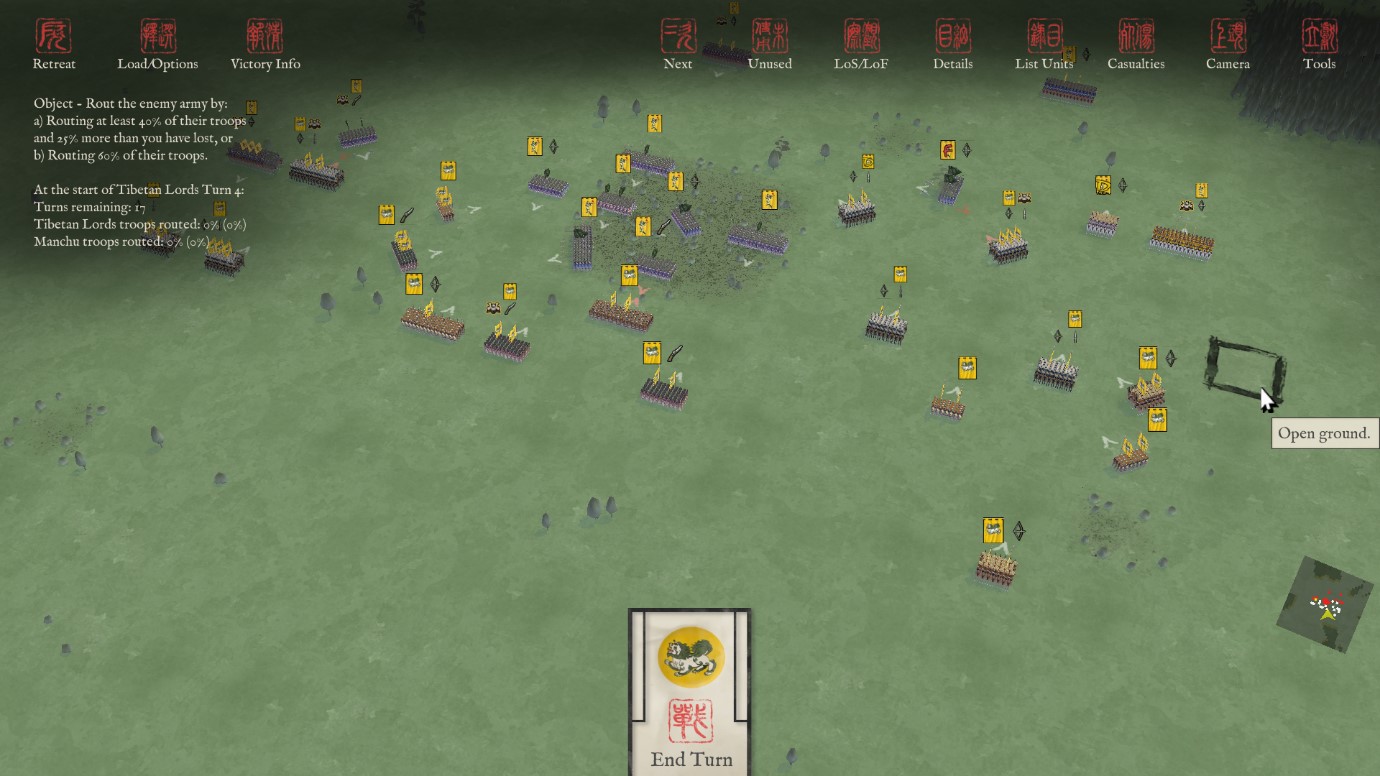
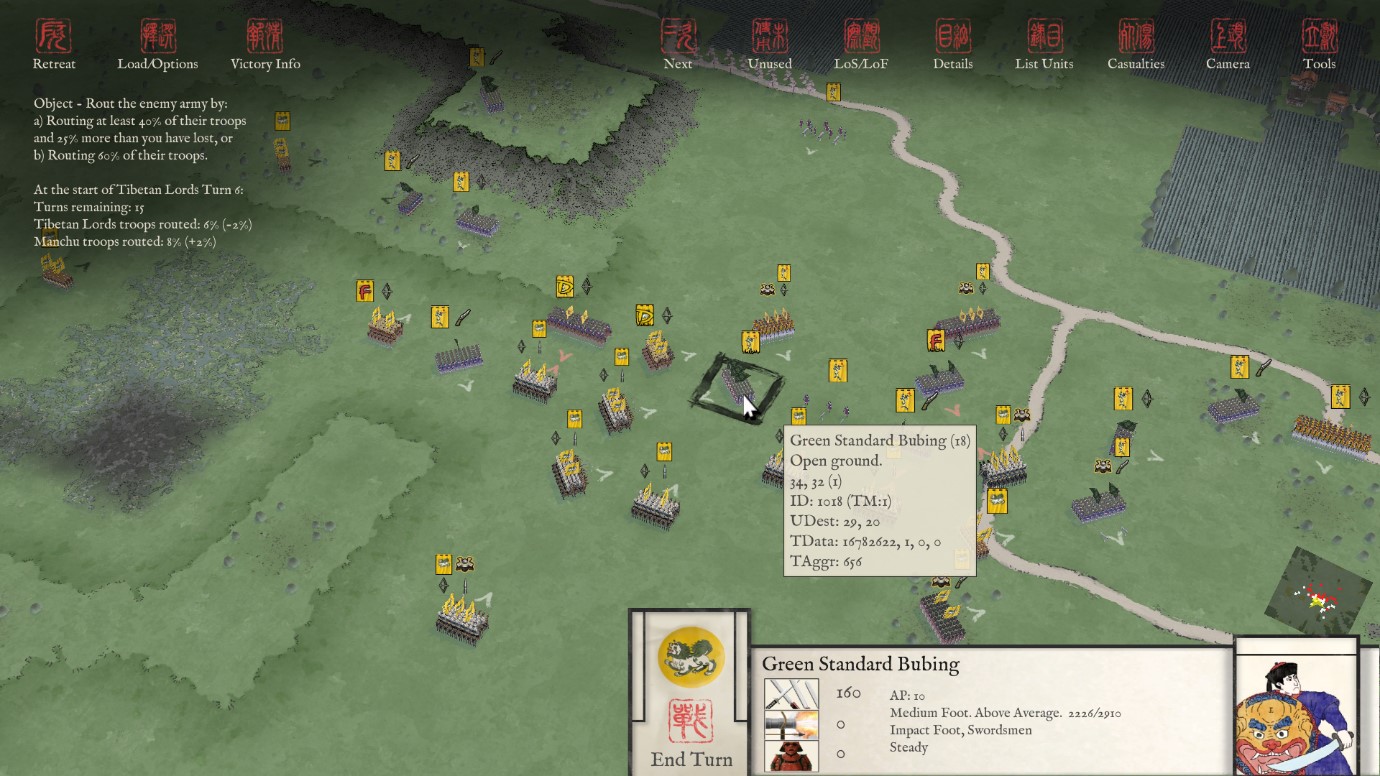
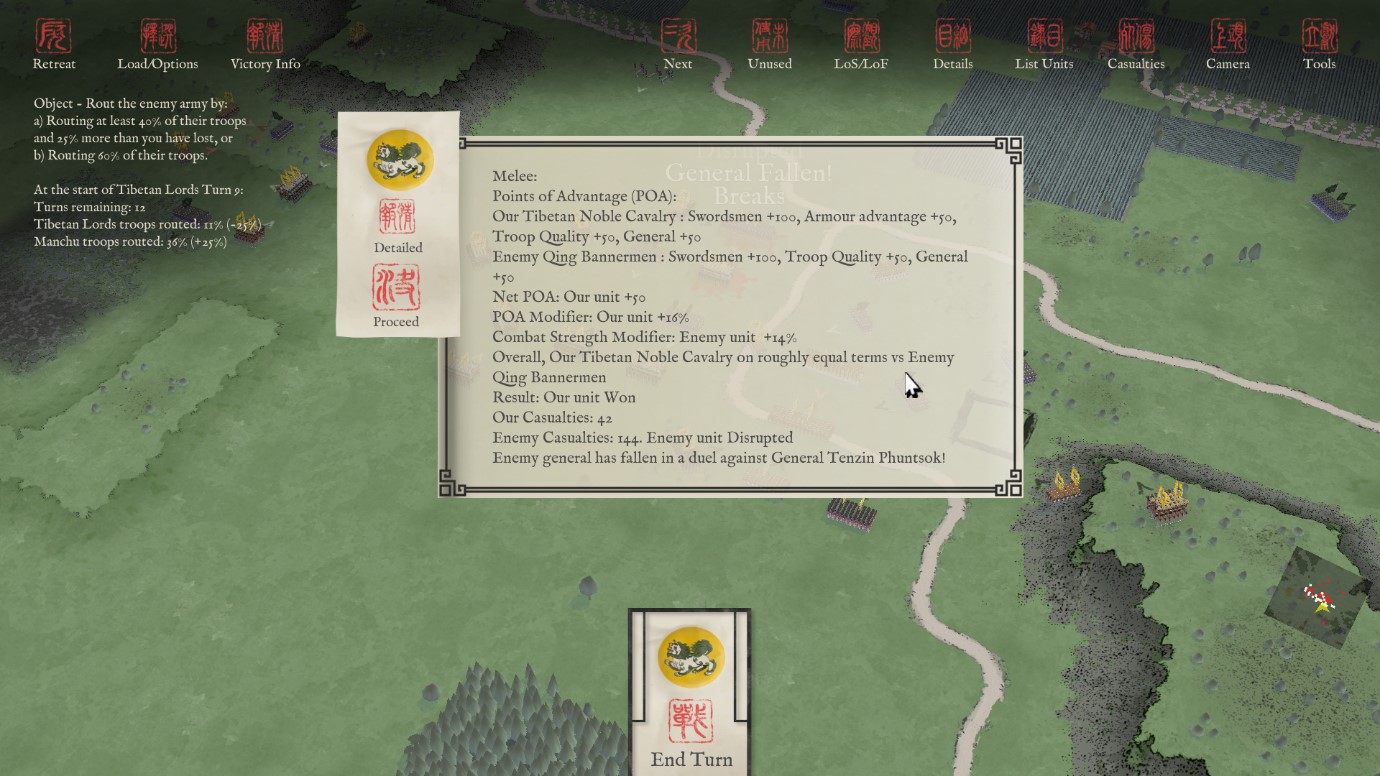
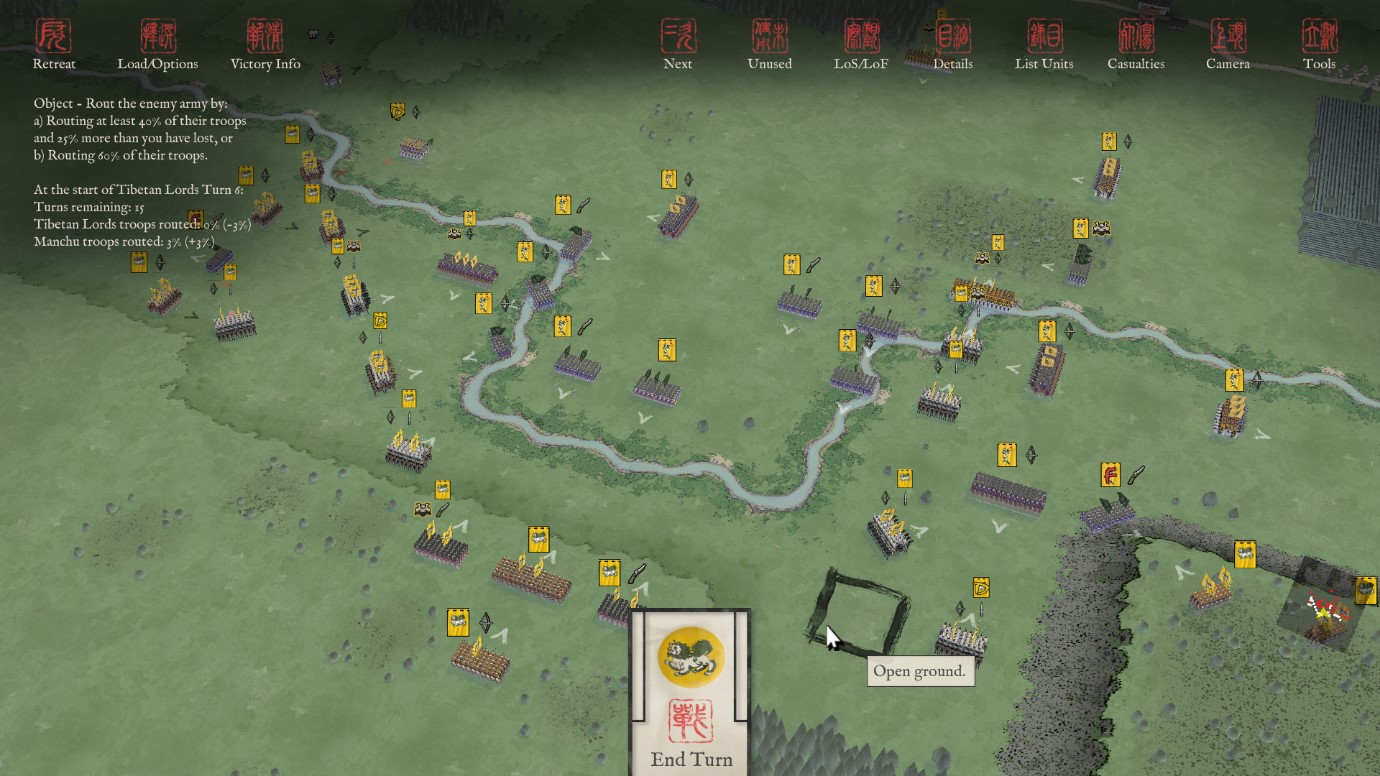
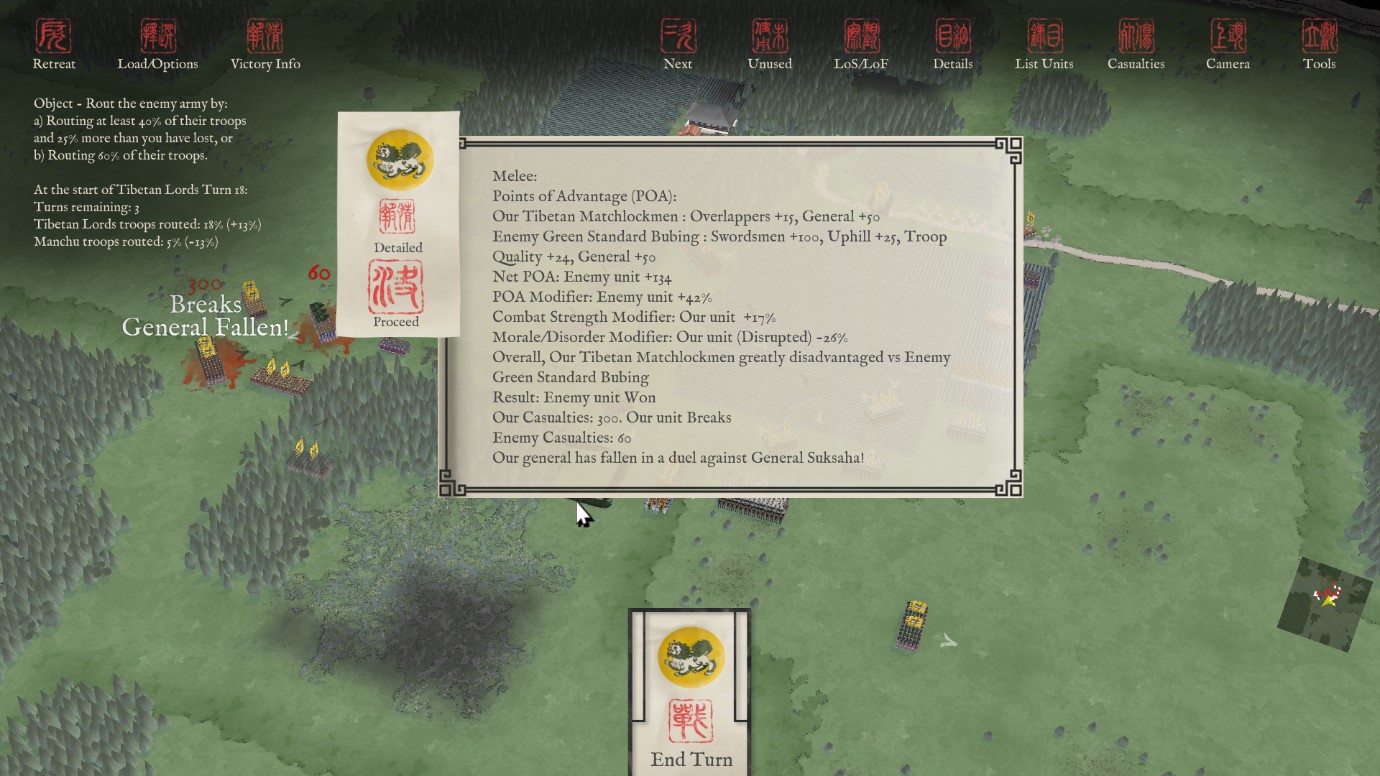
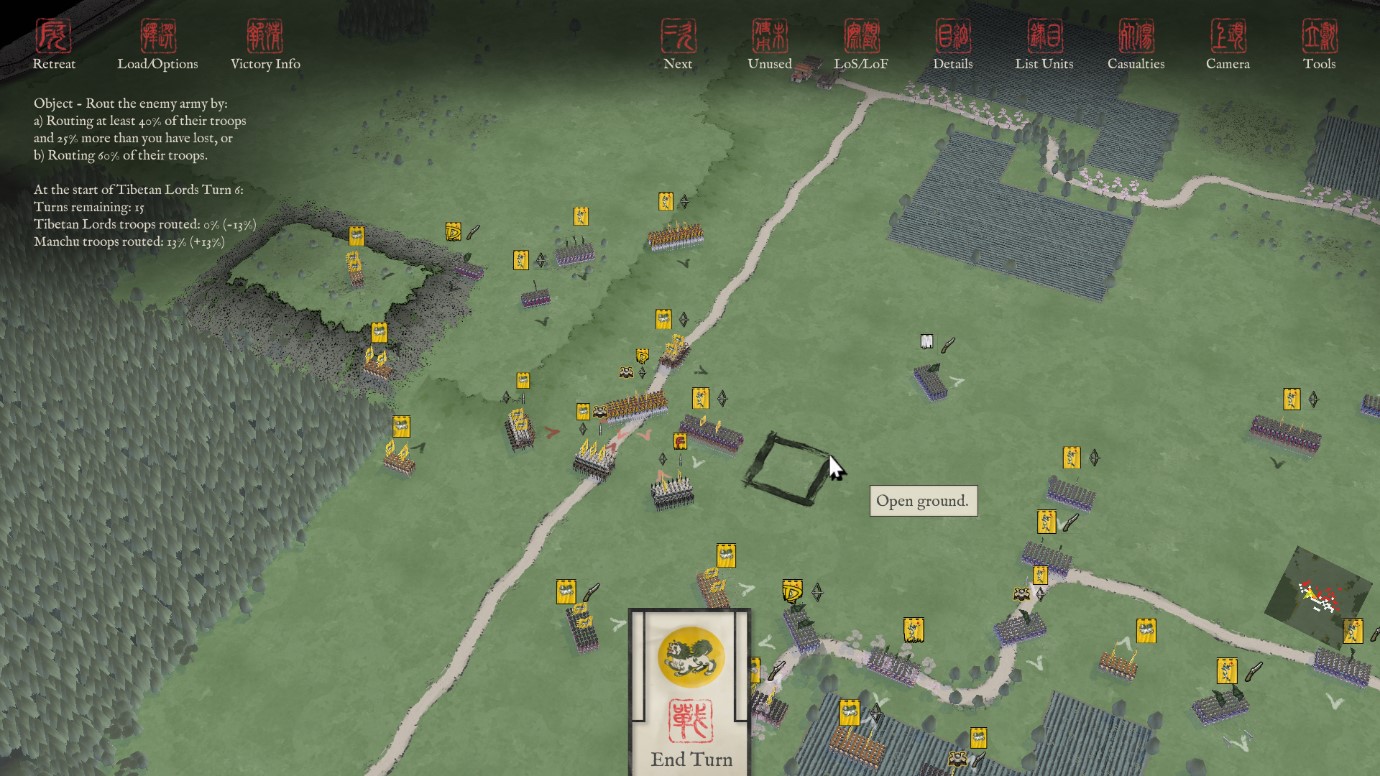
The Qing infantry sought to take advantage of the rough ground in between the two armies. Chokyi Yontan chased off the Qing General Sushun’s Bannermen who refused to fight on the right. On the left, Thokmay Nagwang personally engaged Qing General Fuman’s infantry. But Thokmay lost his arm while fighting General Fuman in personal combat.
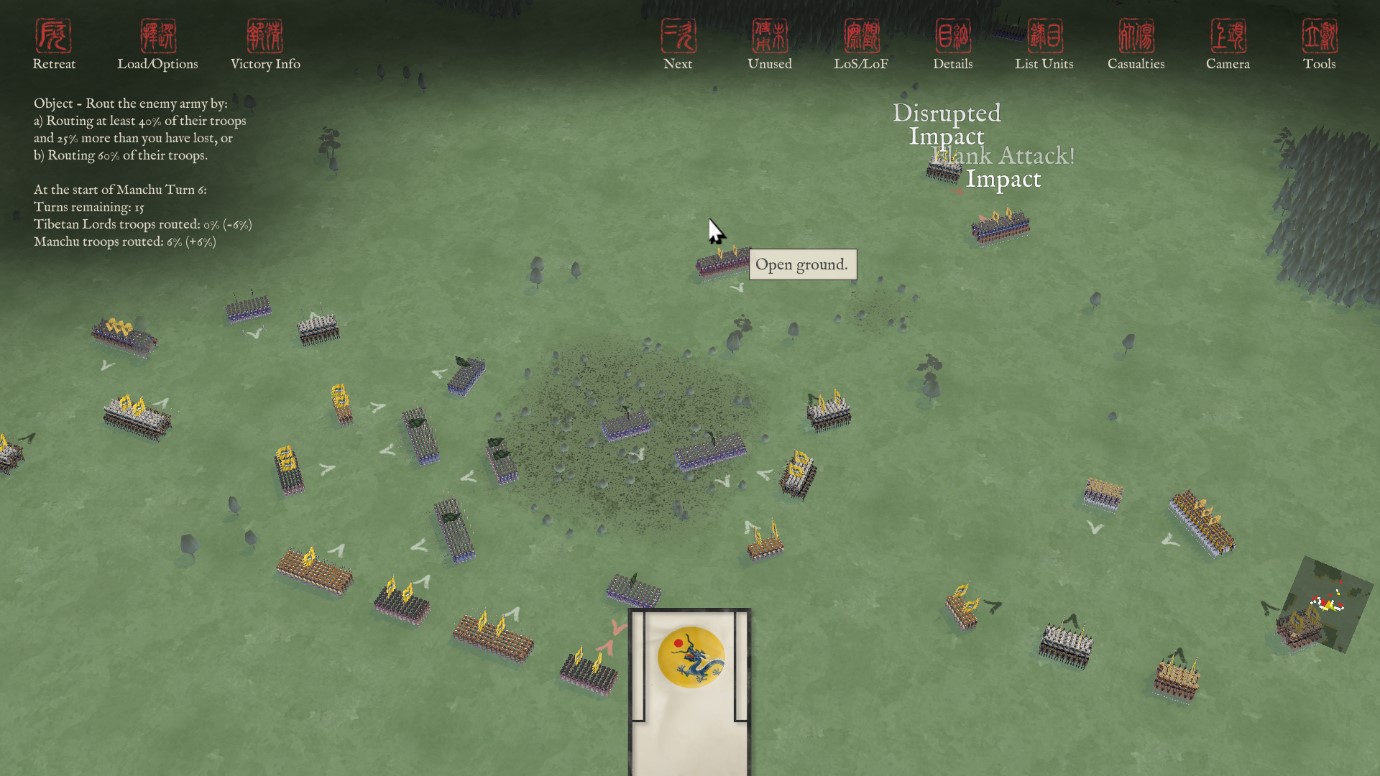
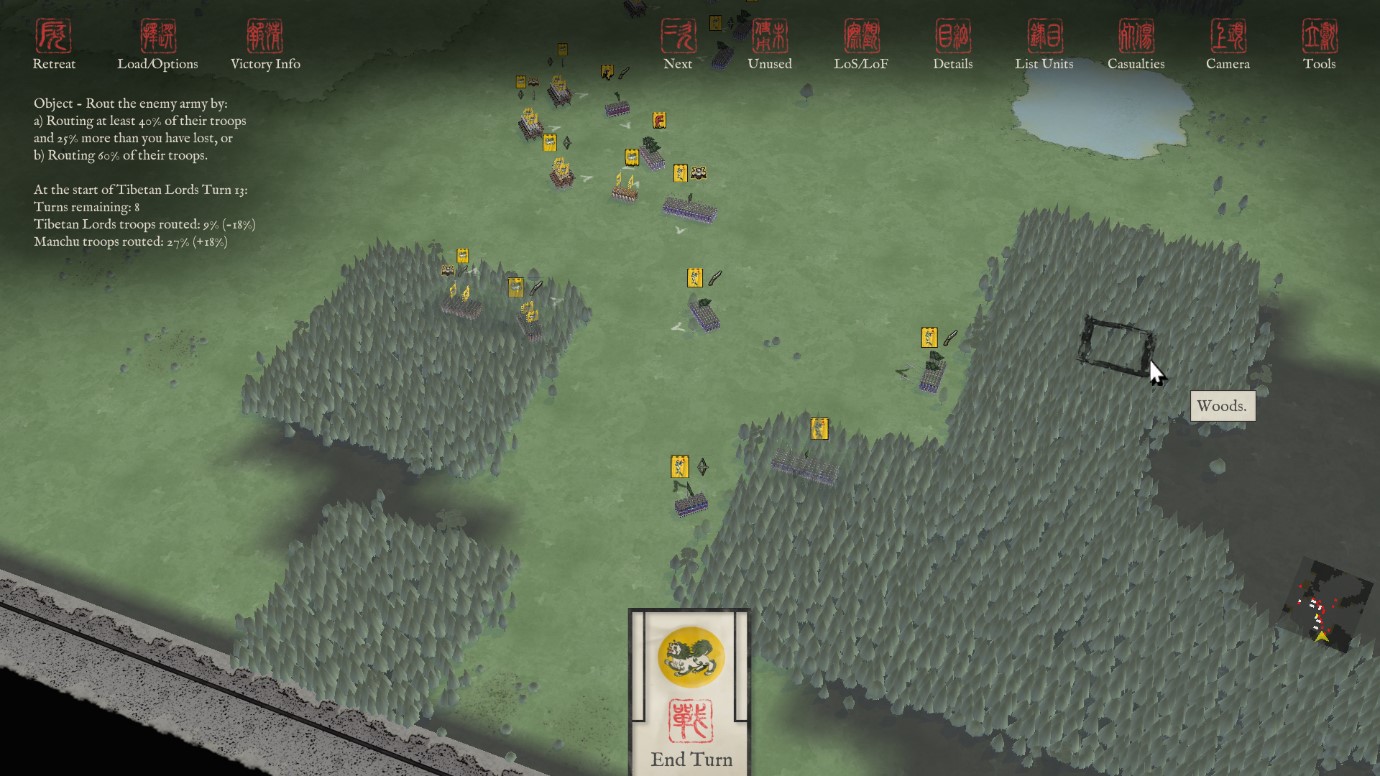
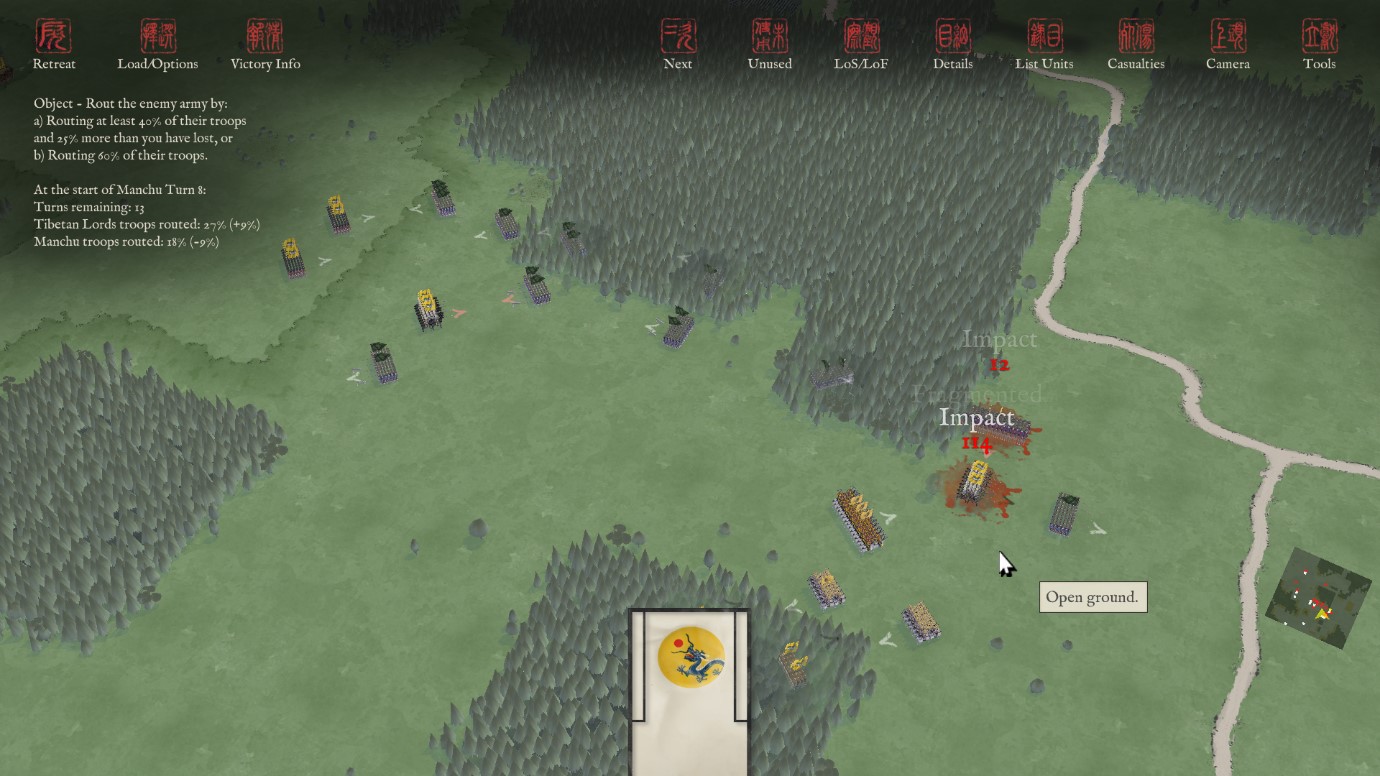
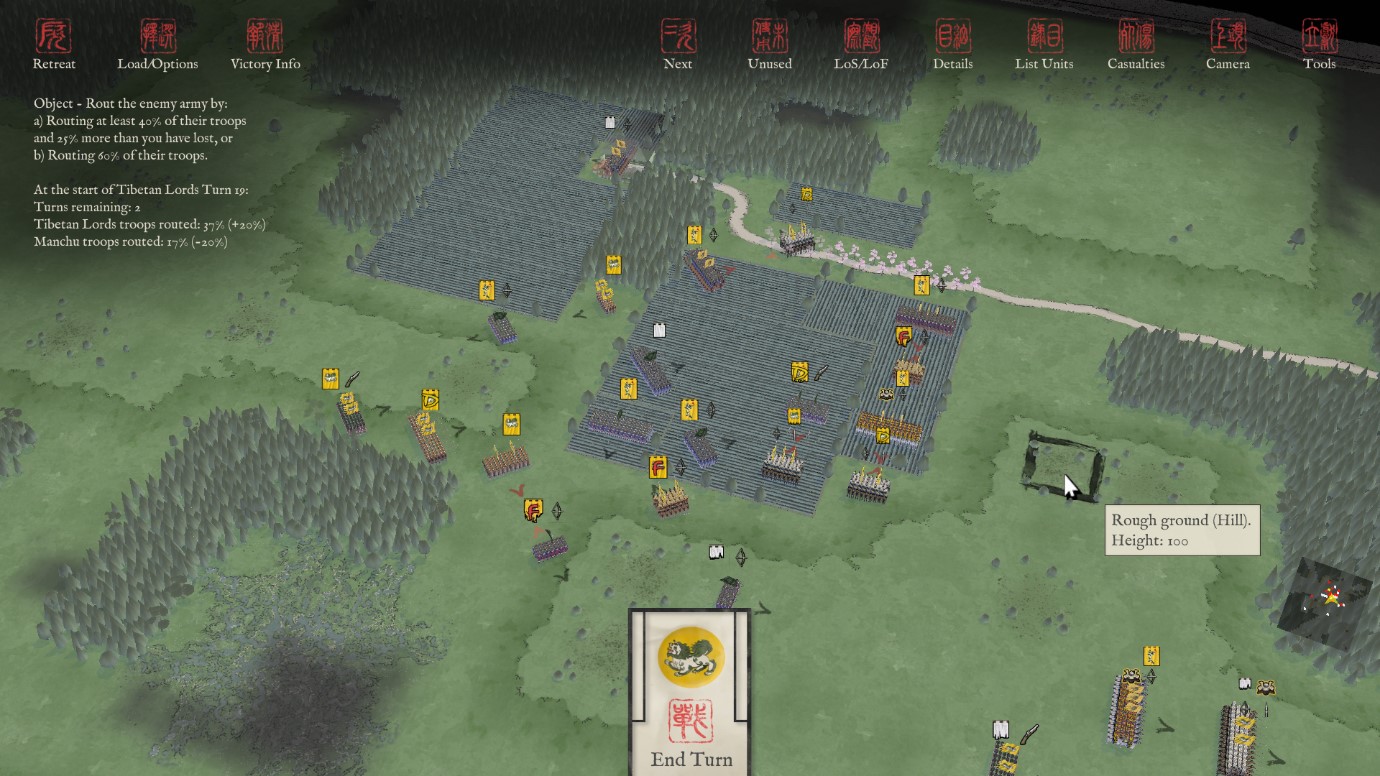
Here we see Qing Bannermen catching Chokyi Yontan from the rear as he pursued fleeing infantry, while his other units forced Sushun’s personal cavalry to rout. Unfortunately, Chokyi, the man who was famed for singlehandedly taking on hundreds of opponents, was killed in action.
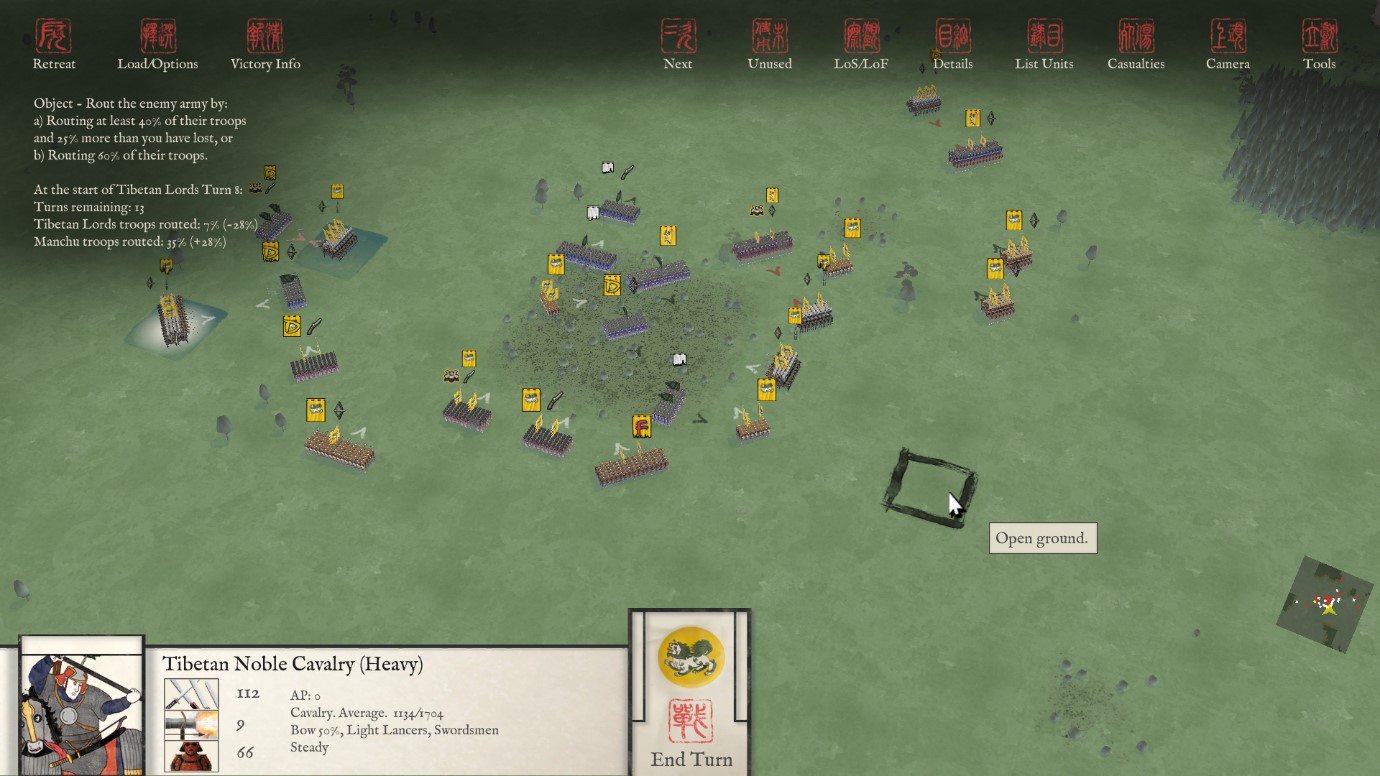
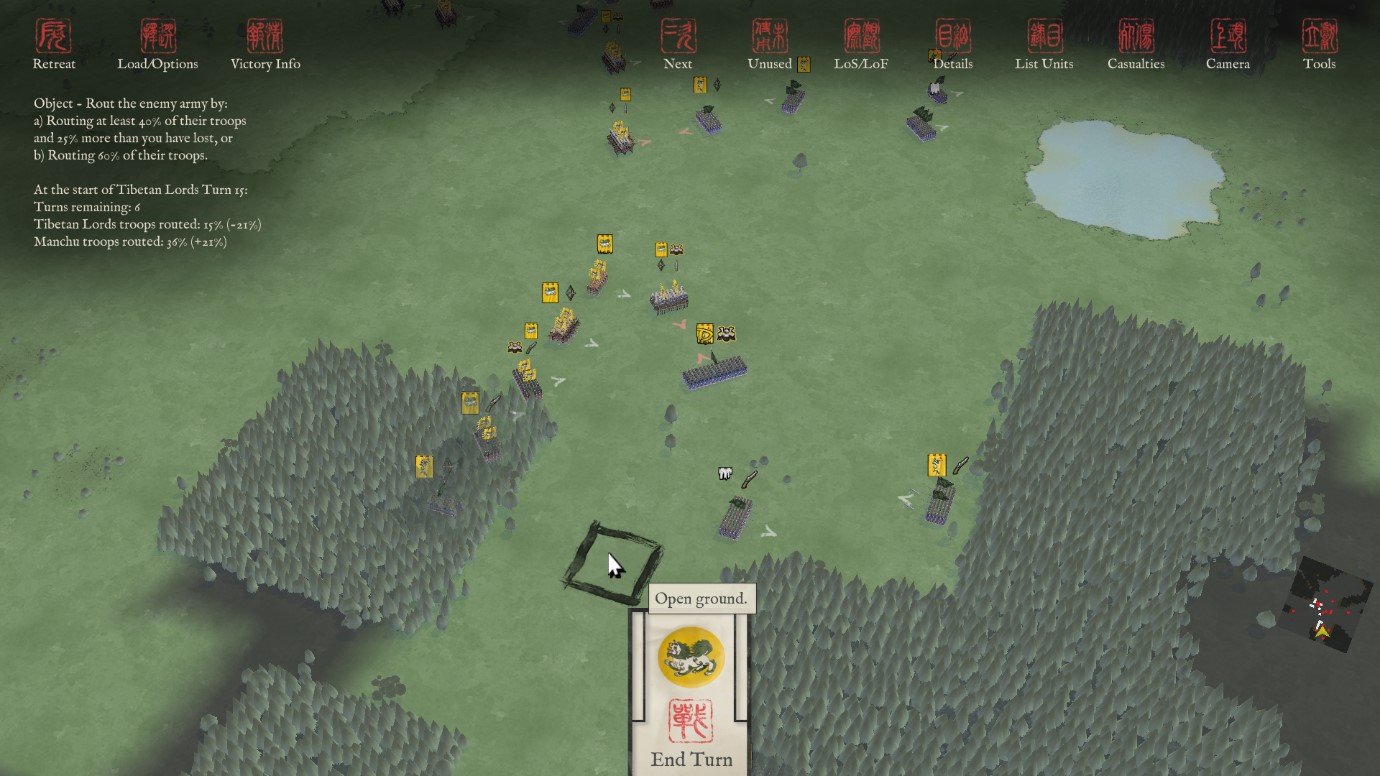
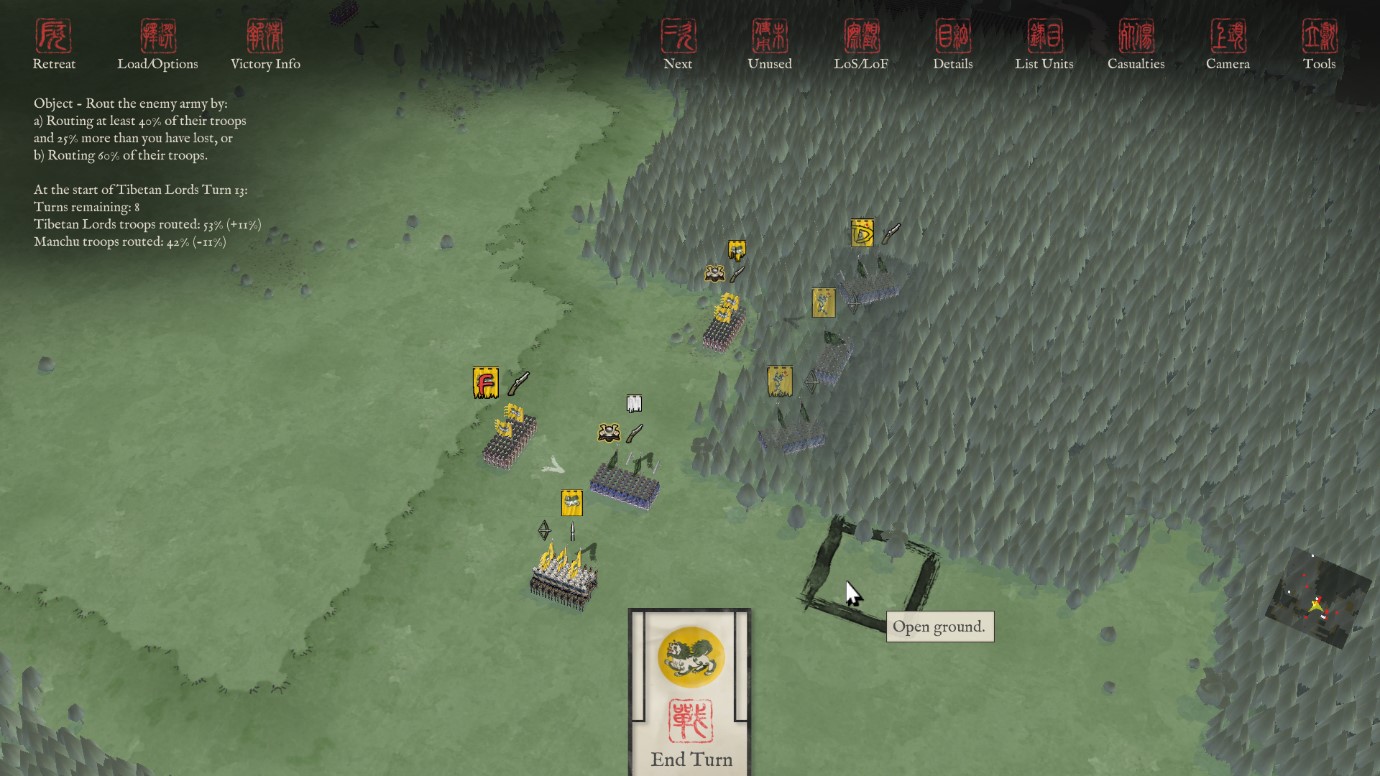
In the centre, Tserin Labdorn’s infantry was victorious against the more numerous Qing infantry. The battle ended with thousands of Qing infantry running for their lives.
Tibet lost 4,000 men. Qing lost 25,000 men. Though the overall casualty count seemed to suggest a decisive victory for the Tibetans, their mood was subdued due to the loss of two generals.
A few days after the battle, Yonten Norbu arrived at Kaifeng and joined Tsering’s army. Kaifeng fell by mid-summer.
Choegyal Talaia marched on to Beijing. The Qing armies did not put up a fight and retreated into Shenyang. Tsering and Yonten then joined the siege after taking Kaifeng. Beijing fell by the end of summer. The Qing emperor was caught and executed while the Tibetan lords prepared to set up a new government.
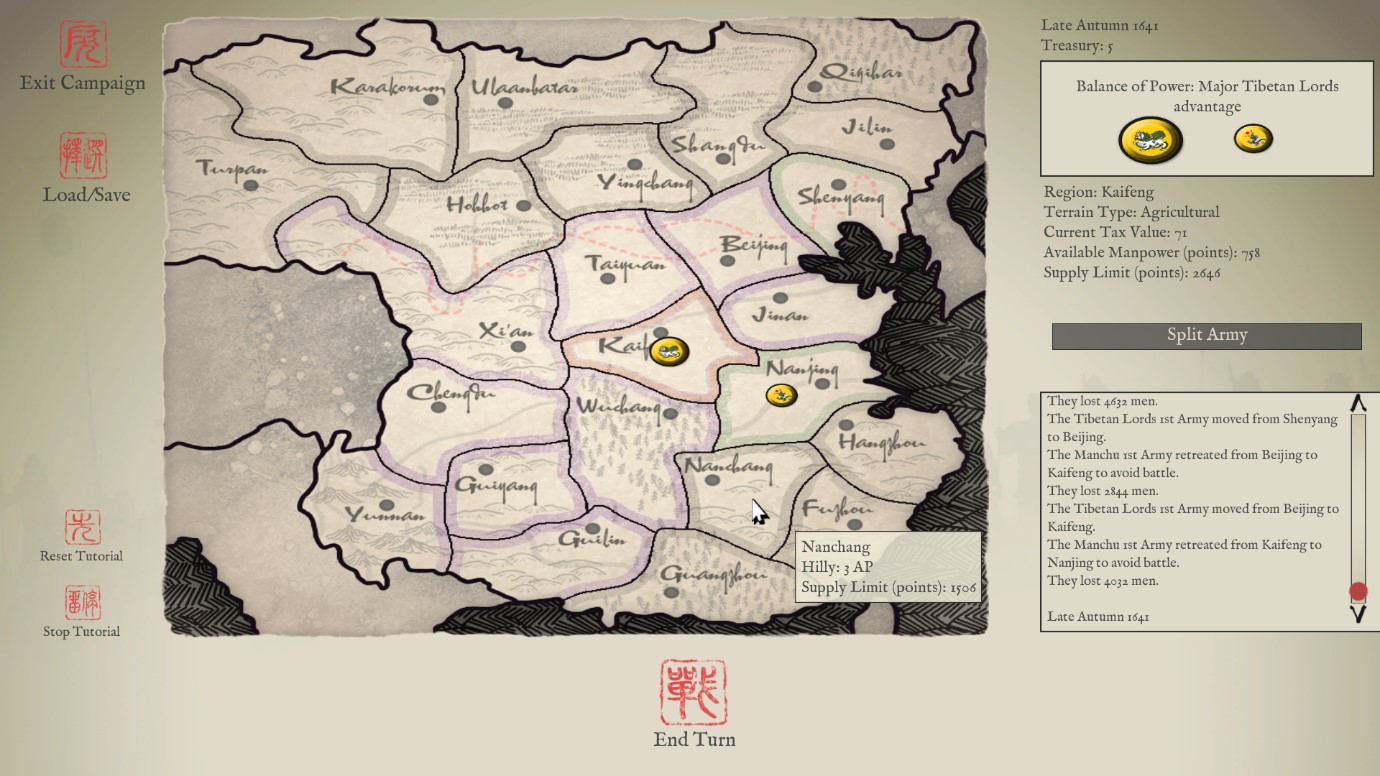
In the meantime, the Tibetan army led by Choegyal chased the Qing army around China for the rest of the year. No battle was fought.
1642
In the following year, Choegyal continued to pursue the remnants of the Qing army as it fled across several provinces. Each time the Qing withdrew, they lost soldiers to rear guard actions and desertion. The Qing did not get any help from the local Han Chinese. The Qing would finally surrender during the year.
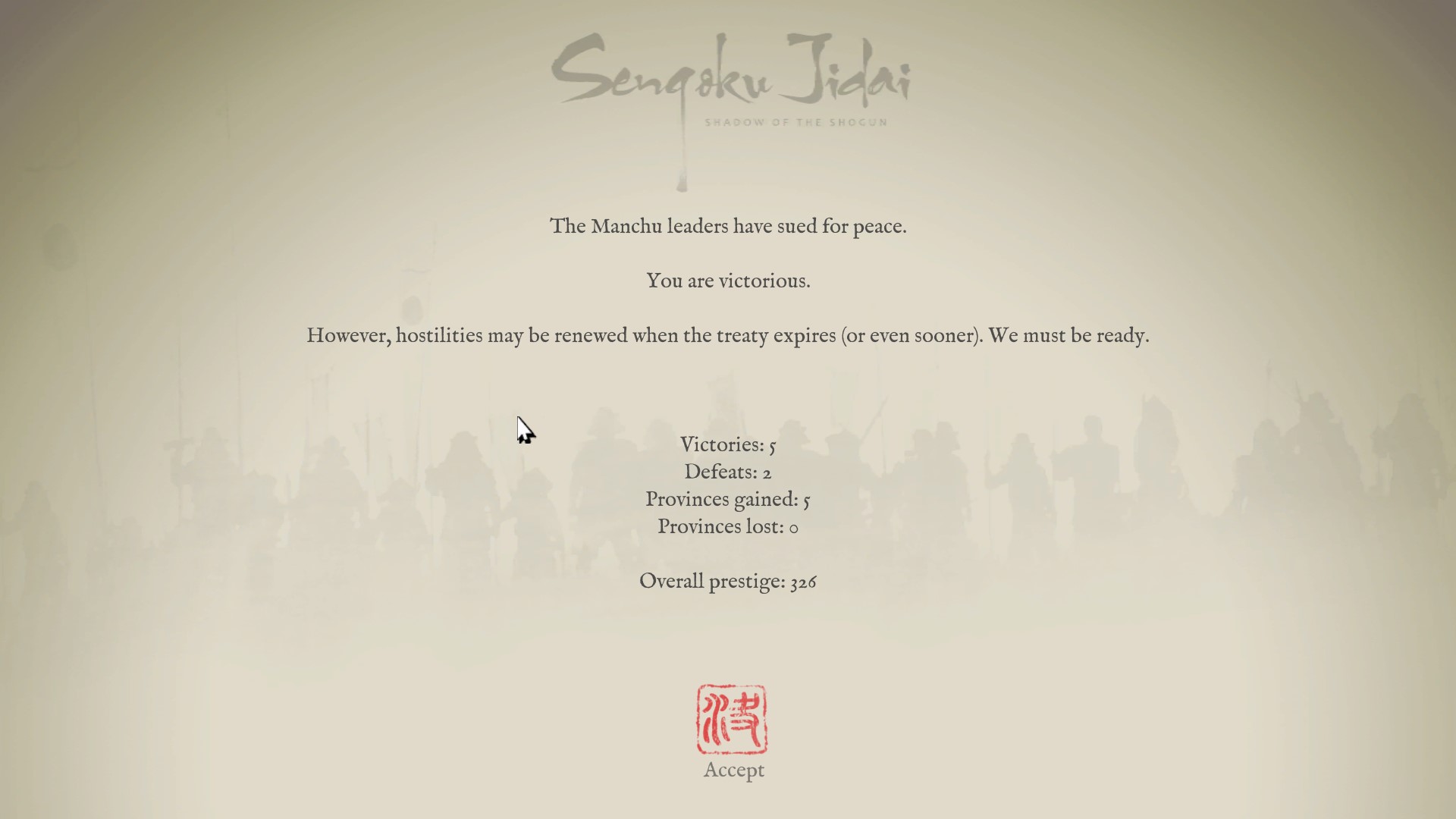
Unlike the Manchus, the Tibetans did not claim the Mandate of Heaven. They wished for the restoration of the Ming Dynasty instead. They established a new government run by former Ming scholars and bureaucrats. As a sign of gratitude, the Emperor of the restored Ming dynasty elevated the status of the Tibetan Kingdom to a level higher than Joseon Korea. Tibetan ministers and religious leaders were invited to the imperial court where they could directly participate in political affairs. This status also helped secure the Tibetan plateau from Mongol ambition. Unlike before, the Ming was now willing to send troops to aid the Tibetans when invaded but left the Kingdom autonomous.
Author’s notes: This is a work of fiction and in no way expresses any opinion on Sino-Tibetan relations. This scenario is purely hypothetical. Though the Tsangpa dynasty of Tibet gained prominence during this era, the Tibetan lords were mostly pre-occupied with in-fighting backed by different opposing Buddhist sects. The Tsangpa were at odds with the Gelug School of the Dailai Lama. The Gelug would then foster close ties with the Mongols. In 1642, Khoshut Mongols led by Gushi Khan captured the Tsangpa stronghold and Karma Tekyong was taken prisoner. Karma Tekyong was subsequently killed and the Dalai Lama was installed to rule Tibet. Tibet was occupied by the Dzungars in 1717. The Qing sent an expeditionary force to expel the invaders in 1720. After defeating the Dzungars, the Qing kept troops in Tibet and organised a new government and the process of integrating Tibet into China began.