gozerius wrote:Graham, I still can't believe that after all these years, you still reject the diagrams in the rules that show exactly how bases conform. Bases in contact conform with enemy by the shortest move necessary.
I don't reject the diagrams, however part of the problem is that the diagrams don't cover every situation. Particularly, they don't tell you what happens when it's important as to which BG conforms first, and they don't properly cover when one charge hits two enemies. The diagram at the top of page 93 is especially problematic as it shows a situation where the end result is not a conformation to the enemy bases in contact (the one in the middle is left alone!)
The rules don't say that bases in contact conform. they say battlegroups conform to the enemy bases in contact, or an overlap position and to do so pivot/slide bases by the minimum possible.
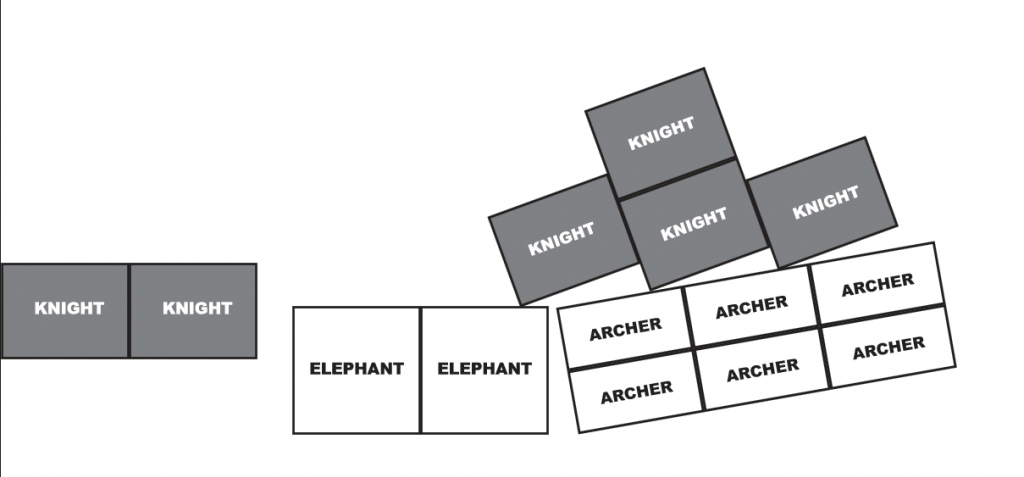
Each base fights the base they would conform to by the shortest move necessary.
It doesn't quite say that though, you've left out an "if". What p92/3 says is they continue to fight in an offset formation with the same
number of bases counting as "in front edge contact" as if they had conformed. And that if two bases would conform to the same enemy base then the one which has the shortest distance to conform fights it. The diag at the top of page 93 shows a unit that would slide over but can't and says which bases fight (albeit that it doesn't explain why they don't slide in the other direction as the way it is written that conforming BG is not conforming to the enemy bases in contact). The problem is with the "if the bases would conform" bit. There are two "ifs" in play here. If the elephants weren't there, the kn base would conform to the archers. But if the archers weren't there it'd conform to the elephants. But what the rules do say is you must conform to the enemy bases in contact. If the kn base touching the elephants were to were to have conformed to the archers then there would be the enemy elephant base in contact that has no-one conformed to it. Which is not what the rules say.
Then in white's phase the archers would conform by the shortest move necessary to line up against the knights and the elephants would conform as an overlap. Insisting that bases only conform with the base they originally contact creates all sorts of geometrical headaches and is not supported by the examples of play in the rules.
Oh, sorry, I'm not saying that that is why the elephants are moved in. The General Movement rules (P40) tell you that movement is made by individual BGs (or BLs). Hence, you move one, then the other. There are tow possible ways to play this, with the same outcome:
1. A sensible player will move the elephants first. There's no overlap position to move to at this stage so they'll go to front edge contact with the kn. then you conform the archers. If you do the archers first, it would end up as you describe.
2. You could say that neither BG can fit in against that kn base on the end to start with so if the archers conform to their right since they can't go left (can't shift friends in contact with enemy). and that means the elephants also pivot/slide to the right
I'll grant you that elements of this are debatable, which is why it's often an umpires call. Invoking the "spirit of the rules" can often be problematic. But as an umpire I'd take the spirit to be "you charged the blasted elephants, so somewhere there is sir somebody facing tusks. Don't expect him to be able to wriggle sideways and fight the chap in a loincloth"