Swedish rebels
Moderators: terrys, hammy, Slitherine Core, FOGR Design
Swedish rebels
Does anyone know where I might get some info on the flags used by this army ?
-
khurasan_miniatures
- Master Sergeant - Bf 109E
- Posts: 480
- Joined: Thu Aug 07, 2008 3:32 am
Re: Swedish rebels
Do you mean the dalarna levy? If so they would have primitive flags, if at all.Scrumpy wrote:Does anyone know where I might get some info on the flags used by this army ?
Are you refering to the Kalmar Union list? If so we have actually have an eyewitness drawing of the flags & symbols carried by the Swedish levies
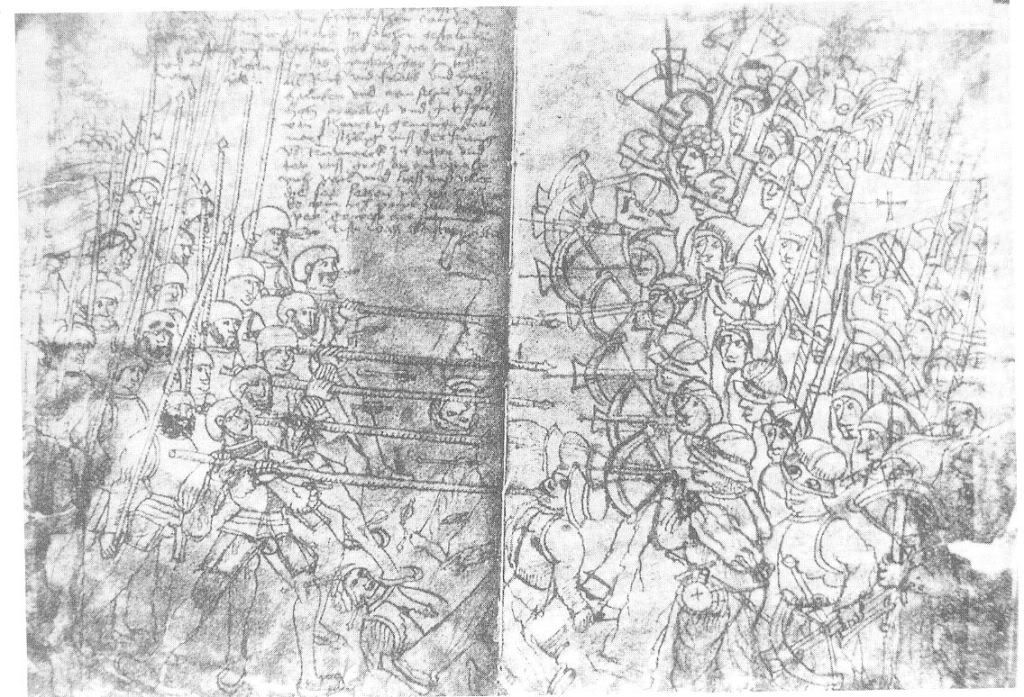
This is the levy of Vastergotland fighting Landsknechts in Danish service near the castle of Elfsborg in 1502. The Swedes carry two "banners" in the middle of their formation. One is a typical medieval standard with a tapered shape. It is divided into two fields, likely with diffrent colours with a cross superimposed on the fields. The other "banner" is a rooster (probably made of wood or cuir boili) mounted directly on a pole.
A 15th Century Rhyme chronicle describing the Swedish 1452 campaign in 'East Denmark' (Aka Scania, today southern Sweden) provide more clues to the style of banners favoured by the Swedissh army. The "Rännebaner", i.e the banner of mounted retainers which acted as advanceguard & scouts carried a banner showing Saint George, the "Skyttbanner" ("Shooters banner") made up of (mounted?) crossbowmen hade Saint Erik and Saint Olof painted on their banner. "Hufvudbaneret" (The 'Main banner') which was formed by the main body of men-at-arms had the virgin Mary holding her infant son in her arms. The Virgin was surrounded by golden sunrays. Regardless of the images painted on the banners in the army all banners were to carry the symbol of three crowns as a national recognition symbol.
This is the levy of Vastergotland fighting Landsknechts in Danish service near the castle of Elfsborg in 1502. The Swedes carry two "banners" in the middle of their formation. One is a typical medieval standard with a tapered shape. It is divided into two fields, likely with diffrent colours with a cross superimposed on the fields. The other "banner" is a rooster (probably made of wood or cuir boili) mounted directly on a pole.
A 15th Century Rhyme chronicle describing the Swedish 1452 campaign in 'East Denmark' (Aka Scania, today southern Sweden) provide more clues to the style of banners favoured by the Swedissh army. The "Rännebaner", i.e the banner of mounted retainers which acted as advanceguard & scouts carried a banner showing Saint George, the "Skyttbanner" ("Shooters banner") made up of (mounted?) crossbowmen hade Saint Erik and Saint Olof painted on their banner. "Hufvudbaneret" (The 'Main banner') which was formed by the main body of men-at-arms had the virgin Mary holding her infant son in her arms. The Virgin was surrounded by golden sunrays. Regardless of the images painted on the banners in the army all banners were to carry the symbol of three crowns as a national recognition symbol.
-
rbodleyscott
- Field of Glory 2
- Posts: 28434
- Joined: Sun Dec 04, 2005 6:25 pm