Do we have any clues what colors were used for cloths, flags etc.?
Where does that skyblue come from that is often used?
Is there any good refrence material? I have no clue what colors to use.

Moderators: terrys, hammy, philqw78, Slitherine Core, Field of Glory Moderators, Field of Glory Design
andAn undercoat of 1-2 layers of black or brown resin was applied to the statues before painting. The combination of the resin layer and the outer coats of pigment created areas of smooth and rough finish and made it possible to conserve pigment while obtaining ideal results. Red and green were the main colors used to decorate the terra cotta warriors.
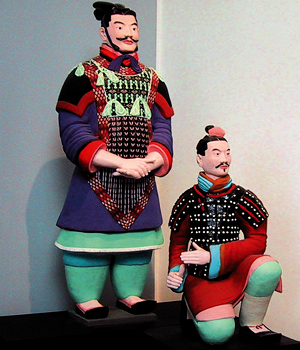
1. Uniform robes were painted red, bright red, purplish red, dark green, light green and sky blue, etc. Uniform trousers were painted dark green, light green, sky blue and purplish red, etc. Shin guards were painted in lavender, bright red, dark green and sky blue. Shoes were mostly red and boots were mostly bright red or dark green. Shoelaces and shoe bindings were bright red, lavender, sky blue or bright yellow. The hands, face and feet of the terra cotta warriors were pink. The terra cotta horses were mostly painted a dark purplish red, and had red tongues, white teeth, black manes, black tails and white hooves.
2. The use of strong contrasting colors was common. A typical example was the combination of a red robe with dark or light green collar and sleeve openings and lavender and sky blue borders and purple or purplish red pants.
3. The upper part of the uniform tended to be bright and the lower part of the uniform tended to be dark. Shoes and shin guard bindings tended to be red or black.
4. During the painting process, artists paid attention to the effects of different color combinations.
andOne distinctive original characteristic of the sculptures that can no longer be immediately perceived by modern viewers is that all of the soldiers were entirely painted with bright and colourful pigments. The horses were painted in brown and black. The sculptures were first covered with a dark-brown lacquer ground and then painted with pigments in one or two layers, sometimes rather thick.The artisans used cinnabar, malachite and azurite, as well as bone white and ‘Han purple’, a rare pigment that was an artificially produced barium copper silicate.
One kneeling archer wears a pink long-sleeved robe with blue undergarment, green trousers and a blue scarf.The hair knot is tied with a red ribbon.The brownish armour plates are fastened with red laces and white rivets. Other figures demonstrate the same tendency towards strong contrasts in pigmentation. Often complementary colours like red and green are combined.This fact may reveal some idea about the aesthetics of Qin people rather than indicating rank or unit of the soldier.According to a recent study, there was no colour ruling prescribed for soldiers’ clothes.The conscripts were not provided with uniforms. Instead, they were supposed to prepare their own robes, using the materials they could afford.
The skin on the face of the kneeling archer is painted in a tint of green. Other sculptures have several shades of yellow or pink flesh colours. In the white eyeballs the iris and even the pupils were clearly marked, giving the sculpture a life-like expression. The hair and the leather armour reveal the dark lacquer ground.
Officers’ armour bore intricate geometric ornamentation, which apparently followed embroidery patterns of the time. Microscopic analysis of the pigments allowed a precise reconstruction of some of the patterns (figs 178–9). The application of such painting must have been an extremely time-consuming process. However, preparing the colours may have been an even more difficult task. Colours would have to be collected or artificially produced, and then ground by hand into fine powder before painting. It has been estimated that – for the red pigment of the terracotta soldiers and horses alone – about 2 tonnes of cinnabar would have had to be ground and prepared.
andInvestigations already undertaken suggest that no two figures were painted in the same colours and that the colour purple was reserved for persons of officer rank.