Low Countries Spanish

Private forum for design team.

Moderators: nikgaukroger, rbodleyscott, Slitherine Core, FOGR Design

Post Reply
nikgaukroger
Field of Glory Moderator
Posts: 10287
Joined: Tue Aug 22, 2006 9:30 am
Location: LarryWorld

Low Countries Spanish

Post by nikgaukroger »

From Xavier.

As explained in the list text, Spanish commanders always considered lancers as capable of disband enemy pistol armed horse, and actually encouraged lancer charges as the best way to defeat enemy pistols.

Taking this into account, I think that lancers should have a POA advantage in impact against pistol armed mounted (as mounted charging with sword currently have).
Once in melee, it looks correct that lancers are in disadvantage if the pistols managed to remain steady after the charge.
OK a rules point rather than a list one, however, the Spanish seem to be in a minority on this one and I think that the actual performance supports the pistoleers having the advantage.

I’ve seen comments the same direction based on the performance of Polish Winged Hussars against the Swedes, and the fact that mounted lancers were recovered later on by most European armies as main shock mounted seems to confirm this.
The winged hussars now have "Imapct Mounted" as a capability which gives them an advantage over pistoleers as this is what the accounts show.


The Idiáquez Tercio present at Nordlingen in 1634 had special tactic to counter the Swedish salvo. Martín de Idiáquez ordered his men to go on their knees just before each Swedish salvo to minimise its effect, and then respond with a salvo of their own first 3 ranks of shooters. This would explain how the Idiáquez Tercio was able to reject up to 15 charges by the Swedes, including various charges of the Yelow, Blue and Black brigades, for almost 7 hours. The Italian Tercio of Toralto was also able to resist all Swedish attacks, but it didn’t had to fight the best Swedish regiments. After that, and seeing that the Swedish troops were exhausted, both Tercios charged down the Swedish files completely defeating them.

With the standard troop grading under FOGR, It would be almost impossible to stand so many charges of Superior Salvo foot with a Superior Tercio, even being uphill (still POA advantage for the Swedes and penalty for the Tercio in the cohesion test for losing impact against salvo). Therefore I would recommend special troop grading for the Spanish Tercios at Nordlingen:
a. Either allow the musketeers of the Idiaquez tercio to be graded as Salvo
b. Either allow the Idiaquez tercio to be graded as Elite (as I did with the Tercios viejos in the Low countries Spanish list)

The first option would reflect the special tactic used by the Spanish, but would probably lead to a too fast victory over the Swedes (same grading but uphill)
The second option should be tested in a simulator, but might better end up giving the historical result. Even with POA disadvantage at impact ant the penalty in the cohesion test, being Elite the Tercio might be able to stand, and little by little benefit of the Elite advantage when it comes to attrition.

In any case, it would be very nice to mention the special tactic and performance of the Idiaquez Tercio at Nordlingen in the list notes of the 30YW Catholic list, since it’s one of the most epic performances of a military unit in a single battle (with some parallelisms to the Spartans at Thermopilae).

Salvo is, IMO, not the right way to go as it is a combination of firepower with an immediate attack to close combat and this does not really have appeared to be the Spanish doctrine - Elite on the otherhand I think will do nicely and reflect the resistance of the formation 8)
Nik Gaukroger

"Never ask a man if he comes from Yorkshire. If he does, he will tell you.
If he does not, why humiliate him?" - Canon Sydney Smith

nikgaukroger@blueyonder.co.uk
rbodleyscott
Field of Glory 2
Field of Glory 2
Posts: 28378
Joined: Sun Dec 04, 2005 6:25 pm

Post by rbodleyscott »

Note that I also posted the lancers vs pistols issue on the beta board, and there have been some replies.
nikgaukroger
Field of Glory Moderator
Posts: 10287
Joined: Tue Aug 22, 2006 9:30 am
Location: LarryWorld

Post by nikgaukroger »

Quick question for Xavier - or anyone who has a view.

The list is called Low Countries Spanish, however, it is clearly also meant to cover the troops of the Cardinal-Infante brought from Italy so is it in fact covering all Spanish armies outside of the Iberian peninsular and so could probably do with a different name?

Also should Nordlingen be an Imperial army with Spanish allies or a Spanish army with Imperial allies? Or indeed a pick half your points from both lists arrangement?
Nik Gaukroger

"Never ask a man if he comes from Yorkshire. If he does, he will tell you.
If he does not, why humiliate him?" - Canon Sydney Smith

nikgaukroger@blueyonder.co.uk
Ghaznavid
1st Lieutenant - 15 cm sFH 18
Posts: 800
Joined: Wed Aug 29, 2007 1:44 am
Location: Germany

Post by Ghaznavid »

nikgaukroger wrote:Also should Nordlingen be an Imperial army with Spanish allies or a Spanish army with Imperial allies? Or indeed a pick half your points from both lists arrangement?

Hmmm, we get: 12,000 imperial troops (7,000 mtd. 5,000 foot), 6,000 bavarian/league troops (rougly 50:50 mtd and foot), 15,000 Spanish troops (3,000 mtd. and 12,000 foot) and finally about 2,000 hungarian and croatian light cavalry (which should probably be added to the imperial contingent). Numbers vary slightly with the source, but the ratios stay roughly the same.
Command was more or less jointly Emperor Ferdinand III, king of Hungaria, Bohemia, etc. and Ferdinand of Austria/Spain, so it's little help in deciding. Given the place of the battle and how contemporaries viewed the army conglomeration I tend slightly to a German army with Spanish allies.
Probably needs permission for two Spanish SUB-Generals though (or one subgeneral if someone wishes to declare his C-in-C as Spanish, technically it would proably require two C-in-C's).
Karsten


~ We are not surrounded, we are merely in a target rich environment. ~
robertthebruce
Field of Glory Moderator
Posts: 505
Joined: Mon Feb 12, 2007 8:24 pm
Location: Granada, Spain.

Post by robertthebruce »

Hi all.

Firstly, I´m sorry a lot, I had been missed for many days, the new Bolonia Plan in the university and some problems with my internet supplier put me out at all.

And Now let´s to work.
The Idiáquez Tercio present at Nordlingen in 1634 had special tactic to counter the Swedish salvo. Martín de Idiáquez ordered his men to go on their knees just before each Swedish salvo to minimise its effect, and then respond with a salvo of their own first 3 ranks of shooters. This would explain how the Idiáquez Tercio was able to reject up to 15 charges by the Swedes, including various charges of the Yelow, Blue and Black brigades, for almost 7 hours. The Italian Tercio of Toralto was also able to resist all Swedish attacks, but it didn’t had to fight the best Swedish regiments. After that, and seeing that the Swedish troops were exhausted, both Tercios charged down the Swedish files completely defeating them.

With the standard troop grading under FOGR, It would be almost impossible to stand so many charges of Superior Salvo foot with a Superior Tercio, even being uphill (still POA advantage for the Swedes and penalty for the Tercio in the cohesion test for losing impact against salvo). Therefore I would recommend special troop grading for the Spanish Tercios at Nordlingen:
a. Either allow the musketeers of the Idiaquez tercio to be graded as Salvo
b. Either allow the Idiaquez tercio to be graded as Elite (as I did with the Tercios viejos in the Low countries Spanish list)

The first option would reflect the special tactic used by the Spanish, but would probably lead to a too fast victory over the Swedes (same grading but uphill)
The second option should be tested in a simulator, but might better end up giving the historical result. Even with POA disadvantage at impact ant the penalty in the cohesion test, being Elite the Tercio might be able to stand, and little by little benefit of the Elite advantage when it comes to attrition.

In any case, it would be very nice to mention the special tactic and performance of the Idiaquez Tercio at Nordlingen in the list notes of the 30YW Catholic list, since it’s one of the most epic performances of a military unit in a single battle (with some parallelisms to the Spartans at Thermopilae).

I´m not sure that it´s necessary to include tha Salvo extra POA, this is not a capability of the Idiaquez Tercio, problably it´s a puntual solution to a hard situation. Grade them as Elite could reflect the same situation and it reflects too the Spanish strength :)

Quick question for Xavier - or anyone who has a view.

The list is called Low Countries Spanish, however, it is clearly also meant to cover the troops of the Cardinal-Infante brought from Italy so is it in fact covering all Spanish armies outside of the Iberian peninsular and so could probably do with a different name?

Also should Nordlingen be an Imperial army with Spanish allies or a Spanish army with Imperial allies? Or indeed a pick half your points from both lists arrangement?

Good Question Nick.

Here we have a list that covers the Spanish troops in flandes and the multinational army in the 30YW, the name of the list must reflect this.

Kasten says that in Nordlingen there was a German Army with a Spanish support, and in the most of the spanish history books only talks about the Spanish army in nordlingen with some foreing troops (National view surely :).

I think we must be the posibility of choice, because we have 2 armies here, the spanish commanded by the Cardenal-Infante and the imperial troops of Mathias Gallas.

I´m not sure if this must be reflected in this list, maybe a allies option for a Later 30YW german and viceversa (Do exist this word in English?) could be fine.


Later Low Countries and 30YW Spanish could be a nice option for a new name, but I must remeber you that the Spanish armies in foreing territory were called "Tercios of (Foreing Country)"

David
nikgaukroger
Field of Glory Moderator
Posts: 10287
Joined: Tue Aug 22, 2006 9:30 am
Location: LarryWorld

Post by nikgaukroger »

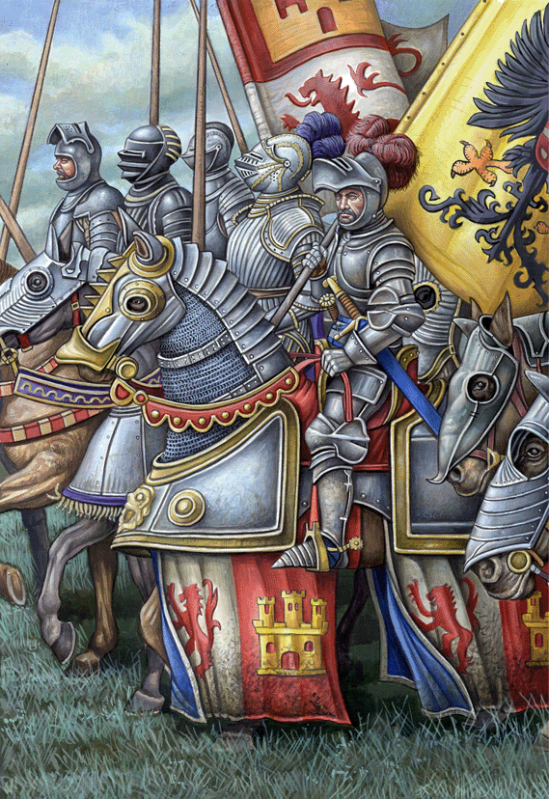
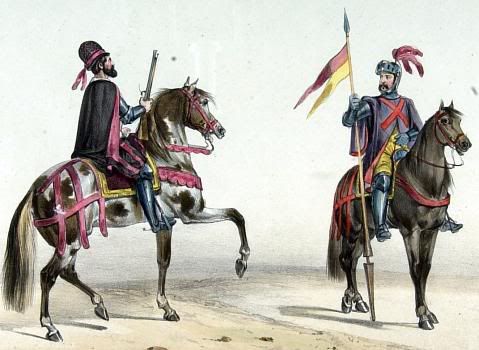
Xaviers list has Fully Armoured lancers - this would mean they had full armour for the rider and horse barding which I find really highly unlikely for the C17th. I am assuming the Heavily Armoured is meant.
Nik Gaukroger

"Never ask a man if he comes from Yorkshire. If he does, he will tell you.
If he does not, why humiliate him?" - Canon Sydney Smith

nikgaukroger@blueyonder.co.uk
robertthebruce
Field of Glory Moderator
Posts: 505
Joined: Mon Feb 12, 2007 8:24 pm
Location: Granada, Spain.

Post by robertthebruce »

Xaviers list has Fully Armoured lancers - this would mean they had full armour for the rider and horse barding which I find really highly unlikely for the C17th. I am assuming the Heavily Armoured is meant.


Spanish Heavy Cavalry, Early and Middle 16C:

Image


Late 16c and Early 17c:

Image


David
nikgaukroger
Field of Glory Moderator
Posts: 10287
Joined: Tue Aug 22, 2006 9:30 am
Location: LarryWorld

Post by nikgaukroger »

Yup, Heavily Armoured in the C17th.
Nik Gaukroger

"Never ask a man if he comes from Yorkshire. If he does, he will tell you.
If he does not, why humiliate him?" - Canon Sydney Smith

nikgaukroger@blueyonder.co.uk
Post Reply

Return to “FoGR Lists”