


Excellent point and I did actually weigh that risk against the protection provided by being in port. The unescorted garrison if outside of port could have been attacked by both Italian sub groups and more effectively by the Italian bomber versus when in port by at most 1-sub and less ineffective.massina_nz wrote:Just some advice for the Crete move.
Although it's very unlikely in this game that Athens will fall next turn, if it did then the transport in the Cretan port would be scuttled. Far safer to place the transport in the hex immediately to the south of Heraklion, although that may require some escort ships to protect it more.
The North Africa Vignette AAR
Moderators: Happycat, rkr1958, Slitherine Core
The Times of London
The Desert Army
(Installment 9)
by Nigel Whitehurst
April 13, 1941.
Cunningham’s sub group was able to establish a blockade of the Rio-Antirrio Straights on April the 3rd; but at a high cost of 25 of the original 50 subs and crews lost. In addition to keeping the bigger Italian surface ships bottled up in the straights this sub group managed to sink a total of 20 destroyers and frigates. The blockade was maintained for over a week until the captain in tactical command of the group order the surviving subs to Malta for repairs and reinforcements.
Generals Leese and Simonds for the invasion of Libya had decided on a strategy of bypassing and isolating Tobruk. The near term objective was Benghazi and the blockade of Tobruk in order to isolate the Italian army there. Once isolated then the Desert Army would reduced the trapped Italians there until they surrendered or were annihilated. Now this was the plan that was put and it’s definitely true what they say about war plans! They last up until initial contact and then they change.
The lead for the push into Libya was the 6th Australian and 21 UK corps. Though, No German ground or air units were encountered, the Italians fought bitterly. The 6th Australian suffered horrendous losses, reduced down to brigade strength and was pulled off the line in an attempt (and hope) to the save the corps. The 21 UK corps faired a bit better but were forced to retreat with losses equal to a division.
The results of this initial meeting were to say the least disappointing; however, General Leese was determined to press the attack as long as no substantial German air or ground force was encountered. Again, the British offensive had a sense of a spoiling attack or of one trying to drawing a German response here. But why? And what did London know that we didn’t? At least it looked like Admiral Cunningham was going to establish a strong British presence on Crete and give the axis a choice of giving us this strategic island or devoting significant resources to taking it from us. Again, was this another spoiling attack?
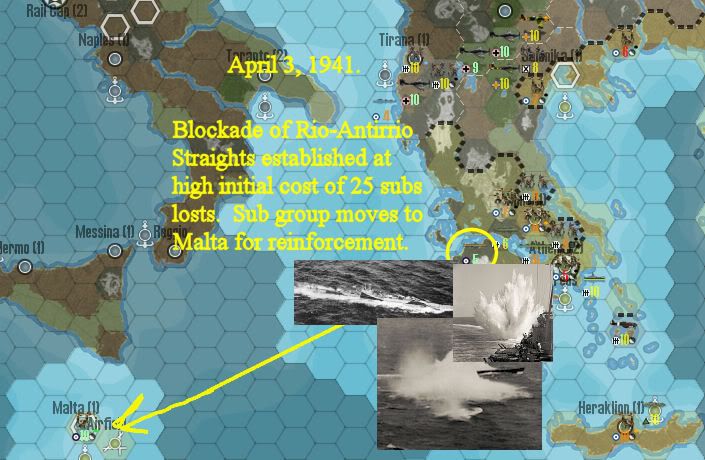
The Times of London. The Blockade of the Rio-Antirrio Straights.
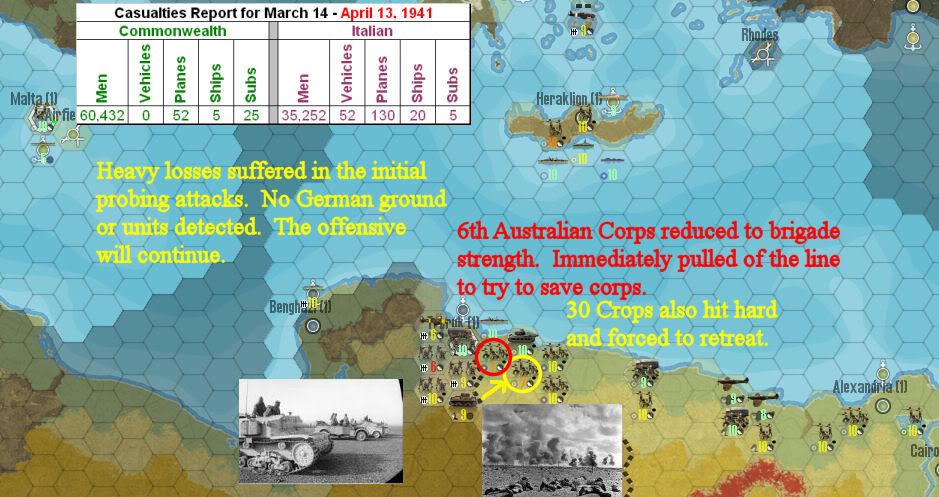
The Times of London. The Push into Libya.
The Desert Army
(Installment 9)
by Nigel Whitehurst
April 13, 1941.
Cunningham’s sub group was able to establish a blockade of the Rio-Antirrio Straights on April the 3rd; but at a high cost of 25 of the original 50 subs and crews lost. In addition to keeping the bigger Italian surface ships bottled up in the straights this sub group managed to sink a total of 20 destroyers and frigates. The blockade was maintained for over a week until the captain in tactical command of the group order the surviving subs to Malta for repairs and reinforcements.
Generals Leese and Simonds for the invasion of Libya had decided on a strategy of bypassing and isolating Tobruk. The near term objective was Benghazi and the blockade of Tobruk in order to isolate the Italian army there. Once isolated then the Desert Army would reduced the trapped Italians there until they surrendered or were annihilated. Now this was the plan that was put and it’s definitely true what they say about war plans! They last up until initial contact and then they change.
The lead for the push into Libya was the 6th Australian and 21 UK corps. Though, No German ground or air units were encountered, the Italians fought bitterly. The 6th Australian suffered horrendous losses, reduced down to brigade strength and was pulled off the line in an attempt (and hope) to the save the corps. The 21 UK corps faired a bit better but were forced to retreat with losses equal to a division.
The results of this initial meeting were to say the least disappointing; however, General Leese was determined to press the attack as long as no substantial German air or ground force was encountered. Again, the British offensive had a sense of a spoiling attack or of one trying to drawing a German response here. But why? And what did London know that we didn’t? At least it looked like Admiral Cunningham was going to establish a strong British presence on Crete and give the axis a choice of giving us this strategic island or devoting significant resources to taking it from us. Again, was this another spoiling attack?
The Times of London. The Blockade of the Rio-Antirrio Straights.
The Times of London. The Push into Libya.
The Desert Army
(Installment 10)
by Nigel Whitehurst
May 13, 1941.
Greece finally falls to their fascists invaders; but we were able to secure Crete and; thus, maintain a stepping stone to the continent. Over 250 RAF fighters supported by the aircraft carrier Illustrious operating from bases in Crete provide air cover for the Greeks as they desperately fought to hold Athens. On May the 10th the Greek defenders were crushed and the Italians entered the city. On May the 13th the Greek government, or those who hadn’t fled, officially surrendered to the Italians. However; one Regiment of Greek soldiers did manage to escape and make their way to Crete to join the 10th Indian corps and the Kirkuk division there. This ground force, supported by the RAF and a substantial commitment from the Med fleet have put in place a strong defense of the island securing it as another vital air and naval base from which to operate against the fascists in Libya and the Med.
The Desert Army continues their offensive against the Italian forces in Libya. No commitment from the German of their air or land forces to this area has been detected. However, the Desert Army continues to engage in bitter fighting with no signs of a breakthrough. Even though given this situation and mounting casualties, General Leese continues to push on.
On one of my routine visits to General Leese’s headquarters I did glimpse a bit of insight into why of all these operations and the lack of German participation in our theater. I’m afraid; however, I will need to save that for our next installment.
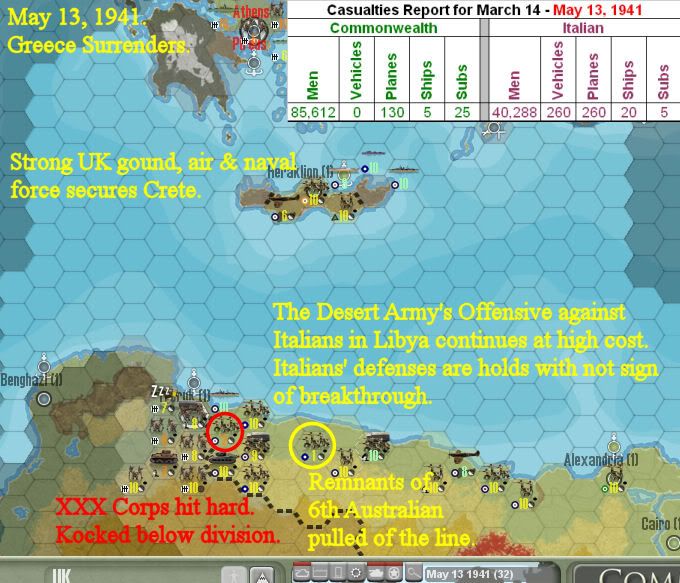
The Times of London. Greece Surrenders. But; Crete is Secured!
(Installment 10)
by Nigel Whitehurst
May 13, 1941.
Greece finally falls to their fascists invaders; but we were able to secure Crete and; thus, maintain a stepping stone to the continent. Over 250 RAF fighters supported by the aircraft carrier Illustrious operating from bases in Crete provide air cover for the Greeks as they desperately fought to hold Athens. On May the 10th the Greek defenders were crushed and the Italians entered the city. On May the 13th the Greek government, or those who hadn’t fled, officially surrendered to the Italians. However; one Regiment of Greek soldiers did manage to escape and make their way to Crete to join the 10th Indian corps and the Kirkuk division there. This ground force, supported by the RAF and a substantial commitment from the Med fleet have put in place a strong defense of the island securing it as another vital air and naval base from which to operate against the fascists in Libya and the Med.
The Desert Army continues their offensive against the Italian forces in Libya. No commitment from the German of their air or land forces to this area has been detected. However, the Desert Army continues to engage in bitter fighting with no signs of a breakthrough. Even though given this situation and mounting casualties, General Leese continues to push on.
On one of my routine visits to General Leese’s headquarters I did glimpse a bit of insight into why of all these operations and the lack of German participation in our theater. I’m afraid; however, I will need to save that for our next installment.
The Times of London. Greece Surrenders. But; Crete is Secured!
The Times of London
The Desert Army
(Installment 11)
by Nigel Whitehurst
June 2, 1941.
I’m afraid that I left you in our last installment with a bit of a teaser that I am yet unable to reveal to you my loyal readers. I will say that the German eyes are looking east and will likely, for now, let us fight it out with the Italians in Libya and the Med.
The Italian defenses in Libya are now showing signs of cracking with a possible breakthrough south of Tobruk starting to develop. General Leese and Simonds have determined that a frontal assault against the fort as Tobruk at this time would have little chance of success and would be futile. Therefore; the objective of the breakthrough if (or when) it happens, as I stated in one of my previous installments, is to make a thrust of Benghazi. The intention of this thrust is to isolate Tobruk and cut off and destroy as much of the Italian army as possible before turning our intention to the reduction and capture of Tobruk.
On Crete, Admiral Cunningham establishes the port of Heraklion as his primary base of operations for the RN Med fleet. And, General Ritche arrives to take command of all ground and air forces there.
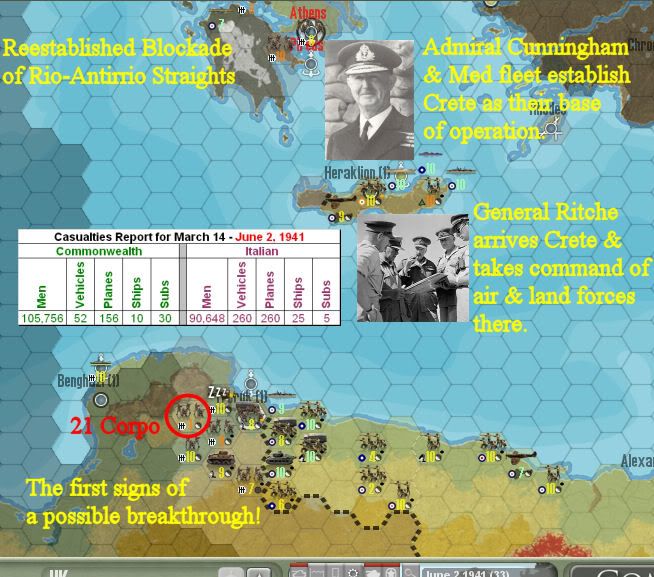
The Times of London. General Ritche Arrives Crete.
The Desert Army
(Installment 11)
by Nigel Whitehurst
June 2, 1941.
I’m afraid that I left you in our last installment with a bit of a teaser that I am yet unable to reveal to you my loyal readers. I will say that the German eyes are looking east and will likely, for now, let us fight it out with the Italians in Libya and the Med.
The Italian defenses in Libya are now showing signs of cracking with a possible breakthrough south of Tobruk starting to develop. General Leese and Simonds have determined that a frontal assault against the fort as Tobruk at this time would have little chance of success and would be futile. Therefore; the objective of the breakthrough if (or when) it happens, as I stated in one of my previous installments, is to make a thrust of Benghazi. The intention of this thrust is to isolate Tobruk and cut off and destroy as much of the Italian army as possible before turning our intention to the reduction and capture of Tobruk.
On Crete, Admiral Cunningham establishes the port of Heraklion as his primary base of operations for the RN Med fleet. And, General Ritche arrives to take command of all ground and air forces there.
The Times of London. General Ritche Arrives Crete.

I guess thanks to canadian reinforcements you will eventually have upper hand in this fighting arount Tobruk, if axis player will not commit any strong forces (german units, airpower). By the way, why would not you block Tobruk/Bengazi ports with your navy, to prevent reinforcements arriving?
It may work for several turns, until/if axis player bring in some good air units to break the blockade, since Italian fleet is already suffered major damage. But can axis commit air now, when they start their eastern campaign?
Personally I hate attacking with no TAC bomber support, since it ends very costly.
It may work for several turns, until/if axis player bring in some good air units to break the blockade, since Italian fleet is already suffered major damage. But can axis commit air now, when they start their eastern campaign?
Personally I hate attacking with no TAC bomber support, since it ends very costly.
Plaid thanks for the comments and I agree with blockading Tobruk. At this stage of the game I’m fairly confident that my opponent will invade Russia in the next turn or two; but you really never know until it happens. I did want to yet move away from Crete and give my opponent an opening there. If he wants I want him to have to fight hard for it requiring him to draw significant air units away from the expected invasion of Russia. Also, I really wanted to finish off the trapped Italian BB (his last one). If I could then he would only have 2 subs group (confirmed) and 1 DD squadron.Plaid wrote:I guess thanks to canadian reinforcements you will eventually have upper hand in this fighting arount Tobruk, if axis player will not commit any strong forces (german units, airpower). By the way, why would not you block Tobruk/Bengazi ports with your navy, to prevent reinforcements arriving?
It may work for several turns, until/if axis player bring in some good air units to break the blockade, since Italian fleet is already suffered major damage. But can axis commit air now, when they start their eastern campaign?
Personally I hate attacking with no TAC bomber support, since it ends very costly.
I feel that the bark is worse than the bite from the Italian surface fleet. What I mean is that the threat of it has a greater impact on RN operations that what damage it can inflict UNLESS it’s operating under the umbrella of strong German air. As the allied player I am more than happy to engage the Italian fleet early (e.g., 1940) when it’s operating alone. As the axis player I’m more than willing to lose the Italian fleet if I can achieve something strategically significant (e.g., delaying the fall of North Africa or the invasion of Sicily for a several turns). However; I don’t feel it’s worth it to lose the Italian navy for only a tactical gain such as the destruction of one or two RN units even if one of them is a CV. My opponent effectively lost the Italian surface fleet in October 1940 in an attempt to inflict damage. He did manage to knock my CV down to 4-steps and my DD down to 6; but lost two BBs, which left him at the time only with 1 DD and 2 subs. This coupled with the loss of Crete and no German air presence there in effect ceded control of the southeast part of the Med, which is vital for the axis if they wish to reinforce the North Africa. I was able to gain and maintain this control with a merger force of 2 BBs, 1 DD, 1 CV and 2 fighters. As you recall, my naval battle in the Atlantic to fend off Sea Lion put me 1 naval point below the minimum there and reduce convoys by 10%. My naval builds and new deployments, consisting of DDs, were focused on addressing that and on combating the German u-boat threat composed of 6 confirmed flotillas. I was pleasantly surprised that I was able to accomplish this with such a merger allied naval and air commitment. I generally don’t achieve this until after US entry and mid 1942.
The game from which this AAR is written is now in May/June 1942. I’m trying to keep out my knowledge of the game future when doing the AAR writeup for a given turn; but sometimes it hard. I do want to try to capture the uncertainty and doubts I had at the time. At this point in the game I really had my doubts about pushing so hard into Libya. I was ready to pull to the plug and hightail it back to Egypt and I would have if I had encountered any significant German forces there. As this AAR progresses I hope to show, and I think it will, the importance of North Africa and of Torch in GSv2.00. I really feel that GSv2.00 plays very historical there. As the allied player in 1941 to 1942, North Africa and the Med are about the only place that I can see where the western allies can strike at the axis.
I agree too that I hate conducting offensive operations without tactical air units. But sometimes situations present themselves, as I think I’m demonstrating in this AAR, that to exploit demands operating with less than the forces, or force mix, that you’d like to have. Like in the real war, sometimes you just have to make do with what you have. That too introduces a historical feel to the game.
Last edited by rkr1958 on Sat Jul 16, 2011 11:11 am, edited 1 time in total.
The Times of London
The Desert Army
(Installment 12)
by Nigel Whitehurst
June 22, 1941.
We no longer stand alone! Today, at 0500 hours local time (0400 hours Poland), armed forces of German, Italy, Hungary, Rumania, and Bulgaria attacked and invaded the Soviet Union on a broad front extending from the Baltic to the Black Seas. As this was unfolding, Finland announced their alliance with the axis and entered the war against Russia. An interesting development to this was that Finland did not declare war on Britain and publicly stated that their intention was only to regain the territory lost to Russia in the “Winter War”. While the politics of this are not relevant to the war in the desert they certainly are interesting. The general consensuses at General Leese’s headquarters is that if Finland doesn’t broaden their war with Russia beyond these stated aims then Britain may not declare war on them.
An immediate effect of the axis invasion of Russia is that Persian announced their entry into the war. Their potential entry had been the subject of much delicate negotiations between the British government and the Shaw for a while. It is only now that I am at liberty to write about them since they are no longer necessary. The tipping point appears to be, and is most surely, the axis invasion of Russia. Their entry immediately adds two more divisions to the Desert Army, though these divisions will most likely be relegated to garrison or second line support duties. A more important effect; however, is that we can establish a supply link between us and Russia.
In Libya, General Simonds’ continues to push forward with X armor, 2nd Canadian, XIII corps and the 9th Australians leading the way. I made a visit to his headquarter at XIII corps this day a week ago and witnessed his hands on command style. General Simonds’ HQ is located only a few miles from the front lines, and while there, I had the pleasure of traveling those few miles and visited our troops there. I can say that both their morale and motivation are high. The Italian defenses are starting to give way and show cracks that our lads are beginning to push through. As a result of their determined fighting, Italian casualties are starting to mount, with the 21st Italian infantry corps completely annihilated this week.
Speaking of casualties, General Leese is required to submit monthly (or more frequent) causality reports to London. Last week, General Leese was informed that his previous reports were deficient because they did not include the naval losses from, “The Battle of the East Med” or from the Rumania bomber losses suffered supporting the Italian attempt to break Cunningham’s submarine blockade of the Rio-Antirrio straights. The previous three reports were revised and reissued along with the newest casualty report. Oh … if it wasn’t for the bean counters in London our empire surely would have collapse centuries ago!
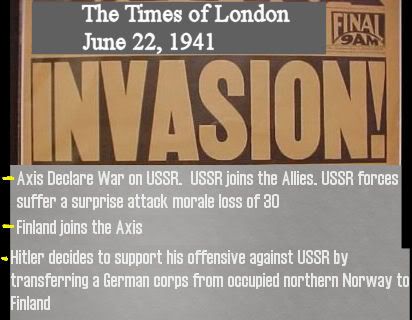
The Times of London. Invasion!
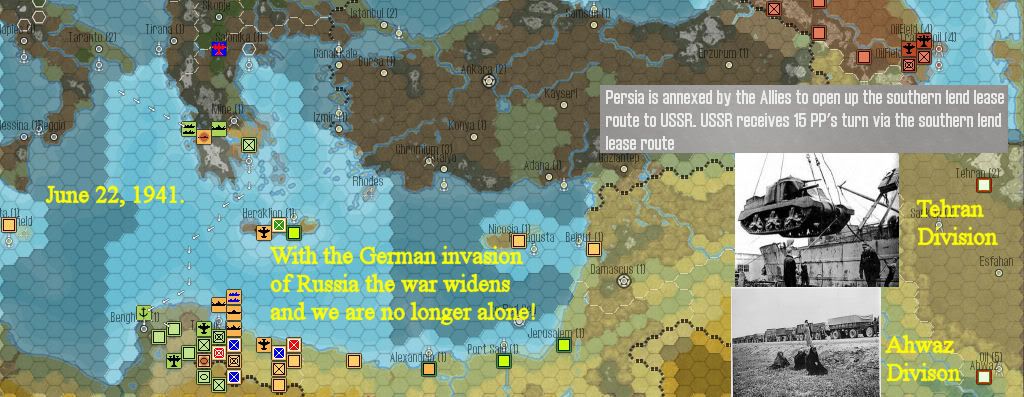
The Times of London. Persia Mobilizes.
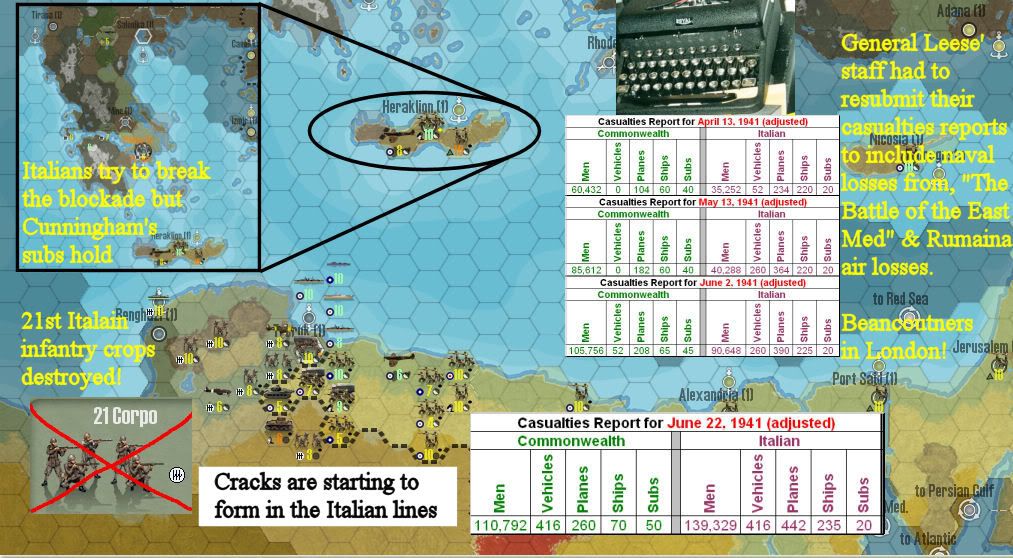
The Times of London. The Desert Army is Starting to Get the Upper Hand.
The Desert Army
(Installment 12)
by Nigel Whitehurst
June 22, 1941.
We no longer stand alone! Today, at 0500 hours local time (0400 hours Poland), armed forces of German, Italy, Hungary, Rumania, and Bulgaria attacked and invaded the Soviet Union on a broad front extending from the Baltic to the Black Seas. As this was unfolding, Finland announced their alliance with the axis and entered the war against Russia. An interesting development to this was that Finland did not declare war on Britain and publicly stated that their intention was only to regain the territory lost to Russia in the “Winter War”. While the politics of this are not relevant to the war in the desert they certainly are interesting. The general consensuses at General Leese’s headquarters is that if Finland doesn’t broaden their war with Russia beyond these stated aims then Britain may not declare war on them.
An immediate effect of the axis invasion of Russia is that Persian announced their entry into the war. Their potential entry had been the subject of much delicate negotiations between the British government and the Shaw for a while. It is only now that I am at liberty to write about them since they are no longer necessary. The tipping point appears to be, and is most surely, the axis invasion of Russia. Their entry immediately adds two more divisions to the Desert Army, though these divisions will most likely be relegated to garrison or second line support duties. A more important effect; however, is that we can establish a supply link between us and Russia.
In Libya, General Simonds’ continues to push forward with X armor, 2nd Canadian, XIII corps and the 9th Australians leading the way. I made a visit to his headquarter at XIII corps this day a week ago and witnessed his hands on command style. General Simonds’ HQ is located only a few miles from the front lines, and while there, I had the pleasure of traveling those few miles and visited our troops there. I can say that both their morale and motivation are high. The Italian defenses are starting to give way and show cracks that our lads are beginning to push through. As a result of their determined fighting, Italian casualties are starting to mount, with the 21st Italian infantry corps completely annihilated this week.
Speaking of casualties, General Leese is required to submit monthly (or more frequent) causality reports to London. Last week, General Leese was informed that his previous reports were deficient because they did not include the naval losses from, “The Battle of the East Med” or from the Rumania bomber losses suffered supporting the Italian attempt to break Cunningham’s submarine blockade of the Rio-Antirrio straights. The previous three reports were revised and reissued along with the newest casualty report. Oh … if it wasn’t for the bean counters in London our empire surely would have collapse centuries ago!
The Times of London. Invasion!
The Times of London. Persia Mobilizes.
The Times of London. The Desert Army is Starting to Get the Upper Hand.
The Times of London
The Desert Army
(Installment 13)
by Nigel Whitehurst
June 23-25, 1941.
June 23. 0700 hours (7am), General Leese’s Headquarters. Throughout the last 3 weeks planes from the aircraft carrier Illustrious have been providing critical air support to the Desert Army. In addition to this, the big ships of Cunningham’s Med fleet have been constantly shelling Tobruk and its Italian defenders. At 0700 hours General Leese gets an encoded flash message from Admiral Cunningham aboard his flagship, the aircraft carrier Illustrious. In response to the Italians trying to force the blockade of the Rio-Antirrio straights, the Admiral has decided to detach the majority of his surface fleet, including the 3 battleships and 1 heavy cruiser, from the Illustrious and move to engage the remnants of the Italian surface fleet. The Illustrious will remain off the coast of Libya with minimum escorts and continue to provide the critical air support that the Desert Army needs to continue its offensive. The Admiral will be leaving the Illustrious and transferring his flag to the battleship, HMS Resolution to lead this battle group and air cover for his group would be provided by over 200 RAF fighters based on Crete and under the command of General Ritche.
June 24. 1900 hours (7pm). Near the Straights of Rio-Antirrio. Destroyers from Cunningham’s battle group encounter Italian submarines and a short but fierce exchange occurs with losses on both sides. But; Cunningham’s destroyers prevail, the Italian sub threat is contained and his group continues. At around 2000 hours a night battle between Cunningham’s main force and the Italian rescue force trying to reach the trapped Italian ships in the straights starts and lasts for the next 3 hours. The Italian rescue force is totally destroyed and the force it was trying to rescue remains bottled up in the straights. The Italians lose a total of 35 ships, including their last heavy cruiser, and 10 submarines. We lose 10 destroyers and frigates and 10 submarines. Cunningham’s battlegroup remains on station west of the straights and under the protection of the RAF fighters on Crete. What a valuable base Crete has turned out to be and what a fortunate occurrence to have gotten without the Jerries contenting us for it.
June 25. 0300 hours (3am). Off the coast of Libya near Tobruk. The aircraft carrier Illustrious comes under direct attack from the second group of Italian subs. The carrier escorts are able to fend off the threat without any subs breaking through to the carrier itself. While the carrier was safe 10 destroyers and frigates were sunk along with 15 Italian subs. The Illustrious will resume air operations at dawn and the Desert Army, though looking a bit battered, will continue to press the Italians who are looking like they may break and much worse than our lads. With Jerry tied up with the invasion of Russia, finishing this thing in the Desert may be something that we can accomplish by years end if Russia can survive.
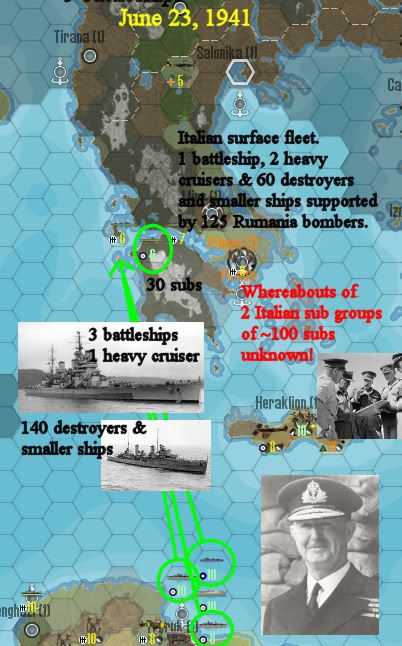
The Times of London. The Battle of Rio-Antirrio Straights – part 1
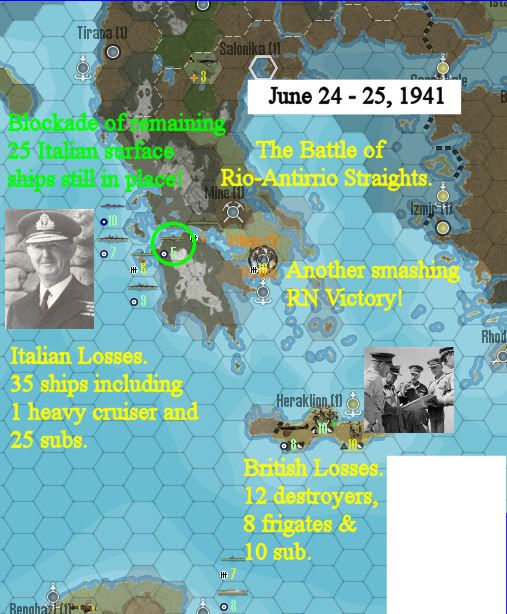
The Times of London. The Battle of Rio-Antirrio Straights – part 2
The Desert Army
(Installment 13)
by Nigel Whitehurst
June 23-25, 1941.
June 23. 0700 hours (7am), General Leese’s Headquarters. Throughout the last 3 weeks planes from the aircraft carrier Illustrious have been providing critical air support to the Desert Army. In addition to this, the big ships of Cunningham’s Med fleet have been constantly shelling Tobruk and its Italian defenders. At 0700 hours General Leese gets an encoded flash message from Admiral Cunningham aboard his flagship, the aircraft carrier Illustrious. In response to the Italians trying to force the blockade of the Rio-Antirrio straights, the Admiral has decided to detach the majority of his surface fleet, including the 3 battleships and 1 heavy cruiser, from the Illustrious and move to engage the remnants of the Italian surface fleet. The Illustrious will remain off the coast of Libya with minimum escorts and continue to provide the critical air support that the Desert Army needs to continue its offensive. The Admiral will be leaving the Illustrious and transferring his flag to the battleship, HMS Resolution to lead this battle group and air cover for his group would be provided by over 200 RAF fighters based on Crete and under the command of General Ritche.
June 24. 1900 hours (7pm). Near the Straights of Rio-Antirrio. Destroyers from Cunningham’s battle group encounter Italian submarines and a short but fierce exchange occurs with losses on both sides. But; Cunningham’s destroyers prevail, the Italian sub threat is contained and his group continues. At around 2000 hours a night battle between Cunningham’s main force and the Italian rescue force trying to reach the trapped Italian ships in the straights starts and lasts for the next 3 hours. The Italian rescue force is totally destroyed and the force it was trying to rescue remains bottled up in the straights. The Italians lose a total of 35 ships, including their last heavy cruiser, and 10 submarines. We lose 10 destroyers and frigates and 10 submarines. Cunningham’s battlegroup remains on station west of the straights and under the protection of the RAF fighters on Crete. What a valuable base Crete has turned out to be and what a fortunate occurrence to have gotten without the Jerries contenting us for it.
June 25. 0300 hours (3am). Off the coast of Libya near Tobruk. The aircraft carrier Illustrious comes under direct attack from the second group of Italian subs. The carrier escorts are able to fend off the threat without any subs breaking through to the carrier itself. While the carrier was safe 10 destroyers and frigates were sunk along with 15 Italian subs. The Illustrious will resume air operations at dawn and the Desert Army, though looking a bit battered, will continue to press the Italians who are looking like they may break and much worse than our lads. With Jerry tied up with the invasion of Russia, finishing this thing in the Desert may be something that we can accomplish by years end if Russia can survive.
The Times of London. The Battle of Rio-Antirrio Straights – part 1
The Times of London. The Battle of Rio-Antirrio Straights – part 2
The Times of London
The Desert Army
(Installment 14)
by Nigel Whitehurst
July 12, 1941.
General Leese’s HQ. 0530 hours (5:30am). Breakfast. I join three of General Leese’s junior staffer officers for breakfast at the ungodly hour of 5:30 am. It is obvious that they’ve been up all night and it is soon that I discover the reason why. They have been preparing a comprehensive status report that, after General Leese’s review and signature, will be flown to London as soon as possible. Oh the beancounters in London again.
The newly prepared report, unlike the order of battle (OOB) that they produced then months ago, includes Italian units and strength estimates for both the British and Italian units. Again, I am treated as a trusted ally of the General’s staff and I’m allowed to review, make a sketch and take very detailed notes of this report.
General Leese arrives at breakfeast at 0630 hours (6:30 am), looking well rested and in an excellent mood. He is kind enough to give me 10 more minutes to finish my sketch and notes before taking and reviewing the report. He looks over the report for 20-minutes and nodding in agreement and appreciation of his junior staff officers’ effort. He then signs the report and gives it back to one of his officers to handle getting it to London as required.
The reason for the excellent mood soon becomes apparent as General Leese shares with the table the contents of an encoded communication that he had just received in the last hour from London. A convoy was forming in England that would be bringing reinforcements to the Med including two aircraft carriers, 25 destroyers, 23 smaller escorts, 50 submarines, 260 fighters and 260 long range bombers. This convoy was to be given the highest priority and would; therefore, be escorted by the entire RN Atlantic fleet. No chances will be taken as to its safety. The 260 long range bombers, supported by a comparable number of RAF fighters, were to be deployed to Crete for carrying out the bombing of the Rumania oil fields at Ploesti.
The reality is that at this stage of the game UK strategic bombers do not have the range to reach the Ploesti oil fields from Crete. However; there are three one-hex Greek islands that do. Two of these three islands are within fighter range of Crete and one within range of Heraklion. My plan is to deploy the UK strategic bomber to the one island within range of Heraklion and a fighter to Heraklion. Note that Heraklion is the only non-rough hex on Crete and this means fair weather is guarantee year around. The other four hexes on Crete are rough and; therefore, have the same weather as in Central Europe which means mud/rain or snow during the bad weather turns.
After breakfast I take some time to review my notes and sketch. The Desert Army, which in strength is really an Army Group, is composed of 5 infantry corps, 2 mechanized corps, 1 armor corps and three reserve infantry divisions. The heavy fighting has definitely taken a toll on these units with X Armor, 9th Australian, and XXX Corps barely above division strength. Also, RAF losses have been high with the total number of serviceable aircraft at just 286 aircraft, which is 55% of its allotted strength of 520 aircraft.
Though our losses have been high, the Italians are in worse shape and their defenses appear on the verge of breaking. They have lost two infantry corps outright (so far). The fact that they are on the verge of cracking can be confirmed by the fact that a division strength unit (1st Libyan) is holding a position that should be held by a corps unit. I am sure that General Leese would like nothing better than to stop and rest his boys but if he did, then this could very well give the Italians the time they need to reestablish their defenses. It’s apparent that there will be no stopping until the Italians are broken, Benghazi is captured and Tobruk is isolated and neutralized.
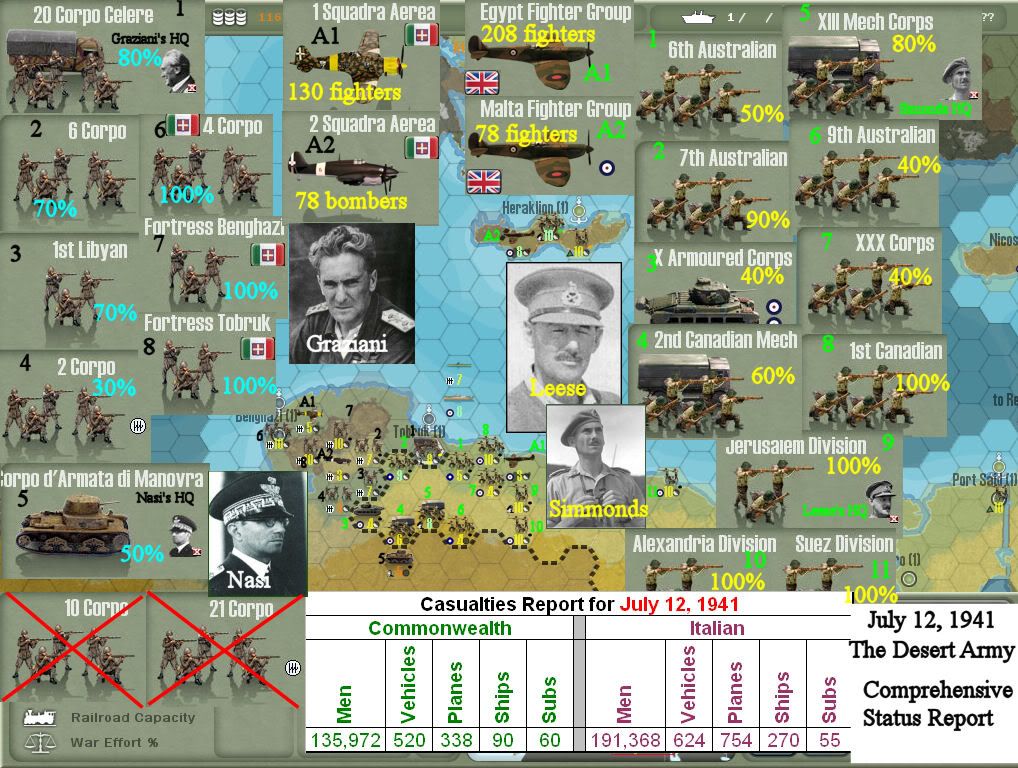
The Times of London. Sketch of July 12, 1941 Comprehensive Report.
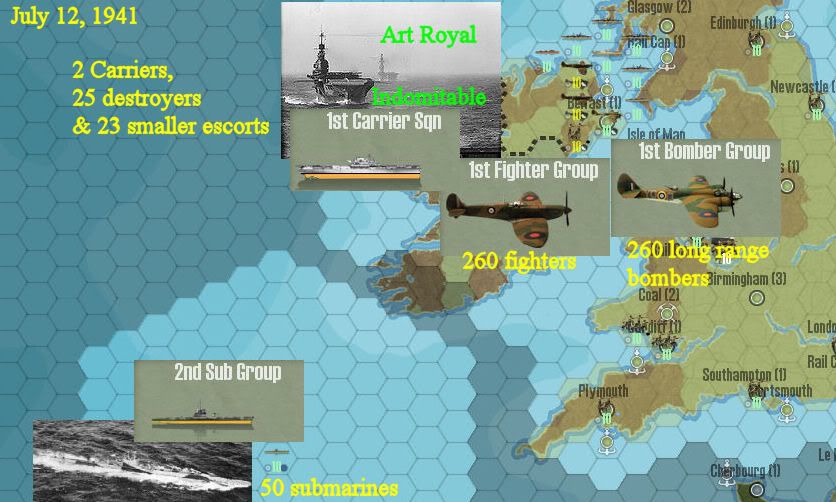
The Times of London. Convoy forming in the Atlantic for the Med.
The Desert Army
(Installment 14)
by Nigel Whitehurst
July 12, 1941.
General Leese’s HQ. 0530 hours (5:30am). Breakfast. I join three of General Leese’s junior staffer officers for breakfast at the ungodly hour of 5:30 am. It is obvious that they’ve been up all night and it is soon that I discover the reason why. They have been preparing a comprehensive status report that, after General Leese’s review and signature, will be flown to London as soon as possible. Oh the beancounters in London again.
The newly prepared report, unlike the order of battle (OOB) that they produced then months ago, includes Italian units and strength estimates for both the British and Italian units. Again, I am treated as a trusted ally of the General’s staff and I’m allowed to review, make a sketch and take very detailed notes of this report.
General Leese arrives at breakfeast at 0630 hours (6:30 am), looking well rested and in an excellent mood. He is kind enough to give me 10 more minutes to finish my sketch and notes before taking and reviewing the report. He looks over the report for 20-minutes and nodding in agreement and appreciation of his junior staff officers’ effort. He then signs the report and gives it back to one of his officers to handle getting it to London as required.
The reason for the excellent mood soon becomes apparent as General Leese shares with the table the contents of an encoded communication that he had just received in the last hour from London. A convoy was forming in England that would be bringing reinforcements to the Med including two aircraft carriers, 25 destroyers, 23 smaller escorts, 50 submarines, 260 fighters and 260 long range bombers. This convoy was to be given the highest priority and would; therefore, be escorted by the entire RN Atlantic fleet. No chances will be taken as to its safety. The 260 long range bombers, supported by a comparable number of RAF fighters, were to be deployed to Crete for carrying out the bombing of the Rumania oil fields at Ploesti.
The reality is that at this stage of the game UK strategic bombers do not have the range to reach the Ploesti oil fields from Crete. However; there are three one-hex Greek islands that do. Two of these three islands are within fighter range of Crete and one within range of Heraklion. My plan is to deploy the UK strategic bomber to the one island within range of Heraklion and a fighter to Heraklion. Note that Heraklion is the only non-rough hex on Crete and this means fair weather is guarantee year around. The other four hexes on Crete are rough and; therefore, have the same weather as in Central Europe which means mud/rain or snow during the bad weather turns.
After breakfast I take some time to review my notes and sketch. The Desert Army, which in strength is really an Army Group, is composed of 5 infantry corps, 2 mechanized corps, 1 armor corps and three reserve infantry divisions. The heavy fighting has definitely taken a toll on these units with X Armor, 9th Australian, and XXX Corps barely above division strength. Also, RAF losses have been high with the total number of serviceable aircraft at just 286 aircraft, which is 55% of its allotted strength of 520 aircraft.
Though our losses have been high, the Italians are in worse shape and their defenses appear on the verge of breaking. They have lost two infantry corps outright (so far). The fact that they are on the verge of cracking can be confirmed by the fact that a division strength unit (1st Libyan) is holding a position that should be held by a corps unit. I am sure that General Leese would like nothing better than to stop and rest his boys but if he did, then this could very well give the Italians the time they need to reestablish their defenses. It’s apparent that there will be no stopping until the Italians are broken, Benghazi is captured and Tobruk is isolated and neutralized.
The Times of London. Sketch of July 12, 1941 Comprehensive Report.
The Times of London. Convoy forming in the Atlantic for the Med.
The Times of London
The Desert Army
(Installment 15)
by Nigel Whitehurst
August 1 – 21, 1941.
August 1. Aboard HMS Illustrious. Reconnaissance planes from the aircraft carrier Illustrious and on patrol in the seas northwest of Benghazi radio back that they’ve spotted unescorted Italian transports headed for Benghazi. This report is immediately relayed to Admiral Cunningham aboard the HMS Resolution off the west coast of Greece. Within minutes Admiral Cunningham sends an action sortie message to all of the Med fleet except for the 1st Battle Squadron currently attached to his battle group to move and engage the Italian transports.
August 2. The Med, northwest of Benghazi. It’s a turkey shoot! The last of the Italian transports carrying reinforcements for Libya is finished off. The British pick up what survivors they can.
August 8. The Rio-Antirrio Straights. The 1st Battle Squadron moves into the straights to finish off the remaining strength of the Italian surface fleet consisting of 15 ships and one badly damage battleship. The battle is short with allItalian ships sunk without any British ships lost.
August 20. General Leese’s Headquarters. 0600 hours (6am). I awake to the news that during the night that the Italian 20th Mech corps defending Tobruk was “evacuated” during the night and that Tobruk is now an open city. Also, another unit assumed to be corps strength was “evacuated” from Benghazi. The remaining Italian ground units in our area retreat toward Benghazi. Unbelievable as it is, Tobruk is ours without a fight and Benghazi is there for our taking. The remaining Italian ground strength in our area is estimated at 2 infantry corps, 3 reserve infantry divisions, 1 infantry corps at brigade strength and 1 armor corps at division strength and stuck in the desert.
August 21. General Leese’s Headquarters. 0800 hours (8am). We get news that lead elements of the 6th Australians enter Tobruk and claim it for the British empire. There are cheers and handshakes all around the general’s headquarters and, though it’s only 8am in the morning, I dare say we had a couple of toasts in celebration. In a few days the capture of Tobruk will be immortalized in the Prime Minister’s speech to parliament in which he will describe it in a way that only he can with the words, “This is not the end or even the beginning of the end; but it is the end of the beginning.”
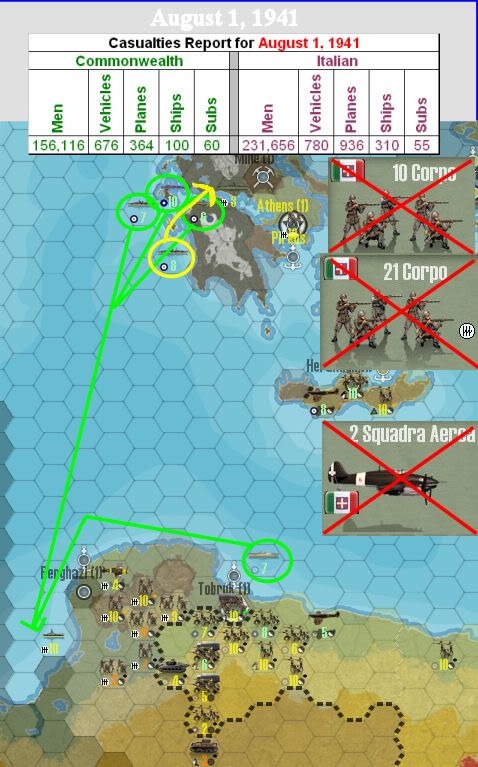
The Times of London. The Desert Army Pushes Forward.
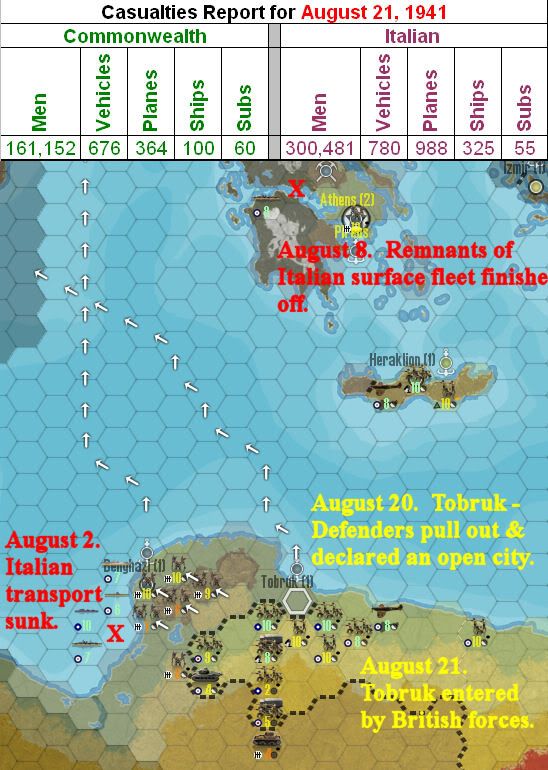
The Times of London. Tobruk Falls!
The Desert Army
(Installment 15)
by Nigel Whitehurst
August 1 – 21, 1941.
August 1. Aboard HMS Illustrious. Reconnaissance planes from the aircraft carrier Illustrious and on patrol in the seas northwest of Benghazi radio back that they’ve spotted unescorted Italian transports headed for Benghazi. This report is immediately relayed to Admiral Cunningham aboard the HMS Resolution off the west coast of Greece. Within minutes Admiral Cunningham sends an action sortie message to all of the Med fleet except for the 1st Battle Squadron currently attached to his battle group to move and engage the Italian transports.
August 2. The Med, northwest of Benghazi. It’s a turkey shoot! The last of the Italian transports carrying reinforcements for Libya is finished off. The British pick up what survivors they can.
August 8. The Rio-Antirrio Straights. The 1st Battle Squadron moves into the straights to finish off the remaining strength of the Italian surface fleet consisting of 15 ships and one badly damage battleship. The battle is short with allItalian ships sunk without any British ships lost.
August 20. General Leese’s Headquarters. 0600 hours (6am). I awake to the news that during the night that the Italian 20th Mech corps defending Tobruk was “evacuated” during the night and that Tobruk is now an open city. Also, another unit assumed to be corps strength was “evacuated” from Benghazi. The remaining Italian ground units in our area retreat toward Benghazi. Unbelievable as it is, Tobruk is ours without a fight and Benghazi is there for our taking. The remaining Italian ground strength in our area is estimated at 2 infantry corps, 3 reserve infantry divisions, 1 infantry corps at brigade strength and 1 armor corps at division strength and stuck in the desert.
August 21. General Leese’s Headquarters. 0800 hours (8am). We get news that lead elements of the 6th Australians enter Tobruk and claim it for the British empire. There are cheers and handshakes all around the general’s headquarters and, though it’s only 8am in the morning, I dare say we had a couple of toasts in celebration. In a few days the capture of Tobruk will be immortalized in the Prime Minister’s speech to parliament in which he will describe it in a way that only he can with the words, “This is not the end or even the beginning of the end; but it is the end of the beginning.”
The Times of London. The Desert Army Pushes Forward.
The Times of London. Tobruk Falls!
Last edited by rkr1958 on Sat Jul 16, 2011 11:16 am, edited 1 time in total.
It looks strange to me, that your opponent was so willing to fight you at fields near Tobruk, but didn't gave a try to hold fortress itself.
It can hold several turns even against overwhelming allied force (like it did in our recent game with Victor). Usually you need to destroy entire fortification (strategic bombers help great!) to reduce defender's supply and finally take fortress from good unit (like italian mech in this game).
Is sitaution on other fronts already so bad for axis, that they need all availiable men in more important places?
It can hold several turns even against overwhelming allied force (like it did in our recent game with Victor). Usually you need to destroy entire fortification (strategic bombers help great!) to reduce defender's supply and finally take fortress from good unit (like italian mech in this game).
Is sitaution on other fronts already so bad for axis, that they need all availiable men in more important places?
I found the decision to abandon Tobruk surprising too. As the axis, while I may pull my commander out at the last minute I will stand in Tobruk to the last man. Also, unless I have a very good opportunity for a counterattack I won't attack out of the fort either. A fully entrenched and full strength unit with a +1 defense leader makes Tobruk a very tough nut to crack even without air support.Plaid wrote:It looks strange to me, that your opponent was so willing to fight you at fields near Tobruk, but didn't gave a try to hold fortress itself.
It can hold several turns even against overwhelming allied force (like it did in our recent game with Victor). Usually you need to destroy entire fortification (strategic bombers help great!) to reduce defender's supply and finally take fortress from good unit (like italian mech in this game).
Is sitaution on other fronts already so bad for axis, that they need all availiable men in more important places?
The Times of London
The Desert Army
(Installment 16)
by Nigel Whitehurst
October 21-22, 1941.
October 21. General Leese’s Headquarters. 0700 hours (7am). It’s been two month since my last installment and today we begin the assault to capture Benghazi. The supply lines to the Italian armor and last infantry corps in the area have been cut. These two corps, which are really now only divisions, are expected to surrender given their hopeless situation.
The attack on Benghazi begins by the 6th Australians, 1st Canadians and 7th Australians supported by naval gunfire and planes from Cunningham’s Med fleet, and RAF fighters used in a ground attack role.
October 22. General Leese’s Headquarters. 0330 hours (3:30am). The Italian division defending Benghazi realize that their situation is hopeless and surrender the city after less than a day worth of fighting. Lead elements of the 6th Australians enter the city and accept their surrender and the surrender of the city. Whether it’s a late dinner from the night before or an early breakfast from the day to come, we sit down to a welcomed meal and toast the capture of Benghazi.
I look back at my past articles and realize that the desert campaign started in earnest this month over a year ago (October 5, 1940) with the naval battle of, “The East Med.” Even with the capture of Benghazi we are reminded by the general that we still have some work to do and that is the capture of Tripoli.
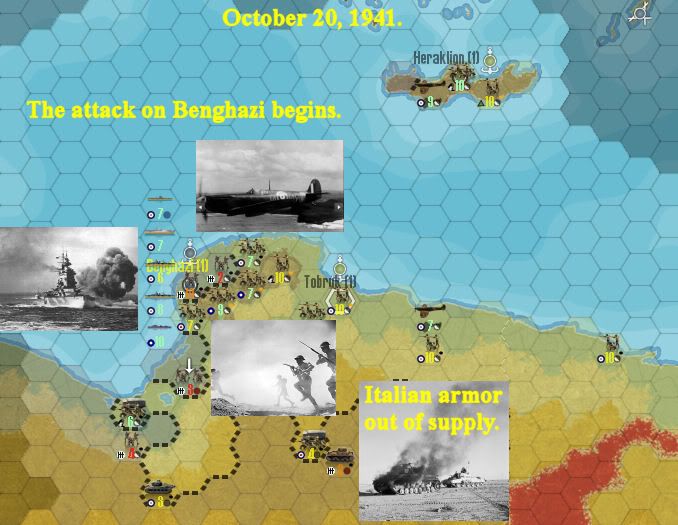
The Times of London. The Attack on Benghazi (part 1)
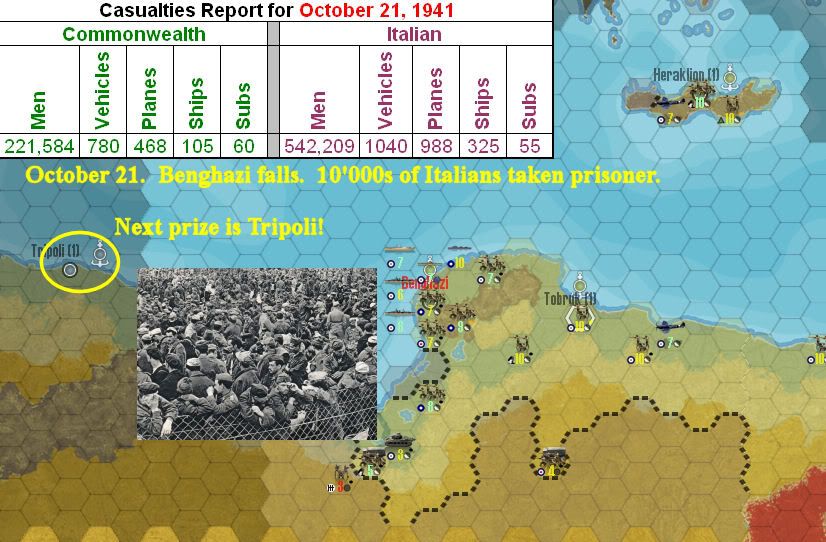
The Times of London. The Attack on Benghazi (part 2)
The Desert Army
(Installment 16)
by Nigel Whitehurst
October 21-22, 1941.
October 21. General Leese’s Headquarters. 0700 hours (7am). It’s been two month since my last installment and today we begin the assault to capture Benghazi. The supply lines to the Italian armor and last infantry corps in the area have been cut. These two corps, which are really now only divisions, are expected to surrender given their hopeless situation.
The attack on Benghazi begins by the 6th Australians, 1st Canadians and 7th Australians supported by naval gunfire and planes from Cunningham’s Med fleet, and RAF fighters used in a ground attack role.
October 22. General Leese’s Headquarters. 0330 hours (3:30am). The Italian division defending Benghazi realize that their situation is hopeless and surrender the city after less than a day worth of fighting. Lead elements of the 6th Australians enter the city and accept their surrender and the surrender of the city. Whether it’s a late dinner from the night before or an early breakfast from the day to come, we sit down to a welcomed meal and toast the capture of Benghazi.
I look back at my past articles and realize that the desert campaign started in earnest this month over a year ago (October 5, 1940) with the naval battle of, “The East Med.” Even with the capture of Benghazi we are reminded by the general that we still have some work to do and that is the capture of Tripoli.
The Times of London. The Attack on Benghazi (part 1)
The Times of London. The Attack on Benghazi (part 2)
The Times of London
The Desert Army
(Installment 17)
by Nigel Whitehurst
December 7-12, 1941.
December 7. Officers Mess 2000 hours (8pm). I am sitting down to dinner with a number of General Leese’s junior staff officers when we get the news of the Japanese surprise air attack on the US naval base at Pearl Harbor. The attack started at about an hour ago or 0700 hours (7am) local time in the Hawaiian Islands. I wonder if the Yanks will only go to war with the Japanese. I do hate they were attacked but it would be nice to have them join us in the fight against the Germans and Italians.
December 12. Officers Mess 1900 hours (7pm). Not surprisingly, the US Congress votes to declare war on Japan. A bit surprising and perplexing is that Germany and Italy declares was on the United States. This saves Mr. Roosevelt the effort of convincing the US congress of the need to go to war with these countries. I wonder where and when the Yanks will engage the Germans and Italians.
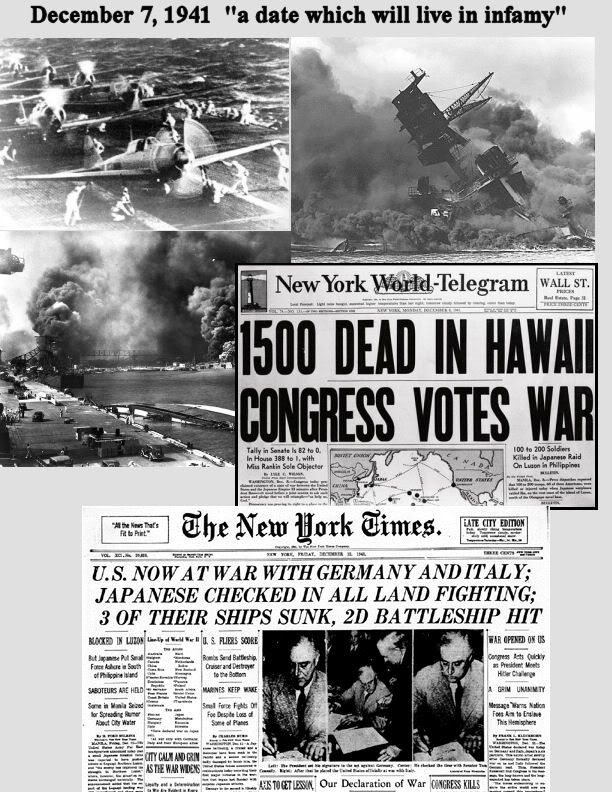
The Times of London. U.S. Now At War with Germany and Italy
The Desert Army
(Installment 17)
by Nigel Whitehurst
December 7-12, 1941.
December 7. Officers Mess 2000 hours (8pm). I am sitting down to dinner with a number of General Leese’s junior staff officers when we get the news of the Japanese surprise air attack on the US naval base at Pearl Harbor. The attack started at about an hour ago or 0700 hours (7am) local time in the Hawaiian Islands. I wonder if the Yanks will only go to war with the Japanese. I do hate they were attacked but it would be nice to have them join us in the fight against the Germans and Italians.
December 12. Officers Mess 1900 hours (7pm). Not surprisingly, the US Congress votes to declare war on Japan. A bit surprising and perplexing is that Germany and Italy declares was on the United States. This saves Mr. Roosevelt the effort of convincing the US congress of the need to go to war with these countries. I wonder where and when the Yanks will engage the Germans and Italians.
The Times of London. U.S. Now At War with Germany and Italy
The Times of London
The Desert Army
(Installment 18 )
by Nigel Whitehurst
January 8, 1942.
260 long range British bombers defended by over 500 RAF fighters all based on Crete, and under the command of General Ritche, begin their bombing of the Rumania oil fields at Polesti. In addition to providing a base from which to bomb these oil fields, Crete has served as a vital air and naval base in the now almost complete conquest of Libya.
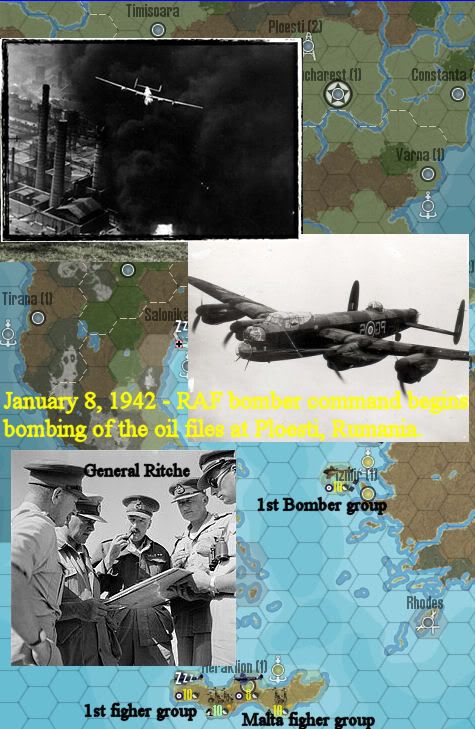
The Times of London. Bombing of the oil fields at Ploesti.
The Desert Army
(Installment 18 )
by Nigel Whitehurst
January 8, 1942.
260 long range British bombers defended by over 500 RAF fighters all based on Crete, and under the command of General Ritche, begin their bombing of the Rumania oil fields at Polesti. In addition to providing a base from which to bomb these oil fields, Crete has served as a vital air and naval base in the now almost complete conquest of Libya.
The Times of London. Bombing of the oil fields at Ploesti.
The Times of London
The Desert Army
(Installment 19)
by Nigel Whitehurst
January 18, 1942.
For the little more than a month since the fall of Benghazi, X Armor supported by the 9th Australian and 1st Canadian push toward Tripoli sweeping aside the token resistance offered by remaining Italian defenders in Libya. On January 18, the last of that resistance surrenders and lead elements of X Armor enter the city to claim it for Britain. All of Libya is now in our hands and as far as I know this should close the book on the Desert Army who along with the Med fleet have been in constant action for the past 15-months.
I go see the General’s [Leese’s] aide to make an appointment to interview him one last time and to make arrangements for my return trip home. I’ve been away from home for 22-months, almost two years now, and I’m sure looking forward to getting back and to my regular sports assignment at The Times. As I met the General’s aide to set the appointment and to make the arrangements he tells me that there is an operation currently underway that will involve the Desert Army and that he wishes me to cover their involvement in said operation. Of course I agree and ask for more details but all the general’s aide will give me is the name, which is Operation Torch. He tells me that at the right time, the general will be glad to fill me on the rest of the details.
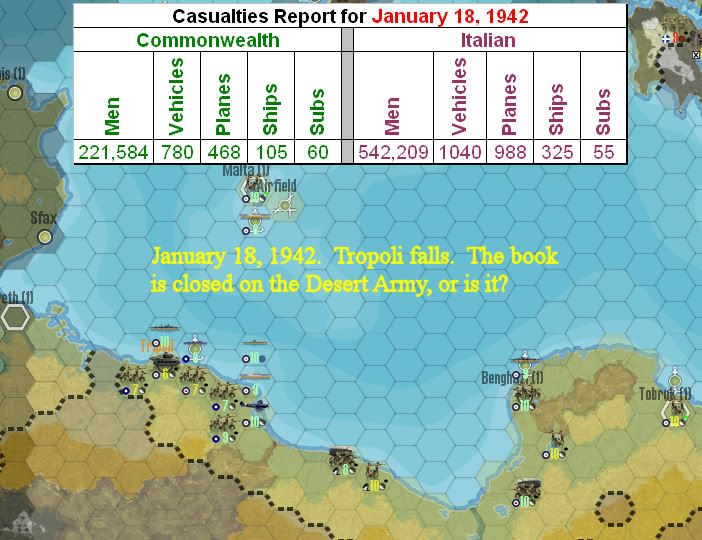
The Times of London. Tripoli falls, Libya is Ours!
The Desert Army
(Installment 19)
by Nigel Whitehurst
January 18, 1942.
For the little more than a month since the fall of Benghazi, X Armor supported by the 9th Australian and 1st Canadian push toward Tripoli sweeping aside the token resistance offered by remaining Italian defenders in Libya. On January 18, the last of that resistance surrenders and lead elements of X Armor enter the city to claim it for Britain. All of Libya is now in our hands and as far as I know this should close the book on the Desert Army who along with the Med fleet have been in constant action for the past 15-months.
I go see the General’s [Leese’s] aide to make an appointment to interview him one last time and to make arrangements for my return trip home. I’ve been away from home for 22-months, almost two years now, and I’m sure looking forward to getting back and to my regular sports assignment at The Times. As I met the General’s aide to set the appointment and to make the arrangements he tells me that there is an operation currently underway that will involve the Desert Army and that he wishes me to cover their involvement in said operation. Of course I agree and ask for more details but all the general’s aide will give me is the name, which is Operation Torch. He tells me that at the right time, the general will be glad to fill me on the rest of the details.
The Times of London. Tripoli falls, Libya is Ours!
The Times of London
The Desert Army
(Installment 20)
by Nigel Whitehurst
March 29, 1942.
British and American forces have been training for amphibious operations for over three months for Operation Torch, which is the invasion of North Africa. Allied planners have been busy planning every detail of the operation from the landings, air support and logistical support. Today all this planning changed and the scope of the operation greatly broadened with the discovery that the Italians only have two divisions defending Sicily and the tip of southern Italy across the Straights of Messina is undefended. An ambitious plan is hatched to not only invade North Africa (Operation Torch) but to also simultaneously invade Sicily, which will be known as Operation Husky. I am stunned when I learn of this dual operation which is being planned for May 8th. I quickly learn the why as I am allowed a quick glance at today’s SIS assessment report. Apparently the SIS believes, and London seems to agree, that if we and the Yanks can capture Palermo and Messina in Sicily (Operation Husky) and Tunis, Tunisia in North Africa (Operation Torch) that Italy will surrender. SIS is certain of their assessment with a confidence of 99% or higher. How on earth can they be so certain I do not know but apparently everyone between London and here are treating it as the gospel.
Operation Torch-Husky will be executed by three task forces known as the Western Task Force, a US force originating from the east coast of the US, the Central Task Force, a British force originating from Britain, and the Eastern Task Force, composed from the Desert Army and originating from Libya. The landings are planned for May the 8th with the Americans responsible for Torch and the Desert Army responsible for Husky. The Americans under the command of General Devers and supported by UK one corps from the Central Task Force will land near Tunis (an Italian surrender city) and Oran. The Eastern Task force, under the command of General Simonds but not in the initial landings, supported by one UK corps from the Central Task force will land in Sicily near Palermo and Messina (both of which are Italian surrender cities).
One major logistical constraint is that our (the UK) amphibious invasion capacity is only two corps and operation Torch-Husky calls for the amphibious landing of up to six UK corps. UK industry and production has recently place emphasis on increasing our invasion capacity (focus on surface ships in naval research and we are certain that by May the 8th our normal capacity will be three corps. However, this will still leave us three short of what was needed to land six corps. After much discussion and maneuvering at the highest levels of UK government and private industry, resources are being scrounge from commercial and private sources, at a great cost I might say, that will allow us to land five corps, which is two above our normal capacity. To land these additional two corps will cost 35 + 70 (or 105 PP’s) but if I can knock Italy out at this early date then this is certainly worth it! In a little less than 6-weeks the greatest and most ambitious seaborne invasion the world had every seen is about to take place. Provide our task forces evade interdiction by enemy sub and the Italians don’t beef up their Sicilian defenses. If either were to happened then it’s likely that Husky will be postponed and only Torch will be executed. For now, that’s not the case the joint operation moves forward with the troops continuing their amphibious training and the operation planners reviewing daily the reconnaissance photos from Sicily and southern Italy.
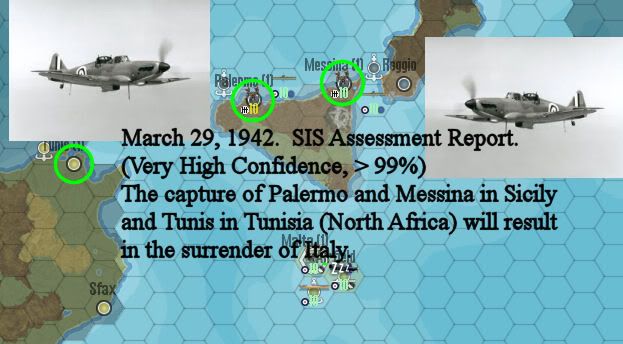
The Times of London. The March 29, 1942 SIS Assessment Report.

The Times of London. The Western and Central Task Forces (Operation Torch)
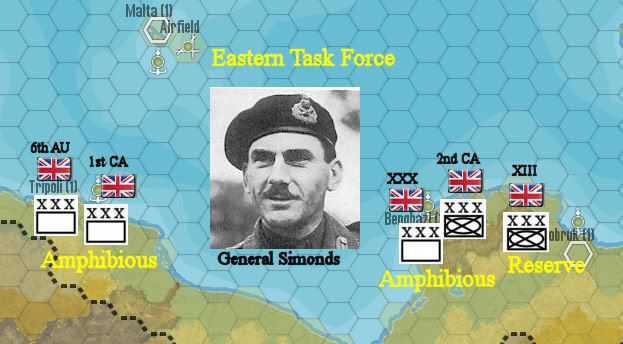
The Times of London. The Eastern Task Force (Operation Husky)
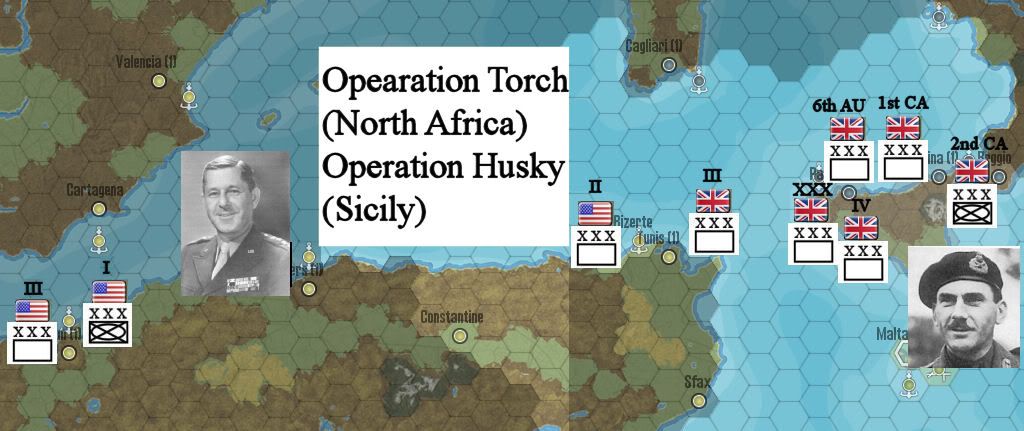
The Times of London. Operation Torch – Husky planned for May 8, 1941.
The Desert Army
(Installment 20)
by Nigel Whitehurst
March 29, 1942.
British and American forces have been training for amphibious operations for over three months for Operation Torch, which is the invasion of North Africa. Allied planners have been busy planning every detail of the operation from the landings, air support and logistical support. Today all this planning changed and the scope of the operation greatly broadened with the discovery that the Italians only have two divisions defending Sicily and the tip of southern Italy across the Straights of Messina is undefended. An ambitious plan is hatched to not only invade North Africa (Operation Torch) but to also simultaneously invade Sicily, which will be known as Operation Husky. I am stunned when I learn of this dual operation which is being planned for May 8th. I quickly learn the why as I am allowed a quick glance at today’s SIS assessment report. Apparently the SIS believes, and London seems to agree, that if we and the Yanks can capture Palermo and Messina in Sicily (Operation Husky) and Tunis, Tunisia in North Africa (Operation Torch) that Italy will surrender. SIS is certain of their assessment with a confidence of 99% or higher. How on earth can they be so certain I do not know but apparently everyone between London and here are treating it as the gospel.
Operation Torch-Husky will be executed by three task forces known as the Western Task Force, a US force originating from the east coast of the US, the Central Task Force, a British force originating from Britain, and the Eastern Task Force, composed from the Desert Army and originating from Libya. The landings are planned for May the 8th with the Americans responsible for Torch and the Desert Army responsible for Husky. The Americans under the command of General Devers and supported by UK one corps from the Central Task Force will land near Tunis (an Italian surrender city) and Oran. The Eastern Task force, under the command of General Simonds but not in the initial landings, supported by one UK corps from the Central Task force will land in Sicily near Palermo and Messina (both of which are Italian surrender cities).
One major logistical constraint is that our (the UK) amphibious invasion capacity is only two corps and operation Torch-Husky calls for the amphibious landing of up to six UK corps. UK industry and production has recently place emphasis on increasing our invasion capacity (focus on surface ships in naval research and we are certain that by May the 8th our normal capacity will be three corps. However, this will still leave us three short of what was needed to land six corps. After much discussion and maneuvering at the highest levels of UK government and private industry, resources are being scrounge from commercial and private sources, at a great cost I might say, that will allow us to land five corps, which is two above our normal capacity. To land these additional two corps will cost 35 + 70 (or 105 PP’s) but if I can knock Italy out at this early date then this is certainly worth it! In a little less than 6-weeks the greatest and most ambitious seaborne invasion the world had every seen is about to take place. Provide our task forces evade interdiction by enemy sub and the Italians don’t beef up their Sicilian defenses. If either were to happened then it’s likely that Husky will be postponed and only Torch will be executed. For now, that’s not the case the joint operation moves forward with the troops continuing their amphibious training and the operation planners reviewing daily the reconnaissance photos from Sicily and southern Italy.
The Times of London. The March 29, 1942 SIS Assessment Report.
The Times of London. The Western and Central Task Forces (Operation Torch)
The Times of London. The Eastern Task Force (Operation Husky)
The Times of London. Operation Torch – Husky planned for May 8, 1941.
All I'm allowed to say at this time is that the game is in November 1942 and severe winter has just hit on the Russian front. Also, as you shall see my axis opponent is and has been having oil issues since June 1942. The Russians have pretty much been left alone and now I've unleashed them. I do think that they will cause the defeat of German; however, the North Africa and Italian operations have contributed significantly though indirectly.Morris wrote:Italy will die by the end of summer 1942 . germany will be a miserable time to hold until the end of 1943 . Is this the final result of this story ?
