

The North Africa Vignette AAR
Moderators: Happycat, rkr1958, Slitherine Core

There's a 25% chance of not being able to land due to bad weather. However; my opponent chose to take that chance and to say the least I was completely caught by surprise.Morris wrote:Is this too dangerous to sealion on sept 16th ? next turn there is possible no landing weather across the strait .
Nigel is totally fictional. I wish you to use my fictional name to keep it in character.Morris wrote:sorry for my limited knowledge that who is the Nigel Whitehurst ? your real name or some one famous in the history ?
We do hope the story goes more dramatic !
The Times of London
The Desert Army
(Installment 4)
by Nigel Whitehurst
September 17, 1940
The mood at General Leese’s HQ is celebratory and even though it’s only 10:00 am in the morning we’ve each had a couple of drinks to toast the great naval victory that drove the German invasion transports away from the shores of England. This victory is being compared to the one over 200 years ago by Lord Nelson at the Battle of Trafalgar. As there, today the Royal Navy proved its dominance off the oceans. Our land armies may be small but we are an island and that island is protected by the full might of the Royal Navy. Here … Here … to the saviors of Britain!
After lunch the celebration ends and General Leese and his staff get back to business. Both his Desert Army and the RN Med fleet are moving toward Libya. Also, there have been reports of a sortie by the Italian fleet. It looks like we may have a naval engagement of our own here in a few days.

The Times of London. The RN Saves England!
The Desert Army
(Installment 4)
by Nigel Whitehurst
September 17, 1940
The mood at General Leese’s HQ is celebratory and even though it’s only 10:00 am in the morning we’ve each had a couple of drinks to toast the great naval victory that drove the German invasion transports away from the shores of England. This victory is being compared to the one over 200 years ago by Lord Nelson at the Battle of Trafalgar. As there, today the Royal Navy proved its dominance off the oceans. Our land armies may be small but we are an island and that island is protected by the full might of the Royal Navy. Here … Here … to the saviors of Britain!
After lunch the celebration ends and General Leese and his staff get back to business. Both his Desert Army and the RN Med fleet are moving toward Libya. Also, there have been reports of a sortie by the Italian fleet. It looks like we may have a naval engagement of our own here in a few days.
The Times of London. The RN Saves England!
The Times of London
The Desert Army
(Installment 5)
by Nigel Whitehurst
October 5 – 7.
Less than three weeks after the great victory by the Royal Navy in what is now being called, “The Battle of the English Channel”, the Royal Navy’s dominance of the seas was once again challenged; but this time by the Regia Marina. At 15:00 hours (3:00pm) on October 5, Admiral Cunningham’s pickets encounter Italian submarines trying to breakthrough to his carriers. Within 20-minutes of this initial contact, observation planes from the aircraft carrier Illustrious and searching 50 miles away spotted a force of 5 Italian battleships, 6 heavy cruisers and 75 ships in total steaming straight for the main body of Admiral Cunningham’s force. This Italian naval force, commanded by Admiral Angelo Iachion, was also supported by over 500 Italian aircraft based in Libya. Admiral Cunningham’s main body was composed of 2 aircraft carriers (Illustrious and Eagle), 2 battleships, 3 heavy cruisers (150 ships in total) supported by 25 submarines and over 500 RAF fighters based in Egypt. A second force consisting of 2 battleships, 1 heavy cruiser (25 ships in total), which had just transited the Suez Canal was headed at top speed to reinforce Cunningham’s main body.
Both the Illustrious and Eagle came under constant attacks by Italian subs and aircraft; but their crews were able to launch countless sorties throughout the afternoon and evening. Their pilots had orders to focus on attacking the Italian battleships and heavy cruisers. These sorties continued until about 18:30 (6:30 pm), which was an hour after sunset and too dark to risk further air operations. At approximately 8:30 pm the Italian surface fleet closed on the British to within 15 to 20 miles, after which a night battle took place that lasted for over 5 hours. During this battle both RN carriers remained under constant attack from Italian subs and both were struck by numerous torpedoes. The Illustrious received moderate damage and was able to operate normally. But; the HMS Eagle was mortally wounded and went down at 03:00 hours on October 6. During all this action, British submarines were also active sinking 2 Italian heavy cruisers and countless other smaller ships.
At 04:00 hours on October the 6th, Admiral Iachion knew that the battle was lost and decided to retreat with his remaining surface fleet. His one mighty surface fleet now consisted off one badly damaged battleship and a total of 54 other ships, none were larger than a destroyer. However; Admiral Iachion still had a strong force submarine force of 90 boat, which he used to cover his retreat. With a major victory in hand, Admiral Cunningham decided not to risk his bruised but still formable surface fleet and decided to retire. This decision was based on the law of calculated risk and the potential for German Stukas and fighters if deployed to Sicily to wreak havoc on his surviving surface fleet.
Admiral Cunningham did; however, order his sub group of 45 subs to pursue and finish off the battleship if possible. These subs followed the leaking oil from the damage battleship to Benghazi. On October 7 at 02:00 hours a number of subs were able to penetrate the harbor defense and finish off this battleship. As an added benefit, 4 additional Italian destroyers that were pursing these subs as they were making their escape were attacked and sunk by other UK subs outside of the harbor in support. Italian planes did manage to sink 10 subs before this group made it back safely.
Dinner on October 7 at 19:00 hours with General Leese and his staff was another joyous and somewhat boisterous affair. While our celebration of the great RN naval victory a few weeks back was over lunch and we each had no more than two drinks, this was not the case tonight. I dare say that each of us had a wee bit more than two drinks. And I am eternally gratefull to General Leese, who graciously share with all of us at his table from his 50 year bottle of Glenfiddich scotch whiskey, which I’m sure was the equivalent of three months pay.
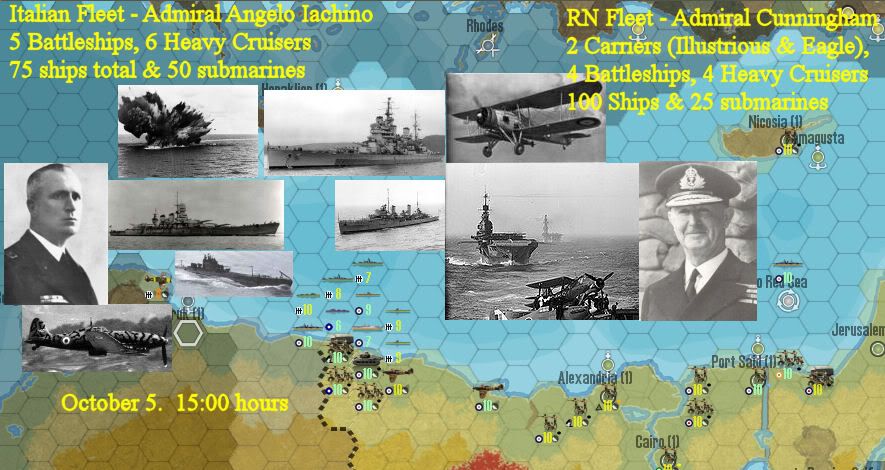
The Time of London. The Battle of the Eastern Med. First Meeting.
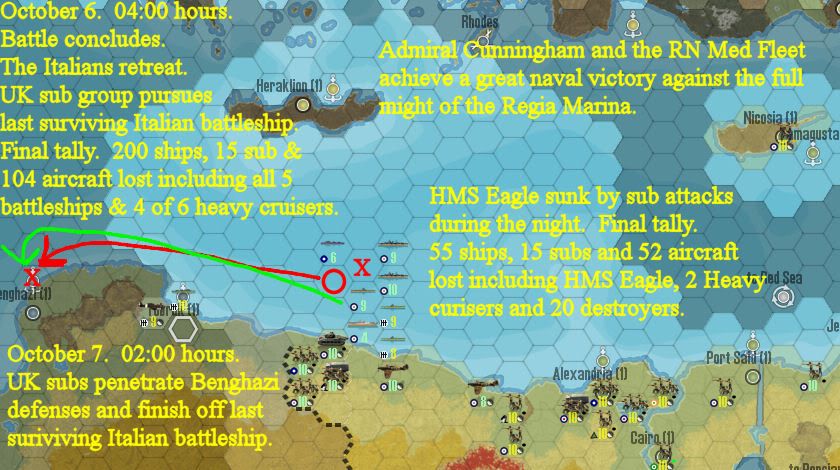
The Time of London. The Battle of the Eastern Med. Another Great Royal Navy Victory!
The Desert Army
(Installment 5)
by Nigel Whitehurst
October 5 – 7.
Less than three weeks after the great victory by the Royal Navy in what is now being called, “The Battle of the English Channel”, the Royal Navy’s dominance of the seas was once again challenged; but this time by the Regia Marina. At 15:00 hours (3:00pm) on October 5, Admiral Cunningham’s pickets encounter Italian submarines trying to breakthrough to his carriers. Within 20-minutes of this initial contact, observation planes from the aircraft carrier Illustrious and searching 50 miles away spotted a force of 5 Italian battleships, 6 heavy cruisers and 75 ships in total steaming straight for the main body of Admiral Cunningham’s force. This Italian naval force, commanded by Admiral Angelo Iachion, was also supported by over 500 Italian aircraft based in Libya. Admiral Cunningham’s main body was composed of 2 aircraft carriers (Illustrious and Eagle), 2 battleships, 3 heavy cruisers (150 ships in total) supported by 25 submarines and over 500 RAF fighters based in Egypt. A second force consisting of 2 battleships, 1 heavy cruiser (25 ships in total), which had just transited the Suez Canal was headed at top speed to reinforce Cunningham’s main body.
Both the Illustrious and Eagle came under constant attacks by Italian subs and aircraft; but their crews were able to launch countless sorties throughout the afternoon and evening. Their pilots had orders to focus on attacking the Italian battleships and heavy cruisers. These sorties continued until about 18:30 (6:30 pm), which was an hour after sunset and too dark to risk further air operations. At approximately 8:30 pm the Italian surface fleet closed on the British to within 15 to 20 miles, after which a night battle took place that lasted for over 5 hours. During this battle both RN carriers remained under constant attack from Italian subs and both were struck by numerous torpedoes. The Illustrious received moderate damage and was able to operate normally. But; the HMS Eagle was mortally wounded and went down at 03:00 hours on October 6. During all this action, British submarines were also active sinking 2 Italian heavy cruisers and countless other smaller ships.
At 04:00 hours on October the 6th, Admiral Iachion knew that the battle was lost and decided to retreat with his remaining surface fleet. His one mighty surface fleet now consisted off one badly damaged battleship and a total of 54 other ships, none were larger than a destroyer. However; Admiral Iachion still had a strong force submarine force of 90 boat, which he used to cover his retreat. With a major victory in hand, Admiral Cunningham decided not to risk his bruised but still formable surface fleet and decided to retire. This decision was based on the law of calculated risk and the potential for German Stukas and fighters if deployed to Sicily to wreak havoc on his surviving surface fleet.
Admiral Cunningham did; however, order his sub group of 45 subs to pursue and finish off the battleship if possible. These subs followed the leaking oil from the damage battleship to Benghazi. On October 7 at 02:00 hours a number of subs were able to penetrate the harbor defense and finish off this battleship. As an added benefit, 4 additional Italian destroyers that were pursing these subs as they were making their escape were attacked and sunk by other UK subs outside of the harbor in support. Italian planes did manage to sink 10 subs before this group made it back safely.
Dinner on October 7 at 19:00 hours with General Leese and his staff was another joyous and somewhat boisterous affair. While our celebration of the great RN naval victory a few weeks back was over lunch and we each had no more than two drinks, this was not the case tonight. I dare say that each of us had a wee bit more than two drinks. And I am eternally gratefull to General Leese, who graciously share with all of us at his table from his 50 year bottle of Glenfiddich scotch whiskey, which I’m sure was the equivalent of three months pay.
The Time of London. The Battle of the Eastern Med. First Meeting.
The Time of London. The Battle of the Eastern Med. Another Great Royal Navy Victory!
Last edited by rkr1958 on Sat Jun 18, 2011 11:35 am, edited 6 times in total.

-
massina_nz
- Lieutenant Colonel - Fw 190A
- Posts: 1137
- Joined: Fri Dec 18, 2009 12:12 am
- Location: Wellington, New Zealand
In a carruent games agaisnt Ronnie, one thing I was able to use the Regia Marina for in mid-game was to block the narrows between Spain and Morocco for about three turns. Sure I lost a fair proportion of the Regia Marina, but I delayed the Allies by three turns, and that's three more turns of the Italians in the war. Well worth it IMHO.Plaid wrote:Probably yes, probably no.
Italian navy is very useless late game (low techs + low number of units, UK and USA can have much more), so maybe its smart to attack early and atleast inflict some damage.
massina_nz wrote:In a carruent games agaisnt Ronnie, one thing I was able to use the Regia Marina for in mid-game was to block the narrows between Spain and Morocco for about three turns. Sure I lost a fair proportion of the Regia Marina, but I delayed the Allies by three turns, and that's three more turns of the Italians in the war. Well worth it IMHO.Plaid wrote:Probably yes, probably no.
Italian navy is very useless late game (low techs + low number of units, UK and USA can have much more), so maybe its smart to attack early and atleast inflict some damage.
 ...
... 
The Times of London
The Desert Army
(Installment 6)
by Nigel Whitehurst
December 1 – 4, 1940.
December 1. Nicosia, Cyprus. Prime Minister Churchill is meeting with King Peter II of Yugoslavia on the island of Cyprus in the port village of Nicosia. Yugoslavia was invaded by the Germans on November 14 and from the very start thing went and continues to go very badly for them. The purpose of this meeting is to discuss Great Britain’s recognition and support of Yugoslavia’s government in exile headed by King Peter when the time came, which was looking like any day now. King Peter has gotten himself and his family out of Belgrade just in time a few days ago.
December 2. Cairo, Egypt. Today the prime minister is meeting with Admiral Cunningham in Cairo, Egypt. The prime minister wanted to personally thank the admiral for his decisive victory over the Italian navy. The admiral was informed that the losses of his smaller ships would be replaced (i.e., light cruisers, destroyers and smaller); but unfortunately the loss of the aircraft carrier HMS Eagle and two heavy cruisers wouldn’t be. For the foreseeable future, the Mediterranean fleet would operate at or below the intended strength of 200 ships and 25 submarines. This strength did included 7 formidable capital ships consisting of 1 aircraft carrier, 4 battleships and 2 heavy cruisers.
Mr. Churchill cautioned the admiral that while the Italian navy had been significantly degraded, its remnants if operating under the protection of German airpower would pose a grave risk to the Royal Navy and that further actions should be conducted with this in mind. SIS placed the remaining Italian naval strength at 1 newly commissioned battleship, 2 newly commissioned heavy cruisers, over 45 light cruisers, destroyers and frigates and 2 sub groups totaling approximately 50 submarines.
December 3. Alexandria, Egypt. Mr. Churchill meets with Generals Leese and Simonds to discussion two major strategy decisions for this theater. The first is the decision to halt the Desert Army’s advance into Libya based on the certain assessment that within a few months the full attention of the axis would be elsewhere and away from this theater for Britain in fact. While in general the SIS assessments had be spotted on they had missed a big one, which was the German’s attempt of Sea Lion. I wondered if this certainty was again based on some device called Enigma.
The second strategy decision was to execute Operation VS as soon as possible in order to remove the threat posed by unfriendly Vichy Syria to the Suez Canal and to Britain’s oil fields in the middle east. Securing Vichy Syria meant not only the removal of this threat but the secure of the eastern flank of the Desert Army. Mr. Churchill requested of General Leese could an estimate of what forces and his timetable for this operation tomorrow morning for his review. This request surely meant a busy and sleepless night for the both generals and their staffs.
December 4. Alexandria, Egypt. 05:00 (5am). It was an early breakfast because of the busy day planned for and with the Prime Minister. I was dining with both generals and their senior staff and though the Prime Minister was expected it was started promptly in his absence at 5:00am. Mr. Churchill was a man who worked late into the night and the wee hours of the morning. I came to find out that General Leese had already met with the Prime Minister an hour ago and briefed the Prime Minister on the requested details of Operation VS. The operation was to be conducted by the 2nd Canadian Mech, XII British Mech, 1st Canadian Infantry, 10th Indian Infantry corps and the Port Said infantry division supported by the entire RAF desert force of over 500 planes. General Simonds would be the tactical commander and in command of the ground operations in against Syria. The operation would be launched on February 2 and was expected to take 3 to 4 weeks to complete.
December 4. The Desert. 11:00 (11am) . Prime Minister Churchill is pleased as he inspects the troops of the Desert Army. One can see that this has an immediate effect of boosting the morale of all involved including the Prime Minister himself. Between visits to various units we are given the news that Yugoslavia has surrendered. While Mr. Churchill shows a brief flash of sadness at this news, the sadness disappears as quickly as it appeared. Today belongs to the troops and Mr. Churchill is determined to make that so.
December 4. Alexandria, Egypt. 17:00 (5pm). The first scheduled leg of the Prime Minister’s journey home was to take him to Malta then on to Gibraltar for the next leg. However; his plans were now altered a bit due to the fall of Yugoslavia. His first leg would now take him to Cyprus where he would take on additional passengers, King Peter II and his family. Yet again another sovereign nation had succumbed to their Nazi invaders and would now be added to the list of Hitler’s conquests. And yet again another government in exile was established.
Though we stood alone against the Nazis, we still stood free and ready to defend that freedom at whatever the cost. Unlike 1914 in Belgium and 1940 in France, we were fighting for our very survival and freedom to live as we chose.
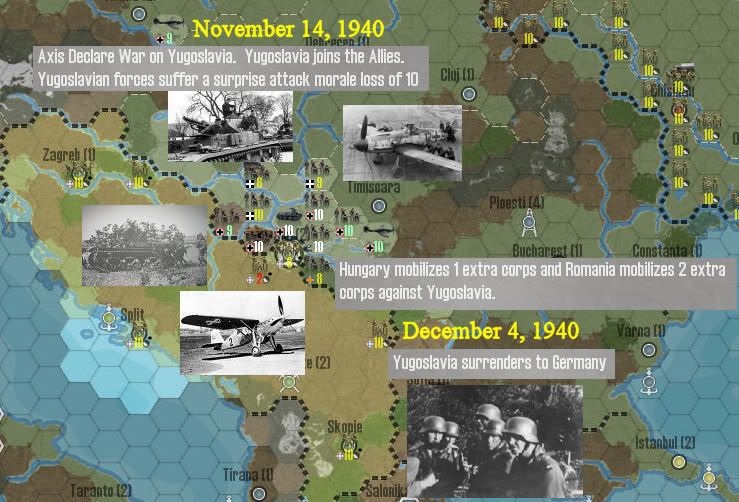
The Times of London. Yugovlavia.
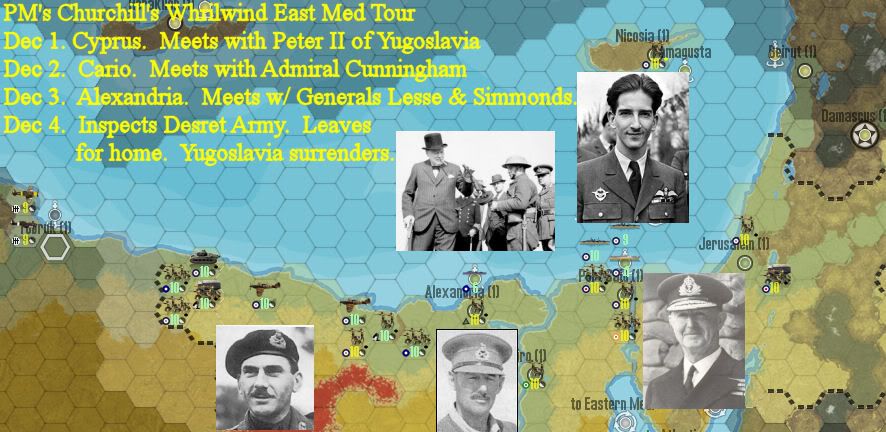
The Times of London. The Prime Minister’s Visit to the Desert.
The Desert Army
(Installment 6)
by Nigel Whitehurst
December 1 – 4, 1940.
December 1. Nicosia, Cyprus. Prime Minister Churchill is meeting with King Peter II of Yugoslavia on the island of Cyprus in the port village of Nicosia. Yugoslavia was invaded by the Germans on November 14 and from the very start thing went and continues to go very badly for them. The purpose of this meeting is to discuss Great Britain’s recognition and support of Yugoslavia’s government in exile headed by King Peter when the time came, which was looking like any day now. King Peter has gotten himself and his family out of Belgrade just in time a few days ago.
December 2. Cairo, Egypt. Today the prime minister is meeting with Admiral Cunningham in Cairo, Egypt. The prime minister wanted to personally thank the admiral for his decisive victory over the Italian navy. The admiral was informed that the losses of his smaller ships would be replaced (i.e., light cruisers, destroyers and smaller); but unfortunately the loss of the aircraft carrier HMS Eagle and two heavy cruisers wouldn’t be. For the foreseeable future, the Mediterranean fleet would operate at or below the intended strength of 200 ships and 25 submarines. This strength did included 7 formidable capital ships consisting of 1 aircraft carrier, 4 battleships and 2 heavy cruisers.
Mr. Churchill cautioned the admiral that while the Italian navy had been significantly degraded, its remnants if operating under the protection of German airpower would pose a grave risk to the Royal Navy and that further actions should be conducted with this in mind. SIS placed the remaining Italian naval strength at 1 newly commissioned battleship, 2 newly commissioned heavy cruisers, over 45 light cruisers, destroyers and frigates and 2 sub groups totaling approximately 50 submarines.
December 3. Alexandria, Egypt. Mr. Churchill meets with Generals Leese and Simonds to discussion two major strategy decisions for this theater. The first is the decision to halt the Desert Army’s advance into Libya based on the certain assessment that within a few months the full attention of the axis would be elsewhere and away from this theater for Britain in fact. While in general the SIS assessments had be spotted on they had missed a big one, which was the German’s attempt of Sea Lion. I wondered if this certainty was again based on some device called Enigma.
The second strategy decision was to execute Operation VS as soon as possible in order to remove the threat posed by unfriendly Vichy Syria to the Suez Canal and to Britain’s oil fields in the middle east. Securing Vichy Syria meant not only the removal of this threat but the secure of the eastern flank of the Desert Army. Mr. Churchill requested of General Leese could an estimate of what forces and his timetable for this operation tomorrow morning for his review. This request surely meant a busy and sleepless night for the both generals and their staffs.
December 4. Alexandria, Egypt. 05:00 (5am). It was an early breakfast because of the busy day planned for and with the Prime Minister. I was dining with both generals and their senior staff and though the Prime Minister was expected it was started promptly in his absence at 5:00am. Mr. Churchill was a man who worked late into the night and the wee hours of the morning. I came to find out that General Leese had already met with the Prime Minister an hour ago and briefed the Prime Minister on the requested details of Operation VS. The operation was to be conducted by the 2nd Canadian Mech, XII British Mech, 1st Canadian Infantry, 10th Indian Infantry corps and the Port Said infantry division supported by the entire RAF desert force of over 500 planes. General Simonds would be the tactical commander and in command of the ground operations in against Syria. The operation would be launched on February 2 and was expected to take 3 to 4 weeks to complete.
December 4. The Desert. 11:00 (11am) . Prime Minister Churchill is pleased as he inspects the troops of the Desert Army. One can see that this has an immediate effect of boosting the morale of all involved including the Prime Minister himself. Between visits to various units we are given the news that Yugoslavia has surrendered. While Mr. Churchill shows a brief flash of sadness at this news, the sadness disappears as quickly as it appeared. Today belongs to the troops and Mr. Churchill is determined to make that so.
December 4. Alexandria, Egypt. 17:00 (5pm). The first scheduled leg of the Prime Minister’s journey home was to take him to Malta then on to Gibraltar for the next leg. However; his plans were now altered a bit due to the fall of Yugoslavia. His first leg would now take him to Cyprus where he would take on additional passengers, King Peter II and his family. Yet again another sovereign nation had succumbed to their Nazi invaders and would now be added to the list of Hitler’s conquests. And yet again another government in exile was established.
Though we stood alone against the Nazis, we still stood free and ready to defend that freedom at whatever the cost. Unlike 1914 in Belgium and 1940 in France, we were fighting for our very survival and freedom to live as we chose.
The Times of London. Yugovlavia.
The Times of London. The Prime Minister’s Visit to the Desert.
Last edited by rkr1958 on Sat Jul 16, 2011 10:55 am, edited 2 times in total.
When I compare situation between the game and history, I'm don't think that I'm in better position. Except with the one major exception that I have the certain of USSR and USA entry, which provide me some measure of comfort which the British people didn't have at the time.Morris wrote:Although UK is alone in late 1940 , but your situation is much better than real history .
This comparison to the historical; especially in the Med is very interesting. In history, the Italian fleet lost half its strength in one night (11–12 November 1940) from the British raid on their naval base at Taranto. Afterwards things didn't go much better either for the Italian fleet.
Reference: http://en.wikipedia.org/wiki/Battle_of_Taranto
The Italian fleet lost about half its strength in one night, and the next day the Regia Marina transferred its undamaged ships from Taranto to Naples to protect them from similar attacks.[3] Repairs to Littorio took about five months, and to Caio Duilio six months; Conte di Cavour required extensive salvage work and her repairs were incomplete when Italy simultaneously surrendered in 1943 and declared war against Nazi Germany.[7] The Italian "fleet-in-being" diminished in importance, and the Royal Navy attained improved control of most of the Mediterranean. This control of the sea, with the help of the U.S. Navy and the Royal Canadian Navy during 1943–44, was to become complete, for all practical purposes. (Excepting only the Turks, who were neutral).
Despite this serious setback, the Regia Marina had adequate resources to fight the Battle of Cape Spartivento on 27 November 1940. However, the British decisively defeated the Italian fleet a few months later in the Battle of Cape Matapan, near Greece, in March 1941.
As you shall later see in a bit in our game, things also continue to go bad for the Italian fleet and the Italian army in North Africa.
With respect to history and the British 8th Army, I saw an interview with General O'Connor in the 1974 BBC series, "World at War". In this interview O'Connor stated that they were within striking distance of Tripoli and the capture of all of Libya in the spring of 1941. However; when the Germans intervene in Greece he was order to send most of his remaining tanks and a number of his forces to Greece. This combined with the introduction of Rommel and the Africa Korps flipped the tables on O'Connor and the British 8th army. In fact O'Connor found himself behind the axis lines and was captured by a support unit. And as we now know, the Africa Krops pushed the British 8th army out of Libya and all the way back to El Alamein. At this point in the game, as in history, there are only Italians present in Libya against which I can make gains. However; unlike history I've decided to wait (for now) because I know that my opponent can reverse the situation by the introduction of German ground and air units and this would cause me great harm there. So for now, I've decided to wait until he's occupied elsewhere before moving in. And, unlike history, I'm fairly certain that he'll be greatly involved elsewhere in the not so distance future.
As you shall see in later posts, things heat up in Libya sooner than I had anticipated. I was presented an opportunity that I took which did pay off. It's the old risk versus gain paradigm ...
The Times of London
The Desert Army
(Installment 7)
by Nigel Whitehurst
February 22, 1940.
Operation VS was a great success. Launched on February 2, it was concluded in less than 3 weeks on February 22. In addition to the 4 corps and 1 division of ground troops from the Desert Army that participated in the operation, 2 battalions of Free French also took part mostly for show. In fact the formal surrender of the Vichy army in Syria was made to General de Gaulle, overall commander of the Free French armed forces. It has been said that General de Gaulle was never beneath taking the credit for the toils of others. And pardon me but after this operation I will say I have to agree. Free French casualties were in the dozens while we lost 5000 men killed or severely wounded with over 50 vehicles destroyed. I was also amazed at how quickly the Vichy soldiers who fought against us are now so willing to join de Gaulle, who hopes to raise a brigade or two out these new converts.
I was tonight against fortunate to dine with General Lesse, General Simonds and their staff one again. Once dinner was a joyous affair and we each have several drinks as we toasted General Simonds and his successful and quick knockout of Vichy Syria. We even toasted General de Gaulle, but I have to say that there was a bit of sarcasm in the toast. Fortunately, General de Gaulle was still in Syria and we were not required to put on pretense for him.
Also at dinner, I pick up on conversation between General Lesse and General Simonds about more saber rattling from the axis in the Balkans. Since Yugoslavia had been under the Nazi jackboot for several months now, this could only mean one thing and that was Greece.
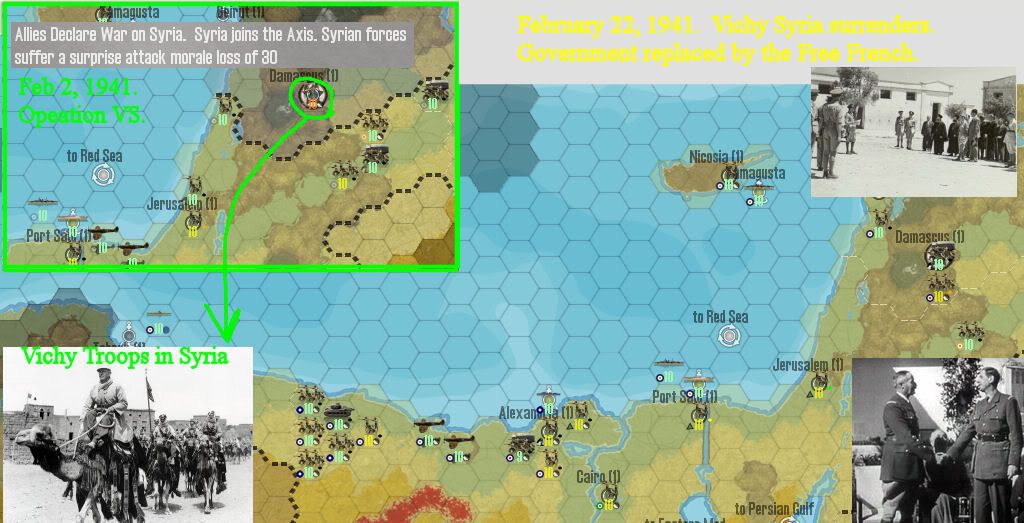
The Times of London. Vichy Syria is Liberated!
The Desert Army
(Installment 7)
by Nigel Whitehurst
February 22, 1940.
Operation VS was a great success. Launched on February 2, it was concluded in less than 3 weeks on February 22. In addition to the 4 corps and 1 division of ground troops from the Desert Army that participated in the operation, 2 battalions of Free French also took part mostly for show. In fact the formal surrender of the Vichy army in Syria was made to General de Gaulle, overall commander of the Free French armed forces. It has been said that General de Gaulle was never beneath taking the credit for the toils of others. And pardon me but after this operation I will say I have to agree. Free French casualties were in the dozens while we lost 5000 men killed or severely wounded with over 50 vehicles destroyed. I was also amazed at how quickly the Vichy soldiers who fought against us are now so willing to join de Gaulle, who hopes to raise a brigade or two out these new converts.
I was tonight against fortunate to dine with General Lesse, General Simonds and their staff one again. Once dinner was a joyous affair and we each have several drinks as we toasted General Simonds and his successful and quick knockout of Vichy Syria. We even toasted General de Gaulle, but I have to say that there was a bit of sarcasm in the toast. Fortunately, General de Gaulle was still in Syria and we were not required to put on pretense for him.
Also at dinner, I pick up on conversation between General Lesse and General Simonds about more saber rattling from the axis in the Balkans. Since Yugoslavia had been under the Nazi jackboot for several months now, this could only mean one thing and that was Greece.
The Times of London. Vichy Syria is Liberated!
You are quite right . But here is my personal opinion : Since the time is almost 1941 , if Axis involve more units in Africa ( according to the UK's scale ,Axis should invest at least two armor ,two Mech ,three INF , 3FTR & plus the Italian troops to balance the situation ),they will have to delay or soft the Babarosa , that will be fatal for the Axis . So I suggest 8th army move forward until you find the German's reinforcement ,otherwise just swept the Italians out of the north africa (inckuding Tunis). It will make axis put more power to defend Sisily & italy mainland . then the Allies will grab the initiative of the War earlier .
You are quite right as you shall see beginning Nigel's next installment. This is an intresting AAR for me because I'm writing from past turns of a game that's now in April 1942. I'm also posting screen caps from the beginning of my turn. I have to load several old consecutive turns to remember as best as I can what I did. Back to Nigel's timeframe of February 22, my opponent will invade Greece next turn. From a game perspective I know that any delay I can force on him by either moving against him in Crete or in North Africa is good for Russia.Morris wrote:You are quite right . But here is my personal opinion : Since the time is almost 1941 , if Axis involve more units in Africa ( according to the UK's scale ,Axis should invest at least two armor ,two Mech ,three INF , 3FTR & plus the Italian troops to balance the situation ),they will have to delay or soft the Babarosa , that will be fatal for the Axis . So I suggest 8th army move forward until you find the German's reinforcement ,otherwise just swept the Italians out of the north africa (inckuding Tunis). It will make axis put more power to defend Sisily & italy mainland . then the Allies will grab the initiative of the War earlier .
In history German was forced to invade Greece , It was a poison of Babarosa . In GS , If Axis could not take Greece within 3 turn ,Allies would get the opportunity to hold Athens for long time . it would be a bloody injury of axis until babarosa .
Axis could not afford this blood whenever there is a war with Russia
.
Axis could not afford this blood whenever there is a war with Russia
.
The Times of London
The Desert Army
(Installment 8 )
by Nigel Whitehurst
March 14-24, 1940.
March 14. 08:30 hours. General Leese’s HQ, Alexandria, Eygpt . We get word that Greece was invaded by armed forces of Italy, German, Romania and Bulgaria at 07:00 hours (or 7am) this morning. The initial ground thrust was by two Italian infantry crops coming from the north and by one Italian corps landed north of Greece by amphibious invasion. Air supported was provided by a large axis air army located in the north and which was composed of 680 German Stukas, 260 Rumania bombers and 260 Rumania fighters. In the south a force of 260 Italian bombers provide the air support. The (estimated) remaining Italian surface fleet of 1 battleship, 2 heavy cruisers and 45 destroyers, frigates and other ships had been moved into the straights of Rio-Antirrio to cover and provide support for the amphibious invasions. The where abouts of the 2 (known) Italian sub groups, consisting of 50 submarines, was unknown but were assumed to be blocking the entrance of the Rio-Antirrio straights and/or access to Crete.
A flash message from the Prime Minister himself had come in ordering General Leese to fly to Port Said as soon as possible to meet with Admiral Cunningham and General Simonds. The meeting was scheduled for 17:30 hours, since General Simonds was currently in Damascus, Syria and it would take him some time to get there.
March 14. 17:30 hours (5:30pm). Aboard the aircraft carrier Illustrious, Port Said, Egypt. Admiral Cunningham begins the meeting was details of a surprising and highly classified dispatch sent in naval code from London to the carrier Illustrious via a roundabout route that took it through the RN Pacific fleet and India for security reasons. The conquest of Greece was certain and; therefore, no Commonwealth ground troops would be sent into mainland Greece. However; any and all actions of low risk that can delay the conquest of Greece and force the axis to devote air forces there for as long as possible are ordered.
What the heck?! In effect, the Desert Army and RN Med fleet were being order to conduct low risk spoiling attacks. But why? And spoiling attacks for whom?! England was safe from Sea Lion … what else was brewing where it was beneficial for the war effort to “keep” axis airpower in the Med for as long as possible?
General Leese and General Simonds are ordered to launch a probing attack into Libya and to press that attack if the situation warrant. However; the ground attacks will continue only if the damage inflicted or the gains made are far greater than the losses incurred. Admiral Cunningham, who continued to read the dispatch in the 3rd person, was ordered to seize Crete and inflict further losses on the Italian fleet if possible with minimum risk.
Admiral Cunningham was given overall command of the Crete operation and was to, as a lower priority, provide naval support to General Leese’s move into Libya.
This meeting continued on through the evening and night without breaking for dinner. Admiral Cunningham’s aide did bring us sandwiches and coffee at 18:00 hours (6:00 pm) and this was greatly appreciated as General Leese and I hadn’t anything to eat since breakfast 12 hours ago. The meeting finally broke up at around 01:00 hours (1am) the next morning and while much was discussed, details of which I don’t have the space or time to print here, four major decisions were reached. (1) General Leese and Simonds would launch a probing attack into Libya on March 24 (in 10 days) supported by over 500 RAF fighters and from the RN 3 battleships, 1 heavy cruiser and 21 destroyers and smaller ships. (2) Admiral Cunningham would send his sub group of 25 submarines to blockade of the Italian surface fleet now operating in the Rio-Antirrio straights. If Italian subs in force were screening the entrance (as expected) then Cunningham’s subs were to set up ambushed of Italian naval ships. If; however and by luck, they were able to establish the blockade then they were to stay in place until their group captain decided that losses versus damage inflicted were becoming unacceptable. (3) The remaining RN Med fleet, consisting of the aircraft carrier Illustrious, 1 battleship, 1 heavy cruiser and 75 destroyers and smaller ships were to be kept in reserve to exploit any opportunities that developed. (4) This by far was the most controversial of the four major decisions. The Kirkuk division at Port Said was to be transported unescorted to Heraklion to establish British control of that city and the island of Crete. If Italian subs were lying in wait and blockading Heraklion (very likely) then this division could be lost. Even if they arrived safely it was expected their presence would draw a significant axis response. Once again Belgium in 1914 and our sacrifice for the greater good came flooding back.
March 24. General Leese’s HQ somewhere in the Egyptian Desert. The men of the Desert Army are about to cross into Libya and taste battle for the first time. Fortunately, it looks like it’s only the Italians facing them.
An encoded dispatch comes in from Admiral Cunningham’s command stating that his sub group was able to establish a blockade of the entrance of the Rio-Antirrio straights and have the remnants of the Italian surface fleet bottled up (for now). Also, the Kirkuk Division had made it through to Crete unmolested and was now disbarking and taking control of the island. No additional axis air movements to cover Crete had been detected and (for now) the only know axis air cover of Crete was by 260 Italian bombers. Given these development, Admiral Cunningham decided to move the 10th Indian infantry corps to Crete and make the axis fight for the island if they really wanted it. This move would be covered by the 75 ships that he had held in reserve 10-days ago. His flagship, the aircraft carrier Illustrious would provide the air cover all units in and around Crete.
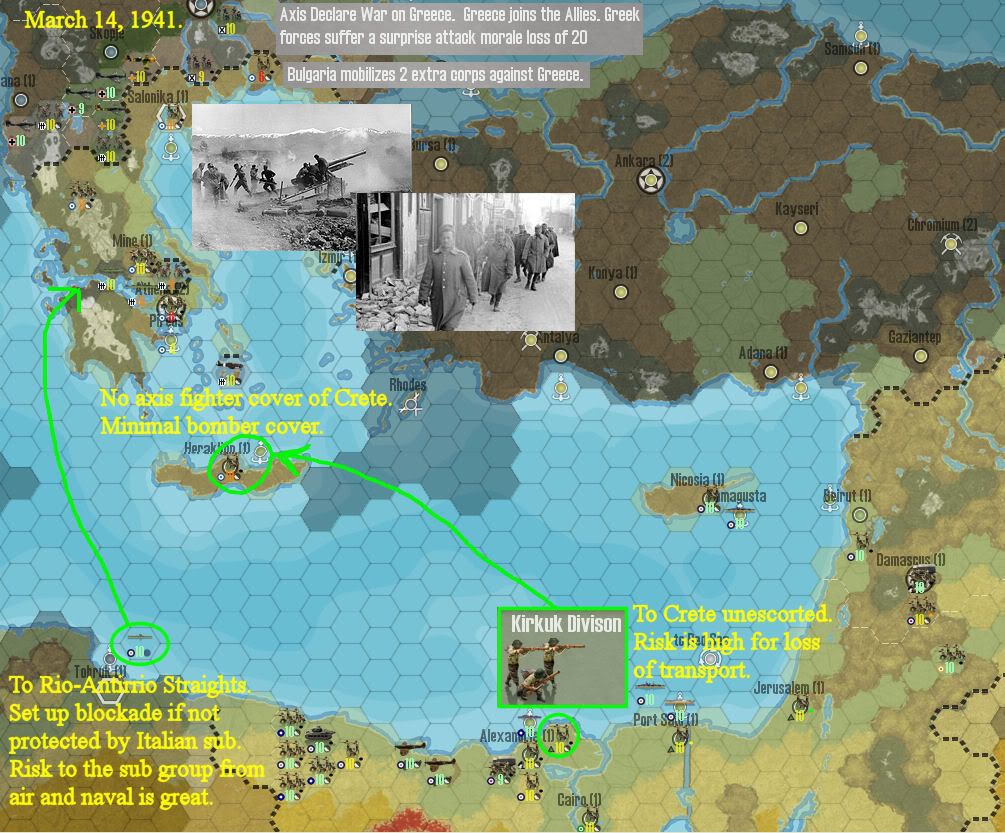
The Times of London. Greece Invaded!
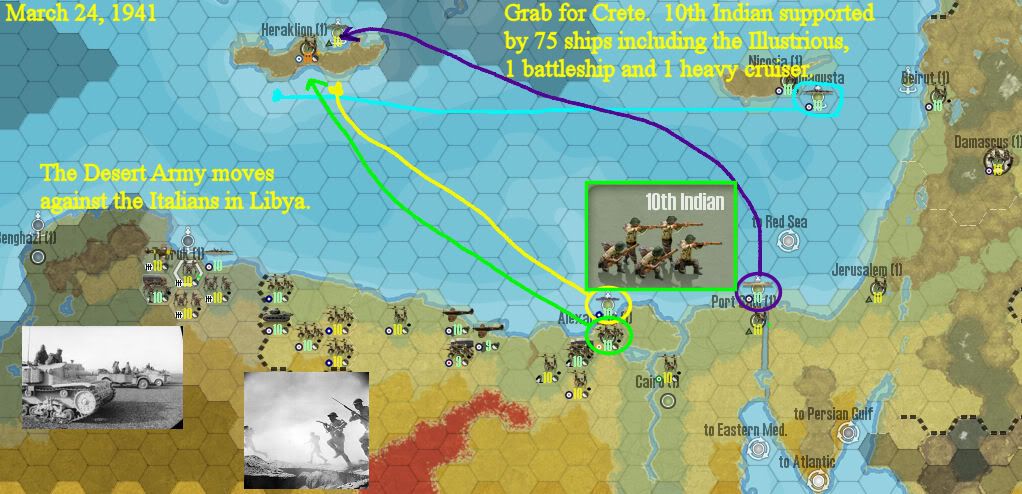
The Times of London. The Desert Army and RN Med fleet on the Move.
The Desert Army
(Installment 8 )
by Nigel Whitehurst
March 14-24, 1940.
March 14. 08:30 hours. General Leese’s HQ, Alexandria, Eygpt . We get word that Greece was invaded by armed forces of Italy, German, Romania and Bulgaria at 07:00 hours (or 7am) this morning. The initial ground thrust was by two Italian infantry crops coming from the north and by one Italian corps landed north of Greece by amphibious invasion. Air supported was provided by a large axis air army located in the north and which was composed of 680 German Stukas, 260 Rumania bombers and 260 Rumania fighters. In the south a force of 260 Italian bombers provide the air support. The (estimated) remaining Italian surface fleet of 1 battleship, 2 heavy cruisers and 45 destroyers, frigates and other ships had been moved into the straights of Rio-Antirrio to cover and provide support for the amphibious invasions. The where abouts of the 2 (known) Italian sub groups, consisting of 50 submarines, was unknown but were assumed to be blocking the entrance of the Rio-Antirrio straights and/or access to Crete.
A flash message from the Prime Minister himself had come in ordering General Leese to fly to Port Said as soon as possible to meet with Admiral Cunningham and General Simonds. The meeting was scheduled for 17:30 hours, since General Simonds was currently in Damascus, Syria and it would take him some time to get there.
March 14. 17:30 hours (5:30pm). Aboard the aircraft carrier Illustrious, Port Said, Egypt. Admiral Cunningham begins the meeting was details of a surprising and highly classified dispatch sent in naval code from London to the carrier Illustrious via a roundabout route that took it through the RN Pacific fleet and India for security reasons. The conquest of Greece was certain and; therefore, no Commonwealth ground troops would be sent into mainland Greece. However; any and all actions of low risk that can delay the conquest of Greece and force the axis to devote air forces there for as long as possible are ordered.
What the heck?! In effect, the Desert Army and RN Med fleet were being order to conduct low risk spoiling attacks. But why? And spoiling attacks for whom?! England was safe from Sea Lion … what else was brewing where it was beneficial for the war effort to “keep” axis airpower in the Med for as long as possible?
General Leese and General Simonds are ordered to launch a probing attack into Libya and to press that attack if the situation warrant. However; the ground attacks will continue only if the damage inflicted or the gains made are far greater than the losses incurred. Admiral Cunningham, who continued to read the dispatch in the 3rd person, was ordered to seize Crete and inflict further losses on the Italian fleet if possible with minimum risk.
Admiral Cunningham was given overall command of the Crete operation and was to, as a lower priority, provide naval support to General Leese’s move into Libya.
This meeting continued on through the evening and night without breaking for dinner. Admiral Cunningham’s aide did bring us sandwiches and coffee at 18:00 hours (6:00 pm) and this was greatly appreciated as General Leese and I hadn’t anything to eat since breakfast 12 hours ago. The meeting finally broke up at around 01:00 hours (1am) the next morning and while much was discussed, details of which I don’t have the space or time to print here, four major decisions were reached. (1) General Leese and Simonds would launch a probing attack into Libya on March 24 (in 10 days) supported by over 500 RAF fighters and from the RN 3 battleships, 1 heavy cruiser and 21 destroyers and smaller ships. (2) Admiral Cunningham would send his sub group of 25 submarines to blockade of the Italian surface fleet now operating in the Rio-Antirrio straights. If Italian subs in force were screening the entrance (as expected) then Cunningham’s subs were to set up ambushed of Italian naval ships. If; however and by luck, they were able to establish the blockade then they were to stay in place until their group captain decided that losses versus damage inflicted were becoming unacceptable. (3) The remaining RN Med fleet, consisting of the aircraft carrier Illustrious, 1 battleship, 1 heavy cruiser and 75 destroyers and smaller ships were to be kept in reserve to exploit any opportunities that developed. (4) This by far was the most controversial of the four major decisions. The Kirkuk division at Port Said was to be transported unescorted to Heraklion to establish British control of that city and the island of Crete. If Italian subs were lying in wait and blockading Heraklion (very likely) then this division could be lost. Even if they arrived safely it was expected their presence would draw a significant axis response. Once again Belgium in 1914 and our sacrifice for the greater good came flooding back.
March 24. General Leese’s HQ somewhere in the Egyptian Desert. The men of the Desert Army are about to cross into Libya and taste battle for the first time. Fortunately, it looks like it’s only the Italians facing them.
An encoded dispatch comes in from Admiral Cunningham’s command stating that his sub group was able to establish a blockade of the entrance of the Rio-Antirrio straights and have the remnants of the Italian surface fleet bottled up (for now). Also, the Kirkuk Division had made it through to Crete unmolested and was now disbarking and taking control of the island. No additional axis air movements to cover Crete had been detected and (for now) the only know axis air cover of Crete was by 260 Italian bombers. Given these development, Admiral Cunningham decided to move the 10th Indian infantry corps to Crete and make the axis fight for the island if they really wanted it. This move would be covered by the 75 ships that he had held in reserve 10-days ago. His flagship, the aircraft carrier Illustrious would provide the air cover all units in and around Crete.
The Times of London. Greece Invaded!
The Times of London. The Desert Army and RN Med fleet on the Move.
-
massina_nz
- Lieutenant Colonel - Fw 190A
- Posts: 1137
- Joined: Fri Dec 18, 2009 12:12 am
- Location: Wellington, New Zealand
Just some advice for the Crete move.
Although it's very unlikely in this game that Athens will fall next turn, if it did then the transport in the Cretan port would be scuttled. Far safer to place the transport in the hex immediately to the south of Heraklion, although that may require some escort ships to protect it more.
Although it's very unlikely in this game that Athens will fall next turn, if it did then the transport in the Cretan port would be scuttled. Far safer to place the transport in the hex immediately to the south of Heraklion, although that may require some escort ships to protect it more.