Free France Campaign

Moderators: The Artistocrats, Order of Battle Moderators

bru888
Order of Battle Moderator
Posts: 6214
Joined: Sun Jan 10, 2016 5:39 pm
Location: United States

Re: Free France Campaign

Post by bru888 »

Free France 1940-1945 v0.52 has been uploaded.

Free France 1940-1945 (eighteen scenarios)

This version includes these changes to the Liberation of Paris scenario:
• Added 2 units of Zundapp Motorcycles (German faction, not SS, and labeled "Geheime Feldpolizei") to the Paris military police. This should increase the partisan casualty rate (which is one reason why I left the turns and quota alone).
• Tweaked German resource income up by 2 per turn.
• Changed condition for activating Western and Eastern Defense groups from one destroyed enemy bunker to one Allied land unit entering Paris (within 8 hexes of primary VP flag).
• Instead of Defend Hex, the order for these Defense groups is Move to Hex (99 aggression, to primary VP flag) and go to Seek & Destroy when they get there.
• ALL German army AI teams will go to Seek & Destroy once the first key site is liberated. This should increase the intensity of the struggle. Any remaining outlying garrisons should make their way into the city, making it important that the necessary preparations have been made by the Allies.
• When the first key site is liberated (and the enemy bunker is replaced with a friendly bunker of the same key site name), a popup message announces a new objective of "Don't let the enemy destroy any key sites."
• To simulate the Allies now defending these key sites (I was thinking of them as neutralized before this change), the spawned Allied bunkers will come with experience.

Here is the new objective (both green-checked objectives are disabled at the start of the scenario and are enabled by circumstances):

Screenshot 1.jpg
Screenshot 1.jpg (407 KiB) Viewed 1749 times

When the player liberates the first key site (any of the 14 buildings and monuments controlled by the Germans at the start), he gets this message and the objective is enabled:

Screenshot 2.jpg
Screenshot 2.jpg (188.06 KiB) Viewed 1754 times
- Bru
ColonelY
Colonel - Ju 88A
Colonel - Ju 88A
Posts: 1519
Joined: Tue Jan 07, 2020 8:46 am

Re: Free France Campaign

Post by ColonelY »

18LiberationOfParis: 8)
(3rd test, v0.52, lvl III)

Now, that's another masterpiece! :D

It's much better, more spicy, with more action/German activity... :D

(MV again during the 25th turn, 8 units of partisans have been destroyed this time; no need at all to change these thresholds.)

:arrow: I would say this scenario is ready. 8)


(Well, I've still have this XP issue, though. But we may keep this for perhaps much, much later. Anyway, I suggest that we forget about this part right now.)
ColonelY
Colonel - Ju 88A
Colonel - Ju 88A
Posts: 1519
Joined: Tue Jan 07, 2020 8:46 am

Re: Free France Campaign

Post by ColonelY »

ColonelY wrote: Fri May 28, 2021 4:02 pm
bru888 wrote: Fri May 28, 2021 3:32 pm [...] By the way, I assume you are seeing those four Victory Messages at the end ("German Surrender," "Joy of Freedom," "Triumphant Generals," and "Paris is Free"), just before the Major Victory screen.
[...] :arrow: Yes, indeed, I've seen correctly the 4 Victory Messages! So that's perfectly fine! :D
Same thing by the way with the last event "Bottleneck Relieved" during 17OperationDragoon. :wink: So, this works as intended! :D
bru888
Order of Battle Moderator
Posts: 6214
Joined: Sun Jan 10, 2016 5:39 pm
Location: United States

Re: Free France Campaign

Post by bru888 »

Up next, another package deal like Medenine and Battle of the Mareth Line. A short introductory scenario (Strasbourg) followed by a longer scenario using the same map (Operation Nordwind).

What I am wrestling with are:
• How short is "short" for Strasbourg? Medenine is only 15 turns; is that what I want for Strasbourg? So far, my research shows that Leclerc virtually sailed into the city, meeting only token resistance.
• How much do I want to "stretch" Operation Nordwind? I do have evidence that the Germans were attacking from north and south (the latter being a small contingent from the Colmar Pocket) but I don't think they got near Strasbourg. For the sake of fun, they may have a better chance in this scenario.
- Bru
ColonelY
Colonel - Ju 88A
Colonel - Ju 88A
Posts: 1519
Joined: Tue Jan 07, 2020 8:46 am

Re: Free France Campaign

Post by ColonelY »

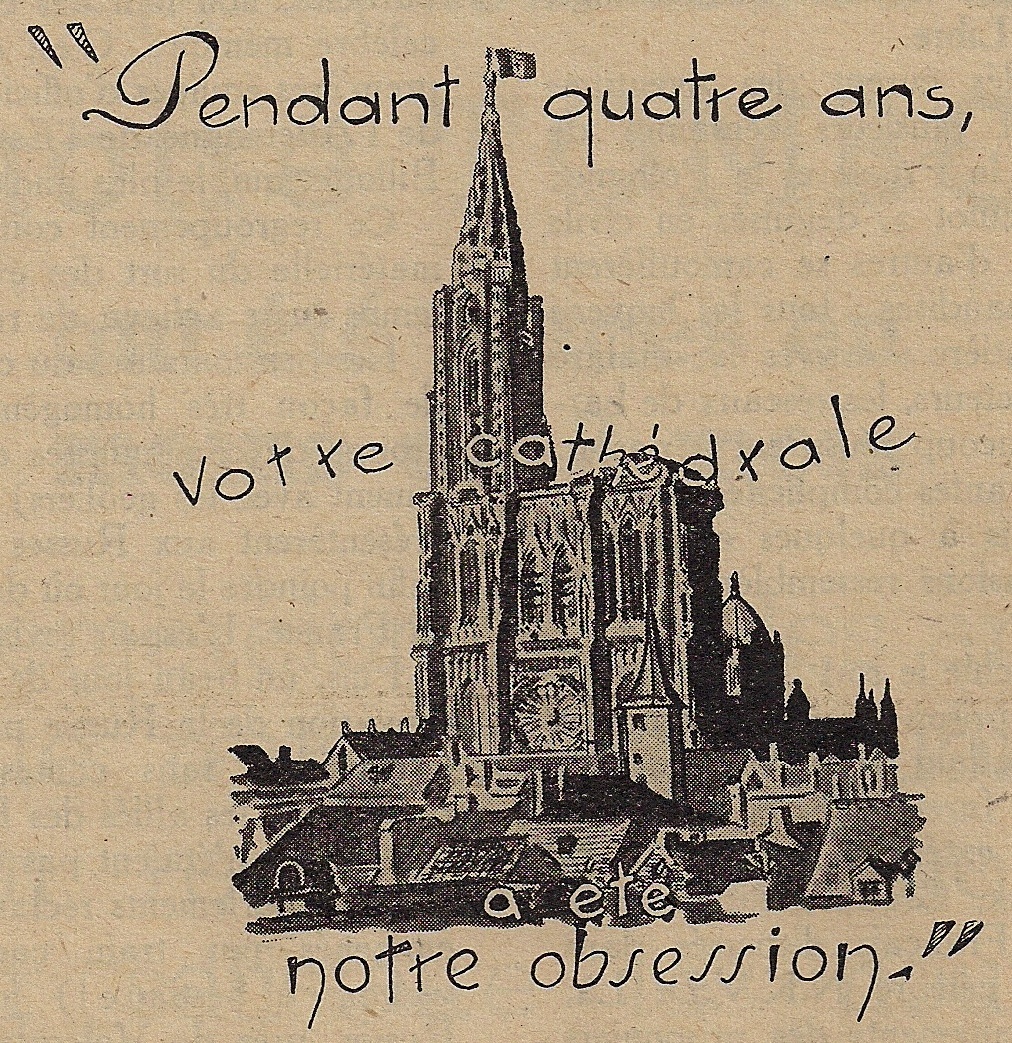
8) http://www.france-libre.net/site/wp-con ... g3-grd.jpg => "Pendant quatre ans, votre cathédrale a été notre obsession." = "For four years, your cathedral has been our obsession."

All the way from the Koufra's oath: http://www.france-libre.net/site/wp-con ... g1-grd.jpg
ColonelY
Colonel - Ju 88A
Colonel - Ju 88A
Posts: 1519
Joined: Tue Jan 07, 2020 8:46 am

Re: Free France Campaign

Post by ColonelY »

bru888 wrote: Sat May 29, 2021 1:53 pm [...] Leclerc virtually sailed into the city, meeting only token resistance. [...]
:? German casualties: "Heavy losses in killed and wounded, 6000 prisoners" (according to https://fr.wikipedia.org/wiki/Lib%C3%A9 ... Strasbourg )
ColonelY
Colonel - Ju 88A
Colonel - Ju 88A
Posts: 1519
Joined: Tue Jan 07, 2020 8:46 am

Re: Free France Campaign

Post by ColonelY »

ColonelY
Colonel - Ju 88A
Colonel - Ju 88A
Posts: 1519
Joined: Tue Jan 07, 2020 8:46 am

Re: Free France Campaign

Post by ColonelY »

Tanslations from the French wiki page (more complete):

"Breakthrough of the Vosges

In November 1944, the 15th American Corps, to which the 2nd armoured division belonged, came up against two successive positions, which the Germans had been organizing since September by using 50,000 Alsatians put to forced labour. The "Vorvogesen Stellung" (first line of defense) and the "Vogesen Stellung" (main line of defense) covered the Vosges mountains and its passes.

The offensive started on November 13th. On November 17th, the 2nd armoured division took Badonviller (Meurthe-et-Moselle) and opened a breach in the German stopping device. During the engagement, lieutenant-colonel de La Horie was killed.

General Leclerc could now launch his charge on Strasbourg. He received from the head of the FFI Alsace, Marcel Kibler (commander Marceau), the assurance that he would find several thousand FFI organized upon his arrival in Alsace to make up for his lack of infantry. He gave his division unambiguous orders: to systematically outflank any resistance without being fixed, to push forward without concern for alignment or liaison with the rear and to find the "hole".

Through Petite-Pierre, the 2nd armoured division overran Sarrebourg and Saverne, which were strongly fortified. Guided by the FFI, it looked for a passage even if it was only a forest road. The Massu group found a track in Dabo, cut by a forest floor neither beaten by fire nor mined. He cleared it easily. General Leclerc found the "hole" he was looking for. On 23 November 1944, the whole 2nd armoured division crossed the Vosges ridge via Dabo. It surprised the enemy by breaking through its rear in the Alsace plain.


The charge of the 2nd armored division

During the night of November 22 to 23, the 2nd armoured division received the order to take Strasbourg in place of the American 6th Corps if it was not ready. General Leclerc gave his orders for the charge of the division: "Objective: Strasbourg-Kehl bridge... Do not linger, but charge to the maximum... Bypass the resistance and eventually do not hesitate to slightly modify the prescribed axes... Do not ensure the guarding of the prisoners but disarm them... Arrest important personalities... ".

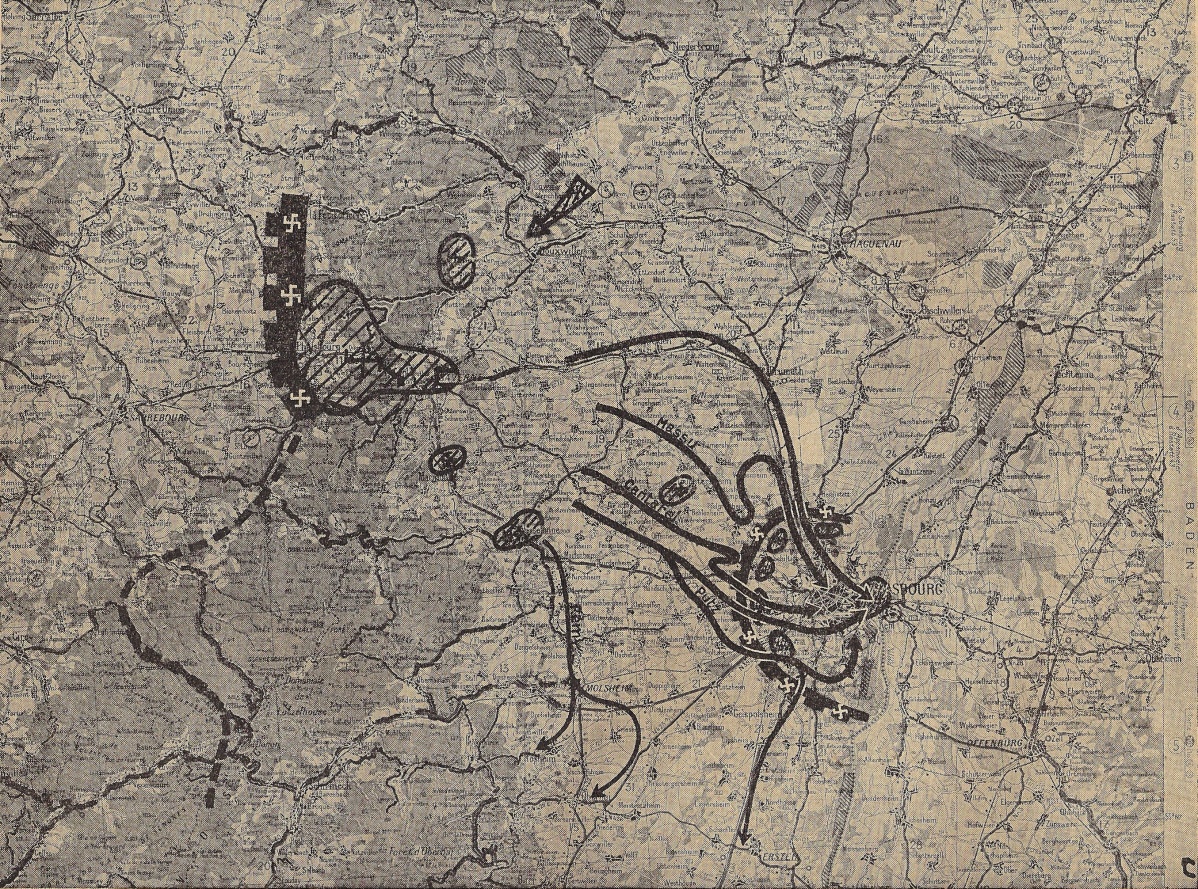
On November 23, 1944 at 7 am, the 2nd armored division charged Strasbourg in five columns guided by the Alsatian FFI. Around 9 am, the suburbs and the western belt of the city's forts were reached (forts Foch, Pétain and Kléber). They were well defended and reinforced by anti-tank ditches and trenches that the people of Strasbourg had to dig. They stopped the progression of the columns. But guided by the FFI Robert Fleig, the column coming from the north along the canal from the Marne to the Rhine broke through the defense line and entered Strasbourg. The lieutenant-colonel Rouvillois who commanded it transmitted the message "Tissu est dans iode" (Fabric is in iodine) which informed General Leclerc that the 2nd armoured division was in Strasbourg and that he was heading towards the Kehl bridge following one of the two routes suggested by his FFI guide Robert Fleig. The other columns changed their axis of progression to follow his route.

The surprise was total. The streetcars, packed with passengers, ran normally. The Germans went about their business as the tanks passed through the streets. Gauleiter Wagner had just enough time to flee to the other side of the Rhine. But 15,000 German civilians were taken prisoner; the proximity of the border saved many of them. General Vaterrodt's chief of staff, who commanded the town of Strasbourg, was captured on horseback, surprised during his daily morning ride, by a platoon of five Shermans.

The Kommandantur and part of General Vaterrodt's staff were captured at the Rhine Palace. General Vaterrodt succeeded in entrenching himself with 600 men in Fort Ney to the north of Strasbourg in the Robertsau forest.

The Kehl bridge was quickly reached but it was well defended by works and heavy fire. It was not crossed. The hope of a bridgehead in Germany vanished despite furious fighting during which the FFI guide Robert Fleig was killed. Near the bridge, the chief marshal Albert Zimmer, from La Wantzenau, was killed on board the tank "Cherbourg". He died a few kilometers from his parents' home, whom he had left in July 1941 when he escaped from Alsace.

At 2:20 p.m., the French flag flew over the cathedral. Strasbourg was taken but the fighting was not over. For several days, the 2nd armored division and the FFI of commander François (Georges Kieffer) cleaned up the pockets of resistance. The Esplanade district, where the barracks were located, was one of the most difficult to reduce, along with the harbour district. The FFI guided the tanks, provided precious infantry for the street fighting, guarded the prisoners, and served as translators for the intelligence service of the 2nd armoured division. Thanks to the resistance fighter Robert Kleffer, leader of the FFI of La Wantzenau, a large part of the German garrison could not cross the Rhine.

On November 25, 1944, General Vaterrodt surrendered with the garrison of Fort Ney (626 men), which brought the number of prisoners to approximately 6,000 soldiers. The city was subjected to heavy artillery fire. During the night of 27-28 November, the last Germans withdrew to the other side of the Rhine and blew up the bridges at Kehl.

On November 27, the former mayor Charles Frey resumed his functions. General de Gaulle appointed Charles Blondel as commissioner of the Republic and Gaston Haelling as prefect.

Strasbourg was liberated but not saved. To consolidate this victory, it was necessary to wait until January 1945 and the terrible battles fought in Kilstett, Kaltenhouse, Schweighouse, Ohlungen and Gambsheim. During the operation "Nordwind" (north wind) led by the generals Johannes Blaskowitz Hans von Obstfelder and Siegfried Rasp. The city remained exposed to artillery fire until May 1945.
"
ColonelY
Colonel - Ju 88A
Colonel - Ju 88A
Posts: 1519
Joined: Tue Jan 07, 2020 8:46 am

Re: Free France Campaign

Post by ColonelY »

:arrow: There are already some interesting ingredients, to prepare something really cool: :D

Clear consigns, many partisans active, 4 named forts, some bridges too strongly defended to be crossed, most of the German units to be trapped within the city, bridges to be blown by evacuating Germans, etc.
ColonelY
Colonel - Ju 88A
Colonel - Ju 88A
Posts: 1519
Joined: Tue Jan 07, 2020 8:46 am

Re: Free France Campaign

Post by ColonelY »

Translated from here: https://www.france-libre.net/liberation-strasbourg/

There will be some repetitions, but some new info as well... :wink:


"On March 1, 1941, at the foot of the flagpole of the fortress of Cufra, from where the Italian colors had just been brought to raise the tricolor flag with the cross of Lorraine, victorious for the first time since "the shameful armistices", Leclerc's companions were a handful, a modest handful of men, to take the famous Oath.

Moved and passionate, they felt intensely the magnitude of their gesture. Beyond themselves, they had just committed all the Free French. And beyond that, all those who, with arms in hand, would set out in days of holy anger along the paths of enslaved France, towards the proud capital of Alsace, whose engraved stone on one of its bridges proclaimed: "Here begins the land of liberty".

Four years later, on November 23, 1944, General Leclerc led his terrible pack of steel and iron to the gates of Alsace. In a charge in which almost every moment was a challenge to traditional military art, he took Strasbourg. On the spire of the cathedral, he brought the Nazi flag and unfurled the French flag.

Certainly this page of history is not the prerogative of the only Free French, they took however, of the general Leclerc to the last of the soldiers of Chad, the dominating part. This is a broad outline of the story.

Since November 13, the 2nd Division, wading through the snow, had been working hard to break through the defensive line of the pre-Vosges, which blocked Saverne, the Donon, the Schlucht and Bonhomme passes.

Badonviller was taken on the 17th and Cirey on the 19th. In these two operations, which were carried out with great force, the Free French paid a heavy price, as usual. Captains Geoffroy, Dubut and Maziéras, all elders of Cufra, were killed, the first two by a bullet in the head, the third by a piece of shrapnel in the heart.

In Cirey, Leclerc felt that he had to catch the enemy off guard and that the moment was approaching for which everything had been done up to that point: the difficult moment of release.

Four armored columns were formed. Each one was given a specific route and waited impatiently for the signal to rush. If the signal is given too early, the pack is immediately stopped by an obstacle that is too hard for it to catch up with. Given too late, it will no longer seize that fleeting moment when the enemy loses his balance, when violence and speed suddenly take over.

The pack will not wait too long. On the morning of the 20th, an armored battalion from Chad, made up of F.F.L. from Chad and the Corps Franc d'Afrique, tore apart the "Gebirgsjager" that had come from Austria to defend the Vosges and blew up the anti-tank barricades at the foot of the mountain in Lafrimbolle. The Massu column rushed through the open passage.

In a hurry, it made it in one go, without any of the numerous roadblocks prepared against it having the time to play, more than 20 kilometers.

At first an empty zone which immediately follows the battle. Soon, the show comes to life. As it approaches a hairpin bend that will take it to the bottom of the valley to return to the opposite side, the lead Jeep sees the tail of the enemy column disappear. At the next bend, the distance had decreased. The 88 motorized vehicles had gone ahead or parked on the crossings (from which some of them would still try to fire at close range), and it was now the horse-drawn artillery, 105s and 150s, that lagged behind. The brave horses galloped as long as they could: they gained another turn, then, under the tac-tac of the machine guns, were abandoned in the blink of an eye by the servants and drivers.

The drifting carriage is pulled up by the tank, which is careful not to stop it across the road. The road, above all, must be kept free. The tank therefore overtook without firing, then, with a blow of its tail, tipped the pieces and the animals into the ditch.

About fifteen pieces passed with their trains, in all at least 50 teams. The corpses of men and horses were strewn across the road, the few who remained in the middle were mercilessly crushed. The cars, trucks, and towed cannons were joined in turn, set on fire at the edge of the villages. The column continued its clash, without a backward glance.

It will stop only at night, at the crossroads of Rehtal where the battle group of colonel de Guillebon, also led by the general on this axis, will join after midnight.

At dawn on the 21st, the movement resumed, with Massu in the lead, followed by the entire Guillebon group. Minjonnet would then pass, and the Langlade group, thus separated into two sections, would only come back together in the plain.

The Azelbourg bridge, the Dabo defenses were empty (we found in Saverne the order to garrison them urgently), Dabo itself was reached after a very small battle. However, a battery of 88s that had retreated blocked the road at the exit of the clearing: would the two hours of respite that the clearing of the trees would give them the opportunity to launch a parry, or at least to carry out the destruction that would considerably delay the descent?

The small papal chapel which saw on this road the medieval vicissitudes of the bishops and the counts dominates from its rocky base the group of sappers who saw the big lying fir trees and who put a blow, I swear it to you. With a gesture of his cane, Massu put the column back on the march towards Alsace.

And in the afternoon, the news spread out. The spindly column descended another 20 kilometers of steep twists and turns in the forest, emerged and spread out over the first clearings on the plain. Birkenwald, Reinhardsmunster, Dimbsthal, Allenwiller. At Singrist, it cuts the main road between Marmoutier and Wasselonne, where many military cars, with their minds at rest, all headlights on, will come to a standstill and be massacred at our traffic jams. The German defense closes in between the walls that have their garrison on the spot; elsewhere, the Alsatian villages that have returned to ours try to speak their French again.

And because the vocabulary is rare, because the same words are repeated, this meeting keeps a serious air. It is denser of all that is not expressed, more solid behind the modesty of the unfinished gestures.

The first quarters are taken in all the austerity of the war.

*

On the way to the Alsatian capital, once the Vosge has been crossed, there is still a powerfully fortified bastion: Saverne. The city and its defenses were attacked from the north, center and south. Saverne fell during the day of November 22nd.

At the end of the evening, the general finally gave his orders for Strasbourg: the columns were to approach the outer defences by the maximum number of routes, and the others were to be diverted to those that proved easier. Once again, the orders were to go forward without wasting a second, not to delay in disarming the enemy and sending him back to the rear without escort, to cross Strasbourg leaving only the indispensable elements and to march straight to the bridge of Kehl.
The general fixed four routes with latitude, for a column (Guillebon) of a fifth. They converged on Strasbourg via Schiltigheim, Mittelhausbergen, Cronenbourg, Kœnisgshoffen. As for a race and as to surprise the enemy everywhere at once, the crossing of the line was imposed at 7:15 am, at daybreak, to the column commanders.

*

So, on the morning of the 23rd, the affair was launched. At their exit, the columns engaged in a few skirmishes with small garrisons. The plain was crossed at full gallop. But resistance was revealed in the belt of forts that covered Strasbourg, and held under fire the anti-tank ditches that blocked the access roads. Three armoured groups commanded by Free Frenchmen struggled hard: Cantarel in front of Fort Pétain, Putz in front of Fort Kléber, Massu in front of Fort Foch. For the latter the situation was very difficult. Its road was indeed strewn with secondary works, well before the main work from which powerful batteries could thunder, and these were manned by well-armed troops. Camouflaged in the hops and ditches of the roadside, snipers, anti-tank grenadiers equipped with Panzerfaust.

The first of these works was removed by surprise and the cleaning up with the gun was quickly done. But the sounds of battle alerted the main fort. The tanks of the vanguard, which had resumed their progression, moved cautiously under an avalanche of mortar and anti-tank rocket fire. The fog still clinging to the ground did not help. The soil of the nearby meadows and valleys was too greasy and the tracks of the tanks and the wheels of the vehicles quickly got stuck, condemning the column to stay on the road bombed with an annoying precision.

Progress was slow. The commander of the vanguard and his officers walked between the slowly advancing vehicles. Shots rang out at short range. Three men are killed by a bullet in the head. A little further on and in less than ten minutes three officers were shot, three free Frenchmen. Firstly, Aspirant Yung, from Strasbourg, who had escaped from Spain and was a former member of the C.F.A., was shot twice in the body. Secondly, Captain Sorret, who had escaped from France in 1940 via Royan and was a former member of the Chad, was shot in the foot. Finally, the commander of the vanguard, an Alsatian from Chad, was hit in the back by a bullet that went right through him. There was only one Alsatian officer left in the column, a lawyer from Strasbourg, who had the joy of going all the way.

Suddenly, at 10:30 a.m., all the command radios announced: "Tissu is in iodine". In short: the Rouvillois column had entered Strasbourg. This column, which had passed far to the north, had miraculously fallen back on the 63rd national road, which was empty of defenders, and had rushed into the city by surprise, rushing as ordered over the Kehl bridge.

The Massu column then left its deadly axis and took the free route that would take it into Strasbourg.

The city is offered in a grey mist. The arrow throws a dark and imprecise point on which the French flag is already flying. Underneath, the streets are empty, except for a few carcasses of cars, a few rare corpses and even rarer passers-by who skim the walls.

The Rouvillois fracas has passed. Before him, the normal life of the city stopped. He machine-gunned the officers who were going to pack their bags, the drivers at the wheel of the cars hastily parked on the street corners, the soldiers who were still trying to cope. Then he disappeared toward Kehl.

With one rush he reached the harbor, crossed the lock bridges intact, forced the Little Rhine. He was 600 meters from the Kehl bridge.

There, the German garrison took hold: a post was set up on the bridge to machine-gun the fugitives. House by house, they fought, soon supported by mortars and artillery. The blockhouses were manned and the officers were certainly in place who, from the Kehl casemates, were responsible for the firing. We will not enter Germany by surprise.

We have borrowed extensively from the book "La 2e D.B. en France". We thank our comrades for the kind permission given (RFL).
Extensive borrowing from the book "La 2e D.B. en France". We thank our comrades for the kind permission given (RFL).

And the extreme point of this charge is marked for us by a deep mourning. The chaplain of the division, Father Houchet, the missionary of Kindamba, whose solidity clothed in so much human indulgence, radiant humor and comradeship had become our recourse to all, was mortally wounded while picking up his driver who had been wounded under fire.

During this time, the Putz column, under the incessant fire of Fort Kléber, crossed the anti-tank ditch in force with the engineers and headed for Kœnigshoffen, followed by the Cantarel column, which cleaned up the southwestern districts. Putz marched in front of Kœnigshoffen, crossed the suburbs south of the Ill, where the barracks had become islands of resistance, and in Neudorf providentially came to support Rouvillois, on whose rear too many shots were fired.

The artillerymen on their side came to the rescue. Using their own routes, as it was difficult to keep a passageway open and clear, they arrived and settled in the city, which was fighting. Their observers and squadron commanders sped ahead with their radios.

The Guillebon column overran the Neudorf airfield and entered the city around 6 p.m. Other movements from the south took place, and at the end of the day, Leclerc, who was in charge of the city, in the tragic silence punctuated by the cannons, took care of restoring order and French authority.

The Cufra Oath was kept.

*

The Free French action was not to stop there, for the benefit of Strasbourg. Indeed, when in January 1945, Von Rundstedt's offensive endangered the Alsatian capital, it was up to our comrades of the 1st D.F.L. to preserve Strasbourg for France.

And Leclerc was able to telegraph that day to his classmate, General Garbay:

"Bravo! My old man.

All in all, the 1st D.F.L. will probably have saved Strasbourg after the 2nd D.B. has taken it...

Congratulate everyone on our behalf
. "


From the Revue de la France Libre, n° 33, December 1950
"
ColonelY
Colonel - Ju 88A
Colonel - Ju 88A
Posts: 1519
Joined: Tue Jan 07, 2020 8:46 am

Re: Free France Campaign

Post by ColonelY »

:!: It will thus not be up to the 2e DB to take charge of the direct defense of the city, during the Nordwing operation, but rather, it seems, to the 1re DFL. :wink:

:idea: But, during this larger scale scenario, the second one, the 2nd armored division may also be on the battle map? :?:
ColonelY
Colonel - Ju 88A
Colonel - Ju 88A
Posts: 1519
Joined: Tue Jan 07, 2020 8:46 am

Re: Free France Campaign

Post by ColonelY »

Translated from here (where they'll talk from Koufra, among others): https://www.france24.com/fr/afrique/202 ... ance-libre

"Promise kept

General Leclerc kept his promise when, on November 23, 1944, Strasbourg was finally liberated and the French flag flew from the top of the cathedral's spire. His troops, composed mostly of black soldiers in Koufra in 1941, will however have changed their appearance, as Jean-Christophe Notin recalls: "The Africans were no longer there when they entered Strasbourg because the Americans did not want them in the armored divisions, but there were still European soldiers who had been in Koufra.

Three years later, the liberator of Paris and Strasbourg lost his life in a plane crash during an inspection tour in North Africa. For a long time, his memory will remain anchored in the minds of his men: "Leclerc never doubted anything and always found solutions. Those who knew him always told me that they were galvanized by his contact. He also cared for them and for human lives. It was audacity, but not madness," summarizes Jean-Christophe Notin [a historian]
." 8)
*******
From the same link...

8) Moreover, about Koufra...

"The isolation of Koufra is extraordinary: it is a situation without equivalent in the whole Sahara, Koufra is almost exactly in the mathematical heart of the Libyan desert. In any direction one moves away, one must cross 400 to 500 kilometers of nothingness to reach an inhabited region." This is how the French geographer and explorer Emile Felix Gauthier described the oasis of Koufra in Libya in 1928 in his book "Sahara". Lost in the middle of nowhere, it was nevertheless the scene of one of the most beautiful pages in the history of Free France.

:idea: Perhaps this quote should be mentioned in the corresponding scenario, by the way? :wink:
bru888
Order of Battle Moderator
Posts: 6214
Joined: Sun Jan 10, 2016 5:39 pm
Location: United States

Re: Free France Campaign

Post by bru888 »

Back to this for a while:
ColonelY wrote: Sat May 29, 2021 12:10 pm (Well, I've still have this XP issue, though. But we may keep this for perhaps much, much later. Anyway, I suggest that we forget about this part right now.)
As a test, I merely imposed the experience without any condition and started the scenario:

Screenshot 2.jpg
Screenshot 2.jpg (501.11 KiB) Viewed 1683 times

and it worked fine:

Screenshot 1.jpg
Screenshot 1.jpg (683.02 KiB) Viewed 1683 times

Which was a relief in a big way: Recently, as you know, I started using more and more US units with FF flags, finally giving in and using US infantry because they could use halftracks for travel (French infantry can use only French trucks). I was concerned that the triggers were ignoring these units for some reason, but no; the determining factor is the faction flag, not the source of the units themselves. That would have been a huge problem.

To be continued ...
- Bru
bru888
Order of Battle Moderator
Posts: 6214
Joined: Sun Jan 10, 2016 5:39 pm
Location: United States

Re: Free France Campaign

Post by bru888 »

In this next test, I force the land experience variables in Mareth Line and Operation Diadem, where they occur in conjunction with secondary objectives:

Screenshot 3.jpg
Screenshot 3.jpg (500.72 KiB) Viewed 1671 times
Screenshot 4.jpg
Screenshot 4.jpg (515.3 KiB) Viewed 1671 times

These screen prints show that in both scenarios, the objective has been completed, meaning the campaign variable condition also fired:

Screenshot 5.jpg
Screenshot 5.jpg (485.18 KiB) Viewed 1671 times
Screenshot 7.jpg
Screenshot 7.jpg (573.8 KiB) Viewed 1671 times

In Operation Diadem, land_experience_1 is working; the base experience in this one is 6 but this unit has 7 XP:

Screenshot 6.jpg
Screenshot 6.jpg (607.14 KiB) Viewed 1671 times

and in Argentan, where the base experience is 7, this unit has 9 XP, indicating that land_experience_1 and land_experience_2 are both working:

Screenshot 8.jpg
Screenshot 8.jpg (526.71 KiB) Viewed 1671 times

Same for Operation Dragoon:

Screenshot 9.jpg
Screenshot 9.jpg (448.09 KiB) Viewed 1671 times

HOWEVER, for Liberation of Paris, where the base experience is 8 for the first time — making the maximum earned with both variables equal 10 — it is NOT working:

Screenshot 11.jpg
Screenshot 11.jpg (474.56 KiB) Viewed 1671 times

Despite the presence of the campaign variable pins:

Screenshot 10.jpg
Screenshot 10.jpg (379.79 KiB) Viewed 1671 times

To be continued ...
- Bru
bru888
Order of Battle Moderator
Posts: 6214
Joined: Sun Jan 10, 2016 5:39 pm
Location: United States

Re: Free France Campaign

Post by bru888 »

Final tests.

1) Is the problem due to the condition being unable to assign the maximum of 10 XP? Reduced it to nine in this trigger in Liberation of Paris and re-ran the campaign from the beginning:

Screenshot 12.jpg
Screenshot 12.jpg (457.44 KiB) Viewed 1666 times

Result: Same; trigger not working.


2) Is the problem due to the condition being unable to work with a unit that is already at 8 XP? Reduced this unit to 7 XP and re-ran the campaign from the beginning:

Screenshot 13.jpg
Screenshot 13.jpg (479.9 KiB) Viewed 1666 times

Result: Same; trigger not working.

Conclusion: It's not the triggers in Liberation of Paris, which work independently. It's not the campaign variables, which work up through Argentan. It IS a disconnect between the campaign variables and the Liberation of Paris scenario, possibly due to some file corruption.

So, Colonel, it's good news and bad news.

The good news, and I am happy about this, is that you don't have to worry about this problem, looking for it in another campaign playthrough. You have done enough already without wasting your time and effort. It is not your game or your saves.

The bad news is, I need to make an executive decision. I ask for your advice with one proviso: Recreating Liberation of Paris from scratch — for that is what it would take, starting with a blank map — is not an option. What I am looking for input on is the following:
a) Should we keep the experience variables in the campaign up to and including Argentan, perhaps editing the description that they "expire" about that time?
b) Or should we remove the experience variables altogether and just going with the natural progression? For, now that this has happened, experience variables are ended anyway — no more after Argentan.
c) What about removing ALL campaign variables? (The others being cruiser_lost, greek_experience, and Bastia_falls, all of which are very minor.)

Now, before you decide what to recommend, consider this in conjunction with option c): I am thinking of making this a SERIES OF SCENARIOS rather than a typical campaign. Think of this: As it is now, there are no core units, no specialisations, AND resource points artificially piling up because only auxiliary units are used.

Why, then, do we need an official OOB campaign model?

What if I listed each scenario individually in the opening post of this thread, allowing the player to cherry-pick them or play them in sequence? What if, between each scenario, I reproduced the campaign popup messages in PDF files or in the opening post itself?

I tell you, as I typed that last paragraph, I am liking option c), which would take a bit of adjustments in various scenarios, and that idea about throwing out the game's campaign module altogether and offering the "campaign" in the opening post.

Please think it over and give me your advice.
- Bru
bru888
Order of Battle Moderator
Posts: 6214
Joined: Sun Jan 10, 2016 5:39 pm
Location: United States

Re: Free France Campaign

Post by bru888 »

For example, in the opening post between the links for Operation Nordwind and Indochina would appear this picture and message:

Operation Nordwind (link facsimile)

Jeannett Guyot

Jeannette_Guyot.png
Jeannette_Guyot.png (201 KiB) Viewed 1659 times

Her parents were resistance fighters, both of whom ended up in concentration camps (her father died but her mother survived). Following their example, Jeannette Guyot became involved in a clandestine network involved exfiltrating agents and civilians to the French free zone. In 1942 she was arrested and sent to prison for three months. The Germans could prove no charges against her and she was set free. Guyot carried on her work after release, but when the Germans closing in, the RAF picked her up in a daring rescue mission. On reaching England, she officially enlisted in the Free French Forces under the name Jeannette Gauthier. In 1944 she got her parachute wings and volunteered for Operation Sussex, the plan to provide the Allies, during and after D-Day, with information on the German order of battle, troop movements, and supply depots. Now, with France mostly liberated, Guyot is performing desk duties for the French Intelligence Service but she has done more than enough. She will receive the Légion d'Honneur and Croix de Guerre and live to the age of 97.

Indochina (link facsimile)

I could also package a PDF file with each scenario download that includes the campaign messages and the campaign screen that immediately precede it. Moreover, there could be one mammoth download with all scenarios and all PDF files included. I tell you, Colonel, I am liking this idea more and more. As a matter of fact, if I had known the difficulties of dealing with the campaign module without the benefits of core units and specialisations, and if I had thought of this approach, I probably would have gone with it.
- Bru
ColonelY
Colonel - Ju 88A
Colonel - Ju 88A
Posts: 1519
Joined: Tue Jan 07, 2020 8:46 am

Re: Free France Campaign

Post by ColonelY »

bru888 wrote: Sat May 29, 2021 7:21 pm [...] The good news, and I am happy about this, is that you don't have to worry about this problem, looking for it in another campaign playthrough. You have done enough already without wasting your time and effort. It is not your game or your saves. [...]
And I'm kind of glad I wasn't entirely fooled by the game. :roll:
*******
bru888 wrote: Sat May 29, 2021 7:21 pm [...] The bad news is, I need to make an executive decision. [...] What I am looking for input on is the following:
a) Should we keep the experience variables in the campaign up to and including Argentan, perhaps editing the description that they "expire" about that time?
b) Or should we remove the experience variables altogether and just going with the natural progression? For, now that this has happened, experience variables are ended anyway — no more after Argentan.
c) What about removing ALL campaign variables? (The others being cruiser_lost, greek_experience, and Bastia_falls, all of which are very minor.)
[...]

Breaking the campaign into scenarios?
:?

Yikes. Well, that can always be done later (for example if you want to put more or even all of them in "Bru's Scenarios" topic - I don't mind at all!)...
But I don't like this idea very much, to me it's like it "degrades" the campaign... :(

:!: Another point is that there are/will be a good 20 scenarios... which would make it so that, if done, the player would have to juggle between the files, especially if he has many other scenarios and campaigns downloaded and installed... :? this can easily become (perhaps even very) inconvenient...

I like option a)... 8) It's easier, you don't change anything except for a clarification about the expiration in Argentan. No more land XP pins from now on and all units on the map will start with the same number of XP stars: 4 for Liberation of Paris, 4 for Liberation of Strasbourg, and maybe 4.5 for Nordwind...

Then, the other campaign variables work well, are nice, are linked to the achievement of objectives... No, just removing them would take something away - no pun intended! :lol: (Well, yes, a little one! :wink: )(Plus, it might even add errors in places if you forget to remove everything properly one time or another. :evil: )

No core units, no specializations :roll: there's nothing we can do about it! But it has never really bothered us that much anyway... :wink:

As for the RPs piling up... :idea: there is an option: :D
-> At the beginning of a scenario, you can add resources for the faction (in the "Setup")... but you can add "-500" for example, which will reduce the starting resources (while being limited to 0 RPs during the game). :wink:
-> I've already written that I intend to replay entirely the campaign as soon as all the planed senarios have been built up, haven't I? 8)
:arrow: So, once all the scenarios are ready for good (or almost), I'll go through the whole campaign again, looking for possible improvements (although I doubt there'll be much to add at this stage), also noting how long it took me to get a Major Victory everywhere, with also the amount of RPs at the beginning of each scenario and at the end of the previous one... This will give us an overview and let us know how many RPs to remove to get something more reasonable. And it won't be very complicated at all.
-> And, by the way, this won't make any difference to make them individual scenarios later on, if you really wish... as the player will never see negative numbers in the RPs. "At worst", only the 0 RPs to start each scenario - which is not a problem at all!
*******
In summary, I would say, "Let's keep moving forward!" :D

There are things we can't do anything about (core, specs). There are things that are great additions and work well - why remove them? :? There is one "annoying" thing that can easily be rectified or "normalized" (extra RPs)... that can be done in its own time. :wink:

No need to change what works - that's what you said, at times you just wanted to move on.

Besides, for the end of the advantage of our extra land XP (and probably air XP too, according to the same logic), there is also a plausible explanation, in the historical context: the troops were reorganized, with mostly American equipment, of course, but also by the removal of most of the African soldiers who had sometimes serious difficulties to support the winter conditions, as well as by the incorporation of (very) many new fighters (whether former resistance fighters, typically, or former Vichy soldiers who of course could not fight from the beginning and therefore gain valuable experience)... :D :wink:

:arrow: Here, then, let us follow the "law of least effort" a little. :D I propose that we just build the last scenarios for the moment. 8) (Now without the variables for XP, nor for the Greeks nor for the cruiser, okay... but without them because we don't need them anymore for these scenarios, and NOT because we have removed everything!)
Last edited by ColonelY on Sat May 29, 2021 8:38 pm, edited 1 time in total.
bru888
Order of Battle Moderator
Posts: 6214
Joined: Sun Jan 10, 2016 5:39 pm
Location: United States

Re: Free France Campaign

Post by bru888 »

ColonelY wrote: Sat May 29, 2021 8:31 pm I like option a)...
Alright, option a). I will put it in terms of something like "More rapid build up of experience, up to 4 stars." Then, with Liberation of Paris, the starting level will be 4 stars as the base. I will make adjustments throughout the campaign so that it looks smooth.
- Bru
ColonelY
Colonel - Ju 88A
Colonel - Ju 88A
Posts: 1519
Joined: Tue Jan 07, 2020 8:46 am

Re: Free France Campaign

Post by ColonelY »

Thanks! :D
ColonelY
Colonel - Ju 88A
Colonel - Ju 88A
Posts: 1519
Joined: Tue Jan 07, 2020 8:46 am

Re: Free France Campaign

Post by ColonelY »

ColonelY wrote: Sat May 29, 2021 8:31 pm [...] As for the RPs piling up... :idea: there is an option: :D
-> At the beginning of a scenario, you can add resources for the faction (in the "Setup")... but you can add "-500" for example, which will reduce the starting resources (while being limited to 0 RPs during the game). :wink:
-> I've already written that I intend to replay entirely the campaign as soon as all the planed senarios have been built up, haven't I? 8)
:arrow: So, once all the scenarios are ready for good (or almost), I'll go through the whole campaign again, looking for possible improvements (although I doubt there'll be much to add at this stage), also noting how long it took me to get a Major Victory everywhere, with also the amount of RPs at the beginning of each scenario and at the end of the previous one... This will give us an overview and let us know how many RPs to remove to get something more reasonable. And it won't be very complicated at all.
-> And, by the way, this won't make any difference to make them individual scenarios later on, if you really wish... as the player will never see negative numbers in the RPs. "At worst", only the 0 RPs to start each scenario - which is not a problem at all!
[...]
And what about this? :?: It shall this the RPs "issue", right? :D
Post Reply

Return to “Order of Battle : World War II - Scenario Design”