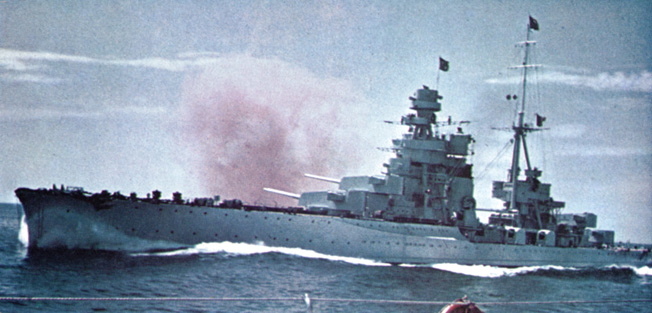
Now!... to add to your terrific-analysis...
"KesaAnna":
The WWII German Army was 80% Horse Drawn; Business
https://www.zdnet.com/article/the-wwii- ... m-history/
Not many people know that the greatest use of horses in any military conflict in history was by the Germans in WWII: 80% of their entire transport was equestrian. Despite all the propaganda about Blitzkreig, formidable German R&D, industrial design and production, the day to day mechanics of that fighting force involved an average of 1.1 million horses throughout the war. Of the 322 German divisions in the middle of the war - 1943 - only 52 were armored or motorized.
 http://www.worldwar2facts.org/the-overl ... n-ww2.html
In the first mechanized war, the German Army found itself relying heavily on the horse. Horse-drawn Artillery, supply wagons, and Cavalry were widely used. It is estimated that the Germans took almost 2.75 million horses into battle, nearly twice what they used in World War I. Yet very little has been written about these units. This area of German military history is, by far, the most overlooked aspect of the war.
Tanks in the Italian Army
https://en.wikipedia.org/wiki/Tanks_in_the_Italian_Army

The first model produced for the Royal [Italian] Army (Regio Esercito), was the FIAT 3000 (by 1935 renamed L5/21). They were ready by 1922, and served well to forge Italian interwar armoured tactics and was in use until 1943.
Another model developed in 1930, was the gun-armed (Vickers-Termi 37mm) serie II or FIAT 3000B. Both formed the bulk of the Italian army corp until new models arrived in 1935.
Italy produced a large number of CV-33 and CV-35 tankettes based on this Vickers-Carden-Lloyd concept.
the Fiat-Ansaldo CV-33 light tank and was only armed with two machine guns and was in wide use at the beginning of the war in Africa. About 300 CV-33s were built.
The L6/40 light tank was developed prior to World War II and used by the Italian army from 1940 and on.
 Fiat-Ansaldo L6/40 tank in 1940.
The Carro Armato L6/40, was put into production in 1939, with 283 finally produced. It was the main tank employed by the Italian forces fighting on the Eastern Front alongside the L6/40-based Semovente 47/32 self-propelled gun. L6/40s were also used in the North African campaign.
M13/40

The M13/40, weighing 13-14 tons, was fitted with a 47 mm gun, having armor-piercing capabilities, in the turret and a four-men crew. Series production began in late 1940.
Beginning in 1942, the Italian Army recognized the firepower weakness of the M13/40 series and employed the Semovente 75/18 self-propelled gun alongside the tanks in their armored units.
Semovente da 75/18 Self-propelled gun
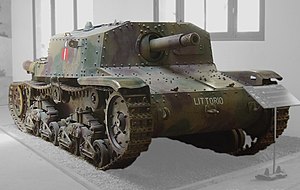 Fiat M14/41 tank.

The Carro Armato M14/41 was essentially the M13/40 fitted with a more powerful diesel engine which was equipped with air filters designed to cope with the harsh conditions of the desert. Production amounted to 1,103 of these vehicles.
M15/42
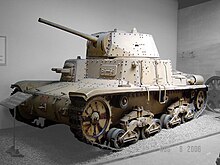
The M15/42 was a medium tank whose production began on 1 January 1943. 90 had been built before the Armistice with the Allies on 8 September 1943. Having occupied most of the Italian territory, Germany confiscated all remaining M15/42s.
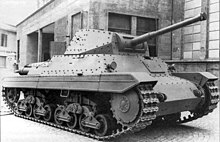
P26/40 medium tank... The design of the
P26/40 "heavy" tank had started in 1940.
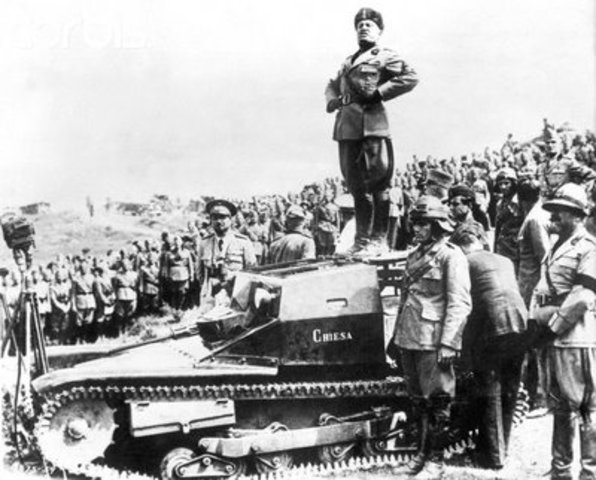
the L3 tank was used almost everywhere that Italian troops fought during World War II. L3s were found on the Italian/French border, North Africa, Italian East Africa, the Balkans, USSR, Sicily, and Italy.
Italian L3/35 in the Balkans, August 1943

A further development of the Fiat L3 light tank, the Fiat L6/40 went through a number of prototypes during the late 1930s and used the Italian army from 1940 and on through World War II. The L6/40 light tanks were used by the Italians in the Balkans Campaign, in the war against the Soviet Union, in the latter stages of the North African campaign, and in the defense of Sicily and Italy. The L6/40 was the main tank employed by the Italian forces fighting on the Eastern Front. The L6 fought alongside the L6/40-based Semovente 47/32 self-propelled gun.
Carro Armato L3/35 light tank:
 Carro Armato L6/40:

It was the main tank employed by the Italian forces fighting on the Eastern Front alongside the L6/40-based Semovente 47/32 self-propelled gun. L6/40s were also used in the North African campaign.
Semovente da 47/32

The Semovente da 75/18 was an Italian self-propelled gun of the Second World War. It was built by mounting the 75 mm Obice da 75/18 modello 34 mountain gun on the chassis of a M13/40, M14/41 or M15/42 tank.
Obice da 75/14 modello 34

About 300 Semoventi da 47/32 were built from 1941 onward. After the Italian armistice in September 1943, the German Army took all Semovente 47/32s they could get hold of for their own use. The German designation was StuG L6 47/32 630(i). Some of these were provided to Germany's Croatian puppet state&[5] and the Slovene Home Guard.
The Semovente da 75/18 was intended to be an interim vehicle until the heavier P40 tank could be available.
Semovente da 75/18 during the North African Campaign, 1942.
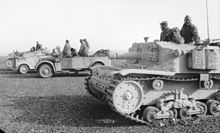

Although these machines were not widely known, the vehicle performed well in its role. Though it was technically similar to the StuG III, it had a totally different role, serving as divisional artillery instead of a pure assault gun. The organic structure consisted of two artillery groups for every armoured division,
The Semovente da 75/18s were deployed in the North African campaign and during the Allied invasion of Sicily, alongside M tank units to provide additional firepower.
Despite the fact that they were not designed to fight other tanks, their 75 mm howitzer proved ideal (thanks to its low muzzle velocity) for firing HEAT shells; its 5.2 kg HEAT shell ("Effetto Pronto" in Italian) could pierce 80 mm of armour at 500 meters, and could thus defeat tanks such as the US built M3 Grant and M4 Sherman used by the British Army.[4] As such, these machines were responsible for many of the successes by the Italian armoured troops during 1942–43, when the medium tanks (all armed with a 47 mm gun) were no longer effective.
The most successful action fought by Semovente da 75/18 took place on 10 June 1942, south of Knightsbridge, during the Battle of Gazala. Thirty M3 Grant and ten M3 Stuart of 1st and 6th Royal Tank Regiment attacked a position held by the Ariete division but were repelled by Semovente da 75/18s as well as some M13/40s and gun trucks, losing three Grants and two Stuarts from 6th Royal Tank Regiment and twelve Grants and three Stuarts from 1st Royal Tank Regiment.[6] The Italians lost two M13/40s.
the Semovente da 75/18 proved successful both in the direct support role and in anti-tank fighting; its main advantages, other than their sheer firepower, was in its thicker armour (relative to the medium tanks) and lower silhouette that made it more difficult to hit. Due to these features, the Semovente da 75/18 has been regarded as the only Italian armoured fighting vehicle to be seriously feared by Allied tank crews.
Semovente da 75/34 Self-propelled gun
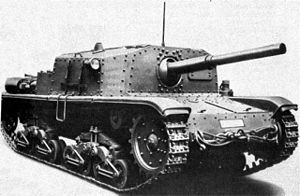
in 1943, production shifted to the M42 variant, with the M15/42 tank chassis and engine.
Carro Armato M15/42 tank
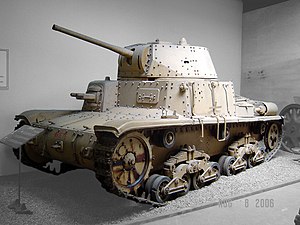
It did not serve in North Africa, the theatre in which it was intended to operate, but served in Italy and in Yugoslavia with the German Wehrmacht.