After rereading this, let me see if I can summarize this correctly:
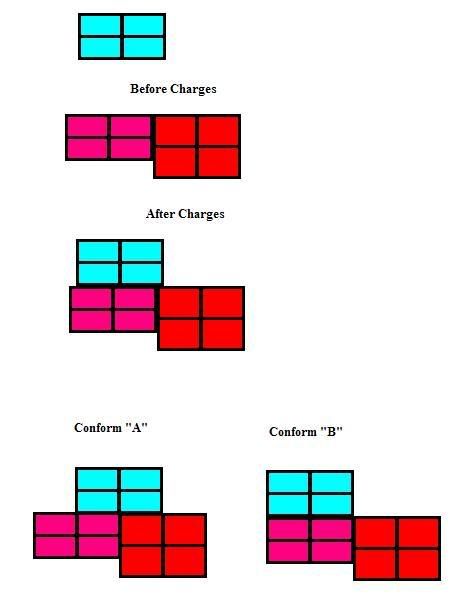
1. Background: Because it looks right in terms of which bases are most in contact, even the best of us sometimes conform as B, pushing Red from frontal contact to overlap, although it is not legal to push a BG in contact out of contact. It is legal to push aside a BG NOT in contact with enemy.
2. Rule: But the rule is that the active player must pivot and slide to conform by the minimum necessary to conform to the enemy bases in contact.
3. Analysis: Because the active player is obligated to conform the BGs "unless otherwise stated below or physically impossible," he must, when there is more than one way of legally conforming the BGs, choose the way that involves the minimum to conform. Therefore, any sequence of BG conforms chosen must be the one that involves the minimum necessary to enable conforming.
4. Mechanics: Red can't conform right since it would no longer be in contact. Its minimum pivot and slide is to line up its left front base with the right base of blue, but can only do that if Pink conforms so there is room. Pink can not conform right since red is there and can't be pushed out of contact into overlap, so it can and must conform left so the front right base of pink conforms to the front left base of blue. With the room clear, red now conforms by sliding left, resulting in DIAGRAM A. It order of conforming matters, the active player must choose to shift pink first to conform and then red in order to enable both to conform. If conforming is effectively simultaneous, the same result occurs.
5. Reasonableness:DIAGRAM A with both charging BGs fighting the target in melee is tactically a far more reasonable than DIAGRAM B as both A and B charge and impact blue and fight in melee as well. Being 4 bases wide, the attackers naturally benefit from and overlap on each side against blue.
At the start of the manoeuvre phase, the active player’s battle groups already in close combat with the enemy must (unless otherwise stated below or physically impossible) pivot and/or slide bases by the minimum necessary to conform to the enemy bases in contact:
• Conforming usually means lining up each base in full front edge to front edge contact with an enemy base, or conforming to an overlap position (see below).
Since the Bgs conforming must do so by the minimum necessary. so (b) is the correct move.
The Red Bg moves the minimum amount to an overlap position, and the pink Bg moves by the minimum amount to front edge contact..
One of the authors has spoken yet the debate continues to try and change the outcome.
AAAh With respect I think my mate Terry may have missed a bit ....
You slide to conform
You can shift any friendly BG not in contact with enemy
Part of the reason for this is so that a BG that fights at impact doesn't then get shoved to overlap position.
You can of course manipulate conforms sensibley by good wheels etc. - all part of good preparatory play pre bloodfwlo IMHO
Have only just seen this stream but the answer is A as far as I am concerned.
To cover the full sequence..
You can choose the order of conforms.
You choose to try to conform Red - it can't as it can't push pink out of the way
You try to conform pink and it can't go right for the same reason - so goes left by minimum distance
You can then conform pink to the left and must if it can - it can.
Hence A.
If there were troops to the side of PINk stopping it sliding the troops would stay uncomformed and the enmy may conform to them the bound after.
Take this as provisional as Terry may have some reasoning up his sleave but I suspect he missed the not being able to shunt BGs in contact with enemy bit (he didn't refer to it in his post)
Si
Simon Hall
"May your dice roll 6s (unless ye be poor)"
Terry never mentioned pushing BGs out of the way as his rationale because his rationale was that as you can conform to an overlap position, and this is the shorter move for the red BG, you do that.
Nik Gaukroger
"Never ask a man if he comes from Yorkshire. If he does, he will tell you.
If he does not, why humiliate him?" - Canon Sydney Smith
But Nik, if you look at the definition of an overlap, if red shifts first to the B position, is that an overlap? It is after all BGs have conformed, but it isn't when it does the initial conform.
Interesting,. I thought that was talking about bases ending in frontal contact or overlap positions as where bases ended up. The diargam referred has it looking at that by base. But maybe there is something in that.
If so then the answer would be either by choosing the order. I think we redinitely want to keep the option of anyone hitting frontally being in frontal contact if desired.
Si
Simon Hall
"May your dice roll 6s (unless ye be poor)"
pbrandon wrote:But Nik, if you look at the definition of an overlap, if red shifts first to the B position, is that an overlap? It is after all BGs have conformed, but it isn't when it does the initial conform.
Paul
I know, I've mentioned it already - if red shifts at that point it does not meet the overlap rules as it is not in side edge contact with a friendly BG that has its full front edge in contact with enemy. Here I was just mentioning what I understood Teery's reasoning was as I think Si made an incorrect assumption about it.
Nik Gaukroger
"Never ask a man if he comes from Yorkshire. If he does, he will tell you.
If he does not, why humiliate him?" - Canon Sydney Smith
I would still like to maintain a "Common Sense" attitude to this issue.
Can anyone point out another situation in the rules (Ie Author's Intent and Consistency) where a BG can be utilized in such a way where it's ability in one phase is maximized while facing no recourse should it not be favorable in a subsequent phase.
Why should a unit with favorable Impact POA not be required to stand and fight in Melle?
One could manufacture a situation where a Unit with only Light Spear may have a POA at Impact so you throw them in knowing that although down 2 POA's in Melle they will only be fighting in overlap and thus cannot be hit so no worries.
If this is not cheese I cannot find a better example.
Also if we are to discuss historical context, Is there precident for a unit committing to a battle in a way that would be considered a "charge" and then just stepping aside to let thier compatriots do the fighting for them? Just does't feel right. Does it?
I think a referee with 20 games ongoing needs a "Litmus Test" to quickly resolve an issue and move on to the next. Hence, a refinment of my original statement:
"If you throw dice at Impact, You must be at RISK in Melle"
It is clean, simple, historically accurate, and seems IMHO to match the intent of the authors and is consistent with the RAW."
Gino
SMAC
PS My appoligies for an spelling errors. Can we ask the webmaster to build in a spell check to this site? I am dyslexic and lazy.
Nik - sorry I didn't appreciate the point you were making.
Gino - what about if a enemy unit (blue below) is charged frontally by friendly red and by friendly pink, not as a flank charge. Friendly pink can pivot to be an overlap but not be at risk in melee because it is only fighting as an overlap. Where else can pink go?
Paul
Last edited by pbrandon on Sun Feb 08, 2009 5:13 pm, edited 1 time in total.
In the above example, it is clearly outlined on page 71, you would line up to conform as an overlap. But, that is an example all on its own. I think Nik and Paul are leading us to the conclusion. Red cannot slide into an overlap, because he wont be eligible to do so as he wont have side edge contact with friendly. Since Pink cant push Red, as Red is in frontal combat, seems like they just maintain their current position and will not conform.
Neither can push the other, doesn't matter what order you use, you cant push friendly already in contact frontally with enemy.
pbrandon wrote:Nik - sorry I dodn't appreciate the point you were making.
Gino - what about if a enemy unit (blue below) is charged frontally by friendly red and by friendly pink, not as a flank charge. Friendly pink can pivot to be an overlap but not be at risk in melee because it is only fighting as an overlap. Where else can pink go?
But in your example pink don't count in impact and in this case it's right it could only fight in melee as overlap, or they can leave the melee in a next manoeuvre phase. I support Gino opinion.
pbrandon wrote:Why doesn't pink count in impact, if both red and pink charge in the same turn?
Paul
Because in impact the number of dice must be the same. Red and blue match exactly, so pink cannot contribute. At impact only blue and red confront, then at melee pink conform as overlap.
marioslaz wrote:
Because in impact the number of dice must be the same. Red and blue match exactly, so pink cannot contribute. At impact only blue and red confront, then at melee pink conform as overlap.
Mario.
The second rank base of blue fights against pink as if it were a front rank base - page 57.
Nik Gaukroger
"Never ask a man if he comes from Yorkshire. If he does, he will tell you.
If he does not, why humiliate him?" - Canon Sydney Smith
Also, the reverse applies. By moving into an overlap position of an existing melee, a BG uses it's melee POA (if any) without having to use an impact POA (e.g. Hermandad sword and buckler men Arm, Sup, Dr, SSw).
marioslaz wrote:
Because in impact the number of dice must be the same. Red and blue match exactly, so pink cannot contribute. At impact only blue and red confront, then at melee pink conform as overlap.
Mario.
The second rank base of blue fights against pink as if it were a front rank base - page 57.
I really don't understand how. In last bullet of page 57, the rule says "... can still contact the flank edge of an enemy base, provided that it was not already in melee to its front". So, I still assume that pink cannot fight in impact. If it was otherwise, I will reconsider my opinion on FoG rules




 but I suspect he missed the not being able to shunt BGs in contact with enemy bit (he didn't refer to it in his post)