


Together with H. Balck we're working on two new early war campaigns (1938-1940). Scale is 1km=1hex, so we're using battalion-sized units. And we stumbled upon a serious problem of German infantry.
Normally German infantry is stronger in games because German infantry division was stronger than an infantry division of Poland, France or UK. However, since we’re comparing infantry battalions here, and not divisions, IMHO the same rule doesn’t apply. In short, German infantry early in the war was stronger because it had more divisional artillery (which we put as separate units in-game), air support (also, separate units in-game) and other divisional stuff, but an average battalion was more or less identical in most contemporary armies.
This is true to sheer number of soldiers in a battalion. It's also true to individual soldier’s equipment (which is what is used by a battalion) was similar: most armies using some version of Mauser Rifle or its' equivalent (Lebel, Carcano and so on). It's also true to heavier equipment: a German infantry battalion had slightly more mortars, a Polish infantry battalion had slightly more heavy machine guns, but on average the sheer firepower was pretty much the same.
As the strength of the German infantry lay in its’ divisional organization, air and artillery support and so on, but not in any major differences when it comes to individual soldiers, I believe the stats for an infantry battalion should be almost identical in all armies of the epoch. What do you guys think?
Cheers
1939 battalions: strength comparison
Moderators: Slitherine Core, Panzer Corps Moderators, Panzer Corps Design
1939 battalions: strength comparison
Originally posted by Juu:
The Soviets won the war. We happened to be nearby.
The Soviets won the war. We happened to be nearby.
-
cougarranger
- Private First Class - Opel Blitz
- Posts: 4
- Joined: Sat Jan 18, 2014 4:30 am
Re: 1939 battalions: strength comparison
I have to disagree. The German infantry tactics were far more advance. This began in the later stages of WWI when the Germans began to develop strumtrooper tactics to overcome the stalemate of trench warfare. These tactics were based on fire powers, maneuver, and initiative at the lowest levels ( not waiting for officers to tell you what to do). Out of these tactics came the need for lighter infantry weapons. This is where the worlds first GPMG the MG 34 and later the 42. These were excellent weapons that were not copied by the Allies until after the war with weapons like the M60 and MAG 58 (American M240). Most western countries did not see the need to adopt the German idea of machine gun tactics becuase they saw machine guns as support weapons like mortars. They support maneuver with suppressive fire. Again out of the strum trooper tactics the Germans belived in a different system. They saw the machinegun as the infantry squad. The squad would maneuver to place the machinegun in an advatagous position to destroy of kill the enemy. All the riflemen in the squad basically carried ammo for the machinegun and protected the flanks of the machinegun crew. This is why the German infantry was able to hold the line so long after 1942. As long as you had Machineguns and ammo a BN could take awful losses but still effectively fight. So no... You can't compare a early war German infantry BN with the allies. I also am not even getting into the infantry gun or assault gun concept of the Germans. Another great concept not copied by allies. Organic artillery for the infantry that was mainly used in the direct fire mode to reduce strong points. Allies would use attach tank units for this role. The us did not copy thus until 2000 with the MGS systems in the Stryker BDEs.
Re: 1939 battalions: strength comparison
Well, the MG34 did not become the focal point of the German infantry squad's efforts until after the 1939 campaign. Back in 1939 the Germans had the good old squad of 13 men (three squads per platoon), with a squad leader, assistant, seven riflemen and a LMG group of four men. While the MG34 proved to be an excellent weapon, this squad organisation proved to be a complete mistake. That's why in 1940-1941 the Wehrmacht started to change it to take advantage of the MG34's sustained rate of fire, mobility and so on. However, in 1939-1940 Wehrmacht's organisation was pretty much the same as everywhere else. Sure, we can argue whether the MG34 was better than its' Polish, French or British counterparts (it was), but for all purposes it was essentially the same weapon. In combat there was no real difference between a MG34, the MG 26(t) and, say, Polish wz. 28 Browning or French FM 24/29. They were all reliable, mobile and great weapons. Sure, the MG34 had more bullets in its' drum (50 compared to 20, 25 or 30 for Polish, British and French LMGs) and had a higher theoretical rate of fire, but was twice as heavy.
As to German infantry tactics, it seems the Germans did not use stormtroopers in early WWII. Not in Poland, not in France. In most cases I can think of the rule of thumb was "if you can't seize the objective, retreat and wait for tanks or artillery, then rinse and repeat". Also, the famed German officers' initiative was visible mostly on higher levels: regimental and divisional. Battalion commanders barely every had the chance to act on their own and in most cases the German infantry did not even accept battle unless outnumbering the enemy.
Also, I'm not sure the German superiority was actually visible on the battalion level. Sure, on higher levels the German war machine was truly overwhelming: better cooperation between different branches of the army, better close air and arty support, more guns attached to every division and so on. However, on battalion level it wasn't really visible. Can you think of any examples that would show otherwise?
BTW, I'm preparing a comparison of battalions of different armies right now, however I can't seem to find a reliable source on the number of carbines and rifles in a German early-war infantry battalion. Such comparison would allow us to check the basic firepower of major nations' battalions ("how many bullets fired per minute"). Anyone?
Cheers
As to German infantry tactics, it seems the Germans did not use stormtroopers in early WWII. Not in Poland, not in France. In most cases I can think of the rule of thumb was "if you can't seize the objective, retreat and wait for tanks or artillery, then rinse and repeat". Also, the famed German officers' initiative was visible mostly on higher levels: regimental and divisional. Battalion commanders barely every had the chance to act on their own and in most cases the German infantry did not even accept battle unless outnumbering the enemy.
Also, I'm not sure the German superiority was actually visible on the battalion level. Sure, on higher levels the German war machine was truly overwhelming: better cooperation between different branches of the army, better close air and arty support, more guns attached to every division and so on. However, on battalion level it wasn't really visible. Can you think of any examples that would show otherwise?
BTW, I'm preparing a comparison of battalions of different armies right now, however I can't seem to find a reliable source on the number of carbines and rifles in a German early-war infantry battalion. Such comparison would allow us to check the basic firepower of major nations' battalions ("how many bullets fired per minute"). Anyone?
Cheers
Originally posted by Juu:
The Soviets won the war. We happened to be nearby.
The Soviets won the war. We happened to be nearby.
-
Anfield
- Staff Sergeant - Kavallerie
- Posts: 341
- Joined: Wed Jan 25, 2012 8:11 pm
- Location: Milwaukee USA
Re: 1939 battalions: strength comparison
Here are few places I use for intel. The first one is hands down the best place i know for german OB.
http://www.feldgrau.com/
This one might be useful too.
http://www.cons.org/redwolf/infantry-toe.html
Last one has a little of everything for all WWII forces.
http://www.bayonetstrength.150m.com/
http://www.feldgrau.com/
This one might be useful too.
http://www.cons.org/redwolf/infantry-toe.html
Last one has a little of everything for all WWII forces.
http://www.bayonetstrength.150m.com/

Re: 1939 battalions: strength comparison
Hello Halibutt, another link with some useful info may be this one: http://forum.axishistory.com/viewtopic. ... 0&t=175147 and the site where his info is being collected: http://www.wwiidaybyday.com/kstn/kstninfmain.htm This site has a graphical representation of a lot of German KSTN documents, including some pre-war ones. I also have a couple of comments/additions about the MG34, both you and cougarranger have very good points, but some extra info may help explain why it became what it was in the German army.Halibutt wrote:BTW, I'm preparing a comparison of battalions of different armies right now, however I can't seem to find a reliable source on the number of carbines and rifles in a German early-war infantry battalion. Such comparison would allow us to check the basic firepower of major nations' battalions ("how many bullets fired per minute"). Anyone?
Cheers
The tricky thing when trying to explain the armaments and organization at that time is that the German weren't free in deciding what to do and what to use. The 'Treaty' of Versailles dictated exactly what the Germans could and could not do with their armed forces, down to the exact number of allowed machineguns and organisational structure:
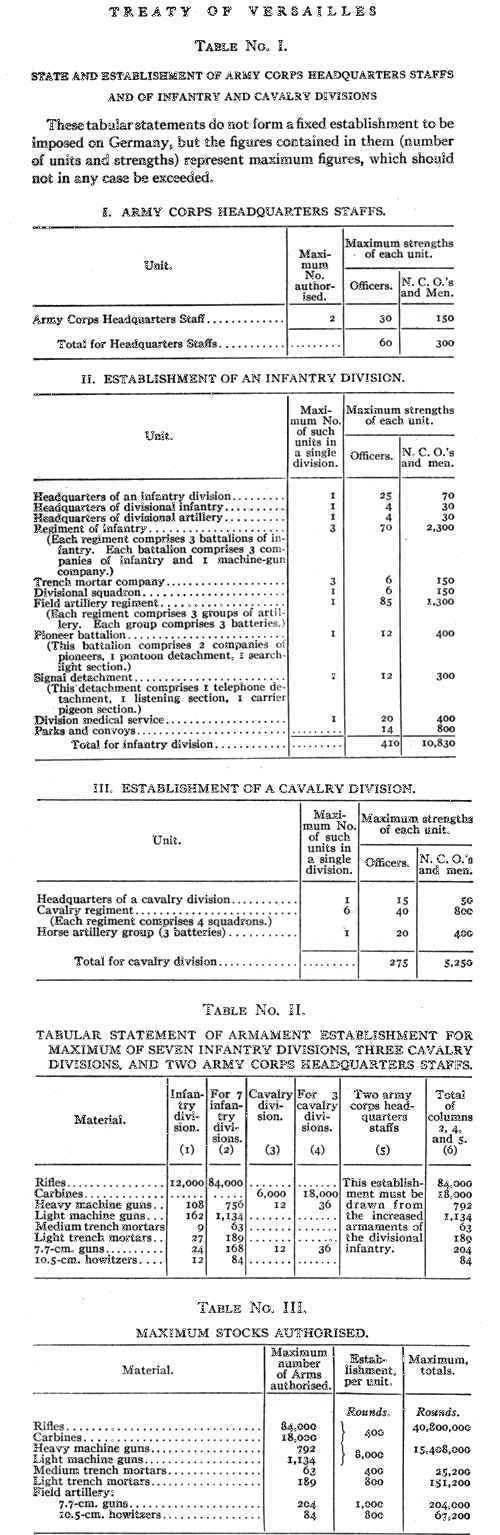
This in effect froze the army, although a lot of creative attempts were made to dodge the restrictions. Such as recycling WWI designations and applying them to new weapons, and moving military R&D abroad, calling tank prototypes 'Agricultural Tractors', etc.
Another solution was to maximize their strength within the restrictions: the 10,5 leFH18 gun-howitzer is a good example:
Note the fake WWI (19)18 designation, although it was developed during the late 1920ies, to make it appear less 'new'. The caliber was chosen because it was the maximum allowed, and the gun was pretty much the optimum that could be squeezed within the Treaty rules. They continued to develop their 7,5cm guns as well because they were allowed, but note that when te Germans abandoned the Treaty these lighter weapons were pretty much ignored and even the latest models (1938) had very low production numbers.
So, about the MG34: the German weren't allowed many 'heavy' (water-cooled, belt-fed) machineguns, but light machineguns were less restricted. So what did they do? They developed a 'light' (portable) machinegun that could double as a heavy machinegun by mounting it on a tripod with an indirect sight. It had to be air-cooled so they made the barrel changeable in seconds. It had to be belt-fed, so they made a small drum to house a 50-rnd belt so it could be carried by one man on an assault but still be used as a 'heavy' machinegun with a 250-rnd belt on a tripod.
And you are not completely right that there are no 'real' differences between the common light machineguns. There are a few crucial differences that can help explain why on paper it didn't seem very special but are actuallt major advantages over the other MG's you listed. The Browning M1918A2 (BAR, similar to wz.28) and the FM 24/29 didn't have a quick-change barrel, although the MG 26(t) and the related Bren gun did, but even than they were issued only a single extra barrel while the MG34 was commonly issued two spare barrels. And all these light machineguns were magazine-fed, and this is a world apart from the belt-fed MG34.
On paper, a 50-rnd belt doesn't look like a big difference, but these belts could be linked (100 and 150 rounds were common, max. was 250), even while they were already loaded in the gun. So a gunner could lay down his MG34 and start firing, and if his belt ran short the ammuntion bearer could attach another belt so the gun would always be ready to provide a large volume of fire. This, together with the quick-change barrel, was one of the reasons why the MG34 could have such a high rate of fire when compared to the other weapons. And it wasn't heavy: I'm not sure where you got the impression that it is twice as heavy, but it simply isn't (12kg), unless you count the tripod as well (20kg total), but then it is no longer a 'light' machinegun. The light MG's you list weighed around 9kg, but this ignores the fact that, in large quantities, ammunition that is carried in belt weighs less than the equivalent number carried in loose magazines.
A magazine-fed weapon needs very frequent changes and while you can pre-emptively reload when a magazine is nearly empty, it cannot compare to the volume of sustained fire of a true belt-fed. And without a quick-change barrel a machinegun can destroy the barrel very quickly. If you want to get a fairly good picture of actual 'firepower', then forget about comparing cyclic (theoretical) rates of fire. You should try to get the true 'sustained rate of fire' for all these weapons. This is the rate of fire over a prolonged period of time, such as during an actual battle. The M1918A2 BAR (wz. 28) has a sustained rate of 'between 40 and 60 rounds per minute' (from FM 23-15). A belt-fed FN MAG 58, which is much more similar to an MG34, can sustain 100 rounds per minute.
If you know the sustained rate of fire, the amount of ammo carried and the effective range, than you can start to get a decent picture of squad-level firepower.
Oh, and the MG34 did have one enormous drawback: it was very expensive to make, both in materials and time. That is the disadvantage of developing the 'perfect' machinegun which is only supposed to be produced in low number (approx. 2000 according to the Treaty). So the silly Germans did not design it to be suitable for mass production, which was the reason they couldn't build enough and had to develop the MG42.
Sorry for the wall of words, but hopefully it gives a better insight in how these sort of small things can affect combat in big ways and how politics can even influence machinegun designs more than a decade later.

Re: 1939 battalions: strength comparison
First of all, thanks for the wall of text. It was an interesting read, even if to some extent unrelated to what I'm thinkingThvN wrote:Hello Halibutt, another link with some useful info may be this one: http://forum.axishistory.com/viewtopic. ... 0&t=175147 and the site where his info is being collected: http://www.wwiidaybyday.com/kstn/kstninfmain.htm This site has a graphical representation of a lot of German KSTN documents, including some pre-war ones.
As to the link - it's a great page. Alas, it only has info on the theoretical rifle companies, and the 1939 reality was slightly different (some companies had less MGs, some had no mortars, war is a mess in more than one sense
Anyway, I compiled a basic comparison of a battalion of Germany, Poland and France in 1939. Sources differ as to the actual number of MGs and such in various armies, even the grand total of manpower of each battalion is not certain, but the overall picture seems to be more or less ok. Anyway, take a look at the last line: it's my estimate of theoretical firepower. Of course it's but a very rough estimate (number of rifles x 10 + number of LMG x 80 + number of HMG x 300), but it leads to an interesting conclusion. Even if we count some of the German MG34 (which in battlefield reality of 1939 were often Czechoslovak guns and not MG34) as HMGs and multiply their firepower by 300 and not 80, the German battalion still is weaker than its' Polish or French counterparts. Sure, it made up a little in mortars to grenade launchers ratio (for simplicity's sake I counted them together), but even counting that, the number of bullets the French and the Germans could send in the air each minute was similar at best, I can't see any major differences that would justify treating the German infantry battalions as significantly stronger.
Which kind of convinces me that my point pretty much still stands: the strength of the German army lay in its' mobility, in its' numbers, in its' regimental artillery support, in the sheer number of planes and tanks, in the initiative of regimental and divisional leaders. But the battalions were pretty much the same. The German battalion simply had more big brothers waiting by.
In game terms I would simulate this by simply making the infantry battalion identical for all armies, and starting from there. The Germans could get +1 initiative for their "Big Brother cooperation", the Poles +1 to AT (more and better AT weapons). The Brits should get -1 to AT and perhaps +1 to mobility, not sure what to do with the French. The Germans would still win as they historically did, as behind the infantry there will be more guns, more planes and more tanks. And the pieces of artillery could have better stats as well, though I'm not sure if the 10.5 cm leFH 18 was actually significantly better than the modernised 105mm Schneider used by both Poland (as "105 mm wz. 29 Schneider") and France as both had similar rate of fire, both had similar range (actually 11km for 10,5 leFH, 15km for wz. 29) and both had similar mobility. Anyway, this would make for a much more historically-accurate game IMHO.
Cheers
Originally posted by Juu:
The Soviets won the war. We happened to be nearby.
The Soviets won the war. We happened to be nearby.