Unless stated otherwise, all these flags should size roughly a man’s height (i.e., 15 to 18mm in the 15mm range).
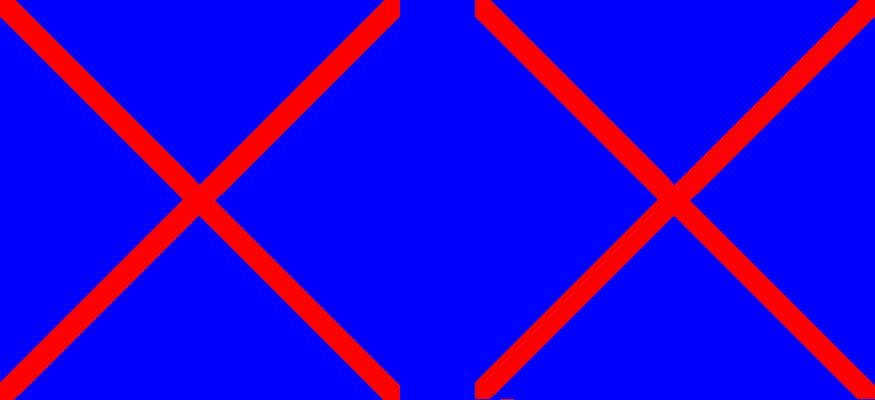
Duque D. Jaime was a ill-tempered man. When he caught his wife with a squire, he killed the couple, allegedly, with his own hands. The King pardoned him on condition that he used his bad temper and money to conquer Azamor, in Morocco, in 1513. The blue flag with the cross of St Andrew is a flag of the Ordenança. Why the Portuguese used that sort of cross is beyond my knowledge, but we’ll find this same type of flags in many other occasions, as we shall see.
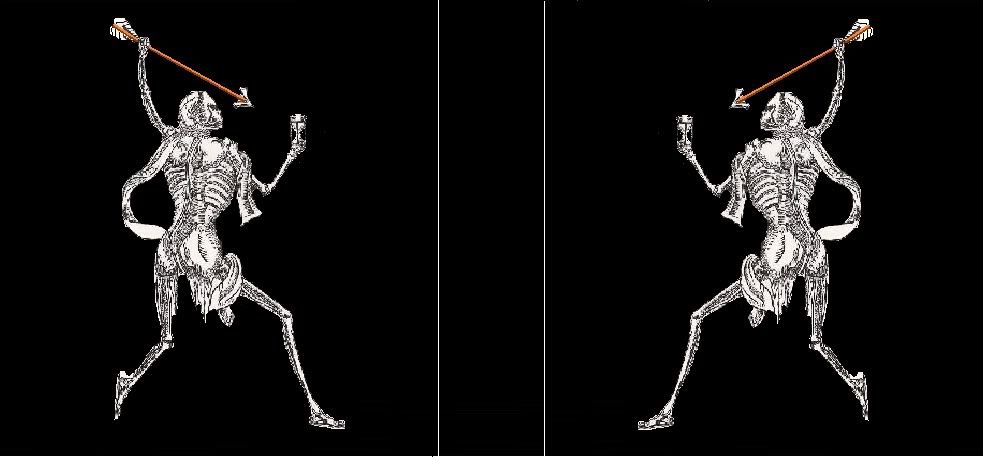
D. Vasco de Lima was a veteran from India, one of those fidalgos who made a career as a soldier in the Tropics. In the failed attempt to storm Diu in 1531, D. Vasco was sent in a small raft armed with a heavy gun to bombard the walls of the city. He was sporting a black flag with the symbol of Death on it, a device considered of bad omen by everyone else. They were right: during the gun duel, a gun shot took D. Vasco’s head and half torso!
Since this is a personal flag, I printed it 1cm height.

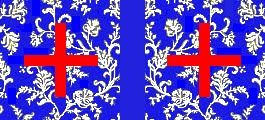
In his expedition in Abyssinia, D. Cristovão da Gama (son of the famous D. Vasco da Gama) had a royal flag with a Cross of Christ on carmine&white damask. His five captains had each a blue&white damask flag with a “red cross” on it (unlike the Cross of Christ of D. Cristovão’s flag). I printed the royal flag a little bit oversize while the captain’s flags were printed just 1cm height.

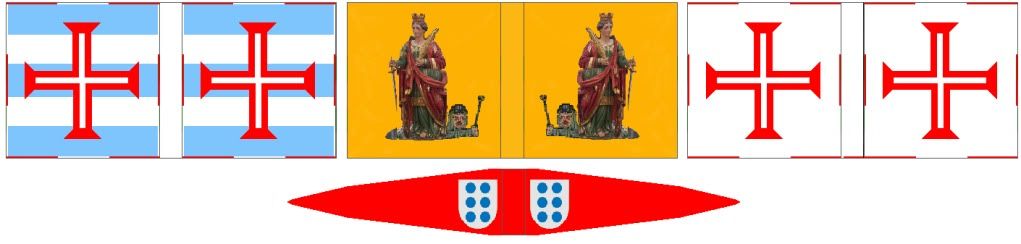
D. João de Castro was a famous Viceroy in Portuguese India, being noted for his cartographical skills and for relieving the siege of Diu in 1546. To commemorate this deed, he was given a “Roman triumph” in Goa. The tapestries that were woven to celebrate this event depict some interesting flags.
The first are plain infantry flags. Note the cross of St Andrew. The colours strictly follow the tapestry.
In the second group of flags, the pennon depicts the coat of arms of the Castro family. The yellow flag depicts a saint (probably St Catherine) with a Muslim by her feet (perhaps Khwaja Safar, or Coge Sofar, as the Portuguese called him, whose head was blown to pieces during the siege). These flags should be printed so that the square flags will be 1cm height.
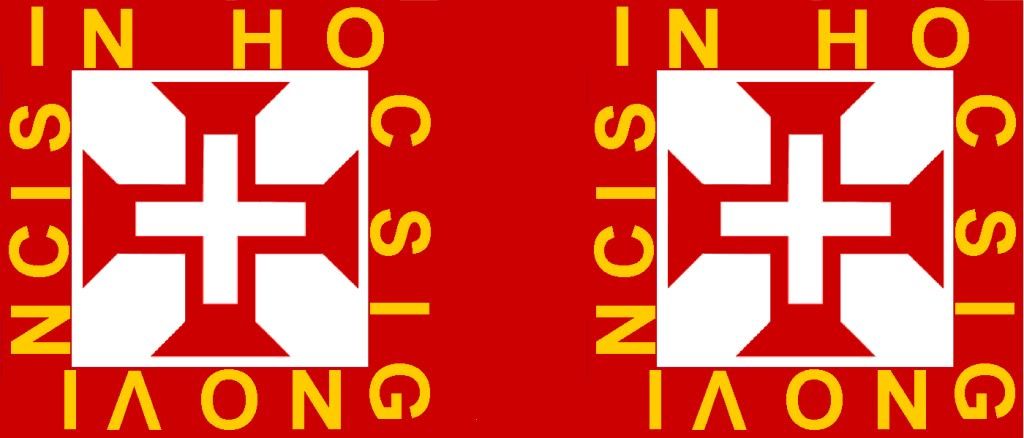
This flag was depicted in the ode by Jerónimo de Corte Real, written to commemorate the second siege of Diu.
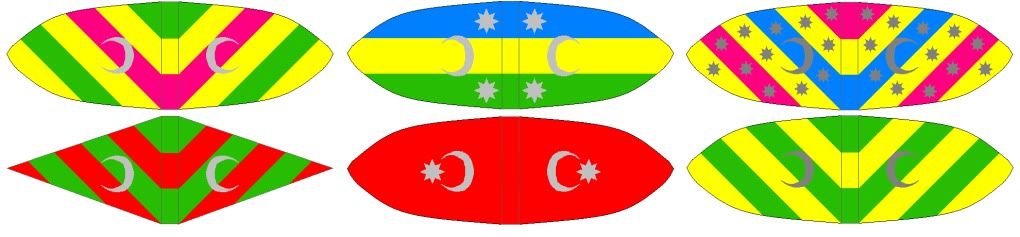
And since we are talking about this siege, lets not forget “the others”. These Muslim flags were based on the work of Jerónimo de Corte Real. I cannot tell if they are accurate or not but nevertheless, here you have’em.
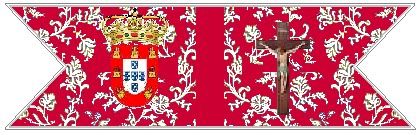
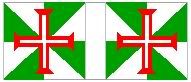
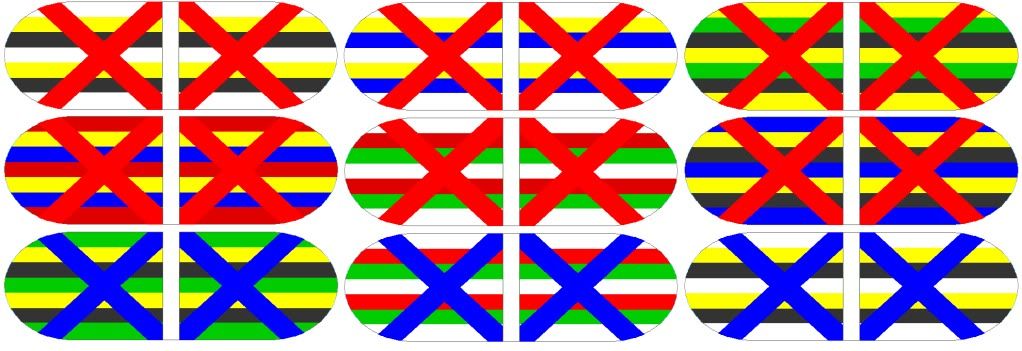
No work on the Portuguese flags of the 16th century would be complete without referring to the fateful battle of Alcácer Quibir. In 1578, King D. Sebastião and a multinational army faced the Moroccans in a pitched battle which sealed the fate of three kings and the fate of Portugal for the next 62 years.
The first flag is the Royal Flag of D. Sebastião. It should be printed at least 1,5cm height.
The second is the king’s personal flag. It should be 1cm height or smaller. Note that the flag of the garrison of Tangier was similar to this one, which lead to some confusion during the battle.
At last, we have the infantry flags. Again we have the cross of St Andrew. The colours are all conjectural but besides that the flags follow the sources. It is also possible that square flags with the cross of St Andrew (or even the Cross of Christ) were used, as some contemporary pictures suggest, but for that you may use some of the flags depicted above.
I hope you like my work and use it for your FoG:R Portuguese armies.