


Norway.
My god. Kill me now. Impossible is right.
I managed a decisive victory after one flat out loss, but that's only because I rushed my top 3 transports and landed those units next to enemy cities to prevent the unstoppable swarm of infantry units.
How was your experience with this scenario?
1939 Campaign, Impossible Setting.
Moderators: Slitherine Core, The Lordz, Panzer Corps Moderators, Panzer Corps Design
-
IainMcNeil
- Site Admin

- Posts: 13558
- Joined: Fri Apr 01, 2005 10:19 am

Re: 1939 Campaign, Impossible Setting.
So, you managed a decisive victory, didn't you?Kerensky wrote: I managed a decisive victory after one flat out loss, but that's only because I rushed my top 3 transports and landed those units next to enemy cities to prevent the unstoppable swarm of infantry units.
How was your experience with this scenario?
 Right now, impossible is the highest difficulty setting in the game, and I always thought that such setting should be like Nightmare in Doom - a real challenge for hardcore players. So thanks for feedback, we'll make that level more difficult.
Oh god, what have I done?
But seriously, I don't necessarily have a problem with impossible being impossible the first time you encounter the scenario. That really is the meaning of the word impossible; it cannot be done. No one is good enough to possibly foresee all the events that can take place over the course of a 20+ turn scenario and plan for that without prior knowledge of the scenario.
What I do have a problem with is I imagine taking on the computer on impossible is almost the equivalent of what the game would be play against another human being of equal, if not superior, intellect and playing ability. The only difference would probably be the human opponent wouldn't have the seemingly unlimited prestige the AI appears to have on impossible mode. (Note: if you tell me that the impossible AI does NOT receive bonus prestige over other AI modes, then I would tell you that fighting the impossible AI *is* the equivalent to fighting another player of nearly equal skill). The computer's lack of skill is compensated by it's increased resources.
If I start playing these scenarios in Head to Head play, what's to stop the defending player from behavior I see the AI is... let's say abusing. Namely: flooding the field with cheapest possible units and camping them into entrench-able terrain.
But seriously, I don't necessarily have a problem with impossible being impossible the first time you encounter the scenario. That really is the meaning of the word impossible; it cannot be done. No one is good enough to possibly foresee all the events that can take place over the course of a 20+ turn scenario and plan for that without prior knowledge of the scenario.
What I do have a problem with is I imagine taking on the computer on impossible is almost the equivalent of what the game would be play against another human being of equal, if not superior, intellect and playing ability. The only difference would probably be the human opponent wouldn't have the seemingly unlimited prestige the AI appears to have on impossible mode. (Note: if you tell me that the impossible AI does NOT receive bonus prestige over other AI modes, then I would tell you that fighting the impossible AI *is* the equivalent to fighting another player of nearly equal skill). The computer's lack of skill is compensated by it's increased resources.
If I start playing these scenarios in Head to Head play, what's to stop the defending player from behavior I see the AI is... let's say abusing. Namely: flooding the field with cheapest possible units and camping them into entrench-able terrain.
-
boredatwork
- Staff Sergeant - Kavallerie
- Posts: 314
- Joined: Sat Jan 15, 2011 5:39 pm
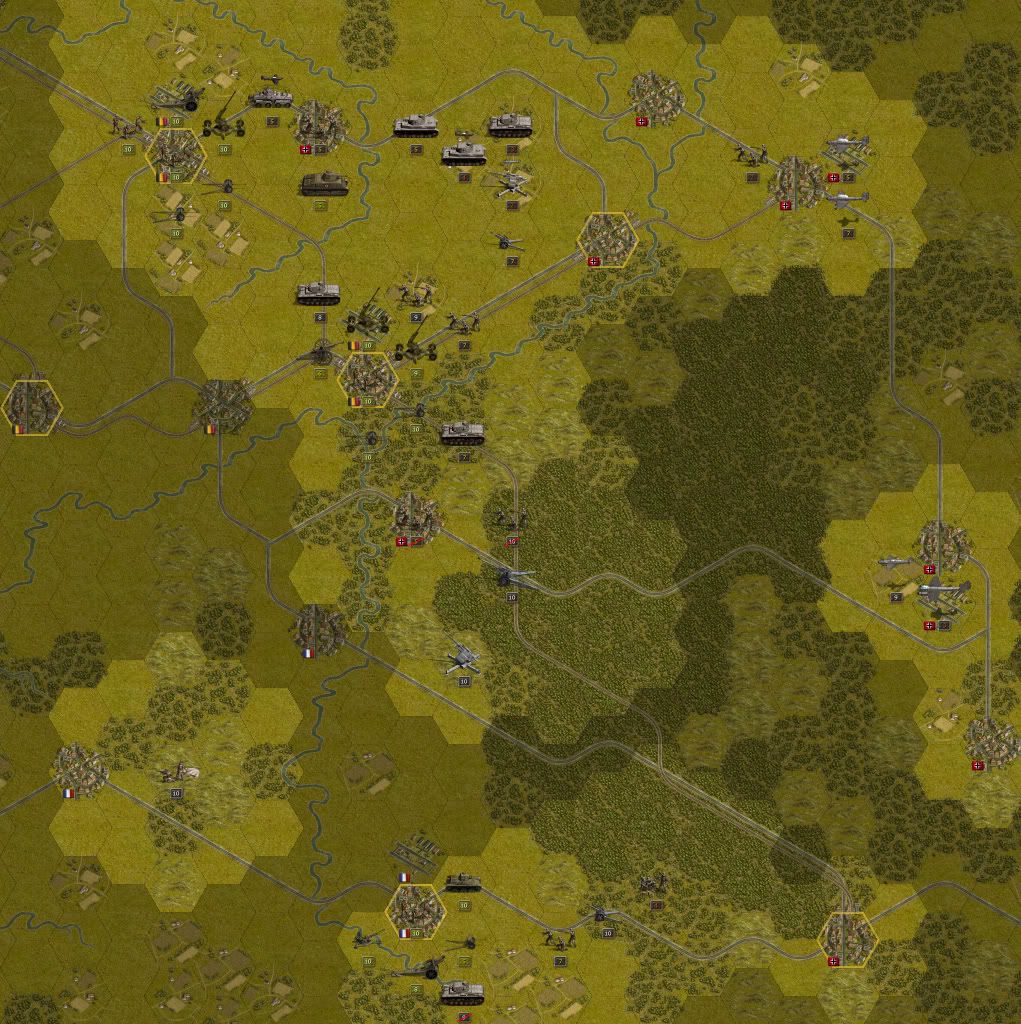
I realise it's early in the Beta so balance is far from polished at the moment however...
One thing I've noticed from playing different scenarios on different difficulty levels is units seem to suffer too many casualties. I know one of the mechanics for balance was to grind prestige down by increasing the number of casualties your core units suffered. The pendulum seems to have swung from PG, where your core units would take minimal (0-1) damage fight after fight, to where they now take substantial (3-5) damage most fights. Playing this now is less making it 'challenging' and more an excercise in frustration because axiomatic with increasing your own casualties you also make your valuable core units more vulnerable to loss - That is not a good thing IMO.
Specifically I think the issues with increasing average casualties relative to the original PG model are potentially as follows:
1) More casualties means units become less effective quicker - in PG a level 9 or 8 or even a 7 could still be effective in attacking weakened units. Even an inexperienced unit might fight 2 or 3 times before requiring replacements. In PzCorp at the moment it seems that that it's too easy for a unit to drop so much after a single attack that it becomes worthless without replacements.
2) Related to 1 because units suffer so many casualties it is dangerous to leave them below strength as they seem to be exceedingly easy to kill during the enemy's turn.
3) Which means I am spending an inordinate amount of time moving units to safety and adding replacements instead of actually fighting with them.
4) Because the replacement button needs to be clicked so often prestige is burnt through frightenly quickly.
5) Because *everything* is tied directly to prestige I think balance will be hard because it will likely rely heavily upon players to know beforehand how much prestige to allocate to new equipment/upgrades versus having to hold in reserve for repairs. In the above shot I started LowCo with ~2700 prestige - after upgrades and new units I still had over 800 which previously was sufficient. This is turn 7 - with <50 prestige left and a largely impotent army.
6) Even easy enemy kills aren't, IMO, a good thing. Killing enemy units too easily means the only way to make the game 'challenging' is to spam spawn cheap units on the objectives to 'challenge' (read: annoy) the player to hack through unlimited cannon fodder with limited resources.
7) The historical "feel" is more out of whack - yes some units went through 200%-300%-600% casualties over the course of the war but rarely was the turnover remotely close to that on average for a single campaign.
The more I think about it the more I think a heavily modified version of the Fantasy General system would be a better way to allow the core units to suffer degraded effectiveness without actually putting them in danger of death. Instead of outright kills instead have most combat results as cumulative **permanent** suppression in addition to regular short term suppression.
The main advantage would be units could be substantially reduced in their ability to do damage to the oposition without a proportional reduction in their ability to survive damage. Additional advantages would be as prestige would only be needed to recover actual wounds (the suppression being restored by not doing anything for a turn) the required amount per scenario would be much smaller hence much more easily foreseen and balanced. Balance could also be influenced by giving units a rate at which they recover suppression automatically. The opposition would also hopefully retain the "interesting" starting units for much longer, albeit being forced back by retreats which would hopefully lessen the boring spam spawn later in the game.

I largely agree, essentially in that it is too easy to destroy a unit entirely. Alex mentioned bringing lasting suppression into the game, which may solve the problem according to your suggestion of decreasing efficiency first, but lowering casualties.
I'll repeat my own suggestion related the issue:
The more damaged a unit is, the quicker is will retreat. It will retreat during the battle, not at the end of it - which I think is what currently happens. I mean that if a unit has 5 HP and you deal 4 damage it will retreat with 1 HP left. But if you deal 6 damage it will be destroyed without any chance to retreat. In CTGW we have "quick retreat" units which will retreat if they are taking too much damage in a fight, and only absorb a % of the damage in return, while doing a slightly smaller % of the expected damage to the attacker. The result is that you have to chase units down a while before you can destroy them entirely OR attack them from 2 sides (retreat not possible in enemy ZoC), which gives an actual reward to outflanking attacks.
For example:
7 HP unit is attacked and expected to take 6 damage and deal 2 damage
Instead it retreats taking only 50% damage (-3 hp) and deals 50% damage (-1 hp).
The unit now has 4 HP.
It is then attacked again, expecting to take 7 damage (more than enough to kill)
Instead it retreats again taking only 50% damage (-3 hp) and deals 0 damage.
The unit now has 1 HP.
I'll repeat my own suggestion related the issue:
The more damaged a unit is, the quicker is will retreat. It will retreat during the battle, not at the end of it - which I think is what currently happens. I mean that if a unit has 5 HP and you deal 4 damage it will retreat with 1 HP left. But if you deal 6 damage it will be destroyed without any chance to retreat. In CTGW we have "quick retreat" units which will retreat if they are taking too much damage in a fight, and only absorb a % of the damage in return, while doing a slightly smaller % of the expected damage to the attacker. The result is that you have to chase units down a while before you can destroy them entirely OR attack them from 2 sides (retreat not possible in enemy ZoC), which gives an actual reward to outflanking attacks.
For example:
7 HP unit is attacked and expected to take 6 damage and deal 2 damage
Instead it retreats taking only 50% damage (-3 hp) and deals 50% damage (-1 hp).
The unit now has 4 HP.
It is then attacked again, expecting to take 7 damage (more than enough to kill)
Instead it retreats again taking only 50% damage (-3 hp) and deals 0 damage.
The unit now has 1 HP.
I'm a little conflicted about unit expiration rates. On one hand, I actually enjoy losing core units because I hate the old invincible cores of PG and PG2. Battles feel like they are actually battles not just a steamroll. I definitely would not want an ability to buy back 'dead' units though. Once players get accustomed to the PzC style of loss, I think they'll be able to adapt. Plus new units can be configured to start with more than 0 xp, or so we've been told, so that will further cushion the hurt.
In that Low Countries, is that impossible setting? Did you play Norway before hand? Are you min/maxing prestige?
IF it is impossible, yea the AI can really drain your prestige with unit flood.
IF you didn't do Norway, that's pretty significant because Norway will award you ridiculous prestige amounts if you destroy the entire enemy fleet and abuse the carrier with a 2 strength unit.
Mix/maxing prestige:

I noticed you can bring a near death unit to full 10 at a cost of only one prestige, if you do so during the deploy phase. This is incredibly powerful because you can bring your 1 strength fighter to a full 10 at a cost of 1 prestige. I'm not 100%, but I'm pretty sure that elite replacements also cost less during the deploy phase. Also, if you elite replace a unit before upgrading it, that also saves you prestige. Bringing a 5 strength 1 star PZ IA to 11 and then upgrading it to a PZ IVD is cheaper than upgrading to a PZ IVD and then elite replacing it from 5 to 11.
I learned pretty fast to avoid the 'elite' reinforcement button like the plague unless I have ridiculous prestige.
At the beginning of Sealion on Impossible, I only have a single 4 star unit, I have 4 fighters that are 2, 1, 1 and 0 stars, 2 bombers are 3 stars each, and all my infantry and tanks are 1-2 stars, with only 3 three star units.
I also have 0 unit slots available and 2256 prestige at the start of the scenario, that is after upgrades and overstrengthing.
I think my core ended up being:
8 or 9 Inf.
8 or 9 Tanks.
4 Fighters.
2 Bombers.
2 Anti-tank.
1 Artillery.
1 Recon.
I would have 0 artillery, except I don't get any prestige back from disbanding the one you start with in Poland, so I just brought it along, never upgraded it, never gave it elite replacements.
My Core in France, the scenario before Sea Lion:
http://img15.imageshack.us/img15/8077/94298051.jpg
Other than 3 '13' infantry (two of which are the basic Wehrmacht because their elite replacements don't break the bank like omg pioneers do), everyone else is 0 star 10, 1 star 11, or a few 2 star 12s.
Using the same tactics as the AI is very effective. Don't buy expensive units, period. Pioneer? Useless, because he isn't even immune to ambush. And even if he was immune to ambush, regular replacements for the pioneer cost more than elite replacements for the standard infantry unit. Matter of fact, I found on Impossible that aside from fighters to clear the enemy air force, bombers are almost a waste of prestige because the AI has a tendency to put 1 if not 2 AA guns per VH hex.
Because this game is so harsh in combat, it's clearly better to have multiple units over singular elites.
I managed a decisive victory in every scenario of the 1939 campaign on impossible, but I probably lost 1 or .5 (1 in 2 turns) core units per turn.
In that Low Countries, is that impossible setting? Did you play Norway before hand? Are you min/maxing prestige?
IF it is impossible, yea the AI can really drain your prestige with unit flood.
IF you didn't do Norway, that's pretty significant because Norway will award you ridiculous prestige amounts if you destroy the entire enemy fleet and abuse the carrier with a 2 strength unit.
Mix/maxing prestige:
I noticed you can bring a near death unit to full 10 at a cost of only one prestige, if you do so during the deploy phase. This is incredibly powerful because you can bring your 1 strength fighter to a full 10 at a cost of 1 prestige. I'm not 100%, but I'm pretty sure that elite replacements also cost less during the deploy phase. Also, if you elite replace a unit before upgrading it, that also saves you prestige. Bringing a 5 strength 1 star PZ IA to 11 and then upgrading it to a PZ IVD is cheaper than upgrading to a PZ IVD and then elite replacing it from 5 to 11.
I learned pretty fast to avoid the 'elite' reinforcement button like the plague unless I have ridiculous prestige.
At the beginning of Sealion on Impossible, I only have a single 4 star unit, I have 4 fighters that are 2, 1, 1 and 0 stars, 2 bombers are 3 stars each, and all my infantry and tanks are 1-2 stars, with only 3 three star units.
I also have 0 unit slots available and 2256 prestige at the start of the scenario, that is after upgrades and overstrengthing.
I think my core ended up being:
8 or 9 Inf.
8 or 9 Tanks.
4 Fighters.
2 Bombers.
2 Anti-tank.
1 Artillery.
1 Recon.
I would have 0 artillery, except I don't get any prestige back from disbanding the one you start with in Poland, so I just brought it along, never upgraded it, never gave it elite replacements.
My Core in France, the scenario before Sea Lion:
http://img15.imageshack.us/img15/8077/94298051.jpg

Other than 3 '13' infantry (two of which are the basic Wehrmacht because their elite replacements don't break the bank like omg pioneers do), everyone else is 0 star 10, 1 star 11, or a few 2 star 12s.
Using the same tactics as the AI is very effective. Don't buy expensive units, period. Pioneer? Useless, because he isn't even immune to ambush. And even if he was immune to ambush, regular replacements for the pioneer cost more than elite replacements for the standard infantry unit. Matter of fact, I found on Impossible that aside from fighters to clear the enemy air force, bombers are almost a waste of prestige because the AI has a tendency to put 1 if not 2 AA guns per VH hex.
Because this game is so harsh in combat, it's clearly better to have multiple units over singular elites.
I managed a decisive victory in every scenario of the 1939 campaign on impossible, but I probably lost 1 or .5 (1 in 2 turns) core units per turn.
-
boredatwork
- Staff Sergeant - Kavallerie
- Posts: 314
- Joined: Sat Jan 15, 2011 5:39 pm
It was on hard, after missing Norway because a polish tank spawned and recaptured an objective in Poland the turn before I was about to take a major victory and decided not to reload. Then playing PG style and assuming that if I had 2660 prestige it would probably be reasonably safe to spend nearly 2000 on elite repairs, upgrades, and new equipment. Apparently not. I replayed saving the bulk of prestige for repairs and replacements and managed a victory and although it was challenging it wasn't *fun*.Kerensky wrote:In that Low Countries, is that impossible setting? Did you play Norway before hand?
I somewhat disagree - the development of core forces was what made the PG games special. While I completely agree with the desirability to eliminate the invincible core army steamroll of the original games - going to the opposite extreme by making them 'challenging' by requiring cheesy wins with an army of disposable lemmings, including lemmings with 2 stars of starting XP which I didn't earn, would kill the game for me. If I wanted to zerg I would play Starcraft (though if I was playing as Russians instead of Germans the current campaign might "feel" right)I'm a little conflicted about unit expiration rates. On one hand, I actually enjoy losing core units because I hate the old invincible cores of PG and PG2. Battles feel like they are actually battles not just a steamroll. I definitely would not want an ability to buy back 'dead' units though. Once players get accustomed to the PzC style of loss, I think they'll be able to adapt. Plus new units can be configured to start with more than 0 xp, or so we've been told, so that will further cushion the hurt.
The challenge of the game IMO should be about accomplishing objectives within a finite time as opposed to accomplishing objectives before running out of units.
Mix/maxing prestige:
...
I learned pretty fast to avoid the 'elite' reinforcement button like the plague unless I have ridiculous prestige.
...
Don't buy expensive units, period.
...
Because this game is so harsh in combat, it's clearly better to have multiple units over singular elites.
I managed a decisive victory in every scenario of the 1939 campaign on impossible, but I probably lost 1 or .5 (1 in 2 turns) core units per turn.
All of which only serves to reinforce my belief that, as it stands now for the average player looking to develope his core forces (as opposed to simply win) the current feel of the campaign is fairly poor. You can't expect people to play and replay scenarios so that they'll know beforehand how much prestige NOT to spend between scenarios or which core units are important versus which are cannon fodder. If expensive units aren't valid at all you've lost the king tiger crowd already.
Managing a core should be reasonably intuitive without any cheese like the order in which you repair/upgrade influencing cost - "Hey could I have 100 replacement PzI tanks? Great! Now could I trade those in for 110 PzIVs? Great!" should NEVER be less expensive than "Hey, as I need 100 new tanks anyways why don't we just make them PzIVs".
Again IMO there are ways that potentially could make the game challenging without having to resort to frequent killing off core units such as:
1) no overstrengthing core units AND/OR
2) allow the *base strength* of allied units to scale above 10 on high difficulty levels - ie in PeG Chinese units started at 15 instead of 10 and could overstrength to 20 - that way allied prestige is being spent on "bigger" units that will survive attacks and be able to respond as opposed to loads of inneffective cannon fodder.
3) reduce the time available to achieve victory in harder difficulty levels.
4) go with much bigger scenarios so your core force is only a small elite fraction of the total force involved - Balkans, Moscow, and the Allied General campaign were good examples - where regardless of what your core force was like you still rellied heavily upon *average* aux units to grind their way forward to help get the major victory. Bagration, Normandy, and most of PG2 on the otherhand were the opposite extreme - Your core formed virtually the entire axis force and thus the scenarios were much more vulnerable to being unbalanced by it's invincibility.
If, for example, you made Bagration 3x the size, with 3-4x the soviet forces but only adding 50 or so weak aux units to the german side as the front line, keeping your own forces as *off map reinforcements*, to be fed in 5-10 per turn (making the railroad movement usefull!) the scenario would be full of challenge (assuming the AI achieves a reasonable minimum in competancy in offensive operations) - You would be challenged using below average units to contain the soviet onslaught, or more likely struggling merely to survive in sufficient shape to reconstitute a new defensive line. Your initial reinforcements would have to counter attack to rescue trapped auxiliary forces without themselves becoming overwealmed. You would have to bring the russian offensive to a stop somewhere. By the time your full core was deployed hopefully you could go on a limited counter attack to recover sufficient objectives for a major victory.
5) reduce unit casualties BUT add long term supression to reduce unit effectiveness without making them vulnerable and remove the option for elite replacements entirely.
6) ***IMPORTANT*** Arguably the biggest flaw in all PG campaigns (and in many other games, MMOs for example) is the concept of giving strength increasing rewards to good players for good play. That might be historically accurate - take less casualties and you'll have a bigger force but from a game design POV it's fundamentally flawed because it becomes impossible to design subsequant content to both keep it accessible to weaker players while simultaneously challenging (with an **easy** to apply handicap) good players who now have the added bonus of the upgraded strength to go along with their good skill. It's like allowing an olympic gold medalists to use steroids because they won which only ensures they won't lose and then have them complaining that theres no challenge to competing anymore. The ideal fixes would, IMO, be:
a) scrap the culmulative prestige pool concept entirely and instead replace it with fixed scenario/between scenario allotments. At the start of a scenario give the player (x/difficulty level) replacement points which could be used purely for that scenario to repair/replace casualties. At the end of the scenario give him an additional set of upgrade points with which to buy new or upgrade existing units which would have to be spent before the scenario started. That would be FAR easier to balance than a single culmulative prestige pool across a campaign with a dozen+ scenarios.
b) reward players for good play by cosmetic incentives like scores and achievements - things for "feel good" bragging rights without actually making his force stronger. Points for NOT using replacements points, capturing secondary objectives in addition to the game winning primary ones, finishing all the scenarios in a campaign, challenge rewards (ex: complete mission X without more than Y tank units in your core) etc. Add medals, ranks and other cosmetic rewards. - completing the SC2 missions on brutal was rewarding in and of itself that I didn't need to have more powerful forces then playing it on normal.
I definately would want an ability to buy back dead units, at 0 experience.I definitely would not want an ability to buy back 'dead' units though.
Though I would preffer an experience management system where units could be reformed at higher experience levels at the cost of other units surrendering some of their experience.
-
boredatwork
- Staff Sergeant - Kavallerie
- Posts: 314
- Joined: Sat Jan 15, 2011 5:39 pm
To be clear I'm not criticising Kerensky for his achievement (congrats btw!), or any enjoyment he might have derived from it.
I merely want to be clear my personal opion than I liked PG for more reasons than just as a system to be beat.
I'm all for greatly increasing the difficulty/challenge of the game but IMO it has to be done in such a way that the core concept of the general games remains consistant (ie if the core becomes a disposable entity it defeats the purpose of having a core force at all and one might as well play any other WW2 game on the market) as well as some consistancy with history (Guderian didn't gut 10 panzer divisions to make it to the coast.)
I merely want to be clear my personal opion than I liked PG for more reasons than just as a system to be beat.
I'm all for greatly increasing the difficulty/challenge of the game but IMO it has to be done in such a way that the core concept of the general games remains consistant (ie if the core becomes a disposable entity it defeats the purpose of having a core force at all and one might as well play any other WW2 game on the market) as well as some consistancy with history (Guderian didn't gut 10 panzer divisions to make it to the coast.)
There are so many points discussed in this topic that it is difficult to replay to all of them in a good manner. I'll try to touch all the more important points.
About how much strength should be killed in combats, I always thought the the first several scenarios in PG (when your core still did not have enough experience) were quite good in this respect. Later, when the units became too well-protected because of the experience, the losses became too low. I don't think it is a good idea to lose more than half strength in an average combat, so we may need to increase most defense ratings a little bit to fix that.
Yes, between the scens replacements cost 1 prestige (actually it is a bug, it should be 0. This is equivalent of PG's free replacements between the scens, only in PzC free replacements are green. Elite replacements are cheaper than inside scenario, but they still cost you.
I think that the ability to revive your units between the scens is good for casual players. For hard-core veterans we may need the ability to switch that off. But a casual player will be punished enough for losing elite unit by the fact that a) it is removed from action till the end of the scen, b) he will need to buy costly elite replacements for it to bring it from strength 0 to strength 10.
 )?
)?
About how much strength should be killed in combats, I always thought the the first several scenarios in PG (when your core still did not have enough experience) were quite good in this respect. Later, when the units became too well-protected because of the experience, the losses became too low. I don't think it is a good idea to lose more than half strength in an average combat, so we may need to increase most defense ratings a little bit to fix that.
Yes, between the scens replacements cost 1 prestige (actually it is a bug, it should be 0
. This is equivalent of PG's free replacements between the scens, only in PzC free replacements are green. Elite replacements are cheaper than inside scenario, but they still cost you.I think that the ability to revive your units between the scens is good for casual players. For hard-core veterans we may need the ability to switch that off. But a casual player will be punished enough for losing elite unit by the fact that a) it is removed from action till the end of the scen, b) he will need to buy costly elite replacements for it to bring it from strength 0 to strength 10.
That sounds like artillery is useless in its current incarnation?Kerensky wrote: I would have 0 artillery, except I don't get any prestige back from disbanding the one you start with in Poland, so I just brought it along, never upgraded it, never gave it elite replacements.
Actually, they should be immune. If you have seen them ambused, and it was not because a pioneer unit walked into previously unspotted enemy, it sounds like a bug.Kerensky wrote: Pioneer? Useless, because he isn't even immune to ambush. And even if he was immune to ambush, regular replacements for the pioneer cost more than elite replacements for the standard infantry unit.
So, looks like AAs are not all that weak in the game after all?Kerensky wrote:Matter of fact, I found on Impossible that aside from fighters to clear the enemy air force, bombers are almost a waste of prestige because the AI has a tendency to put 1 if not 2 AA guns per VH hex.
It is an interesting observation, I did not expect that such playing style would have a benefit, considering that the number of core slots is limited and it is much cheaper to replace a unit than to buy a new one (and it would even preserve 30% of experience if you give it green replacements). Why it is better to lose so many units (1 per turnKerensky wrote: Because this game is so harsh in combat, it's clearly better to have multiple units over singular elites.
I managed a decisive victory in every scenario of the 1939 campaign on impossible, but I probably lost 1 or .5 (1 in 2 turns) core units per turn.
)?I quite agree. I'll think how to tweak the formulas so that the sequence of upgrades and replacements does not effect the end result.boredatwork wrote: Managing a core should be reasonably intuitive without any cheese like the order in which you repair/upgrade influencing cost - "Hey could I have 100 replacement PzI tanks? Great! Now could I trade those in for 110 PzIVs? Great!" should NEVER be less expensive than "Hey, as I need 100 new tanks anyways why don't we just make them PzIVs".
I think, the option to concentrate more firepower within a single unit is actually quite nice, and I would keep it.boredatwork wrote:1) no overstrengthing core units AND/OR
We plan to do that for soviets.boredatwork wrote: 2) allow the *base strength* of allied units to scale above 10 on high difficulty levels - ie in PeG Chinese units started at 15 instead of 10 and could overstrength to 20 - that way allied prestige is being spent on "bigger" units that will survive attacks and be able to respond as opposed to loads of inneffective cannon fodder.
Good idea.boredatwork wrote: 3) reduce the time available to achieve victory in harder difficulty levels.
This is a strong measure, but I would use it with care. Not in all scens.boredatwork wrote: 4) go with much bigger scenarios so your core force is only a small elite fraction of the total force involved - Balkans, Moscow, and the Allied General campaign were good examples - where regardless of what your core force was like you still rellied heavily upon *average* aux units to grind their way forward to help get the major victory. Bagration, Normandy, and most of PG2 on the otherhand were the opposite extreme - Your core formed virtually the entire axis force and thus the scenarios were much more vulnerable to being unbalanced by it's invincibility.
I thought about removing elite replacements, but such a measure will be very unpopular. Basically, if your elite unit takes a lot of damage, you have only two choices: a) remove it from action till the end of the battle (but playing a battle where half of your army is sleeping somewhere behind the line is no fun.), b) give it green replacements (and see your favorite elite unit turning into average).boredatwork wrote: 5) reduce unit casualties BUT add long term supression to reduce unit effectiveness without making them vulnerable and remove the option for elite replacements entirely.
Yes, you put it really well. I'm not a big fan of option a) but option b) might well be the right way to go.boredatwork wrote: 6) ***IMPORTANT*** Arguably the biggest flaw in all PG campaigns (and in many other games, MMOs for example) is the concept of giving strength increasing rewards to good players for good play. That might be historically accurate - take less casualties and you'll have a bigger force but from a game design POV it's fundamentally flawed because it becomes impossible to design subsequant content to both keep it accessible to weaker players while simultaneously challenging (with an **easy** to apply handicap) good players who now have the added bonus of the upgraded strength to go along with their good skill. It's like allowing an olympic gold medalists to use steroids because they won which only ensures they won't lose and then have them complaining that theres no challenge to competing anymore. The ideal fixes would, IMO, be:
a) scrap the culmulative prestige pool concept entirely and instead replace it with fixed scenario/between scenario allotments. At the start of a scenario give the player (x/difficulty level) replacement points which could be used purely for that scenario to repair/replace casualties. At the end of the scenario give him an additional set of upgrade points with which to buy new or upgrade existing units which would have to be spent before the scenario started. That would be FAR easier to balance than a single culmulative prestige pool across a campaign with a dozen+ scenarios.
b) reward players for good play by cosmetic incentives like scores and achievements - things for "feel good" bragging rights without actually making his force stronger. Points for NOT using replacements points, capturing secondary objectives in addition to the game winning primary ones, finishing all the scenarios in a campaign, challenge rewards (ex: complete mission X without more than Y tank units in your core) etc. Add medals, ranks and other cosmetic rewards. - completing the SC2 missions on brutal was rewarding in and of itself that I didn't need to have more powerful forces then playing it on normal.
This might be too big of a change, with no confidence that the end result will be good. So probably not for this release.boredatwork wrote: Though I would preffer an experience management system where units could be reformed at higher experience levels at the cost of other units surrendering some of their experience.
@boredatwork's comments
Although I somewhat agree when you put it like that, the whole '2 star lemmings you didn't even earm' idea. That does sound pretty un-entertaining. Perhaps a compromise?
Instead of all new units are set to X experience, or instead of People's General where you could simply choose to buy 'stars' for more prestige, how about a pool?
For example, after you play through a scenario, suffer some casualties, but also gain more core slots in the following scenario.
When purchasing new units, you can purchase UP to 'X' 2 star units, UP to 'Y' 1 star units, and the rest default no zero experience. So people can get veteran 'new' units, but it's a limited supply. The limited supply can be based on all sort of balancing ideas, such as more decisive victory means larger pool, or more AUX units surviving a scenario add to a larger pool in the future, et cetera.
...
Perhaps for the extra casual player or someone just looking for pure goofing around fun, they can play with their recon only core, but that's what easy difficulty is for.
As long as the PzC doesn't swing too far with this pendulum, it should turn out alright. (One extreme being the invincible core that is made even more invincible because it never needs to spend prestige, and the other extreme being just massing junk units without concern or care for their well being)
For the record, I feel the current game swings too heavily in favor of swarm tactics.
It won't be easy to do, but I suggest that the game be 'adaptive' to the player. Beyond difficulty modes, the AI needs to be able to 'learn'. For example, I learned that buying aircraft, except to clear out the enemy air units, aren't that effective because the AI likes to swarm AA guns. Guess what? I stopped buying new air units, but the AI still floods the field with AA units. Those AA guns are hurting the AI two fold because of my lack of air units and because they are taking the place of another potentially more useful ground unit.

I just figured out how the AI 'thinks' and planned accordingly. I didn't even beat it on my first play through, Norway and Low Countries both required several replays, although once I mastered Low Countries, France and SeaLion were both one shots because of the snowball effect.
Touché.boredatwork wrote:I somewhat disagree - the development of core forces was what made the PG games special. While I completely agree with the desirability to eliminate the invincible core army steamroll of the original games - going to the opposite extreme by making them 'challenging' by requiring cheesy wins with an army of disposable lemmings, including lemmings with 2 stars of starting XP which I didn't earn, would kill the game for me. If I wanted to zerg I would play Starcraft (though if I was playing as Russians instead of Germans the current campaign might "feel" right)
Although I somewhat agree when you put it like that, the whole '2 star lemmings you didn't even earm' idea. That does sound pretty un-entertaining. Perhaps a compromise?
Instead of all new units are set to X experience, or instead of People's General where you could simply choose to buy 'stars' for more prestige, how about a pool?
For example, after you play through a scenario, suffer some casualties, but also gain more core slots in the following scenario.
When purchasing new units, you can purchase UP to 'X' 2 star units, UP to 'Y' 1 star units, and the rest default no zero experience. So people can get veteran 'new' units, but it's a limited supply. The limited supply can be based on all sort of balancing ideas, such as more decisive victory means larger pool, or more AUX units surviving a scenario add to a larger pool in the future, et cetera.
Agreed, it was fun to abuse, but it is rather silly.boredatwork wrote:Managing a core should be reasonably intuitive without any cheese like the order in which you repair/upgrade influencing cost - "Hey could I have 100 replacement PzI tanks? Great! Now could I trade those in for 110 PzIVs? Great!" should NEVER be less expensive than "Hey, as I need 100 new tanks anyways why don't we just make them PzIVs".
I think AUX have their place, but I honestly hope they shy away from the extreme of this model. I hate, hate, HATED, any custom PG2 scenario where AUX outnumbered my core by a ridiculous ratio, or scenarios that flat out prevented use of my core entirely. The problem is that the game no longer becomes 'your custom force VS what is set up against you by the designer/AI' it becomes 'what I set up for you vs what I set up for you on the other team' Now play the set piece battle I constructed for you.boredatwork wrote:4) go with much bigger scenarios so your core force is only a small elite fraction of the total force involved - Balkans, Moscow, and the Allied General campaign were good examples - where regardless of what your core force was like you still rellied heavily upon *average* aux units to grind their way forward to help get the major victory. Bagration, Normandy, and most of PG2 on the otherhand were the opposite extreme - Your core formed virtually the entire axis force and thus the scenarios were much more vulnerable to being unbalanced by it's invincibility.
...
Playing devil's advocate, the danger of not doing that is you encourage non-optimal or bad play. If someone who plays like a moron (just an example, not referring to anyone here) such as only ever buying recon units, should the game have mechanics in play to compensate for that player's bad tactics, thus enabling them to continue to play poorly, or should it punish them with defeat as a way of telling them: "That doesn't work, stop doing it"?boredatwork wrote:is the concept of giving strength increasing rewards to good players for good play.
Perhaps for the extra casual player or someone just looking for pure goofing around fun, they can play with their recon only core, but that's what easy difficulty is for.
As long as the PzC doesn't swing too far with this pendulum, it should turn out alright. (One extreme being the invincible core that is made even more invincible because it never needs to spend prestige, and the other extreme being just massing junk units without concern or care for their well being)
For the record, I feel the current game swings too heavily in favor of swarm tactics.
It won't be easy to do, but I suggest that the game be 'adaptive' to the player. Beyond difficulty modes, the AI needs to be able to 'learn'. For example, I learned that buying aircraft, except to clear out the enemy air units, aren't that effective because the AI likes to swarm AA guns. Guess what? I stopped buying new air units, but the AI still floods the field with AA units. Those AA guns are hurting the AI two fold because of my lack of air units and because they are taking the place of another potentially more useful ground unit.
Always a welcome addition. Don't forget online stat/achievement tracking, people gotta compare e-peens, you know.boredatwork wrote:b) reward players for good play by cosmetic incentives like scores and achievements - things for "feel good" bragging rights without actually making his force stronger.
Um, what does that mean? How is that any different from buying a new unit? For example, you lose a 2 star Tiger I. You buy a new unit, at zero experience. That is both "buying back a dead unit at 0 xp" and "buying a brand new unit of the same type." Or did you mean for like... stat tracking? For example, your 2 Star Tiger I might be named after a historical unit, or your girlfriend, and have various 'awards' and also it's own personal kill tracker(like PG2). Are you trying to preserve those stats?boredatwork wrote: I definately would want an ability to buy back dead units, at 0 experience.
It's just the beta, I don't consider beating Impossible an achievement, but thanks.boredatwork wrote:To be clear I'm not criticising Kerensky for his achievement (congrats btw!), or any enjoyment he might have derived from it.
I merely want to be clear my personal opion than I liked PG for more reasons than just as a system to be beat.
I'm all for greatly increasing the difficulty/challenge of the game but IMO it has to be done in such a way that the core concept of the general games remains consistant (ie if the core becomes a disposable entity it defeats the purpose of having a core force at all and one might as well play any other WW2 game on the market) as well as some consistancy with history (Guderian didn't gut 10 panzer divisions to make it to the coast.)
I just figured out how the AI 'thinks' and planned accordingly. I didn't even beat it on my first play through, Norway and Low Countries both required several replays, although once I mastered Low Countries, France and SeaLion were both one shots because of the snowball effect.
@Rudankort's comments
In the same way that once you start a campaign, you cannot decide to turn supply, weather, fog ON or OFF in the middle of a campaign scenario, this option should also exist.
This is how far I got in Norway before I ran out of prestige.
Northern front:
http://img101.imageshack.us/img101/5889/northg.jpg
Southern front:
http://img291.imageshack.us/img291/4112/southn.jpg
That's what 10k (Ten Thousand) prestige worth of pioneers looks like after 13 turns of Norway. The Norway example is especially important, because it almost entirely consists of combat suited for engineer duty: fighting entrenched infantry in difficult terrain that lacks artillery/tank/air support.
Part of the problem is evident in the South picture. 4 to 4 combat odds. A unit that costs 490+transport vs a unit that costs 30, and they have even odds in the battle prediction, which with bad RNG can actually be worse for me. So ask yourself, does the 1 pioneer have enough ammunition, time, and plain RNG luck to fight 10+ times as many infantry units?
The AI likes AA guns. AA guns shred aircraft, but are near useless against ground assault. I don't buy an air heavy core (and save a mountain of prestige in doing so), but the AI still has lots and lots of AA guns.
And it isn't necessarily that AA guns are so 'strong' is the problem, it's that aircraft are just so damn expensive. Basic replacements on an air unit, mid scenario, are crippling. Elite replacements, well you might as well just give up because you've shot your own foot. I know for a fact I like to exaggerate to get my point across, but this is one time where I'm actually not exaggerating.

45 prestige to bring a 4 to a 10. If that fighter had significant experience, he's now crippled, but hey at least it was cheaper than a fresh fighter for 300.
180 prestige to bring it to an elite 10.
One hundred eighty. That's a PZ IVD and a half! Or I accept my crippled air unit cannot contribute to the remainder of the scenario and is only good for reducing entrenchment. Say if it was a 3 star or higher, this is a lose/lose decision.
Say my core is limited to 20 units and I have 5 AUX units on the map.
I lose and replace 8 (including killing a core slot, replacing that slot, killing it again, replacing it again) of those 20 core units over the course of a scenario, how big was my core? On the map at any one time? 20. Actually though? It's 28. Those potential 8 may be less experienced units, but they gain massive flexibility. I can 'morph' my infantry unit into a tank if I need a tank, but more than just that, I can teleport the potential unit across to map(within deploy restrictions) to where I might really NEED a tank.
Compound this problem with the fact you cannot replace dead AUX units, I actually want to kill and replace certain expendable core units and I'm more inclined to want to preserve my irreplaceable AUX units. Why? Because if I lose a core unit, the maximum amount of units I can have on the map does not change, it's still 25. If I lose an AUX unit, I cannot put a new unit on the map after that unit dies, I'm reduced to 24. The logic is solid, but how perverse is that?
However, as in previous PG titles, the game isn't just fighting the enemy, you're fighting the clock. Also, remember all that prestige I saved by not having a large and experienced air force? Paying off huge dividends.
I have a crippled infantry unit near an enemy city.
One turn to retreat.
One turn to reinforce. Add MORE turns if I want to also bring it to 100% ammunition. Add MORE turns if I overstrength it as well.
One or two turns to get back to the front, depending how fast the rest of my units are advancing.
Absolute minimum two turns downtime. Realistic downtime is more like 4 or even 5 turns.
And that two turns is really lenient too, because it assumes you: Moved(1turn), reinforced(1turn), and then on the third turn, there was an enemy close enough for that infantry unit to walk up to and fight. If the front is moving that slow, you're probably in trouble (or fighting for something like London).
OR
I have a crippled infantry unit near an enemy city.
I suicide him, using up defensive artillery ammo, defensive unit ammo, and eat one level of entrenchment too.
In the same turn I suicide, I can buy a brand new replacement.
The following turn, my new unit is ready for action, and can engage in combat at a full 10 strength.
Potentially zero turn downtime. Realistic downtime is more like 1 or 2 turns, depending on city spacing on the map.
Why zero? I had an infantry unit attack, consume enemy ammo, and die in turn 5. I also bought his replacement on turn 5. In turn 6, that 'core slot' is a unit that is in position and ready to attack.
Think of it like this:
I have a 0 star infantry unit I give replacements to, he's done.
I lose a 0 star infantry unit. When I buy a new 0 star infantry unit he(compared to the strength of the original unit): gains full ammunition, gains full fuel, can potentially teleport across the map to a new crisis area (following deployment restrictions), and all it costs me is some extra prestige and a reset on unit experience.
That's a $%^&ing steal.
In all the scenarios we've seen thus far, cities are more than plentiful, it's not a big deal to deploy a unit that can reach the front in one or two turns.
Considering how the AI luvs to flood the field, it's imperative that speed be an utmost priority. It's the difference between fighting a single infantry unit in a city VS two ATG, two artillery, two AA, and the infantry unit in the city. I can fight that battle and win, but it takes so much time and resources, if I fight that battle for every single city? Forget it, game over Norway style.
Plus, if I rush two infantry units in trucks adjacent to an enemy city, one will probably die, but the other is still alive and prevents unit purchasing.
As for everything else you wrote, I don't have any particular responses for what you said to boredatwork that wasn't already covered in my reply to him.
That sounds like a fair assessment. My only request is that this option be a campaign 'setting' and not a 'toggle'.Rudankort wrote:I think that the ability to revive your units between the scens is good for casual players. For hard-core veterans we may need the ability to switch that off. But a casual player will be punished enough for losing elite unit by the fact that a) it is removed from action till the end of the scen, b) he will need to buy costly elite replacements for it to bring it from strength 0 to strength 10.
In the same way that once you start a campaign, you cannot decide to turn supply, weather, fog ON or OFF in the middle of a campaign scenario, this option should also exist.
They are all but useless, literally. Like one step up from 'useless' in that they are extraordinarily inefficient. I won't say more here, because you saw and responded on this in the Suppression Artillery topic.Rudankort wrote:That sounds like artillery is useless in its current incarnation?
After further playtesting, I apparently was wrong, they are immune. I got confused because I was using a pioneer in his half track transport to attack, and that attack was susceptible to AMBUSH. However, I also found upon playtesting that pioneers are right down there with artillery in being near useless. So what I did was give myself 10,000 prestige, and I bought nothing but pioneer infantry.Rudankort wrote:Actually, they should be immune. If you have seen them ambused, and it was not because a pioneer unit walked into previously unspotted enemy, it sounds like a bug.
This is how far I got in Norway before I ran out of prestige.
Northern front:
http://img101.imageshack.us/img101/5889/northg.jpg

Southern front:
http://img291.imageshack.us/img291/4112/southn.jpg

That's what 10k (Ten Thousand) prestige worth of pioneers looks like after 13 turns of Norway. The Norway example is especially important, because it almost entirely consists of combat suited for engineer duty: fighting entrenched infantry in difficult terrain that lacks artillery/tank/air support.
Part of the problem is evident in the South picture. 4 to 4 combat odds. A unit that costs 490+transport vs a unit that costs 30, and they have even odds in the battle prediction, which with bad RNG can actually be worse for me. So ask yourself, does the 1 pioneer have enough ammunition, time, and plain RNG luck to fight 10+ times as many infantry units?
That is a very dangerous sentiment. I would interpret it more like because AA guns are so strong, they are incredibly weak.Rudankort wrote:So, looks like AAs are not all that weak in the game after all?
The AI likes AA guns. AA guns shred aircraft, but are near useless against ground assault. I don't buy an air heavy core (and save a mountain of prestige in doing so), but the AI still has lots and lots of AA guns.
And it isn't necessarily that AA guns are so 'strong' is the problem, it's that aircraft are just so damn expensive. Basic replacements on an air unit, mid scenario, are crippling. Elite replacements, well you might as well just give up because you've shot your own foot. I know for a fact I like to exaggerate to get my point across, but this is one time where I'm actually not exaggerating.
45 prestige to bring a 4 to a 10. If that fighter had significant experience, he's now crippled, but hey at least it was cheaper than a fresh fighter for 300.
180 prestige to bring it to an elite 10.
One hundred eighty. That's a PZ IVD and a half! Or I accept my crippled air unit cannot contribute to the remainder of the scenario and is only good for reducing entrenchment. Say if it was a 3 star or higher, this is a lose/lose decision.
You're right, it is cheaper to get normal replacements. "Limited core size" is a bit of a misconception though.Rudankort wrote:It is an interesting observation, I did not expect that such playing style would have a benefit, considering that the number of core slots is limited and it is much cheaper to replace a unit than to buy a new one (and it would even preserve 30% of experience if you give it green replacements). Why it is better to lose so many units (1 per turn
Say my core is limited to 20 units and I have 5 AUX units on the map.
I lose and replace 8 (including killing a core slot, replacing that slot, killing it again, replacing it again) of those 20 core units over the course of a scenario, how big was my core? On the map at any one time? 20. Actually though? It's 28. Those potential 8 may be less experienced units, but they gain massive flexibility. I can 'morph' my infantry unit into a tank if I need a tank, but more than just that, I can teleport the potential unit across to map(within deploy restrictions) to where I might really NEED a tank.
Compound this problem with the fact you cannot replace dead AUX units, I actually want to kill and replace certain expendable core units and I'm more inclined to want to preserve my irreplaceable AUX units. Why? Because if I lose a core unit, the maximum amount of units I can have on the map does not change, it's still 25. If I lose an AUX unit, I cannot put a new unit on the map after that unit dies, I'm reduced to 24. The logic is solid, but how perverse is that?
However, as in previous PG titles, the game isn't just fighting the enemy, you're fighting the clock. Also, remember all that prestige I saved by not having a large and experienced air force? Paying off huge dividends.
I have a crippled infantry unit near an enemy city.
One turn to retreat.
One turn to reinforce. Add MORE turns if I want to also bring it to 100% ammunition. Add MORE turns if I overstrength it as well.
One or two turns to get back to the front, depending how fast the rest of my units are advancing.
Absolute minimum two turns downtime. Realistic downtime is more like 4 or even 5 turns.
And that two turns is really lenient too, because it assumes you: Moved(1turn), reinforced(1turn), and then on the third turn, there was an enemy close enough for that infantry unit to walk up to and fight. If the front is moving that slow, you're probably in trouble (or fighting for something like London).
OR
I have a crippled infantry unit near an enemy city.
I suicide him, using up defensive artillery ammo, defensive unit ammo, and eat one level of entrenchment too.
In the same turn I suicide, I can buy a brand new replacement.
The following turn, my new unit is ready for action, and can engage in combat at a full 10 strength.
Potentially zero turn downtime. Realistic downtime is more like 1 or 2 turns, depending on city spacing on the map.
Why zero? I had an infantry unit attack, consume enemy ammo, and die in turn 5. I also bought his replacement on turn 5. In turn 6, that 'core slot' is a unit that is in position and ready to attack.
Think of it like this:
I have a 0 star infantry unit I give replacements to, he's done.
I lose a 0 star infantry unit. When I buy a new 0 star infantry unit he(compared to the strength of the original unit): gains full ammunition, gains full fuel, can potentially teleport across the map to a new crisis area (following deployment restrictions), and all it costs me is some extra prestige and a reset on unit experience.
That's a $%^&ing steal.
In all the scenarios we've seen thus far, cities are more than plentiful, it's not a big deal to deploy a unit that can reach the front in one or two turns.
Considering how the AI luvs to flood the field, it's imperative that speed be an utmost priority. It's the difference between fighting a single infantry unit in a city VS two ATG, two artillery, two AA, and the infantry unit in the city. I can fight that battle and win, but it takes so much time and resources, if I fight that battle for every single city? Forget it, game over Norway style.
Plus, if I rush two infantry units in trucks adjacent to an enemy city, one will probably die, but the other is still alive and prevents unit purchasing.
As for everything else you wrote, I don't have any particular responses for what you said to boredatwork that wasn't already covered in my reply to him.
-
boredatwork
- Staff Sergeant - Kavallerie
- Posts: 314
- Joined: Sat Jan 15, 2011 5:39 pm
Something along those lines might work - it's been a while since playing PeG but I don't remember being too put out by their system.Pools could also work.Kerensky wrote:Touché.
Although I somewhat agree when you put it like that, the whole '2 star lemmings you didn't even earm' idea. That does sound pretty un-entertaining. Perhaps a compromise?
Though again my preference would be the ability to establish new/replacement units with cadres from your existing force but the boss does not aprove! =)
You should be punished with a minor victory or loss for not using sufficient quality play for the level of difficulty you're playing at. However victory, which by definition should require difficulty appropriate tactics should then be it's own reward.Playing devil's advocate, the danger of not doing that is you encourage non-optimal or bad play. If someone who plays like a moron (just an example, not referring to anyone here) such as only ever buying recon units, should the game have mechanics in play to compensate for that player's bad tactics, thus enabling them to continue to play poorly, or should it punish them with defeat as a way of telling them: "That doesn't work, stop doing it"?
I view it less about allowing for bad play and more keeping force values within predictable norms.
Obviously the concept of core force that improves based on players success is at odds with the idea of not rewarding good play materially. The problem with the PG series of games was, within the context of pre-made scenarios, it was too easy for the advantage to snowball - where success by good play in the early scenarios would result in advantages that guaranteed success despite sloppy play in the later half of the game.
By offering more cosmetic rewards as opposed to materialistic the ideal would be to chain the core forces from scenario to scenario (in terms of value) to a more predictable norm thus simplifying balancing the end scenarios in a campaign. Afterall if I can play the same SC2 mission 10 times just to get a challenging achievement I think secondary objectives for achievements would add difficulty without increasing the balance difficulty later in the campaign.
This of course would be ideal, especially if it could be extended to the starting forces as well - increasing their overstrength, base strength, experience, and possibly quantity/mix in response to the core units in the players forces.It won't be easy to do, but I suggest that the game be 'adaptive' to the player. Beyond difficulty modes, the AI needs to be able to 'learn'. For example, I learned that buying aircraft, except to clear out the enemy air units, aren't that effective because the AI likes to swarm AA guns. Guess what? I stopped buying new air units, but the AI still floods the field with AA units. Those AA guns are hurting the AI two fold because of my lack of air units and because they are taking the place of another potentially more useful ground unit.
That is exactly what I mean - preserve the name, kills, the awards, the medals, but reset the XP to 0.Or did you mean for like... stat tracking? For example, your 2 Star Tiger I might be named after a historical unit, or your girlfriend, and have various 'awards' and also it's own personal kill tracker(like PG2). Are you trying to preserve those stats?
And then build on the battle honours - earn medals for every 5-10 kills, earn unit commendations for battles where a unit was particularly heavily enguaged or accomplish some feat like surviving 3 enemy attacks in one turn. Battle honours for capturing certain cities. In otherwords cosmetic development that would distract from the fact the mechanics were otherwise conspiring against maxing out your force.
I just wanted to be clear that my criticism was of the campaign, based on your analysis, not of you for being an elitist jerkIt's just the beta, I don't consider beating Impossible an achievement, but thanks.