


GS v1.10g Developer Notes
In our attempt to maximize historical realism we have proposed a set of changes to GS that are now going through play test. Our definition of historical realism is NOT that the historical chain of events are, or must be, followed every game but that the option to follow the historical chain of events is as least as appealing as following other non-historical, but possible, events. For example, it had become standard practice for the allied player to invade Ireland and often Portugal to establish airbases to use for ASW. Also, it was becoming standard practice in some quarters for the axis player not to invaded Yugoslavia and Greece. While these are certainly valid and historically possible strategies these did not happen historically. We didn’t want the game to evolve to where historical options would never be chosen but to a point were it’s good strategy in some games to do so and in other games not to.
general.txt file. All proposed GS v1.10e changes described below are enabled, or disabled, and controlled through the general.txt file. Players have the ability to disable all proposed changes and reconfigure their game to that for GS v1.06 is they wish.
Tension in the Balkans. Because of the tension in Balkans between German axis minors and Yugoslavia or Greece these axis minors will defend their borders against these countries unless they are pacified (i.e., invaded) by Germany or Italy. Also, axis minors will activate earlier than expected if the axis invades the Balkans prior to their normal activation times.
1. Romania and Hungary will join the Axis the turn Yugoslavia is DoW'ed and Bulgaria will join the turn Greece is DoW'ed. So it's possible to speed up the activation of these countries by an earlier DoW. This means an axis player might declare war on Yugoslavia from Austria and Italy and rail reinforcements to Hungary and Romania on that turn (e. g. in August 1940). Remember that the countries joining will NOT move on the turn they join. So the player will probably need two turns to take out Belgrade. It also becomes more attractive to take out Greece from the north since a player can take out Yugoslavia in August / September and move adjacent to Greece to march to Athens in maybe September / October. Weather is always nice down there. A seaborne invasion of Greece was the only way to secure Greece early enough because a player never got through Yugoslavia in time.
2. One Hungarian and two Romania infantry corps are removed from their initial countries setup and will be spawned on the turn that the axis player declares war on Yugoslavia. If this never happens then these three infantry corps are assumed to be assigned to home defense until released in July 1943 (see 4).
3. Two Bulgarian infantry corps are removed for Bulgaria’s initial setup and will be spawned on the turn that the axis player declares war on Greece. If this never happens then these two infantry corps are assumed to be assigned to home defense until release in July 1943 (see 4).
4. The Axis minor units that were kept for protection against Yugoslavia and Greece will be released on July 1943 if they weren't released before from activating Yugoslavia and Greece. This simulates that the threat from Russia increases so these units might do more good protecting their borders against Russia than the borders against Yugoslavia and Greece. So a player won't permanently lose these units if they decide to never DoW Yugoslavia and Greece. Also remember that the units will spawn if the ALLIES DoW Yugoslavia and Greece.
5. Greek setup. A 4-step DD is added.
6. Romania setup. The 5-step fighter was increased to 6-steps. The 10-step DD was reduced to 5-steps. A 4-step tactical bomber was added.
Allied Aggression. Because of the isolationist attitude in the USA before entry in the war certain acts of UK or French aggression have an adverse impact on USA mobilization prior to their entry in the war. Also, an allied attack on Portugal at any time has an adverse impact on their neighbor Spain. Basically, an attack on Portugal would signal danger to Spain and move them close to Germany for their own protection.
7. Every declaration of war by Britain or France on a minor neutral country (e.g., Ireland, Portugal) prior to USA entry reduces the USA war effort by 5. Since, the USA is at industry level 2 the impact of this reduction is 6 (i.e., 1.2 x 5). After US entry, Allied DoW's on neutrals won't have any effect on the US war effort. The US will mobilize because they're at war. The US will regain any lost war effort immediately when they join the Allies. The reason is that they mobilize and the US public would forget about reluctance to enter the war since they're already at war.
8. An allied declaration of war against Portugal results in the transfer of 5 PPs per turn from Spain to Germany. These are from the Spanish lead mine traded to Germany for military equipment and training. This training and equipment is represented by Spanish units immediately getting the same as German tech level -2 or keeping their current tech if it's higher. Please notice that if the Germans get more tech later then the Spanish will NOT get that until the Allies DoW Spain as well and then only if the Germans pay for an upgrade of the Spanish units. So the tech received from Germany upon an allied declaration war against Portugal is a one time FREE upgrade to the German tech -2.
German Volunteers. There was a history of units composed of foreign volunteers that fought for Germany during WW-II.
9. Germany will get 1 free garrison in 1940, 1941, 1942 and 1944 and a mechanized corps in 1943. The mechanized corps consists of the SS Wiking panzergrenadier division, SS Nordland panzergrenadier division, the Estonian infantry division and some support troops from the Nordic countries. The corps was actually called III Germanic panzer corps, but mechanized corps is a better unit since the divisions were mechanized and not pure armor.
Port Damage. Ports that were captured were often damaged and had to be repaired before they became usable.
10. Captured ports are reduced to 0-stength, which means that they won’t be able to repair or upgrade naval units with red damage (0-1 strength).
Scorched Earth. The fighting in the east was brutal and without mercy. Both the Germans and Russians in retreat destroyed as much usable materials as they could over leaving them behind for the enemy to use.
11. Any Russian core city captured, or recaptured, will lose an additional 5-steps if above 5-steps or be reduced to 0-steps if at 5-steps or less. Damaged cities and ports regenerate at the rate of 1-step per turn.
Initial Setups
12. Spain. Changed the 10-step Spanish fighter to 6-steps. Added a 4-step tactical bomber. Reduced the two 10-step DDs to 5-steps. One is deployed in the Atlantic and the other is in the Med.
13. USA. Added the leader Devers.
14. France. Included the ability to add a tactical bomber to France’s initial setup. However; this is NOT currently implemented in the GS v1.10e changes.
Transport Fog of War
15. You will no longer be able to know what unit is loaded on your opponent’s transport and vise a versa. This adds a more realistic element to the fog of war and makes transport protection and interdiction more realistic. Player’s are no longer required to rename their transports to hidden the unit type for their opponent.
Contested Invasions
16. Transports carrying infantry, mechanized or armor corps can now attack occupied coastal hexes. These attacks consume one amphibious invasion point and if the attacked unit retreats the invasion transport can land its parent unit. The attack strength of the invasion transport is independent of its parent unit and is weaker than the attack strength of a normal infantry corps. This attack strength represents brigade size marines and airborne units that make up the first wave of a seaborne invasion. The parent unit represents the second, third and subsequence waves that come ashore over the remaining 19 days of the turn assuming that the initial wave was successful in securing the beach (i.e., destroying the enemy unit or forcing it to retreat). Note however if the transport takes damage during the invasion attack it is the parent unit that suffers this damage.
17. An invasion transport that successfully clears a hex advances into it the same way a ground unit would. It does NOT unload and if you click off the unit before advancing you cannot advance or unload that turn. Note that an invasion transport could clear a hex and choose not to advance leaving that hex open for another invasion transport to land and attack. This action would use two amphibious invasion points. One for the transport that attacked and the second for the second transport that landed in an enemy controlled hex.
18. For those into equations here they are for how technology impacts transports:
a. attack strength = attackVal + max(0,floor((techSurfaceShips + 1) / 2))
b. shock = shockVal + max(0,floor((techSurfaceShips + 3) / 4))
c. quality = qualityVal + max(0,floor(techSurfaceShips / 4))
d. flak = flakVal + max(0, techRadar - 4)
attackVal, shockVal, qualityVal and flakVal are the current values for these variables and are passed to the methods in which the above equations are added.
19. The coefficients of these functions are controlled through the general.txt file in order to be able to tweak these functions as necessary. The general form for equations (a-c) is: val + (A*techSurfaceShips + B) / C and for equation d is: val + (A*techRadar + B) / C. The coefficients A, B & C are set separately for each of the four areas in the general.txt file.
The Atlantic Wall
20. Strasbourg on the Maginot is changed to city when France falls. This represents that material from the dismantling of this fort being is used in the construction of The Atlantic Wall. Brest and Nantes will be changed to fortresses in July 1942. Rouen, Calais (clear hex on the map) and Antwerp will be changed in July 1943. Rouen and Antwerp will be changed in July 1944. Cherbourg and Bordeaux will be in July 1944.
Map and Scenario Changes
21. Fredericton in Canada has been renamed to Saint John.
22. All units starting in Canada has Canadian in their name. Therefore; they will “unlock” the Canadian specific unit graphics.
23. The US Lend Lease destroyer has been renamed to include Canadian in the name and will also “unlock” the Canadian specific unit graphics.
Softer Air Bases when Used in a Ground Defense Role
It was becoming common practice to use air units in ground defense roles. Because of the movement range of these units they were at times being deployed at speeds and distances that modern airmobile forces would envy. Also, they were often times holding up just as well or even better against ground attacks than normal ground units. While air units do have a significant number of ground troops that were historically used in infantry roles they had no where near the ability to hold as did regular infantry.
24. The survivability for air units attacked by ground units or invasion transports is halved (rounded up) and caped at 5 (i.e., cannot exceed 5).
a. defenderSurv = min(ceil(A*defenderSurv/B), C)
b. A=1, B=2 & C=5 and are set in the general.txt file.
25. The survivability for air units attacked by destroyers or battleships is NOT halved but is caped at 5.
a. defenderSurv = min(defenderSurv,C)
b. C=5 and is set through the general.txt file (the same C as in 24).
Commonwealth Units and Leaders
26. The following British, or Commonwealth, units that are name or renamed will have their own country specific unit graphics. This allows players all over the world to easily customize their British forces by just including the following “key” in a unit’s name to “unlock” the country’s specific unit graphic for that country.
a. Canada or Canadian
b. Australia or Australian
c. India or Indian
d. New Zealand
e. South Africa or South African
f. Poland or Polish
27. Now players can also command UK/CW forces with a leader from their favorite CW country. Added the following CW leaders to the UK faction.
a. Bernard Freyberg, 1st Baron Freyberg (New Zealand) (1889 - 1963).
b. Guy Granville Simonds (Canadian) (1903 - 1974).
c. Sir Thomas Blamey (Australian) (1884 – 1951)
d. Harry D.G. Crerar (Canadian) (1888 - 1965)
e. Field-Marshal, Jan Christian Smuts (South African) (1870-1950)
f. Captain Kodandera "Kipper" Madappa Cariappa (Indian) (1899 - 1993)
g. Boleslaw Bronislaw Duch (Polish) (1885-1980)
28. Both CW units/ leaders are “chrome” and are functionally UK units/leaders. However; players can now customize the look and feel of the UK/CW forces to add a bit more flair, historical realism and / or national pride to their GS gaming experience.
Elite Units
German SS units were “elite” because they were both composed by more fanatical troops than regular army units and because they got priority on equipment, manpower and training. It was often the later that contributed to their “eliteness”.
Russian “Guards” units were the elite units in the Russian army. They achieved their elite status through extraordinary performance on the battlefield.
29. German units can be “upgraded” to SS units by renaming them to include SS, which a space either before or after, in their new name. This upgrade follows the rules of a technology upgrade where the unit cannot be adjacent to an enemy unit and will not be able to move the turn of the upgrade. The cost of the upgrade, however, is 15 PPs for armor, mechanized and infantry corps and 10 PP garrisons and is quite a bit more than a technology upgraded. The upgrade results in an increase of 1 in attack, defense, shock, quality and survivability. Also, the image or counter for the upgraded unit will change to a SS version of the image or counter. There is a limit on the maximum number of SS units in play at any one time, which is 0 (1939 – 1940), 1 (1941), 3 (1942), 5 (1943), 8 (1944) and 10 (1945).
30. Soviet units that achieve an experience level of 75 (i.e., level 3), or higher, are promoted to a “Guards” unit. Once promoted they will never lose that status unless completely destroyed. There is no cost for this promotion; however Guards units do get an increase of 1 in attack, defense, shock, quality and survivability. Also, the image or counter for the promoted unit will change to a Guards version of the image or counter. There is a limit on the maximum number of Guards units in play at any one time, which is 0 (1939 – 1940), 2 (1941), 5 (1942), 8 (1943), 12 (1944) and 16 (1945). When at this limit no more units will be promoted until the limit increases or a Guards unit is destroyed.
31. A German, or Russian, unit must be in supply level 4 (or higher) to be converted, or promoted, to an elite unit.
32. The 1942, 1943 and 1944 scenarios were slightly updated by adding some, but not many, Guards and SS units.
Experience Level
There have been extensive changes to how experience is lost and gained in order that units don’t lose experience so easily and that units attacking secondary and, usually, easy targets (e.g., naval bombardment) don’t gain experience at the same rate as if attacking their primary target (e.g., other ships).
33. Ground units. Ground units per attack gain 6 XP points for attacks on other ground units and 3 for attacks on air units. On defense they gain 4 XP points versus defense against other ground units, 4 XP versus defense against air and 2 XP version defense against naval. Ground units lose no experience for repair (i.e., reinforcement) at 8-steps or 9-steps and lose a flat 5 XP points per step; otherwise. For example, a ground unit is at 5-steps and repairs back to 10-steps. They would lose 5 + 5 + 5 + 0 + 0 = 15 XP points. The same unit at 3-steps, which repaired 5-steps back to 8, would lose 5 + 5 + 5 + 5 + 5 = 25 XP points.
a. GROUND_VS_GROUND_ATTACK_XP 6
b. GROUND_VS_GROUND_DEFENSE_XP 4
c. GROUND_VS_AIR_ATTACK_XP 3
d. GROUND_VS_AIR_DEFENSE_XP 4
e. GROUND_VS_NAVAL_DEFENSE_XP 2
34. Air units. Air units lose a flat 5 XP points per step repaired even at 8- or 9-steps.
a. FIGHTER_VS_AIR_ATTACK_XP 6
b. FIGHTER_VS_AIR_DEFENSE_XP 6
c. BOMBER_VS_AIR_ATTACK_XP 3
d. BOMBER_VS_AIR_DEFENSE_XP 3
e. FIGHTER_VS_NAVAL_ATTACK_XP 3
f. TAC_BOMBER_VS_NAVAL_ATTACK_XP 6
g. STRAT_BOMBER_VS_NAVAL_ATTACK_XP 6
h. AIR_VS_NAVAL_DEFENSE_XP 2
i. FIGHTER_VS_GROUND_ATTACK_XP 3
j. TAC_BOMBER_VS_GROUND_ATTACK_XP 6
k. STRAT_BOMBER_VS_GROUND_ATTACK_XP 3
l. AIR_VS_GROUND_DEFENSE_XP 2
m. FIGHTER_VS_RESOURCE_ATTACK_XP 3
n. TAC_BOMBER_VS_RESOURCE_ATTACK_XP 3
o. STRAT_BOMBER_VS_RESOURCE_ATTACK_XP 6
35. Naval units. Naval units lose a flat 5 XP points per step repaired even at 8- or 9-steps.
a. NAVAL_VS_NAVAL_ATTACK_XP 6
b. NAVAL_VS_NAVAL_DEFENSE_XP 4
c. NAVAL_VS_AIR_ATTACK_XP 0
d. NAVAL_VS_AIR_DEFENSE_XP 4
e. NAVAL_VS_GROUND_ATTACK_XP 0
36. NATO images for all countries at zoom level 3 will show a number of dots equal to the experience level for each unit.
Garrisons as Headquarter Units
37. A leader attached to a garrison increase the movement of that garrison by 1 as long as the leader is attached.
Ronnie (allies) vs. Borger (axis) with GS v1.10h (No Borger)
Moderators: Happycat, rkr1958, Slitherine Core
Ronnie (allies) vs. Borger (axis) with GS v1.10h (No Borger)
Last edited by rkr1958 on Sun Sep 05, 2010 3:04 am, edited 2 times in total.
Pre game thoughts and planned strategy.
First off, I must be crazy to not only play two very strong players like Borger and Neil but to post these games in AARs for the community to see me get my rear end kicked.
I plan to play conservative against Borger and try to fall as historical timeline as I can. With the new changes shown above I will not invade Ireland for additional ASW air bases. Also, I will not try to get to Europe through Portugal and Spain because Borger has established a solid line of units on the coast. I suspect Borger will also follow a fairly historical timeline and I have no doubt that with his usual efficiency I'll be hard pressed for the Russians to make it into Poland or for the western Allies to recaptured Paris by the end of the game. Playing Borger is like playing "Big Blue", the IBM computer that beat the chess master who's name I can't recall. For those of you who have yet to play Borger our AARs will show you how extremely tough opponent he is.
My plans for the UK and USA is for them to establish control of the Atlantic and of the air by late 1942 at which time I will likely launch Torch. My early war strategy for Russia is survival. I don't plan any massive counterattacks but only plan to trade space for units. That is, I want to save as much of the Russian corps as I can.
First off, I must be crazy to not only play two very strong players like Borger and Neil but to post these games in AARs for the community to see me get my rear end kicked.
I plan to play conservative against Borger and try to fall as historical timeline as I can. With the new changes shown above I will not invade Ireland for additional ASW air bases. Also, I will not try to get to Europe through Portugal and Spain because Borger has established a solid line of units on the coast. I suspect Borger will also follow a fairly historical timeline and I have no doubt that with his usual efficiency I'll be hard pressed for the Russians to make it into Poland or for the western Allies to recaptured Paris by the end of the game. Playing Borger is like playing "Big Blue", the IBM computer that beat the chess master who's name I can't recall. For those of you who have yet to play Borger our AARs will show you how extremely tough opponent he is.
My plans for the UK and USA is for them to establish control of the Atlantic and of the air by late 1942 at which time I will likely launch Torch. My early war strategy for Russia is survival. I don't plan any massive counterattacks but only plan to trade space for units. That is, I want to save as much of the Russian corps as I can.
Last edited by rkr1958 on Wed Aug 25, 2010 5:49 am, edited 1 time in total.
Turn 1. September 1, 1939 Allied
A survey of the German units in Poland finds all three tank corps, both mechanized corps and all German air units except for the strategic bomber. This is a very good sign that Borger isn't planning for a quick attack into Holland and / or Belgium. My estimate is that he will invade Denmark next turn and finish off Poland.
Two 10-step Polish infantry corps counterattacked taking 1-step off a German mechanized and tank corps. The Polish infantry corps didn't fare too well but they'll be gone next turn away. I did repair the garrison north of Warsaw, which brought it up to 9-steps. This only cost me 2 PPs.
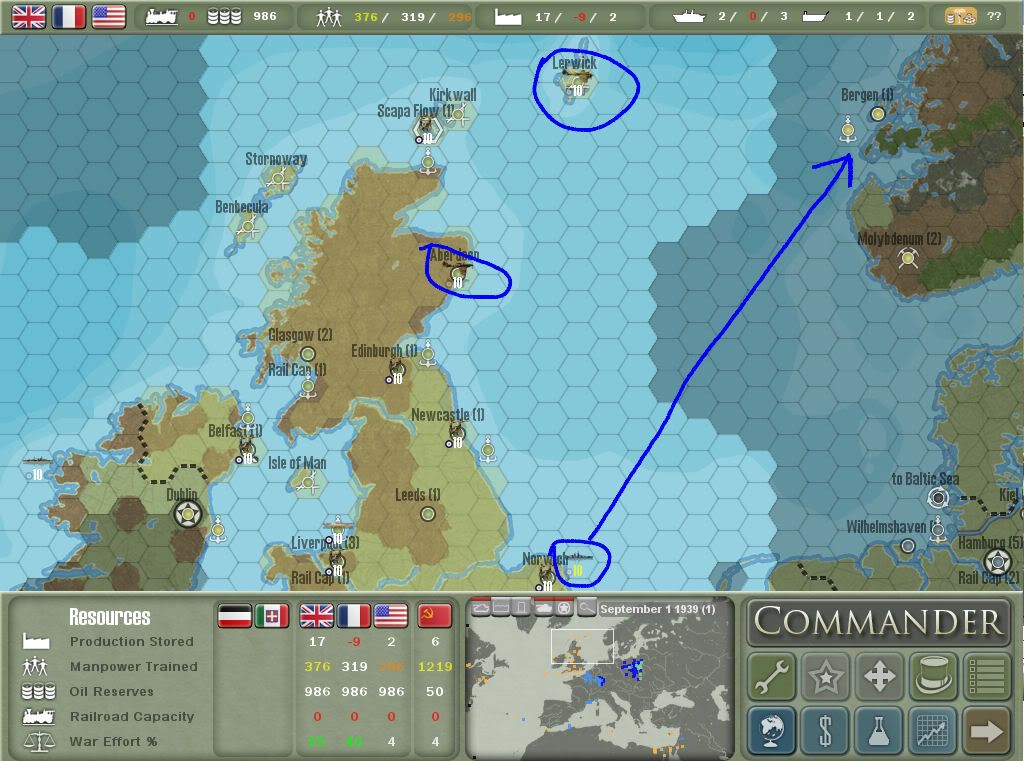
In the west, I moved the French Atlantic fleet (i.e., 1 BB) through the channel to a position southeast of England. I also moved the RAF in England to bases in Scotland or in the North Sea. I'm hoping to get lucky with the Atlantic French BB next turn and find one of the two u-boats that I know will exit Kiel next turn.
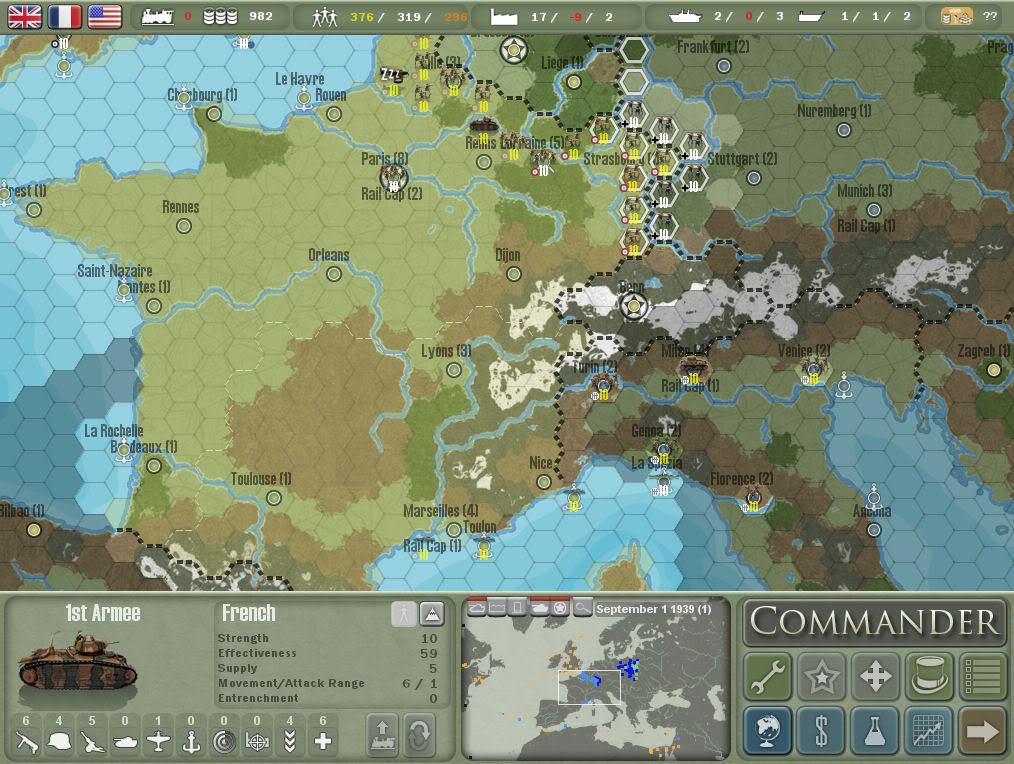
Nothing fancy in the mobilization of France. I am not going to deploy any UK units to France and will hold the RAF on reserve until near the fall of France. I will move the Canadian fighter, infantry and mechanized corps and garrison to England as a deterrent (or counter) to any thought of Sea Lion.
The first UK lab buy was air with no focus. Next turn I'll buy a naval lab. I haven't decided yet if I'll keep it no focus or focus on ASW, which starts at 0. However; even though surface ship tech starts at 1, that tech is now so important to not only transport and invasion capacity but to the ability to land on a contested coastal hex. I'll probably focus it on ASW because that's also vital to gaining control of the Atlantic.
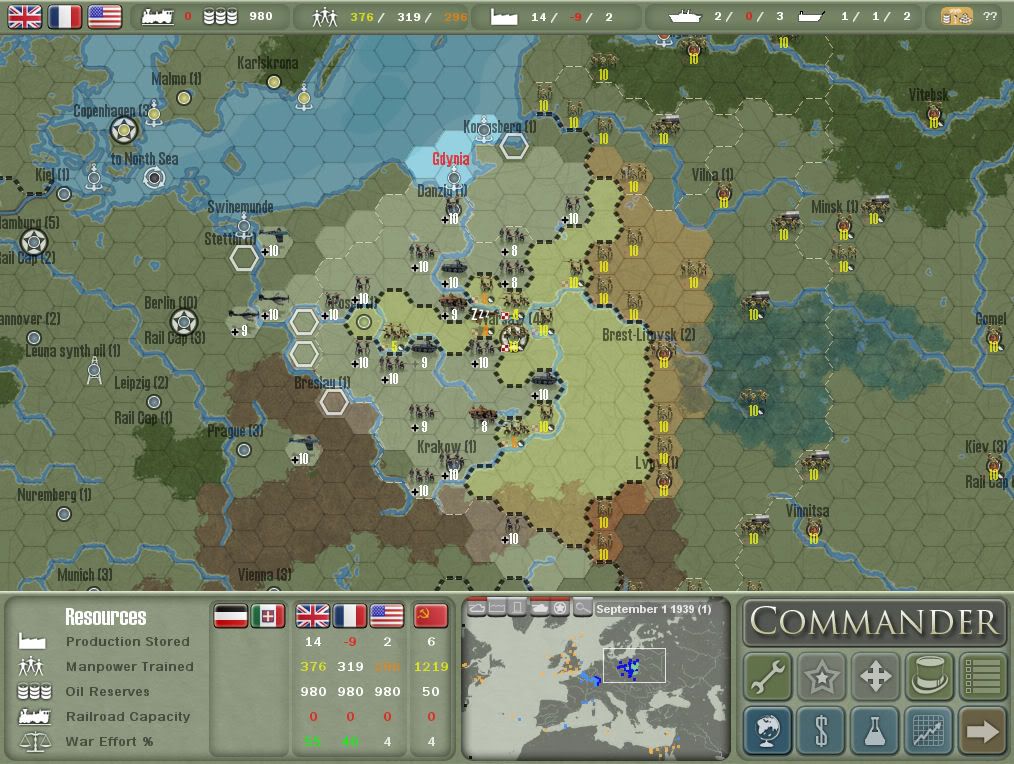
A survey of the German units in Poland finds all three tank corps, both mechanized corps and all German air units except for the strategic bomber. This is a very good sign that Borger isn't planning for a quick attack into Holland and / or Belgium. My estimate is that he will invade Denmark next turn and finish off Poland.
Two 10-step Polish infantry corps counterattacked taking 1-step off a German mechanized and tank corps. The Polish infantry corps didn't fare too well but they'll be gone next turn away. I did repair the garrison north of Warsaw, which brought it up to 9-steps. This only cost me 2 PPs.
In the west, I moved the French Atlantic fleet (i.e., 1 BB) through the channel to a position southeast of England. I also moved the RAF in England to bases in Scotland or in the North Sea. I'm hoping to get lucky with the Atlantic French BB next turn and find one of the two u-boats that I know will exit Kiel next turn.
Nothing fancy in the mobilization of France. I am not going to deploy any UK units to France and will hold the RAF on reserve until near the fall of France. I will move the Canadian fighter, infantry and mechanized corps and garrison to England as a deterrent (or counter) to any thought of Sea Lion.
The first UK lab buy was air with no focus. Next turn I'll buy a naval lab. I haven't decided yet if I'll keep it no focus or focus on ASW, which starts at 0. However; even though surface ship tech starts at 1, that tech is now so important to not only transport and invasion capacity but to the ability to land on a contested coastal hex. I'll probably focus it on ASW because that's also vital to gaining control of the Atlantic.
Turn 2. September 21, 1939 Allied.
Both Poland and Denmark falls this turn. I was hoping that Denmark would hold for two turns but no such luck.
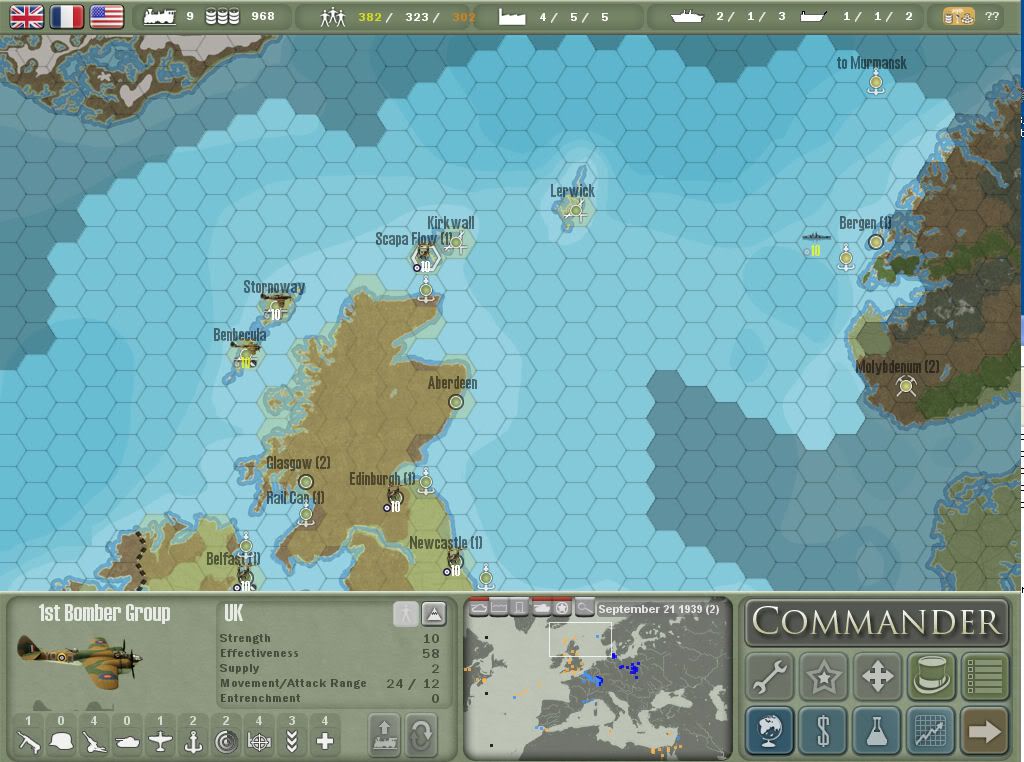
The French Atlantic BB fleet made no contact in the North Sea. This was a low probability sweep but with no risk. So why not. The French Atlantic BB fleet and the RAF positioned for one last blind sweep next turn. I feel like a blind man trying to hit a baseball.
RN and French escorts are forming up in the Atlantic to escort the Canadian fighter and garrison to England.
The British built their 2nd lab, which was a naval lab with focus on ASW.
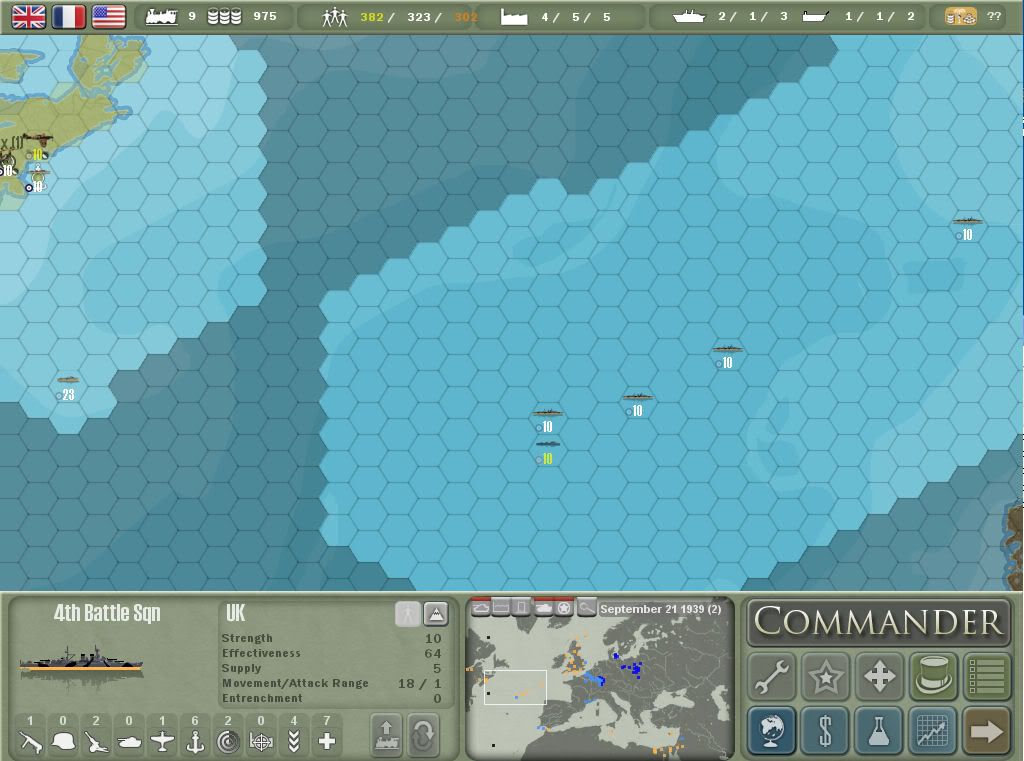
Both Poland and Denmark falls this turn. I was hoping that Denmark would hold for two turns but no such luck.
The French Atlantic BB fleet made no contact in the North Sea. This was a low probability sweep but with no risk. So why not. The French Atlantic BB fleet and the RAF positioned for one last blind sweep next turn. I feel like a blind man trying to hit a baseball.
RN and French escorts are forming up in the Atlantic to escort the Canadian fighter and garrison to England.
The British built their 2nd lab, which was a naval lab with focus on ASW.
The Blind Sweep Against the U-boat Breakout Can Actually Work!
I just had to show someone that the blind sweep on turn 2 against the u-boat breakout through the North Sea can actually work. The screen cap below is from my game with Jim. Unfortunately it drew a blank in this AAR game against Borger. But, I did want to show that it can work. Apparently, Jim wasn't keeping up with my AAR against Borger before he did his last move.
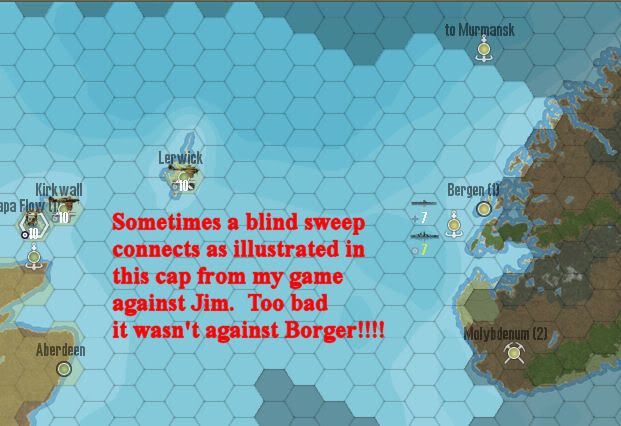
I just had to show someone that the blind sweep on turn 2 against the u-boat breakout through the North Sea can actually work. The screen cap below is from my game with Jim. Unfortunately it drew a blank in this AAR game against Borger. But, I did want to show that it can work. Apparently, Jim wasn't keeping up with my AAR against Borger before he did his last move.
-
massina_nz
- Lieutenant Colonel - Fw 190A
- Posts: 1137
- Joined: Fri Dec 18, 2009 12:12 am
- Location: Wellington, New Zealand
-
schwerpunkt
- Sergeant First Class - Panzer IIIL
- Posts: 367
- Joined: Fri Apr 17, 2009 12:26 am
- Location: Western Australia

Turn 3. October 11, 1939 Allied.
Naturally, my second and last blind sweep against the u-boat breakout expected through the North Sea drew a blank and Borger got fair weather to invade Holland. Well, those events were expected so I really can't complain.
The Canadian fighter and garrison transports were formed and moved to sea heavily escorted. Can you tell which one is the fighter? By the way, the newest changes hide the unit being transported from your opponent, so Borger won't see the unit types. However; I don't he will have trouble figuring out which one is the fighter and which one is the garrison.
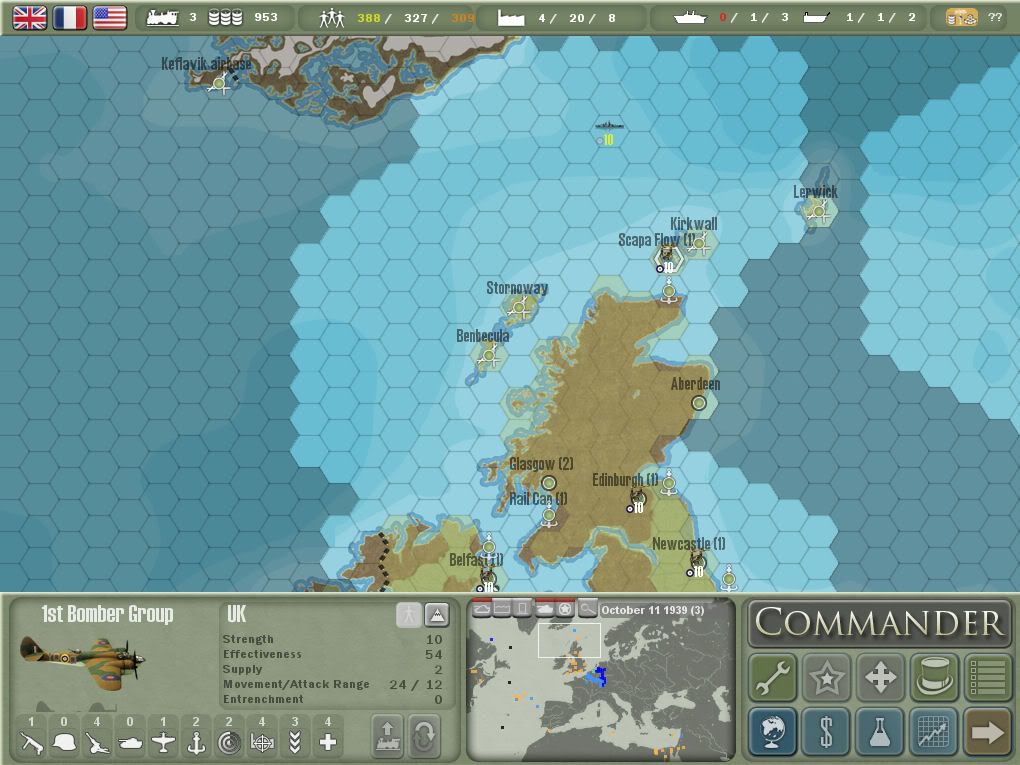
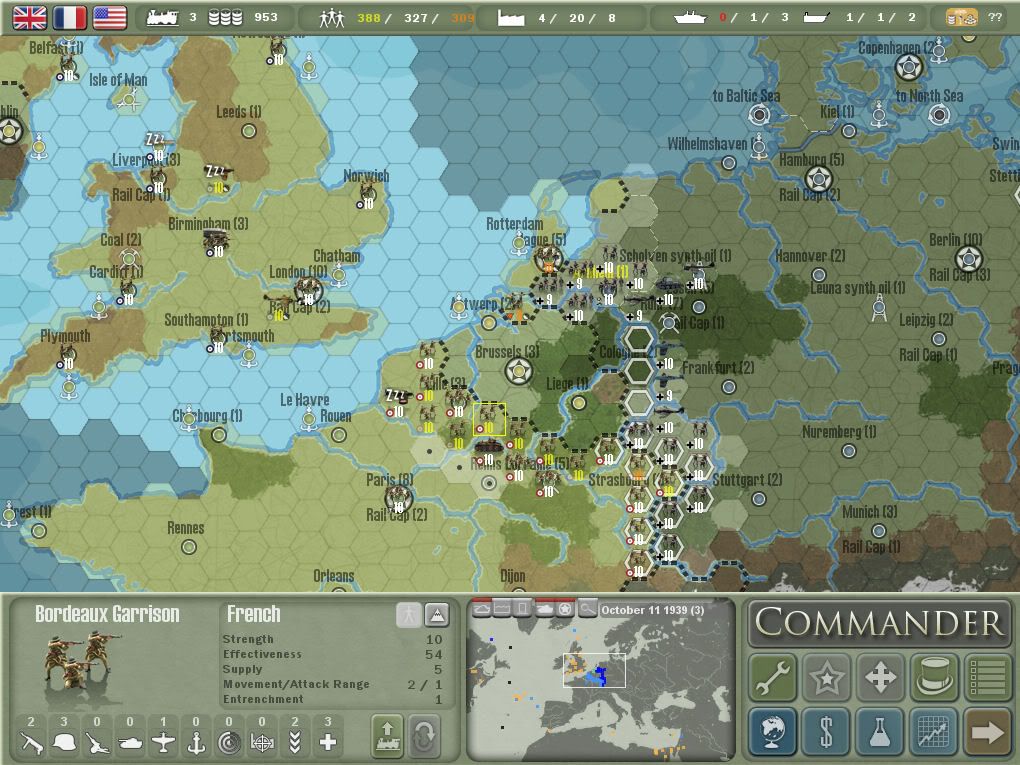
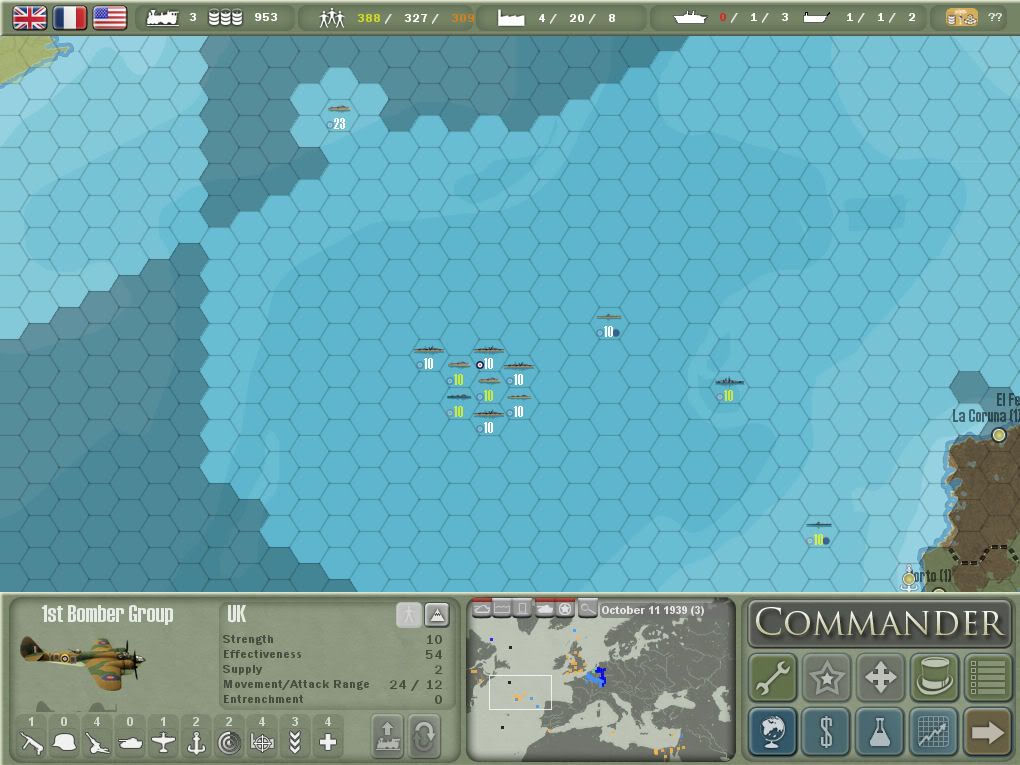
Naturally, my second and last blind sweep against the u-boat breakout expected through the North Sea drew a blank and Borger got fair weather to invade Holland. Well, those events were expected so I really can't complain.
The Canadian fighter and garrison transports were formed and moved to sea heavily escorted. Can you tell which one is the fighter? By the way, the newest changes hide the unit being transported from your opponent, so Borger won't see the unit types. However; I don't he will have trouble figuring out which one is the fighter and which one is the garrison.
-
massina_nz
- Lieutenant Colonel - Fw 190A
- Posts: 1137
- Joined: Fri Dec 18, 2009 12:12 am
- Location: Wellington, New Zealand

Turn 4. October 31, 1939 Allied.
Holland fell and the weather was fair in Central Europe. This also allowed Borger to do the small things that he does, which can drive you absolute crazy as an opponent. He bombed one of the front line French garrisons, knocking off 1-step and which I repaired, to draw out the fighter fighter, which he didn't because in was grounded. Then the German strategic bomber hit Paris knocking of 1-PP. While that didn't do much it still cost me a couple of PPs!
The French had enough PPs to build an infantry corps. Also, the Brits will have enough PPs to purchase their 3rd lab for 35 PPs. I'm planning on purchasing an infantry lab.

Holland fell and the weather was fair in Central Europe. This also allowed Borger to do the small things that he does, which can drive you absolute crazy as an opponent. He bombed one of the front line French garrisons, knocking off 1-step and which I repaired, to draw out the fighter fighter, which he didn't because in was grounded. Then the German strategic bomber hit Paris knocking of 1-PP. While that didn't do much it still cost me a couple of PPs!
The French had enough PPs to build an infantry corps. Also, the Brits will have enough PPs to purchase their 3rd lab for 35 PPs. I'm planning on purchasing an infantry lab.
-
massina_nz
- Lieutenant Colonel - Fw 190A
- Posts: 1137
- Joined: Fri Dec 18, 2009 12:12 am
- Location: Wellington, New Zealand
Not sure why drawing out our French fighter is a bad thing, it's not like he can attack it again.rkr1958 wrote:Turn 4. October 31, 1939 Allied.
Holland fell and the weather was fair in Central Europe. This also allowed Borger to do the small things that he does, which can drive you absolute crazy as an opponent. He bombed one of the front line French garrisons, knocking off 1-step and which I repaired, to draw out the fighter fighter, which he didn't because in was grounded. Then the German strategic bomber hit Paris knocking of 1-PP. While that didn't do much it still cost me a couple of PPs!
<snip>
Turn 5. November 20, 1939 Allied.
Naturally, Borger gets fair weather in November when I can't buy a fair weather turn against Neil! These two opponents are tough enough without the weather gods being on their side.
Well I did have a bit of luck in the Atlantic. The French DD found the third, and hidden, German u-boat flotilla next to a good size convoy off the west coast of Ireland. The French Atlantic BB that had done blind sweeps the last two turns moved into the area along with the French sub group and the RAF long range fighter. I can't image that Borger will go after this convoy. But, I wouldn't mind if he did.
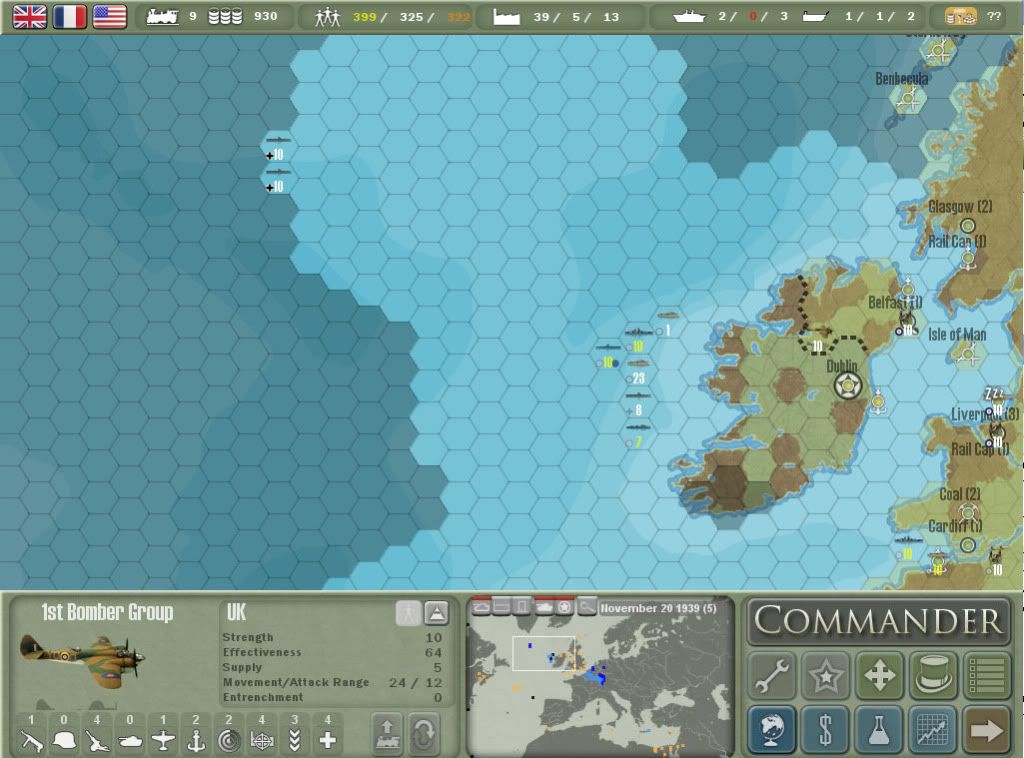
Naturally, Borger gets fair weather in November when I can't buy a fair weather turn against Neil! These two opponents are tough enough without the weather gods being on their side.
Well I did have a bit of luck in the Atlantic. The French DD found the third, and hidden, German u-boat flotilla next to a good size convoy off the west coast of Ireland. The French Atlantic BB that had done blind sweeps the last two turns moved into the area along with the French sub group and the RAF long range fighter. I can't image that Borger will go after this convoy. But, I wouldn't mind if he did.
Update to GS v1.10g (Beta)
For the full list of changes in GS v1.10 see: viewtopic.php?p=165310#165310
Changes since GS v1.10f.
Contested Invasions
18. For those into equations here they are for how technology impacts transports:
a. attack strength = attackVal + max(0,floor((techSurfaceShips + 1) / 2))
b. shock = shockVal + max(0,floor((techSurfaceShips + 3) / 4))
c. quality = qualityVal + max(0,floor(techSurfaceShips / 4))
d. flak = flakVal + max(0, techRadar - 4)
attackVal, shockVal, qualityVal and flakVal are the current values for these variables and are passed to the methods in which the above equations are added.
19. The coefficients of these functions are controlled through the general.txt file in order to be able to tweak these functions as necessary. The general form for equations (a-c) is: val + (A*techSurfaceShips + B) / C and for equation d is: val + (A*techRadar + B) / C. The coefficients A, B & C are set separately for each of the four areas in the general.txt file.
Commonwealth Country Specific Graphics
21. The following British, or Commonwealth, units that are name or renamed will have their own country specific unit graphics. This allows players all over the world to easily customize their British forces by just including the following “key” in a unit’s name to “unlock” the country’s specific unit graphic for that country.
a. Canada or Canadian
b. Australia or Australian
c. India or Indian
d. New Zealand
e. South Africa or South African
f. Poland or Polish
Elite Unit Specific Graphics
22. German units with names that include “SS” with trigger German SS NATO images.
23. Soviet units with names that include “Guards”, “GDS” or “Gds” will trigger Soviet Guards NATO images.
24. Soviet units that reach experience level 3 will automatically be promoted to Guards.
25. NATO images for all countries at zoom level 3 will now show a number of dots equal to the experience level for each unit.
Map and Scenario Changes
26. Fredericton in Canada has been renamed to Saint John.
27. All units starting in Canada has Canadian in their name. Therefore; they will “unlock” the Canadian specific unit graphics.
28. The US Lend Lease destroyer has been renamed to include Canadian in the name and will also “unlock” the Canadian specific unit graphics.
Softer Air Bases when Used in a Ground Defense Role
It was becoming common practice to use air units in ground defense roles. Because of the movement range of these units they were at times being deployed at speeds and distances that modern airmobile forces would envy. Also, they were often times holding up just as well or even better against ground attacks than normal ground units. While air units do have a significant number of ground troops that were historically used in infantry roles they had no where near the ability to hold as did regular infantry.
29. The survivability for air units attacked by ground units or invasion transports is halved (rounded up) and caped at 5 (i.e., cannot exceed 5).
a. defenderSurv = min(ceil(A*defenderSurv/B), C)
b. A=1, B=2 & C=5 and are set in the general.txt file.
30. The survivability for air units attacked by destroyers or battleships is NOT halved but is caped at 5.
a. defenderSurv = min(defenderSurv,C)
b. C=5 and is set through the general.txt file (the same C as in 29).
For the full list of changes in GS v1.10 see: viewtopic.php?p=165310#165310
Changes since GS v1.10f.
Contested Invasions
18. For those into equations here they are for how technology impacts transports:
a. attack strength = attackVal + max(0,floor((techSurfaceShips + 1) / 2))
b. shock = shockVal + max(0,floor((techSurfaceShips + 3) / 4))
c. quality = qualityVal + max(0,floor(techSurfaceShips / 4))
d. flak = flakVal + max(0, techRadar - 4)
attackVal, shockVal, qualityVal and flakVal are the current values for these variables and are passed to the methods in which the above equations are added.
19. The coefficients of these functions are controlled through the general.txt file in order to be able to tweak these functions as necessary. The general form for equations (a-c) is: val + (A*techSurfaceShips + B) / C and for equation d is: val + (A*techRadar + B) / C. The coefficients A, B & C are set separately for each of the four areas in the general.txt file.
Commonwealth Country Specific Graphics
21. The following British, or Commonwealth, units that are name or renamed will have their own country specific unit graphics. This allows players all over the world to easily customize their British forces by just including the following “key” in a unit’s name to “unlock” the country’s specific unit graphic for that country.
a. Canada or Canadian
b. Australia or Australian
c. India or Indian
d. New Zealand
e. South Africa or South African
f. Poland or Polish
Elite Unit Specific Graphics
22. German units with names that include “SS” with trigger German SS NATO images.
23. Soviet units with names that include “Guards”, “GDS” or “Gds” will trigger Soviet Guards NATO images.
24. Soviet units that reach experience level 3 will automatically be promoted to Guards.
25. NATO images for all countries at zoom level 3 will now show a number of dots equal to the experience level for each unit.
Map and Scenario Changes
26. Fredericton in Canada has been renamed to Saint John.
27. All units starting in Canada has Canadian in their name. Therefore; they will “unlock” the Canadian specific unit graphics.
28. The US Lend Lease destroyer has been renamed to include Canadian in the name and will also “unlock” the Canadian specific unit graphics.
Softer Air Bases when Used in a Ground Defense Role
It was becoming common practice to use air units in ground defense roles. Because of the movement range of these units they were at times being deployed at speeds and distances that modern airmobile forces would envy. Also, they were often times holding up just as well or even better against ground attacks than normal ground units. While air units do have a significant number of ground troops that were historically used in infantry roles they had no where near the ability to hold as did regular infantry.
29. The survivability for air units attacked by ground units or invasion transports is halved (rounded up) and caped at 5 (i.e., cannot exceed 5).
a. defenderSurv = min(ceil(A*defenderSurv/B), C)
b. A=1, B=2 & C=5 and are set in the general.txt file.
30. The survivability for air units attacked by destroyers or battleships is NOT halved but is caped at 5.
a. defenderSurv = min(defenderSurv,C)
b. C=5 and is set through the general.txt file (the same C as in 29).
GS v1.10h (Beta).
We will now switch to GS v1.10h. For the complete v1.10 change log see the first post in this AAR. The changes since the last update are highlighted in red below.
Commonwealth Units and Leaders
26. The following British, or Commonwealth, units that are name or renamed will have their own country specific unit graphics. This allows players all over the world to easily customize their British forces by just including the following “key” in a unit’s name to “unlock” the country’s specific unit graphic for that country.
1. Canada or Canadian
2. Australia or Australian
3. India or Indian
4. New Zealand
5. South Africa or South African
6. Poland or Polish
27. Now players can also command UK/CW forces with a leader from their favorite CW country. Added the following CW leaders to the UK faction.
1. Bernard Freyberg, 1st Baron Freyberg (New Zealand) (1889 - 1963).
2. Guy Granville Simonds (Canadian) (1903 - 1974).
3. Sir Thomas Blamey (Australian) (1884 – 1951)
4. Harry D.G. Crerar (Canadian) (1888 - 1965)
5. Field-Marshal, Jan Christian Smuts (South African) (1870-1950)
6. Captain Kodandera "Kipper" Madappa Cariappa (Indian) (1899 - 1993)
7. Boleslaw Bronislaw Duch (Polish) (1885-1980)
28. Both CW units/ leaders are “chrome” and are functionally UK units/leaders. However; players can now customize the look and feel of the UK/CW forces to add a bit more flair, historical realism and / or national pride to their GS gaming experience.
Elite Units
German SS units were “elite” because they were both composed by more fanatical troops than regular army units and because they got priority on equipment, manpower and training. It was often the later that contributed to their “eliteness”.
Russian “Guards” units were the elite units in the Russian army. They achieved their elite status through extraordinary performance on the battlefield.
29. German units can be “upgraded” to SS units by renaming them to include SS, which a space either before or after, in their new name. This upgrade follows the rules of a technology upgrade where the unit cannot be adjacent to an enemy unit and will not be able to move the turn of the upgrade. The cost of the upgrade, however, is 15 PPs for armor, mechanized and infantry corps and 10 PP garrisons and is quite a bit more than a technology upgraded. The upgrade results in an increase of 1 in attack, defense, shock, quality and survivability. Also, the image or counter for the upgraded unit will change to a SS version of the image or counter. There is a limit on the maximum number of SS units in play at any one time, which is 0 (1939 – 1940), 1 (1941), 3 (1942), 5 (1943), 8 (1944) and 10 (1945).
30. Soviet units that achieve an experience level of 75 (i.e., level 3), or higher, are promoted to a “Guards” unit. Once promoted they will never lose that status unless completely destroyed. There is no cost for this promotion; however Guards units do get an increase of 1 in attack, defense, shock, quality and survivability. Also, the image or counter for the promoted unit will change to a Guards version of the image or counter. There is a limit on the maximum number of Guards units in play at any one time, which is 0 (1939 – 1940), 2 (1941), 5 (1942), 8 (1943), 12 (1944) and 16 (1945). When at this limit no more units will be promoted until the limit increases or a Guards unit is destroyed.
31. A German, or Russian, unit must be in supply level 4 (or higher) to be converted, or promoted, to an elite unit.
32. The 1942, 1943 and 1944 scenarios were slightly updated by adding some, but not many, Guards and SS units.
Experience Level
There have been extensive changes to how experience is lost and gained in order that units don’t lose experience so easily and that units attacking secondary and, usually, easy targets (e.g., naval bombardment) don’t gain experience at the same rate as if attacking their primary target (e.g., other ships).
33. Ground units. Ground units per attack gain 6 XP points for attacks on other ground units and 3 for attacks on air units. On defense they gain 4 XP points versus defense against other ground units, 4 XP versus defense against air and 2 XP version defense against naval. Ground units lose no experience for repair (i.e., reinforcement) at 8-steps or 9-steps and lose a flat 5 XP points per step; otherwise. For example, a ground unit is at 5-steps and repairs back to 10-steps. They would lose 5 + 5 + 5 + 0 + 0 = 15 XP points. The same unit at 3-steps, which repaired 5-steps back to 8, would lose 5 + 5 + 5 + 5 + 5 = 25 XP points.
1. GROUND_VS_GROUND_ATTACK_XP 6
2. GROUND_VS_GROUND_DEFENSE_XP 4
3. GROUND_VS_AIR_ATTACK_XP 3
4. GROUND_VS_AIR_DEFENSE_XP 4
5. GROUND_VS_NAVAL_DEFENSE_XP 2
34. Air units. Air units lose a flat 5 XP points per step repaired even at 8- or 9-steps.
1. FIGHTER_VS_AIR_ATTACK_XP 6
2. FIGHTER_VS_AIR_DEFENSE_XP 6
3. BOMBER_VS_AIR_ATTACK_XP 3
4. BOMBER_VS_AIR_DEFENSE_XP 3
5. FIGHTER_VS_NAVAL_ATTACK_XP 3
6. TAC_BOMBER_VS_NAVAL_ATTACK_XP 6
7. STRAT_BOMBER_VS_NAVAL_ATTACK_XP 6
8. AIR_VS_NAVAL_DEFENSE_XP 2
9. FIGHTER_VS_GROUND_ATTACK_XP 3
10. TAC_BOMBER_VS_GROUND_ATTACK_XP 6
11. STRAT_BOMBER_VS_GROUND_ATTACK_XP 3
12. AIR_VS_GROUND_DEFENSE_XP 2
13. FIGHTER_VS_RESOURCE_ATTACK_XP 3
14. TAC_BOMBER_VS_RESOURCE_ATTACK_XP 3
15. STRAT_BOMBER_VS_RESOURCE_ATTACK_XP 6
35. Naval units. Naval units lose a flat 5 XP points per step repaired even at 8- or 9-steps.
1. NAVAL_VS_NAVAL_ATTACK_XP 6
2. NAVAL_VS_NAVAL_DEFENSE_XP 4
3. NAVAL_VS_AIR_ATTACK_XP 0
4. NAVAL_VS_AIR_DEFENSE_XP 4
5. NAVAL_VS_GROUND_ATTACK_XP 0
36. NATO images for all countries at zoom level 3 will show a number of dots equal to the experience level for each unit.
Garrisons as Headquarter Units
37. A leader attached to a garrison increase the movement of that garrison by 1 as long as the leader is attached.
We will now switch to GS v1.10h. For the complete v1.10 change log see the first post in this AAR. The changes since the last update are highlighted in red below.
Commonwealth Units and Leaders
26. The following British, or Commonwealth, units that are name or renamed will have their own country specific unit graphics. This allows players all over the world to easily customize their British forces by just including the following “key” in a unit’s name to “unlock” the country’s specific unit graphic for that country.
1. Canada or Canadian
2. Australia or Australian
3. India or Indian
4. New Zealand
5. South Africa or South African
6. Poland or Polish
27. Now players can also command UK/CW forces with a leader from their favorite CW country. Added the following CW leaders to the UK faction.
1. Bernard Freyberg, 1st Baron Freyberg (New Zealand) (1889 - 1963).
2. Guy Granville Simonds (Canadian) (1903 - 1974).
3. Sir Thomas Blamey (Australian) (1884 – 1951)
4. Harry D.G. Crerar (Canadian) (1888 - 1965)
5. Field-Marshal, Jan Christian Smuts (South African) (1870-1950)
6. Captain Kodandera "Kipper" Madappa Cariappa (Indian) (1899 - 1993)
7. Boleslaw Bronislaw Duch (Polish) (1885-1980)
28. Both CW units/ leaders are “chrome” and are functionally UK units/leaders. However; players can now customize the look and feel of the UK/CW forces to add a bit more flair, historical realism and / or national pride to their GS gaming experience.
Elite Units
German SS units were “elite” because they were both composed by more fanatical troops than regular army units and because they got priority on equipment, manpower and training. It was often the later that contributed to their “eliteness”.
Russian “Guards” units were the elite units in the Russian army. They achieved their elite status through extraordinary performance on the battlefield.
29. German units can be “upgraded” to SS units by renaming them to include SS, which a space either before or after, in their new name. This upgrade follows the rules of a technology upgrade where the unit cannot be adjacent to an enemy unit and will not be able to move the turn of the upgrade. The cost of the upgrade, however, is 15 PPs for armor, mechanized and infantry corps and 10 PP garrisons and is quite a bit more than a technology upgraded. The upgrade results in an increase of 1 in attack, defense, shock, quality and survivability. Also, the image or counter for the upgraded unit will change to a SS version of the image or counter. There is a limit on the maximum number of SS units in play at any one time, which is 0 (1939 – 1940), 1 (1941), 3 (1942), 5 (1943), 8 (1944) and 10 (1945).
30. Soviet units that achieve an experience level of 75 (i.e., level 3), or higher, are promoted to a “Guards” unit. Once promoted they will never lose that status unless completely destroyed. There is no cost for this promotion; however Guards units do get an increase of 1 in attack, defense, shock, quality and survivability. Also, the image or counter for the promoted unit will change to a Guards version of the image or counter. There is a limit on the maximum number of Guards units in play at any one time, which is 0 (1939 – 1940), 2 (1941), 5 (1942), 8 (1943), 12 (1944) and 16 (1945). When at this limit no more units will be promoted until the limit increases or a Guards unit is destroyed.
31. A German, or Russian, unit must be in supply level 4 (or higher) to be converted, or promoted, to an elite unit.
32. The 1942, 1943 and 1944 scenarios were slightly updated by adding some, but not many, Guards and SS units.
Experience Level
There have been extensive changes to how experience is lost and gained in order that units don’t lose experience so easily and that units attacking secondary and, usually, easy targets (e.g., naval bombardment) don’t gain experience at the same rate as if attacking their primary target (e.g., other ships).
33. Ground units. Ground units per attack gain 6 XP points for attacks on other ground units and 3 for attacks on air units. On defense they gain 4 XP points versus defense against other ground units, 4 XP versus defense against air and 2 XP version defense against naval. Ground units lose no experience for repair (i.e., reinforcement) at 8-steps or 9-steps and lose a flat 5 XP points per step; otherwise. For example, a ground unit is at 5-steps and repairs back to 10-steps. They would lose 5 + 5 + 5 + 0 + 0 = 15 XP points. The same unit at 3-steps, which repaired 5-steps back to 8, would lose 5 + 5 + 5 + 5 + 5 = 25 XP points.
1. GROUND_VS_GROUND_ATTACK_XP 6
2. GROUND_VS_GROUND_DEFENSE_XP 4
3. GROUND_VS_AIR_ATTACK_XP 3
4. GROUND_VS_AIR_DEFENSE_XP 4
5. GROUND_VS_NAVAL_DEFENSE_XP 2
34. Air units. Air units lose a flat 5 XP points per step repaired even at 8- or 9-steps.
1. FIGHTER_VS_AIR_ATTACK_XP 6
2. FIGHTER_VS_AIR_DEFENSE_XP 6
3. BOMBER_VS_AIR_ATTACK_XP 3
4. BOMBER_VS_AIR_DEFENSE_XP 3
5. FIGHTER_VS_NAVAL_ATTACK_XP 3
6. TAC_BOMBER_VS_NAVAL_ATTACK_XP 6
7. STRAT_BOMBER_VS_NAVAL_ATTACK_XP 6
8. AIR_VS_NAVAL_DEFENSE_XP 2
9. FIGHTER_VS_GROUND_ATTACK_XP 3
10. TAC_BOMBER_VS_GROUND_ATTACK_XP 6
11. STRAT_BOMBER_VS_GROUND_ATTACK_XP 3
12. AIR_VS_GROUND_DEFENSE_XP 2
13. FIGHTER_VS_RESOURCE_ATTACK_XP 3
14. TAC_BOMBER_VS_RESOURCE_ATTACK_XP 3
15. STRAT_BOMBER_VS_RESOURCE_ATTACK_XP 6
35. Naval units. Naval units lose a flat 5 XP points per step repaired even at 8- or 9-steps.
1. NAVAL_VS_NAVAL_ATTACK_XP 6
2. NAVAL_VS_NAVAL_DEFENSE_XP 4
3. NAVAL_VS_AIR_ATTACK_XP 0
4. NAVAL_VS_AIR_DEFENSE_XP 4
5. NAVAL_VS_GROUND_ATTACK_XP 0
36. NATO images for all countries at zoom level 3 will show a number of dots equal to the experience level for each unit.
Garrisons as Headquarter Units
37. A leader attached to a garrison increase the movement of that garrison by 1 as long as the leader is attached.
-
DukeOfLight
- Senior Corporal - Destroyer
- Posts: 122
- Joined: Thu Jun 03, 2010 5:01 pm
- Location: Bucharest (Romania)
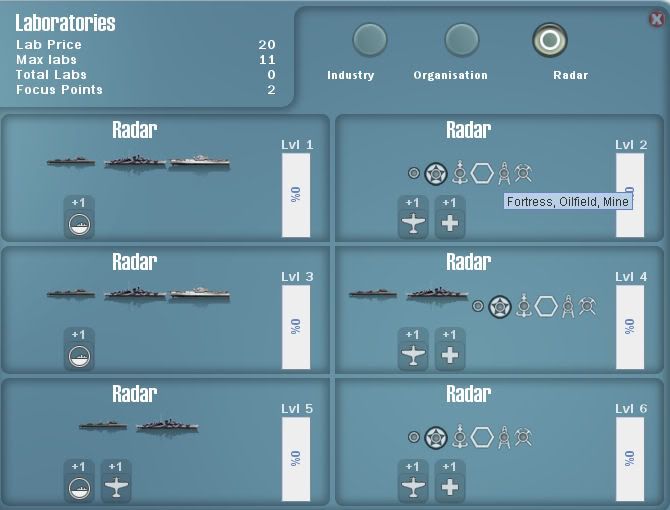
mines and oil
There are also upgrades for this tilies when you advance on rader tech?
-
DukeOfLight
- Senior Corporal - Destroyer
- Posts: 122
- Joined: Thu Jun 03, 2010 5:01 pm
- Location: Bucharest (Romania)
Re: mines and oil
Yes. At levels 2, 4 & 6.DukeOfLight wrote:There are also upgrades for this tilies when you advance on rader tech?
-
PinkPanzer
- Administrative Corporal - SdKfz 251/1
- Posts: 129
- Joined: Sat Feb 06, 2010 9:40 pm
Yep, your crazy rkr1958.First off, I must be crazy to not only play two very strong players like Borger and Neil but to post these games in AARs for the community to see me get my rear end kicked.
I plan to play conservative against Borger and try to fall as historical timeline as I can. With the new changes shown above I will not invade Ireland for additional ASW air bases. Also, I will not try to get to Europe through Portugal and Spain because Borger has established a solid line of units on the coast. I suspect Borger will also follow a fairly historical timeline and I have no doubt that with his usual efficiency I'll be hard pressed for the Russians to make it into Poland or for the western Allies to recaptured Paris by the end of the game. Playing Borger is like playing "Big Blue", the IBM computer that beat the chess master who's name I can't recall. For those of you who have yet to play Borger our AARs will show you how extremely tough opponent he is.
My plans for the UK and USA is for them to establish control of the Atlantic and of the air by late 1942 at which time I will likely launch Torch. My early war strategy for Russia is survival. I don't plan any massive counterattacks but only plan to trade space for units. That is, I want to save as much of the Russian corps as I can.
+I'll give you generic wargaming advice, for both your aar vs borger and neil, because I'm not as experienced with Ceaw GS as you are.
The first piece of advice is: He who wins the recon battle wins the war.
For naval warfare subs are the ideal recon unit because they're hidden and for land warfare air units and CV's(for axis coastal areas) are the ideal recon unit. Obviously a priority on air research with some focus at times on strat ops affects sea and land spotting for air units and CV's. The reason why recon is much more important than most people realize is that you gain an information advantage that you can use to exploit set up air or naval or amphib ambush's of axis units/undefended ports.
For example on the tactical level UK subs can hide and watch axis ports for axis naval units, if an axis sub is spotted in Bordeaux, UK DD's,CV's or air units can be moved into position(out of range of axis air units) to possibly ambush the sub. On the strategic level UK subs can watch axis ports or UK coastal waters for a possible sea lion invasion and once the danger of sea lion has passed UK naval and air units can be shifted to the med.
In general allied play subs can be used to recon enemy ports for ship (A UK sub can see Axis subs in port) and transport movements to gain positional advantage and air units or CV's with superior land spotting can recon for potential amphib invasions sites. The end result should be a better allied Battle of the Atlantic & Med. Better decisions regarding defending against sealion and lots of nuisance invasions of to weaken axis barbarossa.
A side advantage of building UK subs is that they can effectively sweep for axis subs, just like DD's. It's better than sweeping with a BB.
A side advantage of high priority air research and more focus on strat ops is better attack range and movement sooner so your strat and tac bombers can win the battle of the atlantic sooner.
Assuming that you playing with unit names being unchangeable it's probably a good idea to keep track on paper of all axis air, armour and naval units locations so you can look for patterns to exploit.
The second piece of advice is: There are 3 ways to gain operational mobility.
1. Paratroopers. There aren't any in this game.
2. Naval transports. I think that most axis and allied russian players overlook the possibilities for gaining naval supremacy and using naval transports to gain operational mobility by amphib attacks along the black and baltic sea coastal areas behind the opponents front lines. You can take advantage of naval transports and shore bombardment to capture far away ports or use them to help break/unhinge a defensive live at the coast. Obviously, an axis player idealy has to capture istanbul or conquer Turkey to allow italian naval units to help establish naval superiority in the black sea.
3. Combined air/armour attacks to achieve a 2 or 3 hex gap to allow follow up armour/mech units to breakout beyond enemy defence lines. If an armour breakout is combined close to a coastal amphib/shore bombardment breakout, it's possible to surround and cut off from supply several axis units which can be easily be zoc'ed in place and killed at low cost when their effectiveness hits zero in a few turns.
The three Guderian rules for effective armoured operational breakouts are: mass, good terrain and surprise. In Ceaw GS good weather and leaders with good attack also applies.
Good Luck. May the Sun Tzu, Van Creveld, Boyd force be with you.
Indirect tactics, efficiently applied, are as inexhaustible as Heaven and Earth, unending as the flow of rivers and streams; like the sun and moon, they end but to begin anew; like the four seasons, they pass away but to return once more. Sun Tzu
-
DukeOfLight
- Senior Corporal - Destroyer
- Posts: 122
- Joined: Thu Jun 03, 2010 5:01 pm
- Location: Bucharest (Romania)
beta status
Hi guys,
When the beta will be ready?, by thy amount of new additions i think it will take at least 2 weeks.
When the beta will be ready?, by thy amount of new additions i think it will take at least 2 weeks.