

Post 1: General notes
Post 2: Troop type notes
Post 3: Partial draft list
Post 4: Misc
This list covers Japanese armies from 1494 to 1698, although the last large battle was in 1615. . . .
SENGOKU JIDAI
The Sengoku Jidai (warring states era) began before our period in 1457 and saw almost continual warfare at home or abroad until 1603, when the Tokugawa Shogunate was established. Organization, weapons, and tactics were honed in this survival-of-the-fittest contest to determine who would control Japan as Shogun. Daimyo Takeda Shingen is famous for the Takeda cavalry and his battles with Uesugi Kenshin, but his great contribution was his military reforms, including organizing, equipping, disciplining and controlling his ashigaru effectively. His enemy Oda Nobunaga (d. 1582) and then other daimyos copied this. Nobunaga unified Japan by military means, his commander Hideyoshi (d. 1598) was able to re-consolidate power again through a combination of military, political and diplomatic means, and Tokugawa Ieyasu (d. 1616) created the Tokugawa Shogunate in 1603 after patiently accumulating land and power as an ally of Nobunaga and then Hideyoshi. There is a famous poem about the nature of the three men based on how they might deal with a nightingale that won’t sing. In brief, Nobunaga: I’ll kill it. Hideyoshi: I’ll make it. Tokugawa: I’ll wait for it.
By the end of this period, Japan had large, veteran, modern armies with a tactical system somewhat similar to European pike and shot that relied heavily on firepower. Factors in this were the expansion and professionalization of the ashigaru (“light feet,” referring to their self-provided light arms and equipment) and their change of role into the most numerous and significant element of a Japanese army, the advent and adoption of firearms, the integration of the yari (spear) into effective mixed formations with troops armed with yumi (bows) or teppō (light muskets), and the consequent continuing decline of cavalry’s role in battle in Japan.
Ashigaru can be treated as relatively poorly-equipped Warriors or Medium Foot during the yumi and early teppō periods, then as better Medium Foot once disciplined. Note that as much as 40% of an army could be armed ashigaru in support roles such as baggage carriers, grooms, drummers, and logistics personnel.
The army, even under Hideyoshi, remained “feudal” in that its divisions comprised the contingents of various daimyos and their vassals and retainers, and the daimyo contingents retained some scope of independence under their orders even as late as Korea. Adoption of the sashimono was very useful in identifying friend, foe and formation. Methods of command and control, however, were very well developed, using fans, signals, and messengers within a common doctrine. The Koreans were amazed by the degree of tactical control of the Japanese.
The arrival, immediate adoption, and proliferation of modern firearms in Japan – the teppō era – began in 1543 with arquebus purchases from the Portuguese. They were first used in battle in Japan in 1549. Takeda Shingen had equipped a castle with 300 in 1555, and by 1569 was reducing yari numbers and prioritizing firearms. By the end of the century the teppō ashigaru were the predominant troop type, displacing yari in part and yumi almost entirely.
The yari and teppō diminished cavalry’s role over the 1500s. After the Mongol invasion showed the utility of foot archers and they became numerous, they could not be effectively opposed by individual samurai horse archers and their followers. Casualty records indicate that horsemen continued to charge through infantry up to 1450, but the fielding of formed yari (Spearmen rather than Light Spear, in FOGR terms) meant the cavalry could no longer safely engage enemy frontally. By our period the weapon commonly used both mounted and on foot was the mochi-yari (10-13 foot). On horseback, it could be used as a lance or slashing two-handed while standing in the stirrups.
Longer yari and more teppō saw a sharp reduction of mounted forces between the 1570s and the 1590s, so that by 1600 cavalry were few and normally fought dismounted, often with firearms.
Japan’s one foreign war was the Imjin War, an ambitious invasion of Korea from 1592-98 intended as a springboard for the conquest of China. The Japanese overran most of the country initially, but Korean naval power and popular resistance, large-scale military assistance by Ming China to its Korean vassal, and severe logistical problems led to the Japanese ultimately abandoning the peninsula. The Koreans and Japanese both credited firearms as a key Japanese advantage from the start, with greater range and penetration than the Korean bows and arrows, which in turn outshot Japanese bows. Volley fire by itself also had a clear psychological impact on unprepared opponents.
TEPPŌ TIME
The Japanese were unimpressed by simple Chinese handguns but were impressed by the Portuguese. Schools of gunsmithing quickly formed. The teppō was first used in battle in Japan in 1549 (used as the start date for teppō), and was regularly seen on battlefields by the early 1550s. The Ikko Ikki and monks led use of this disruptive new technology in quantity in the front ranks of battle since samurai status concerns were not an issue for them. Nobunaga learned effective firearms tactics from their example, he himself used volley fire as early as Muraki castle in 1554.
Nagashino:
At Nagashino Nobunaga deployed teppō infantry and their yari supports behind fences set up in 3 layers, with gaps arranged so teppō ashigaru posted in front of the fence could screen the obstacle and provoke the enemy to attack, penetrated the gaps, and be trapped under fire and counterattacks by yari samurai (i.e., pike and shot combination). Nobunaga’s best officers kept the teppō fire under strict control and volleys commenced at short range for maximal effect. Takeda initial casualties included a high proportion of leaders but they were only broken after hours of fighting at the fence and elsewhere. Unlike the film version, the attackers were not just Takeda cavalrymen – they had twice their number of retainers on foot, who attacked with them in traditional Japanese style.
Nagashino was not the first use of field works, as the advantage of defending breastworks was clear. However, it did attract notoriety, and the Japanese continued to gain great experience attacking and forcing or luring the enemy out of fortified positions. This experience stood them in good stead in Korea, where Japanese siege assaults through the war relied heavily on musketry and light artillery to drive the defenders back from the walls, as well as use of bluff and deception.
Nagashino was significant but not a watershed in firearms development or distribution in Japan. Different Japanese armies ramped up teppō use at different rates. On a broad scale, convenient focal dates would be the defeat of the Takeda at Nagashino (1575), followed by a steady increase that accelerated in Korea and continued into the next century. In Korea the Japanese relied increasingly on the teppō and sought to arm many as possible. Even samurai took up firearms. Letters home often asked for more guns and heavier cannon. Shimazu Yoshihiro wrote early in the war “Please arrange to send us guns and ammunition. There is absolutely no use for spears. It is vital that you arrange somehow to obtain a number of guns.” In 1597, another wrote "When troops come [to Korea] from the province of Kai, have them bring as many guns as possible, for no other equipment is needed. Give strict orders that all men, even the samurai, carry guns." Cost, however, was often a constraint for poorer daimyos.
Japanese Tactical System
The system that evolved through the late 16th century placed teppō in the front ranks of the line, then yumi, yari, and swordsmen behind. Having the ashigaru take the place of honor, leading in battle, was a difficult thing for the samurai to accept. Flanking bodies comprised teppō, yumi and yari. Nagaeyari fought 2 to 3 ranks deep, enough to repel enemy but not as deep pike. More ranks were not needed with the reduced mounted forces faced in Japan and their style of fighting.
Depth varied and multiple lines were common. At Anegawa in 1570, Nobunaga drew up his troops 13 ranks deep, but it was still penetrated. Shimazu swordsmanship broke through two lines of Hideyoshi’s at Sendaigawa River in 1587 though diverted and stopped by the third line and a mounted charge.
Logistical personnel followed in the rear, but even these ashigaru proved capable of handling a teppō or sword at need. This formation resembles the traditional crane's wing (kakuyoku) formation of 3 divisions in front and one in rear support. A theoretical FOGR array would be a front line of mixed infantry with gaps for second line bodies to advance through in an assault.
As a rule, the troops of each daimyo’s contingent fought together (including the 38 daimyos in the Korean campaign). Contingents were of varying sizes and different ratios among the troop types. In each contingent, teppō ashigaru formed the vanguard to open the fight with musketry at long range, supported by archers at shorter range. The infantry would advance and fire successive volleys to seek to disrupt the enemy. Heavy reliance on shooting was not new – wound studies of battles in Japan indicate about 3/4 being were from projectiles both before and after the advent of the teppō.
Close combat troops with yari and katana stood ready in the rear ranks to rush forward leading the assault when the enemy wavered or retreated, or to manoeuvre in front to form a defensive “hedge” of yari against mounted or other attackers. Avenues for their advance were opened by the shooters. The author of the Zohyo Monogatari (a book written in 1649 about ashigaru warfare) writes that if the enemy came close the teppō should divide up to right and left to let the yari ashigaru through, then sheathe their guns and enter the fray. In Korea, initial volleys were commonly followed quickly by a fierce charge which proved effective.
There is also reference to interlined (alternating) small bodies of shot and yari within a daimyo’s formation, which appears to have evolved into the better organized and disciplined mixed rank formations.
I found one possible reference to breaking off, but it may just describe a series of tactical encounters by different units: The intense fighting between the forces of Fukushima Masanori and Ukita Hideie is characterized in “Sekigahara” as waves clashing and receding repeatedly. “Fukushima would push deep into the Western lines, only to have Western lancers drive him back again.” Lancers = nagae-yari.
The yumi and later the teppō, combined with the long nagae-yari, left little tactical scope for cavalry on Japanese battlefields near the end of the 16th century. Horses were used mainly by people of rank or for mobility. Horsemen remained useful for their utility on and off the battlefield, and leaders commonly continued to charge on horseback with their troops. Although they did not operate as a separate arm with cavalry units as such, mounted men were occasionally gathered into ad hoc tactical formations as was done in Korea, so some battle groups are allowed.
Weapons:
Ashigaru had one or two swords in addition to their primary weapons. While swords were the dominant wounding weapon in the 1300s and a cult of the sword developed, from the Onin War they dropped dramatically with the yari overwhelmingly dominant, although, confusingly, “push of pike” continued to be expressed in Japanese literary terms as an exchange of sword blows.
The Samurai preferred to use the yari in pursuit of single combat, but with the ashigaru the use of formed bodies of yari began in the second half of the 15th C. The yari started at man-height but trended longer for the ashigaru. Circa 1530 the mochi-yari (long spear) of 8-14 ft had lengthened to a pike-like nagae-yari (long-shafted spear). The nagae yari consisted of an inner core of hardwood (usually oak) with a laminated layer of bamboo, lacquered against weather. The usual length of the nagae-yari was 3 ken, though Nobunaga’s yari was 3.5 ken long, adopted 1553 or earlier. The ken (standard unit of Japanese architectural design) until 1650 was 1970 mm, when it was reduced to 1818 mm, and, assuming references use the later shorter ken, these would be 18 feet and 21 feet. Nagae-yari required more drill and coordination to be effective, and the troops were accordingly increasingly more drilled and disciplined, with close attention to maintaining good order. It is not clear whether the advantage of length was enough to count as Pike vs. Spearmen as would be relevant between Japanese armies – the advantage may be too marginal compared with the importance of firepower.
Naginata HW works with Pikes, not Spearmen. Use of the naginata would have been very rare in Korea.
The longer reach of Japanese swords and spears often commented upon by Chinese and Koreans in the 1590s, prompting use of anti-wo-ko’u style troops.
Armour:
A century of warfare had perfected practical Japanese armour, with less lacquered armour and more metal, including steel plates covering the chest for protection against bullets, but with flexibility and better weight distribution. Ashigaru were provided armour in the second half of the 16th century, even if on occasions they did not use it. Hideyoshi equipped his entire army with okashi gusuku (munitions grade armour), and by the 1590s all ashigaru would be armoured. Bullet-tested armour and more elaborate designs were generally reserved for the wealthy, although Date Masamune equipped his army with bullet-tested sendai-do, and Konishi Yukinaga and Otomo Sorin did the same with namban-do armour. Their armies would also have very good teppō troops, and Otomo Sorin had cannon.
Armoured and Heavily Armoured have the same POA for being shot at, so the difference manifests in close combat against non-Shot opponents and can distinguish the best armoured Samurai on foot or all of the heavily armoured infantry of certain daimyos.
Japanese List Info and ideas
Moderators: rbodleyscott, nikgaukroger, Slitherine Core, FOGR Design
Troop Type Notes
Troop Type Notes
Concepts:
Representing contingents by one type of mixed body does not give the feel and flavour of the Japanese way of fighting even if organizationally correct. Breaking up the troops into Samurai and Ashigaru BGs is preferable, but ratios should mirror the Samurai’s downward trend in the percentages of effective combatants in armies. One approach is to say that the proportions players pick determines the date they must come from.
Warriors have poor drill, are sensitive to mounted attack, and can’t form divisions. This is an option for ashigaru during their “undrilled” period early in the 16th century, maybe somewhat longer for support ashigaru. I tried it to represent early Samurai. The drill penalty is not as bad with Superior re-rolls, the speed is good, I’m ambivalent about them as terrain troops, they are too vulnerable to mounted, and I miss the cohesion effect of being heavier against enemy foot.
Japanese advantages could be represented by having a high proportion of Superior troops rather than capabilities, but I think it is better to use capabilities than quality to represent attributes and leave Superior ashigaru for veterans and the best daimyo armies.
Different daimyo’s contingents had ashigaru with different lengths of yari, and length did matter, but it did not come into play when shooting and I think making a capability distinction in the teppō era is overstating its overall role. Distinctions are more important in the first half of the 16th century, but I don’t expect there is space or information to break it down by daimyo and period. A convenient transition period for regularization of the ashigaru would be 1550 to 1570+. Yumi units could continue with Spearmen through the period, while teppō to the extent available would get ashigaru classified as Pike, as would primarily yumi BGs after the transition period.
Commanders: Japanese battlefield tactical control was fairly sophisticated in the second half of the 16th century. The feudal structure and improved organization and command structures in the mid and late 16th century make a difference, but the date is open to argument. Treachery was an issue, even on the battlefield, from the armies of other daimyos, but there were commanders who faced no such risk within their own armies (e.g., Takeda, Oda, Hideyoshi, Tokugawa).
Allies are not a limitation under the earlier Muromachi list, which raises a continuity issue. If they had been, then limiting subcommanders to 2 until the end of the Muromachi period in 1568 could be justified.
Japanese Horse:
Cavalry continued to be mixed with retainers (e.g., average of 2 retainers per Takeda horseman at Nagashino) with some exceptions, such as moving ahead to pursue routers. Retainers were originally intended to assist and protect the horseman and shifted later to offensive action as well. Outrunning the retainers was not a real issue – Japanese mounts were sturdy and good in uneven terrain, but small and slow.
Takeda qualitative advantages were better horseflesh, excellent commanders, command structure, training and drill. Other than numbers, Heavy Lancers vs. Light might be an appropriate way to represent this advantage for internal Japanese battles, but this is problematic for hypothetical European battles.
Horse armour was rare and mobility was the main advantage of horsemen. Samurai arms and armour became more suited for dismounted combat. Horsemen would increasingly and then routinely fight dismounted unless pursuing enemy or other performing other mounted utility roles.
Even small parties of mobile horsemen could be useful to threaten or deliver a flank or rear charge.
Adoption of yari did not change the skirmish and hit and run tactics they used as horse archers. They would be well modeled as Light Spear in FOGAM, not available in FOGR.
Yumi might be retained by some for symbolic purposes. By the arrival of the teppō there was already negligible use of yumi by horsemen. 1530 is an approximation based on a general reference to the decade. Allowing mounted yumi Samurai across the board to 1548 is too late.
Having Light Lancers with Bow* might make more sense numerically, but gets the tactics wrong.
Horse seems the appropriate classification in terms of behaviour since Lancers will not be allowed to skirmish.
Japanese cavalry used pistols and carbines in increasing number during and after Korea. Tokugawa Ieyasu is said to have used mounted arquebusiers to provoke the Takeda at Nagashino (not at the fence, which was Oda Nobunaga’s sector). This list allows Dragoons to represent these or other mounted samurai with firearms. In Korea samurai with firearms tended to dismount to shoot – they may have preferred yari combat, but responded to the tactical situation by using their guns. The Tokugawa shogunate established a force of 25 companies of 100 firearms cavalry each (teppō-nin-gumi), but I don’t have information on the date.
For hypothetical 17th century battles, mounted firearms would be an element – maybe Dragoons, Cavalry or Horse.
They could well be Heavily Armoured in the foot role. I list these as only Armoured because horse armour was rare. Firearms available late, at least when dismounted.
Samurai
They would be armoured, heavily armoured with “bullet tested” armour in some cases (see “Armour”). In Hideyoshi’s armies, many with Yumi or Yari on foot. They took up firearms in the course of the Imjin War. In 1592, samurai were a modest percentage of the Korea invasion army. They were convinced or ordered to adopt firearms use in Korea from early in the war. This was a big change of attitude for Samurai.
BG-level contingents already include samurai in the mix with ashigaru infantry. For the feel of the army it seems like FOG’s approach is to have separate BGs. These would in any event be a smaller percentage of a late army.
Samurai Capability Alternatives:
Impact Foot Swordsmen – My choice as it interacts properly with Mandarin Duck Spearmen, provides an offensive POA even against protected ashigaru or Europeans, and includes the “Swordsmen” capability.
Spearmen - Based on the use of yari and mochi-yari. This is not really consistent with an individual style of yari fighting and ruled out because it is impotent against Impact Foot and protected pike or shot.
HW - based on continuity with FOGAM.
Type Alternatives:
Determined Foot: Aggressive, faster heavy foot. My choice.
Warriors: Issues mentioned above. CT minus if losing. Swordsmen or HW get overlap advantages even if not Warriors so that doesn’t provide a benefit.
Idea: 4-8 (by period) Superior, Heavily Armoured or Armoured Determined Foot – Impact Foot, Swordsmen;
possibly Bow* (or firearms (Pistol being the weak 1 per 2 capability) from 1593 or 1597).
Yari ashigaru, Mixed ashigaru infantry, Yumi ashigaru:
This mandates some mixed BGs and allows some all yari or all yumi. The endpoint for this and the starting point for Yumi infantry in 1560 is intended to precede Kawanakajima in 1561 and relates to the accelerated trend to a larger disciplined ashigaru army component that would use mixed formations in which the yari proportion declined over time, and ends before the general adoption of heavier armour in the 1580s. It would be reasonable to have these various types overlap, but that gives a degree of pick-and-choose flexibility and loss of period flavour that FOG generally does not encourage.
The ashigaru restriction on yumi not exceeding yari before 1560 is necessary to avoid a player weighted too heavily to yumi.
Yumi Infantry:
Kawanakajima in the north in 1561 was fought by yari with yumi support as shown in contemporary representations, so that is captured in this period.
The majority of missile troops of this BG are yumi rather than teppō. Yumi lost ground overall to teppō, and 1581 is a somewhat arbitrary breakpoint based on the ratios and the death of Nobunaga the next year.
The transition to Pike from Spearmen is for consistency/accuracy but does not help these units much in historical context. It does mean only 1 rank is needed for POAs against Mounted, and it blocks Impact or Melee Pistol, but there is no POA against infantry.
TEPPŌ INFANTRY:
These represent BGs with teppō as the majority of shooters. On the small unit level, Teppō were provided with yari ashigaru for protection soon after they were first fielded. On the battle group level, daimyo’s contingents included multiple troop types during this period, with the main changes being an increase in firepower and the shift from yumi to teppō.
Ratios: Yumi and Teppō
1582: Estimated 1/3 teppō (combatants) for leading barons by 1582. Casualty records indicate equal rates for yumi and sword in the 1580s. The war in Korea was a major impetus to use of guns, which were even taken up by samurai. We can assume that the better ashigaru units led in having firearms.
1587: Hojo were slow adopters - contingent of 2/5 yari, 1/5 each cavalry, teppō and yumi.
1591: Hideyoshi’s requisition to Shimazu Yoshihiro was for 10,000 men, arms to be 1500 teppō, 1500 yumi, and 500 yari. This 40% ratio among the fighting component seems reasonable pre-war. A substantial portion of the rest would be logistical personnel.
1600: Yumi rates had declined to 20% or less. That year, Date Masamune sent Tokugawa Ieyasu a reinforcement of 1,200 teppō, 850 yari, and 200 yumi.
1614: Date clan's army in the Winter siege of Osaka 1210 yari, 3430 teppō, 660 mounted.
Restrictions:
Not more than half of all Teppō infantry BGs may be Armoured before 1570, half or more must be from 1580 -1590, and all must be from 1591.
There must be more Yumi Infantry BGs than Teppō Infantry BGs before 1575, the must be more Teppō Infantry BGs than Yumi Infantry BGs from 1593, and the difference in numbers of BGs must not be more than 3 between those dates.
Early Teppō
The numbers in the table reflect the small numbers of teppō in the 1550s, negligible in many cases. The calendar breakpoints are intended to match up with the yumi.
In the 1560s-1570s the yari normally outnumbered the shooters, and I tried different things. 4 Pike and 2 teppō looks like a colunela, except nagae-yari formations were shallow, not deep, and Pike 2 wide x 2 deep makes no rules sense. So 4 Spearmen and 2 teppō (adding more teppō later) makes more sense.
A formation I like representationally for the 70s to 80s is 4 Shot, 2 Pike and 1-2 HW or Swordsmen in the rear. Tactically, it’s not always easy to get the HW/Swordsmen into action on a wing in melee due to space or alignment, but they can fill in for base losses. Having 7 bases doesn’t increase the base loss that autobreaks (though 8 does). Both help on HPB. Because the second rank of Musket* shoots only 1 per 2, the BG shoots with 2 dice at long and 3 dice at short range (3 shots for 8 bases), which keeps the firepower ratio reasonable.
A simple 4 teppō, 2 yari formation would also work for the 1570s/80s.
As described earlier, the nagae-yari was employed in a way similar in effect to pikes in late 17th century Europe and in terms of ratios in the late period (1590s on) can be modeled the same way - 1 Pike with 5 Shot. This works very nicely in terms of explicitly modeling the tactical dynamic of the nagae-yari moving to the front to counter close combat attackers.
Impact Foot works for the BG as a whole to reflect standard tactics in the late 16th century and for battles against their foreign opponents. As Shot, Swordsmen is not permitted as it double-dips with protection from Determined or Heavy Foot Pike or Spearmen. Yumi/Swordsmen would not double dip, but I have included Impact Foot for consistency with the other contingents with teppō outnumbering yumi.
Artillery
Japanese terrain, mountainous with many unbridged waterways and paddies and irrigation on level terrain, presented both mobility and tactical impediments to artillery. This is one likely reason for late and limited use of substantial cannon. The way castles and fortifications were built was another. Tokugawa Ieyasu had to use heaver European guns to fire on the tower of Osaka Castle.
Artillery did not attain significance in Japanese land warfare until the 1570s. Nobunaga placed an order for a 200-momme gun (~700g) in 1571. The use of cannon spread across Japan in the 1570s and 1580s for battles and sieges. Demand for heavier guns developed from 1592 to assist with capture of Korean castles, but medium or heavy guns remained few.
Japanese artillery tended to be light, including short wide-bore muskets or hand cannons, and generally smaller field pieces than their neighbours. Korean terrain was also a challenge for large pieces. There are references to artillery use but not highlighted the way teppō were, although cannon available were too few to suit the field commanders who frequently had to deal with defending or attacking fortifications.
One BG of Light Artillery of 2-3 bases @ 12 points each. Other light artillery subsumed within infantry firepower, so this BG is not compulsory.
The heaviest available guns in the field would be medium artillery, but light artillery more typical.
Support Ashigaru
They were all armed with swords, and might have other weapons, but teppō least likely in quantity since that would be reserved for the primary combat troops. Light Spear Swordsmen Warriors? Heavy Weapon Bow*?
Hatamoto Guards: My assumption is these are incorporated in other BGs, the Samurai in particular, but a small force is also plausible. They might well be the only mounted in later periods. However, even before 1550, mounted men acting as horse archers would be archaic. See mention of teppō-nin-gumi above.
Marksmen: Skirmishers were used though not in large numbers. These were skilled archers and later shifted to a mix (e.g., clusters of 3 teppō, 2 yumi shown in prints). These may be represented as Arquebus. Skirmishing and sniping was one area where skilled archers were useful even as archers were other wise being displaced. When teppō were few, they were used as skirmishers along with the yumi as above. At Namwon in Korea, small rotating parties of teppō were used that made a poor target for enemy artillery.
Ronin: I assume this is in here to provide some warrior swordsmen colour. It’s hard to fit a large body of these into the larger and more professional armies evolving in this period which had reduced percentages of samurai and were more organized by their daimyos. If present, they would be in Japan only.
Palisades: Hill forts were common and the advent of guns fostered further fortifications, with castles of stonework becoming common in the 1540s to 1560s, though often placed in economically rather than tactically important positions. Field fortifications were used before Nagashino, but it led to greater respect for the risks of assaulting fortifications. Having opposing armies both dig in did not become common until after that battle.
Pavises could be used in the field by yumi, teppō and yari troops. E.g., Kawanakajima.
Town militia, Ikko Ikki or similar troops: Omitted.
Commanding out Shot Rules. My thought is no commanding out shot for Japanese.
Concepts:
Representing contingents by one type of mixed body does not give the feel and flavour of the Japanese way of fighting even if organizationally correct. Breaking up the troops into Samurai and Ashigaru BGs is preferable, but ratios should mirror the Samurai’s downward trend in the percentages of effective combatants in armies. One approach is to say that the proportions players pick determines the date they must come from.
Warriors have poor drill, are sensitive to mounted attack, and can’t form divisions. This is an option for ashigaru during their “undrilled” period early in the 16th century, maybe somewhat longer for support ashigaru. I tried it to represent early Samurai. The drill penalty is not as bad with Superior re-rolls, the speed is good, I’m ambivalent about them as terrain troops, they are too vulnerable to mounted, and I miss the cohesion effect of being heavier against enemy foot.
Japanese advantages could be represented by having a high proportion of Superior troops rather than capabilities, but I think it is better to use capabilities than quality to represent attributes and leave Superior ashigaru for veterans and the best daimyo armies.
Different daimyo’s contingents had ashigaru with different lengths of yari, and length did matter, but it did not come into play when shooting and I think making a capability distinction in the teppō era is overstating its overall role. Distinctions are more important in the first half of the 16th century, but I don’t expect there is space or information to break it down by daimyo and period. A convenient transition period for regularization of the ashigaru would be 1550 to 1570+. Yumi units could continue with Spearmen through the period, while teppō to the extent available would get ashigaru classified as Pike, as would primarily yumi BGs after the transition period.
Commanders: Japanese battlefield tactical control was fairly sophisticated in the second half of the 16th century. The feudal structure and improved organization and command structures in the mid and late 16th century make a difference, but the date is open to argument. Treachery was an issue, even on the battlefield, from the armies of other daimyos, but there were commanders who faced no such risk within their own armies (e.g., Takeda, Oda, Hideyoshi, Tokugawa).
Allies are not a limitation under the earlier Muromachi list, which raises a continuity issue. If they had been, then limiting subcommanders to 2 until the end of the Muromachi period in 1568 could be justified.
Japanese Horse:
Cavalry continued to be mixed with retainers (e.g., average of 2 retainers per Takeda horseman at Nagashino) with some exceptions, such as moving ahead to pursue routers. Retainers were originally intended to assist and protect the horseman and shifted later to offensive action as well. Outrunning the retainers was not a real issue – Japanese mounts were sturdy and good in uneven terrain, but small and slow.
Takeda qualitative advantages were better horseflesh, excellent commanders, command structure, training and drill. Other than numbers, Heavy Lancers vs. Light might be an appropriate way to represent this advantage for internal Japanese battles, but this is problematic for hypothetical European battles.
Horse armour was rare and mobility was the main advantage of horsemen. Samurai arms and armour became more suited for dismounted combat. Horsemen would increasingly and then routinely fight dismounted unless pursuing enemy or other performing other mounted utility roles.
Even small parties of mobile horsemen could be useful to threaten or deliver a flank or rear charge.
Adoption of yari did not change the skirmish and hit and run tactics they used as horse archers. They would be well modeled as Light Spear in FOGAM, not available in FOGR.
Yumi might be retained by some for symbolic purposes. By the arrival of the teppō there was already negligible use of yumi by horsemen. 1530 is an approximation based on a general reference to the decade. Allowing mounted yumi Samurai across the board to 1548 is too late.
Having Light Lancers with Bow* might make more sense numerically, but gets the tactics wrong.
Horse seems the appropriate classification in terms of behaviour since Lancers will not be allowed to skirmish.
Japanese cavalry used pistols and carbines in increasing number during and after Korea. Tokugawa Ieyasu is said to have used mounted arquebusiers to provoke the Takeda at Nagashino (not at the fence, which was Oda Nobunaga’s sector). This list allows Dragoons to represent these or other mounted samurai with firearms. In Korea samurai with firearms tended to dismount to shoot – they may have preferred yari combat, but responded to the tactical situation by using their guns. The Tokugawa shogunate established a force of 25 companies of 100 firearms cavalry each (teppō-nin-gumi), but I don’t have information on the date.
For hypothetical 17th century battles, mounted firearms would be an element – maybe Dragoons, Cavalry or Horse.
They could well be Heavily Armoured in the foot role. I list these as only Armoured because horse armour was rare. Firearms available late, at least when dismounted.
Samurai
They would be armoured, heavily armoured with “bullet tested” armour in some cases (see “Armour”). In Hideyoshi’s armies, many with Yumi or Yari on foot. They took up firearms in the course of the Imjin War. In 1592, samurai were a modest percentage of the Korea invasion army. They were convinced or ordered to adopt firearms use in Korea from early in the war. This was a big change of attitude for Samurai.
BG-level contingents already include samurai in the mix with ashigaru infantry. For the feel of the army it seems like FOG’s approach is to have separate BGs. These would in any event be a smaller percentage of a late army.
Samurai Capability Alternatives:
Impact Foot Swordsmen – My choice as it interacts properly with Mandarin Duck Spearmen, provides an offensive POA even against protected ashigaru or Europeans, and includes the “Swordsmen” capability.
Spearmen - Based on the use of yari and mochi-yari. This is not really consistent with an individual style of yari fighting and ruled out because it is impotent against Impact Foot and protected pike or shot.
HW - based on continuity with FOGAM.
Type Alternatives:
Determined Foot: Aggressive, faster heavy foot. My choice.
Warriors: Issues mentioned above. CT minus if losing. Swordsmen or HW get overlap advantages even if not Warriors so that doesn’t provide a benefit.
Idea: 4-8 (by period) Superior, Heavily Armoured or Armoured Determined Foot – Impact Foot, Swordsmen;
possibly Bow* (or firearms (Pistol being the weak 1 per 2 capability) from 1593 or 1597).
Yari ashigaru, Mixed ashigaru infantry, Yumi ashigaru:
This mandates some mixed BGs and allows some all yari or all yumi. The endpoint for this and the starting point for Yumi infantry in 1560 is intended to precede Kawanakajima in 1561 and relates to the accelerated trend to a larger disciplined ashigaru army component that would use mixed formations in which the yari proportion declined over time, and ends before the general adoption of heavier armour in the 1580s. It would be reasonable to have these various types overlap, but that gives a degree of pick-and-choose flexibility and loss of period flavour that FOG generally does not encourage.
The ashigaru restriction on yumi not exceeding yari before 1560 is necessary to avoid a player weighted too heavily to yumi.
Yumi Infantry:
Kawanakajima in the north in 1561 was fought by yari with yumi support as shown in contemporary representations, so that is captured in this period.
The majority of missile troops of this BG are yumi rather than teppō. Yumi lost ground overall to teppō, and 1581 is a somewhat arbitrary breakpoint based on the ratios and the death of Nobunaga the next year.
The transition to Pike from Spearmen is for consistency/accuracy but does not help these units much in historical context. It does mean only 1 rank is needed for POAs against Mounted, and it blocks Impact or Melee Pistol, but there is no POA against infantry.
TEPPŌ INFANTRY:
These represent BGs with teppō as the majority of shooters. On the small unit level, Teppō were provided with yari ashigaru for protection soon after they were first fielded. On the battle group level, daimyo’s contingents included multiple troop types during this period, with the main changes being an increase in firepower and the shift from yumi to teppō.
Ratios: Yumi and Teppō
1582: Estimated 1/3 teppō (combatants) for leading barons by 1582. Casualty records indicate equal rates for yumi and sword in the 1580s. The war in Korea was a major impetus to use of guns, which were even taken up by samurai. We can assume that the better ashigaru units led in having firearms.
1587: Hojo were slow adopters - contingent of 2/5 yari, 1/5 each cavalry, teppō and yumi.
1591: Hideyoshi’s requisition to Shimazu Yoshihiro was for 10,000 men, arms to be 1500 teppō, 1500 yumi, and 500 yari. This 40% ratio among the fighting component seems reasonable pre-war. A substantial portion of the rest would be logistical personnel.
1600: Yumi rates had declined to 20% or less. That year, Date Masamune sent Tokugawa Ieyasu a reinforcement of 1,200 teppō, 850 yari, and 200 yumi.
1614: Date clan's army in the Winter siege of Osaka 1210 yari, 3430 teppō, 660 mounted.
Restrictions:
Not more than half of all Teppō infantry BGs may be Armoured before 1570, half or more must be from 1580 -1590, and all must be from 1591.
There must be more Yumi Infantry BGs than Teppō Infantry BGs before 1575, the must be more Teppō Infantry BGs than Yumi Infantry BGs from 1593, and the difference in numbers of BGs must not be more than 3 between those dates.
Early Teppō
The numbers in the table reflect the small numbers of teppō in the 1550s, negligible in many cases. The calendar breakpoints are intended to match up with the yumi.
In the 1560s-1570s the yari normally outnumbered the shooters, and I tried different things. 4 Pike and 2 teppō looks like a colunela, except nagae-yari formations were shallow, not deep, and Pike 2 wide x 2 deep makes no rules sense. So 4 Spearmen and 2 teppō (adding more teppō later) makes more sense.
A formation I like representationally for the 70s to 80s is 4 Shot, 2 Pike and 1-2 HW or Swordsmen in the rear. Tactically, it’s not always easy to get the HW/Swordsmen into action on a wing in melee due to space or alignment, but they can fill in for base losses. Having 7 bases doesn’t increase the base loss that autobreaks (though 8 does). Both help on HPB. Because the second rank of Musket* shoots only 1 per 2, the BG shoots with 2 dice at long and 3 dice at short range (3 shots for 8 bases), which keeps the firepower ratio reasonable.
A simple 4 teppō, 2 yari formation would also work for the 1570s/80s.
As described earlier, the nagae-yari was employed in a way similar in effect to pikes in late 17th century Europe and in terms of ratios in the late period (1590s on) can be modeled the same way - 1 Pike with 5 Shot. This works very nicely in terms of explicitly modeling the tactical dynamic of the nagae-yari moving to the front to counter close combat attackers.
Impact Foot works for the BG as a whole to reflect standard tactics in the late 16th century and for battles against their foreign opponents. As Shot, Swordsmen is not permitted as it double-dips with protection from Determined or Heavy Foot Pike or Spearmen. Yumi/Swordsmen would not double dip, but I have included Impact Foot for consistency with the other contingents with teppō outnumbering yumi.
Artillery
Japanese terrain, mountainous with many unbridged waterways and paddies and irrigation on level terrain, presented both mobility and tactical impediments to artillery. This is one likely reason for late and limited use of substantial cannon. The way castles and fortifications were built was another. Tokugawa Ieyasu had to use heaver European guns to fire on the tower of Osaka Castle.
Artillery did not attain significance in Japanese land warfare until the 1570s. Nobunaga placed an order for a 200-momme gun (~700g) in 1571. The use of cannon spread across Japan in the 1570s and 1580s for battles and sieges. Demand for heavier guns developed from 1592 to assist with capture of Korean castles, but medium or heavy guns remained few.
Japanese artillery tended to be light, including short wide-bore muskets or hand cannons, and generally smaller field pieces than their neighbours. Korean terrain was also a challenge for large pieces. There are references to artillery use but not highlighted the way teppō were, although cannon available were too few to suit the field commanders who frequently had to deal with defending or attacking fortifications.
One BG of Light Artillery of 2-3 bases @ 12 points each. Other light artillery subsumed within infantry firepower, so this BG is not compulsory.
The heaviest available guns in the field would be medium artillery, but light artillery more typical.
Support Ashigaru
They were all armed with swords, and might have other weapons, but teppō least likely in quantity since that would be reserved for the primary combat troops. Light Spear Swordsmen Warriors? Heavy Weapon Bow*?
Hatamoto Guards: My assumption is these are incorporated in other BGs, the Samurai in particular, but a small force is also plausible. They might well be the only mounted in later periods. However, even before 1550, mounted men acting as horse archers would be archaic. See mention of teppō-nin-gumi above.
Marksmen: Skirmishers were used though not in large numbers. These were skilled archers and later shifted to a mix (e.g., clusters of 3 teppō, 2 yumi shown in prints). These may be represented as Arquebus. Skirmishing and sniping was one area where skilled archers were useful even as archers were other wise being displaced. When teppō were few, they were used as skirmishers along with the yumi as above. At Namwon in Korea, small rotating parties of teppō were used that made a poor target for enemy artillery.
Ronin: I assume this is in here to provide some warrior swordsmen colour. It’s hard to fit a large body of these into the larger and more professional armies evolving in this period which had reduced percentages of samurai and were more organized by their daimyos. If present, they would be in Japan only.
Palisades: Hill forts were common and the advent of guns fostered further fortifications, with castles of stonework becoming common in the 1540s to 1560s, though often placed in economically rather than tactically important positions. Field fortifications were used before Nagashino, but it led to greater respect for the risks of assaulting fortifications. Having opposing armies both dig in did not become common until after that battle.
Pavises could be used in the field by yumi, teppō and yari troops. E.g., Kawanakajima.
Town militia, Ikko Ikki or similar troops: Omitted.
Commanding out Shot Rules. My thought is no commanding out shot for Japanese.
Last edited by SirGarnet on Tue Jul 13, 2010 7:48 am, edited 1 time in total.
Draft Japanese List
Draft Suggested List: This list is not complete and should be read with the notes above. Japanese can get trickier than I expected from a rules perspective.
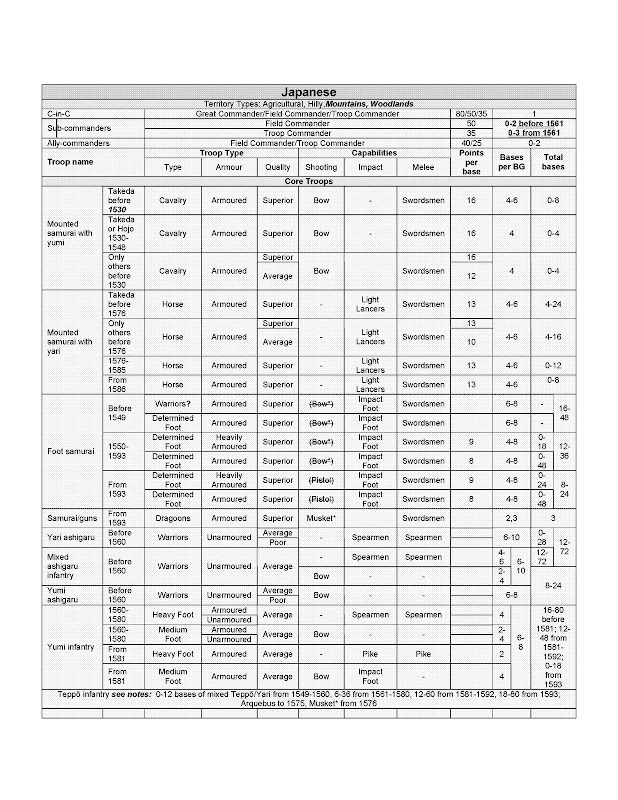
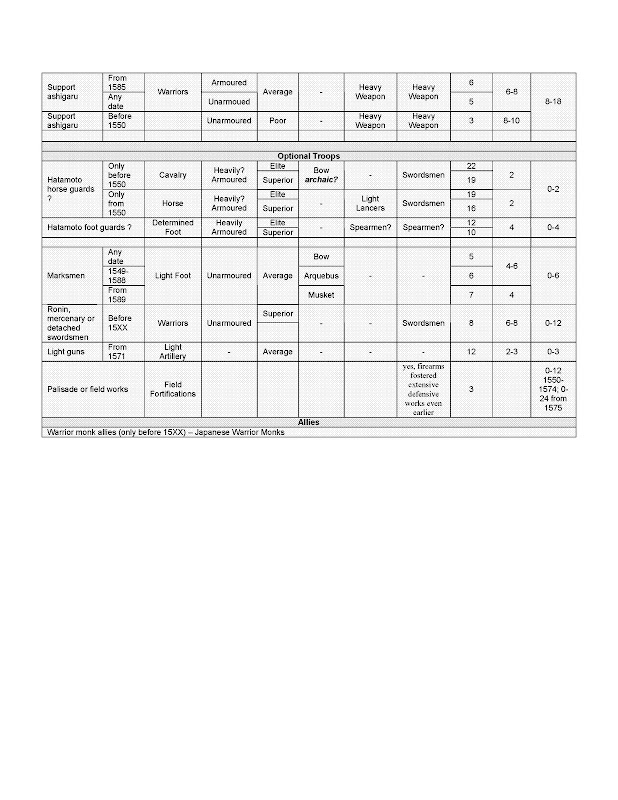
All bases in a BG must have the same Armour.
Before 1560, the total number of ashigaru foot bases with Bow may not exceed the total with Spearmen.
Not more than half of all Yumi infantry BGs may be Armoured before 1570, half or more must be from 1580 -1590, and all must be from 1591.
Not more than half of all Teppō infantry BGs may be Armoured before 1570, half or more must be from 1580 -1590, and all must be from 1591.
There must be more Yumi Infantry BGs than Teppō Infantry BGs before 1575, the must be more Teppō Infantry BGs than Yumi Infantry BGs from 1593, and the difference in numbers of BGs must not be more than 3 between those dates.
All bases in a BG must have the same Armour.
Before 1560, the total number of ashigaru foot bases with Bow may not exceed the total with Spearmen.
Not more than half of all Yumi infantry BGs may be Armoured before 1570, half or more must be from 1580 -1590, and all must be from 1591.
Not more than half of all Teppō infantry BGs may be Armoured before 1570, half or more must be from 1580 -1590, and all must be from 1591.
There must be more Yumi Infantry BGs than Teppō Infantry BGs before 1575, the must be more Teppō Infantry BGs than Yumi Infantry BGs from 1593, and the difference in numbers of BGs must not be more than 3 between those dates.
Last edited by SirGarnet on Tue Jul 13, 2010 7:53 am, edited 1 time in total.
-
nikgaukroger
- Field of Glory Moderator

- Posts: 10287
- Joined: Tue Aug 22, 2006 9:30 am
- Location: LarryWorld
Mike,
Lots of good stuff in there - it'll take me a while to digest it
However, one thing I really think we need to avoid is for eastern BGs having the same, or very similar, make-up to western pike and shot BGs as I think players will think it wrong,/silly and will be a point of criticism and bring us into disrepute. It is the "Romans in funny clothes" syndrome in a later context and needs to be avoided. Therefore, if some sort of combined formations are needed we need a different solution I fear. This may involve a bit of caricature, however, that underlies a lot of list writing.
Lots of good stuff in there - it'll take me a while to digest it
However, one thing I really think we need to avoid is for eastern BGs having the same, or very similar, make-up to western pike and shot BGs as I think players will think it wrong,/silly and will be a point of criticism and bring us into disrepute. It is the "Romans in funny clothes" syndrome in a later context and needs to be avoided. Therefore, if some sort of combined formations are needed we need a different solution I fear. This may involve a bit of caricature, however, that underlies a lot of list writing.
Nik Gaukroger
"Never ask a man if he comes from Yorkshire. If he does, he will tell you.
If he does not, why humiliate him?" - Canon Sydney Smith
nikgaukroger@blueyonder.co.uk
"Never ask a man if he comes from Yorkshire. If he does, he will tell you.
If he does not, why humiliate him?" - Canon Sydney Smith
nikgaukroger@blueyonder.co.uk
-
rbodleyscott
- Field of Glory 2

- Posts: 28440
- Joined: Sun Dec 04, 2005 6:25 pm
Especially if contemporary illustrations don't show Japanese in formations physically resembling the pike and shot formations seen in contemporary depictions of European warfare.nikgaukroger wrote:However, one thing I really think we need to avoid is for eastern BGs having the same, or very similar, make-up to western pike and shot BGs as I think players will think it wrong/silly and will be a point of criticism and bring us into disrepute.
Of course if they do.....
-
nikgaukroger
- Field of Glory Moderator
- Posts: 10287
- Joined: Tue Aug 22, 2006 9:30 am
- Location: LarryWorld
rbodleyscott wrote:Especially if contemporary illustrations don't show Japanese in formations physically resembling the pike and shot formations seen in contemporary depictions of European warfare.nikgaukroger wrote:However, one thing I really think we need to avoid is for eastern BGs having the same, or very similar, make-up to western pike and shot BGs as I think players will think it wrong/silly and will be a point of criticism and bring us into disrepute.
Of course if they do.....
Good point - I can't recall any from what I've read, however, Mike may have better info.
Nik Gaukroger
"Never ask a man if he comes from Yorkshire. If he does, he will tell you.
If he does not, why humiliate him?" - Canon Sydney Smith
nikgaukroger@blueyonder.co.uk
"Never ask a man if he comes from Yorkshire. If he does, he will tell you.
If he does not, why humiliate him?" - Canon Sydney Smith
nikgaukroger@blueyonder.co.uk
It’s clear that formations were mixed and the tactics that developed (and orders from the top) were to keep the teppō in front where they could shoot and close combat supports out of the way until they advance to the front to repel an enemy charge or lead a friendly one. Turnbull stresses the similarities with Western pike & shot, which I agree to the extent of close integration of shot and pike or spear. I think Turnbull was taken by, and he refers somewhere to, alternating groups of teppō and yari in what would be the early or middle teppō period.
In terms of appearance, a proper 1590 appearance (which is just an evolution in proportions of earlier formations) would have a front rank of shot, a second rank of archers, a third rank of yari and perhaps a swordsmen/HW base behind. Both shooting ranks would shoot using their respective weapons, while the yari or other bases could step forward or move to the flanks in the attack.
Obviously, this is not a functional grouping in FOGR without throwing in special rules. The closest thing in appearance and function is the 5 shot/1 pike formation, which ratio works only for the late period, though putting a few yari on the rearward teppō bases to correspond with the halved firepower of the second rank (as Musket*) would look better, and I mentioned adding a HW/Swordsmen in back for a more authentic look and effect.
Time permitting, I can look again for illustrations I have accessible, but some books are back to the libraries and I didn’t take time to track art online when taking notes, except for some Korean/Chinese images useful for friends’ painting which won’t help much here. There are Japanese drill books, but not around here.
There is a good Japanese history forum where I could ask questions, but what questions would be useful? Also, what about questions/feedback in the beta forum?
I’d be surprised if there is anything that looks like a large pike block with two shot sleeves unless captured at the point where yari are advancing forward with the shot having separated to either side to allow them through, and at BG scale those avenues would have opened at many points in the front. That appearance would be transitory.
I think getting the tactical interactions right to the extent rules permit is the most important thing. The Japanese development path was different in much of the 16th century, but the result in terms of infantry was similar in effect to Western pike and shot in important ways, with the micro differences not evident at the BG level.
If the development path and effects are represented properly and explained in the intro, I think most people who know something about the Samurai will recognize that they know little or nothing about the 1590s and later - the glamorous battles they make movies about are two or three decades earlier. Indeed, Nagashino can be spun as a tragedy in which (unsporting) modern weapons ended the true age of the samurai warrior.
In terms of appearance, a proper 1590 appearance (which is just an evolution in proportions of earlier formations) would have a front rank of shot, a second rank of archers, a third rank of yari and perhaps a swordsmen/HW base behind. Both shooting ranks would shoot using their respective weapons, while the yari or other bases could step forward or move to the flanks in the attack.
Obviously, this is not a functional grouping in FOGR without throwing in special rules. The closest thing in appearance and function is the 5 shot/1 pike formation, which ratio works only for the late period, though putting a few yari on the rearward teppō bases to correspond with the halved firepower of the second rank (as Musket*) would look better, and I mentioned adding a HW/Swordsmen in back for a more authentic look and effect.
Time permitting, I can look again for illustrations I have accessible, but some books are back to the libraries and I didn’t take time to track art online when taking notes, except for some Korean/Chinese images useful for friends’ painting which won’t help much here. There are Japanese drill books, but not around here.
There is a good Japanese history forum where I could ask questions, but what questions would be useful? Also, what about questions/feedback in the beta forum?
I’d be surprised if there is anything that looks like a large pike block with two shot sleeves unless captured at the point where yari are advancing forward with the shot having separated to either side to allow them through, and at BG scale those avenues would have opened at many points in the front. That appearance would be transitory.
I think getting the tactical interactions right to the extent rules permit is the most important thing. The Japanese development path was different in much of the 16th century, but the result in terms of infantry was similar in effect to Western pike and shot in important ways, with the micro differences not evident at the BG level.
If the development path and effects are represented properly and explained in the intro, I think most people who know something about the Samurai will recognize that they know little or nothing about the 1590s and later - the glamorous battles they make movies about are two or three decades earlier. Indeed, Nagashino can be spun as a tragedy in which (unsporting) modern weapons ended the true age of the samurai warrior.
-
nikgaukroger
- Field of Glory Moderator
- Posts: 10287
- Joined: Tue Aug 22, 2006 9:30 am
- Location: LarryWorld
MikeK wrote: In terms of appearance, a proper 1590 appearance (which is just an evolution in proportions of earlier formations) would have a front rank of shot, a second rank of archers, a third rank of yari and perhaps a swordsmen/HW base behind. Both shooting ranks would shoot using their respective weapons, while the yari or other bases could step forward or move to the flanks in the attack.
Sounds much more like the type of formations that we would represent in FoG by having shooting bases with a front rank with a combat capability to me.
Nik Gaukroger
"Never ask a man if he comes from Yorkshire. If he does, he will tell you.
If he does not, why humiliate him?" - Canon Sydney Smith
nikgaukroger@blueyonder.co.uk
"Never ask a man if he comes from Yorkshire. If he does, he will tell you.
If he does not, why humiliate him?" - Canon Sydney Smith
nikgaukroger@blueyonder.co.uk
-
rbodleyscott
- Field of Glory 2
- Posts: 28440
- Joined: Sun Dec 04, 2005 6:25 pm
It seems like the early 16thC Scandinavian formation with crossbows at the front and polearms at the back, that we represent the other way round to make the rules work correctly.nikgaukroger wrote:MikeK wrote: In terms of appearance, a proper 1590 appearance (which is just an evolution in proportions of earlier formations) would have a front rank of shot, a second rank of archers, a third rank of yari and perhaps a swordsmen/HW base behind. Both shooting ranks would shoot using their respective weapons, while the yari or other bases could step forward or move to the flanks in the attack.
Sounds much more like the type of formations that we would represent in FoG by having shooting bases with a front rank with a combat capability to me.
How many ranks deep were these Japanese formations?
The shot were organized by file, and I recall seen an illustration with a fourth man in a support role with ammo etc. Volley fire by rank in 3 ranks was standard. There is a reference to 3-5 ranks of yari behind, but late period this had to be fewer due to the proportions. Bow behind or possibly in files or groups of files with the Shot.
References to deeper ranks than that I think probably counts sub units behind since the contingents deployed in some depth and multiple battle lines with a deep overall army deployment were common.
The Danish formation has inflexible 50% overall shooter proportions that fits the mid-Teppo period but is too light on shooting for the late period and too heavy for early.
Of more importance, what would go in the front rank that works in terms of POA fierce charge and combined arms protection against mounted?
Front rank bayonet doesn't have any particular offensive advantage but is a good POA neutralizer as is Pike and Shot. I did not test it because of the name of the POA and because the Pike and Impact Shot formation was working nicely in testing.
If a difference is necessary from Western types, Spear and Impact Shot does that. Protection applies but the Spear work somewhat differently. In period, its POA against Light Spear and HW offset the POA they get against it. The Spear get a POA against many things and some common opponents get one against the Spearmen files to offset against it (HW, Light Spear) as well as Pistol for ahistorical matches. Spearmen are more conducive to adjusting ratios - 2 yari files and 2 teppo files gets the 50% era covered correctly, and by having only 2 shooters in one file (or divided evenly?) it covers the early period.
G'night,
Mike
References to deeper ranks than that I think probably counts sub units behind since the contingents deployed in some depth and multiple battle lines with a deep overall army deployment were common.
The Danish formation has inflexible 50% overall shooter proportions that fits the mid-Teppo period but is too light on shooting for the late period and too heavy for early.
Of more importance, what would go in the front rank that works in terms of POA fierce charge and combined arms protection against mounted?
Front rank bayonet doesn't have any particular offensive advantage but is a good POA neutralizer as is Pike and Shot. I did not test it because of the name of the POA and because the Pike and Impact Shot formation was working nicely in testing.
If a difference is necessary from Western types, Spear and Impact Shot does that. Protection applies but the Spear work somewhat differently. In period, its POA against Light Spear and HW offset the POA they get against it. The Spear get a POA against many things and some common opponents get one against the Spearmen files to offset against it (HW, Light Spear) as well as Pistol for ahistorical matches. Spearmen are more conducive to adjusting ratios - 2 yari files and 2 teppo files gets the 50% era covered correctly, and by having only 2 shooters in one file (or divided evenly?) it covers the early period.
G'night,
Mike
-
nikgaukroger
- Field of Glory Moderator
- Posts: 10287
- Joined: Tue Aug 22, 2006 9:30 am
- Location: LarryWorld
I've had a trawl though nearly all the Osprey's on Japanese armies for the period, which contain quite a lot of nice contemporary illustrations, and there is nothing that looks like a western pike & shot formation. Therefore, regardless of other arguments, I think they have to be ruled out, otherwise we will face derision from the punters.
The (rather limited) descriptions of fighting talk of bodies of teppo men separate from bodies of close fighters, with the latter charging in after softening up by the teppo. Battles are clearly decided by sustained hand to hand fighting. Alas I haven't seen anything that gives any indication on what sort of size the bodies were other than by the odd battle where you can deduce some sort of patter - e.g. Nagashino where there were, at most, 3000 teppo armed men in bodies behind a palisade and, thus, distinct from the close combat troops who were by far the majority.
I did find a short reference to teppo troops still using obstacles in the late C16th which may, but only may, imply that the hand to hand support was not that closely integrated - at least at times, as other references are to the teppo troops moving aside for the close fighter to charge. Looking at some of the theoretical battle formations this is, IMO, most likely to be a second line of units/troops moving up rather than any closely integrated formation.
As an aside from this matter I did note that the illustrations of combat show troops in pretty dispersed formations. IMO this undoubtedly rules out Determined Foot as a viable classification as that is a form of close order infantry, the Japanese are way too dispersed for that.
The (rather limited) descriptions of fighting talk of bodies of teppo men separate from bodies of close fighters, with the latter charging in after softening up by the teppo. Battles are clearly decided by sustained hand to hand fighting. Alas I haven't seen anything that gives any indication on what sort of size the bodies were other than by the odd battle where you can deduce some sort of patter - e.g. Nagashino where there were, at most, 3000 teppo armed men in bodies behind a palisade and, thus, distinct from the close combat troops who were by far the majority.
I did find a short reference to teppo troops still using obstacles in the late C16th which may, but only may, imply that the hand to hand support was not that closely integrated - at least at times, as other references are to the teppo troops moving aside for the close fighter to charge. Looking at some of the theoretical battle formations this is, IMO, most likely to be a second line of units/troops moving up rather than any closely integrated formation.
As an aside from this matter I did note that the illustrations of combat show troops in pretty dispersed formations. IMO this undoubtedly rules out Determined Foot as a viable classification as that is a form of close order infantry, the Japanese are way too dispersed for that.
Nik Gaukroger
"Never ask a man if he comes from Yorkshire. If he does, he will tell you.
If he does not, why humiliate him?" - Canon Sydney Smith
nikgaukroger@blueyonder.co.uk
"Never ask a man if he comes from Yorkshire. If he does, he will tell you.
If he does not, why humiliate him?" - Canon Sydney Smith
nikgaukroger@blueyonder.co.uk
Agreed, not a western-style block and sleeves formation. Alternating frontage of yari and teppo or yumi would only superficially resemble that. I've seen art with high troop density, and lots with dramatic combat scenes, but not the western look.nikgaukroger wrote:I've had a trawl though nearly all the Osprey's on Japanese armies for the period, which contain quite a lot of nice contemporary illustrations, and there is nothing that looks like a western pike & shot formation.
Some of the meanings of punters are ruled out by context or being too sordid. By punters do you mean unsophisticated customers for whom a little knowledge supports a dangerously hasty opinions? Is Spear and Shot different enough to pacify punters?Therefore, regardless of other arguments, I think they have to be ruled out, otherwise we will face derision from the punters.
The (rather limited) descriptions of fighting talk of bodies of teppo men separate from bodies of close fighters, with the latter charging in after softening up by the teppo.
Just as block and sleeves or horns in the west are separate bodies operating together as part of a tactical unit? Nominal BG size (1500-2000 for 6-8 bases) is not much smaller than the first-line troop portion of the typical daimyo's contingent in Korea (not counting the support ashigaru), and those contingents were mixed, which was an element of continuity from the past. I wondered about the shot at Nagashino for a while, since the shot are celebrated, but in Nagashino it makes clear the teppo troops' yari comrades were right behind and advanced forward to the front in the thick of the fight when it got to close quarters.
Speaking of the second half of the 16th C, the wording seems to imply that battles were all about close combat, rather than just that it was the decisive phase when firepower already either failed to break the enemy or disrupted the enemy, creating an advantage followed up with close combat. Or one side wanted to close and abbreviate the firefight.Battles are clearly decided by sustained hand to hand fighting.
Late in my readings I discovered that there is a Japanese literary convention of discussing close combat as a clash of swords (I reflected that our colloquial references to "hand-to-hand combat" are also terribly misleading), and the ashigaru, despite their tactical importance, serve as backdrop for the activities of the illustrious samurai. This cleared up some mysteries as to why yari armed troops seemed to be engaged in swordfighting.
See above re Nagashino - the shot/yari at the palisade, and the rest of the army were bow/yari/mounted.Alas I haven't seen anything that gives any indication on what sort of size the bodies were other than by the odd battle where you can deduce some sort of patter - e.g. Nagashino where there were, at most, 3000 teppo armed men in bodies behind a palisade and, thus, distinct from the close combat troops who were by far the majority.
I assume you mean pavises or shields to protect against shooting. Fortifying a position with defenses became common in the late 16th C. Yari ashigaru could carry large, simple wooden shields to counter archery, not meant for close combat.I did find a short reference to teppo troops still using obstacles in the late C16th which may, but only may, imply that the hand to hand support was not that closely integrated - at least at times, as other references are to the teppo troops moving aside for the close fighter to charge. Looking at some of the theoretical battle formations this is, IMO, most likely to be a second line of units/troops moving up rather than any closely integrated formation.
The theoretical formations designed for archers and including overhead fire would not work for shot, and the spacings between troops bodies could mean half a dozen or more lines, or one giant multi-layered cluster, depending on how you look at it. It's actually a system that could have been (but wasn't) represented well by DBR, with lots of small bodies represented by single bases manoeuvring around and through each other in a tactical ballet that would give the flavour of the period, and even the movies.
If the question is whether the real Japanese could be represented reasonably by uni-type BGs, it is a stretch at best and to do it would require small 2 and 4 base BGs and special rules for flank protection and interpenetration to come close. For the way I understand the Japanese, they can be fairly pigeonholed into existing formations.
Admittedly, if the Japanese just fought themselves, the armies were fairly symmetrical - although some had the jump on others for a time - and this would not be such an issue. However, the big war was overseas, and there are always ahistorical match-ups.
Fighting in-region, this would all be less of an issue if MF or Warrior Pike or Spear provided and received protection like HF do, but that would require a special rule.
Sorry if I seem to be too compulsive about figuring this out. I probably am.
Cheers
Mike
-
rbodleyscott
- Field of Glory 2
- Posts: 28440
- Joined: Sun Dec 04, 2005 6:25 pm
Agreed.nikgaukroger wrote:I've had a trawl though nearly all the Osprey's on Japanese armies for the period, which contain quite a lot of nice contemporary illustrations, and there is nothing that looks like a western pike & shot formation. Therefore, regardless of other arguments, I think they have to be ruled out, otherwise we will face derision from the punters.
-
nikgaukroger
- Field of Glory Moderator
- Posts: 10287
- Joined: Tue Aug 22, 2006 9:30 am
- Location: LarryWorld
MikeK wrote: Some of the meanings of punters are ruled out by context or being too sordid. By punters do you mean unsophisticated customers for whom a little knowledge supports a dangerously hasty opinions? Is Spear and Shot different enough to pacify punters?
Punters = all customers, at least in this context. IMO Spear and Shot would not avoid derision. I'm rather resigned to going down the distinct BG approach to be honest - unless anyone can come up with a brilliant alternative quickly.
Sorry if I seem to be too compulsive about figuring this out. I probably am.
Not a problem, its making us think which can only be good
Nik Gaukroger
"Never ask a man if he comes from Yorkshire. If he does, he will tell you.
If he does not, why humiliate him?" - Canon Sydney Smith
nikgaukroger@blueyonder.co.uk
"Never ask a man if he comes from Yorkshire. If he does, he will tell you.
If he does not, why humiliate him?" - Canon Sydney Smith
nikgaukroger@blueyonder.co.uk