

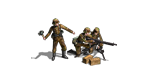
(Tanegashima was the original name for firearms based on the original acquisitions from the Portuguese, but the term teppō (iron cannon) previously applied to Chinese gunpowder weapons came to embrace tanegashimas).
This is a bullet point outline (if only I knew how to make actual bullets here!) of the factors behind the proposed classifications in the Japanese posts that I am still working on. Parts will make more sense in that context.
Early classification as Arquebus (prior to development of standard Japanese tactics):
- The Tanegashima was based on Portuguese Arquebus.
Technical improvements occurred over time.
Firearms drill, discipline, and tactical methods took time to develop.
Greater proportion of archers in the infantry overall, in separate BGs.
- Technical features and performance over time advanced, compare with French or Dutch light musket of the 1580s-90s and light musket standard in the mid-17th century.
- Represents shooters plus factors in partial (declining) bow mix and Japanese light artillery/heavy small arms (like the heavy musket) that is commonly reported but not in great numbers.
Tactical:
- Encourages several exchanges of fire at range prior to contact with infantry, even if assaulting there will be at least two rounds of advancing fire to seek to disrupt enemy.
Should outrange Bows (Musket* only equal, but closer to that effect) and be preferable to Bows, which were obsolescent.
Performance of weapon and drilled troops relative to opponents. Outrange Chinese and Korean Shot and Bow (prior to a small flow of Korean copies).
Can engage enemy horsemen with destructive long range fire outside the horse’s charge range. Discourages cavalry action in front of the Japanese infantry.
Accuracy paid well in enemy officer casualties and disruption at range.
Armour continues to serve a purpose by reducing enemy shooting POA at long range.
Technical:
- The debate in Japan centered on range and accuracy.
Comparable to “lightweight musket”, like French or Dutch light musket of the period.
Typical caliber was about 15.8 mm to 18.7mm, though they could run smaller or much larger.
Typical barrel length initially 3 feet, though over time longer weapons were preferred (120-140 cm). Special teppō were designed for sniping or wall gun purposes. Smaller variations included tanzutsu (pistol size), bajōzutsu (carbines for horsemen, less than 3 feet long).
6 momme bullet is 22.5grams. Comparables France 1580: musket ball was 31.35g and arquebus 10.18g, though in 1590 the heavy musket was adopted. After reductions in the 17th C muskets “by the 1630s muskets commonly had calibers of sixteen to the pound and fired balls weighing eighteen to the pound” which is over 25g for these lightweight types.
Teppō featured superior accuracy from snapping matchlock ignition and from the cheek stock, used in Europe for accuracy in hunting and target shooting. Cheek stock practical for light but not heavy muskets.
Sights normally used. Adjustable sights for elevation were used – I don’t know how commonly.
Used cartridges and optimal blends of corned powder, more powerful than Ming mix, for example.
Standard bore, interchangeable parts and balls for weapons bought from practitioners of a particular gunmaking school. Reduced and more consistent windage (better range and accuracy) and improved logistical and firing efficiency.
Could achieve 20 second reload times, slowed as usual with fouled barrels.
Ahead of West in weatherproofing.
Rifled weapons by 1600 using efficient screw rifling process that was patented in England in 1635.
All these technical improvements in place by 1580s other than rifling near 1600.
Just for interest: teppō and cannon making in detail: http://www.rekihaku.ac.jp/e-rekihaku/114/index.html

