Game 2 - Hittites vs Egyptians

This forum is for any questions about the rules. Post here is you need feedback from the design team.

Moderators: philqw78, terrys, hammy, Slitherine Core, Field of Glory Moderators, Field of Glory Design

Post Reply
madaxeman
Lieutenant-General - Do 217E
Posts: 3002
Joined: Thu Nov 16, 2006 5:15 am
Location: London, UK
Contact:

Game 2 - Hittites vs Egyptians

Post by madaxeman »

Egyptians:
IC, TC, FC
3 x 4 Light Chariots, Superior Drilled Bow
2 x 6 Runners, Av Drilled Unprotected bowmen Psiloi
3 x 6 Close Fighters Av Drilled Protected Swordsmen
2 x 6 + 1 x 8 Bowmen Average Drilled Unprotected Bowmen
12 Sherden Average Undrilled Protected Impact Foot Swordsmen
8 Javelin Ps, Av Undrilled Protected Javelin + LS

Hittites
Generals - 1 x IC, 1 x FC, 1 x TC (I will do the same)
3 BGs of 4 Light Chariots - Superior Drilled with Light Spear
1 BG of 6 Heavy Chariots - Superior Drilled with Light Spear
2 BGs of 6 Psiloi Runners - Av Protected Jav & Light Spear
1 BG or 8 Auxilai - Average Drilled Protected Light Spear
2 BGs of 12 Auxilia - Average Drilled Unprotected Defensive Spearmen Spearmen
1 BG of 8 Bowmen - Poor Undrilled Unprotected Bowmen
1 BG of 10 Gasgans (Warband F), Average Undrilled Protected Impact Foot Swordsmen

(DBx Classifications to make it easier to find the troops in the box!)

Not much terrain - one prominent orchard in the hittites forward / left area.

As Egyptians, my plan was to wheel a long line of bowmen out towards the orchard (which was on my right) maneuver the Axeman and Sherden past and round it and clobber the Hittites as they tried to close in on the bowmen, whilst skirminshing with bow armed chariots on my left.

The Hittites advanced with their best foot and the heavy chariots past the orchard, with a deep mass of rubbish foot backing them up. Some JLS armed foot came straight through the orchard, behind some psiloi. The Hittite javelin armed chariots ended up facing off against my bow armed ones.

In game terms, the initial skirmish took place with two lots of protected javelin skirmishers engaging in front of the orchard - the egyptians supported by some bowmen who formed an overlap. However the Hittites got the better of the initial combat and disrupted the Egyptian psiloi, who never really recovered.

With the main lines, the Egyptains bowmen got probably a little too far forwards - or the Hittites got forwards too quickly -
and the shooting iflicted by the egyptians was derisory on both the Hittite foot and the chariots - it was hard to get in enough rounds of shooting to do any damage, and the rule (see later) about any element of a unit engaged in combat cannot shoot really hurt the Egyptians, as 2 blocks of bowmen were neutralized by one unit of Hittite foot, allowing the chariotry to attack with impunity. Even the belated arrival of some Egyp[tian axemen was not enough to stem the tide, and the hittites smashed the two bow units and then the Egyptian army imploded, with some of its best units not even getting ito the game.

Meanwhile the Hittite JLS chariotry had been forcing the egyptian bow armed ones back and eventually caught them, butchering them badly - partly through evade/pursuit rolls, and partly because there simply isnt that much table to evade across - especially with trooops who evade being unable to shoot in that turn.

This meant the game was over in about 6 turns. Definatel seemed easier - although we had set out the POAs that would apply in this game, listed by troop type, on a separate sheet so that did help. We werent checking to see what was and what wasnt a CMTs all the time

As the Egyptian player, I definately tried an over-ambitious plan, and my shooting and combat dice were poor, and the Hitties passed almost every Cohesion test. So it was going to be tough But I also struggled to see much real value in bowmen in the game given their extreme vulnerability to any sort of foot, and lack of great impact of shooting on decent sized units of chariotry. I can see there are POAs that would help against cavalry but it seems everything moves further than in DBM, but shooting is less effective and its (effective) range hasnt increased so shooters get a relatively bum deal. Whether this is right or wrong historically, I dont know, but Id put my faith in more swordsmen and less bowmen next time. The hittites used their bow as filler at the back - it never even shot, and they just led with a block of their best troops led by generals - which worked very well .

It also felt very hard to skirmish for more than a handful of turns with my skirminshing chariotry, as the loss of shooting in turns where you skirmish, and the knowledge that the hittites had a POA in combat meant even a DISR result on the Hittite light chariots from shooting would still only make them evens at impact (8 dice DISR to 6 dice, hitting on 3 for JLS, vs 8 dice hitting on 4 for the egyptians). My take - skirmishers were overpriced, because there is not enough table for them to skirmish back across !

And we are still not convinced of the value of expensive generals. They fight in combats and help out a lot there, but othewise troops are chugging forwards anyway.

Questions:

1. Why count generals for scouting ? They don't ever count as their troop type in combat or other circumstances, and so it seems to be giving a no-brainer advantage to armies who can choose if their general is heavy or light cavary (like the Hittites). It also is another aspect of the rules that makes the generals element seem more like a "real" element that is actually there on table - instead of generals being "an abstraction of the command and control influence exercised by the commanders of the army" ... which I suspect they are supposed to be in these rules. (see later for another example)

2. Do bowmen get +1 at Impact for a 2nd rank of bows, or is this restructed to "supporting psiloi" types?

3. Rear Support for Cohesion tests. Requiring it to be "better grade" seemed counter intuitive for both biblical and medieval armies, who would lead with the nobles and have the crap at the back. Should density be a better measure maybe? And does/should facing of the support troops make any difference

4. Cheese Alert ! Contracting 2 bases whilst stationary is a great way to get out of charge range of an enemy - especially as they can only charge by wheeling. Contracting within (2,3,4??) MUs maybe should be either not allowed, or a CMT for everyone at the very least...

5. Wheeling a deep formation. How do you measure move distance? Do columns get handbrake turns with the rearmost elements?

6. We had a situation when a skirmisher on skirmisher combat got bogged down into a slogging match/deadlock - which prevented the main battle lines closing. Should skirmishers be able to break off under certain circumstances?

7. Sometimes generals simply dont fit and when sitting behind a formation they can prevent others closing up gaps. There needs some clarity / explicitness as to whether they really exist as on table elements (see above as well)

8. "Contract one or two bases" in movement. We assume this is "contract a BG's frontage by.." but it needs to be clarified, or pikemen (anyone!!) may never be able to expand or contract in anyones lifetime!

9. When do troops conform - and/or expand? Or are we making this up - cant find it in the rules, so maybe its in the wrong section. Should it be after impact?

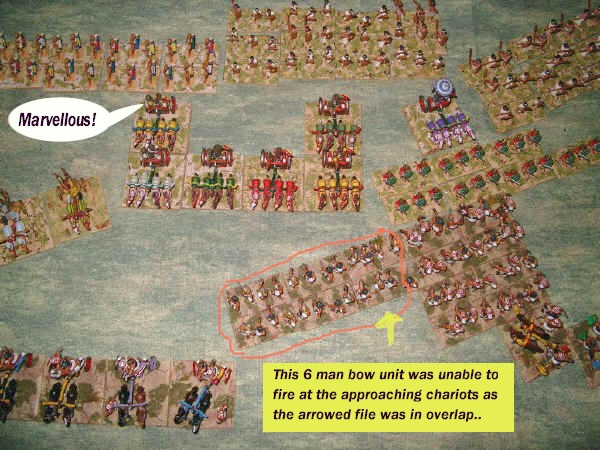
10 You cannot shoot if your BG is involved in combat. But you can be a target of shooting. This seemed incredibly unfair on wide/large bow units who are clipped at one end.
Image

This was a situation in which the Hittite chariots (top) were able to approach and attack Egyptian bown with impunity even though the bowmen were only acting as an overlap with a frontage on 1 element.

11. Can you contract out of contact during the movement phase? (or out of an overlap position?)

12. We had a situation in which some egyptian heavy foot charged the Hittites in the bogged-down skirmisher fight . This mean t the hittites evaded (I should have just moved in in the movement phase and joined a combat I know....doh!) but the net effect was to leave a fragged egyptian skirmisher unit in front of my best two units on table. And a fragged skirmisher unit is rather hard to withdraw, so my fragged skirmishers ended up as a protective screen to the Hittite army. Shoudl disrupted skirmishers be able to withdraw to the rear of friendly troops anyway ?

13. Shooting into a melee - this can cause Cohesion tests which affect the melee, and where the generals presence doesnt count as the unit/general involved is in melee. Ouch ?

14. One of my generals made an effort to rush back and help rally a broken unit of skirmishers, just to see how this worked really. In retrospect it was a waste of time - the game simply doesnt take long enough for moving, trying to rally, failing the first time, trying again, never mind improving them from Fragged. Maybe this is the idea, as I dont actually like the idea of generals functions being to run around and act as a a backstop anyway - but almost why bother putting rallying routers in the rules at all I suspect ?
http://www.madaxeman.com
Holiday in Devon? Try https://www.thecaptainscottagebrixham.com
shall
Field of Glory Team
Field of Glory Team
Posts: 6137
Joined: Fri Mar 17, 2006 9:52 am

Post by shall »

Thanks for the great battle report Tim. Only 1 general comment from your report...ccertainly you should find that Bwin the open are not as powerful as Bw(O) and Bw(S) in DBM. The ones who can do this have other POAs as well - e.g. HW for English Longbowmen and Samurai with Sk Sw as well as Bw. This is more historical but we need to work on the ablance - be it game mechanisms or points systems. The calibration at present is set up to be rather nip and tuck - if the Bow can DISR attacking mounted troops they are not bad as they tend to get 9 dice (6 front rank adn 3 for second rank shooters) at IMPACT to 4 (6 down to 4 for DISR). This is scaled so that 9 dice needing 5s gets 3 hits and 4 dice needing 3s gets 2.33 - so slight edge to the foot troops in the charge. But if they don't DISR the mounted its the oterway round. If the Bw win the IMPACT phase they can rout the DISRed mounted in the melee phase. Might be worth trying 3 or 4 times on a table top to see what you think.

Details comments below....
1. Why count generals for scouting ? They don't ever count as their troop type in combat or other circumstances, and so it seems to be giving a no-brainer advantage to armies who can choose if their general is heavy or light cavary (like the Hittites). It also is another aspect of the rules that makes the generals element seem more like a "real" element that is actually there on table - instead of generals being "an abstraction of the command and control influence exercised by the commanders of the army" ... which I suspect they are supposed to be in these rules. (see later for another example)


A fair point and I suspect not an areof strong views from any of the authors. The more important bit by far is whether the general is any good or not. Your way is neater and more consistent with other things IMHO.
2. Do bowmen get +1 at Impact for a 2nd rank of bows, or is this restructed to "supporting psiloi" types?
Aha think I have just seen part of the answer to your bowmen puzzle. MF get the extra dice added at impact. It is specificaly there for the bow/mounted interaction as above. Psiloi supports get it too but at half rate.
3. Rear Support for Cohesion tests. Requiring it to be "better grade" seemed counter intuitive for both biblical and medieval armies, who would lead with the nobles and have the crap at the back. Should density be a better measure maybe? And does/should facing of the support troops make any difference
Will add to the discussion list. I had thought it was was equal grade but haven't the full rules here in the spanish cyber-cafe. No doubt Richard or Terry will check before I get the chance.
4. Cheese Alert ! Contracting 2 bases whilst stationary is a great way to get out of charge range of an enemy - especially as they can only charge by wheeling. Contracting within (2,3,4??) MUs maybe should be either not allowed, or a CMT for everyone at the very least...
We seem to have largely emptied the cheese shop but will investigate the remains of Mr Weynesleydale that is in the fridge :-)
5. Wheeling a deep formation. How do you measure move distance? Do columns get handbrake turns with the rearmost elements?
At present I guess they do but a good question as to whether we should limit this. The only thing is that the base depthes are not real if you see what I mean. They are only that size dueto our penchant for pushing little metal figures around a table. In real terms a 4 deep unit of Cavalry is probably no deeper than a single base of Cav figures - or liekly even less. So although it looks like a handbrake turn it isn't really.
6. We had a situation when a skirmisher on skirmisher combat got bogged down into a slogging match/deadlock - which prevented the main battle lines closing. Should skirmishers be able to break off under certain circumstances?
We've kept it simple so far but perhaps we should allow, or force skimrishers in combats that are clogging up to break off. We'll add it to the discussion list.
7. Sometimes generals simply dont fit and when sitting behind a formation they can prevent others closing up gaps. There needs some clarity / explicitness as to whether they really exist as on table elements (see above as well)
They don't at present but perhaps this is not clear enough. They can be placed anywhere touching a BG to count as with it and anywhere in the front rank in order to count a doing this. expect there are ways to conjure up situations where there is nowhere for them to stand. Will have to think about that one.


Batch 2 soon.

Si
shall
Field of Glory Team
Field of Glory Team
Posts: 6137
Joined: Fri Mar 17, 2006 9:52 am

Post by shall »

8. "Contract one or two bases" in movement. We assume this is "contract a BG's frontage by.." but it needs to be clarified, or pikemen (anyone!!) may never be able to expand or contract in anyones lifetime!
Indeed. Perhaps we should define files as a term (a front unit and all bases behind it) as we really mean this throughout.
9. When do troops conform - and/or expand? Or are we making this up - cant find it in the rules, so maybe its in the wrong section. Should it be after impact?
Not so much conform as such. It comes in 3 ways. 1. You can shift sideways dring movement by either a full base (if moving 3 MU or more) width or a half base width (if moving 1U or more) and not cahnging formation - details inthe rules. This allows you to shift towards targets to get in. 2. You charge off-line as it doesn't matter at this stage. but at the beginning of your melee phase you conform your troops in contact to the opposing sides bases if this is possible (i.e. move them so they line up with bases they touched at IMPACT). 3. You can thereafter expand by a file on 1 side of a combat if it was yur move or if your opponent expads or has an existing overlap.

All of these need wording tightening as they go but that is the gist of it. In essence 3 things designed into the rules (1) to get you into the right place., (2) to allow charges even if there are funny angles and line up later, (3) to allow combas t grow and allwo numbers t start to count.
10 You cannot shoot if your BG is involved in combat. But you can be a target of shooting. This seemed incredibly unfair on wide/large bow units who are clipped at one end.


This was a situation in which the Hittite chariots (top) were able to approach and attack Egyptian bown with impunity even though the bowmen were only acting as an overlap with a frontage on 1 element.


Hmm..it does doensn't it....one for us to think about. Also a probem with larger units, which is soemthing we want to try to avoid...2x4 man bowmen units get to shoot more than 1 8 man unit with exactly the same sitation.
11. Can you contract out of contact during the movement phase? (or out of an overlap position?)
The only movements allowed when in contact are those covered by expanding and contracting in combat. The intent is certainly that you cannot contract out of contact but I think we have worded it so you could at present. I suspect all 3 authros will agree with is not what we want On the fix list. The overlap I guess is more debatable as you might want to make spcae for something else. We'll give that a think through.
12. We had a situation in which some egyptian heavy foot charged the Hittites in the bogged-down skirmisher fight . This mean t the hittites evaded (I should have just moved in in the movement phase and joined a combat I know....doh!) but the net effect was to leave a fragged egyptian skirmisher unit in front of my best two units on table. And a fragged skirmisher unit is rather hard to withdraw, so my fragged skirmishers ended up as a protective screen to the Hittite army. Should disrupted skirmishers be able to withdraw to the rear of friendly troops anyway ?
A good one. Looks like we may need a way to get LF out of the way of other troops.
13. Shooting into a melee - this can cause Cohesion tests which affect the melee, and where the generals presence doesnt count as the unit/general involved is in melee. Ouch ?
Yes if you can find a way to bombard a unit enough to for a drop you then improve the melee a great deal.....ts not easy to do thought unless there are flanks and rears hanging out. Troops ned to be 3 raks deep or have lost of free elements. I guess the worst case might be a long line of UProtected warrior monks 2 deep engaged at one end wth HF and shot at by 10 bowmen along the rest of the line at short range. 7 dice shooting at 3s for 4-5 hits forcing a test with a -1 even on such a big unit and a-1 for MF vs HF in the combat. Mind you although it sounds painful it sounds quite realistic perhaps?
14. One of my generals made an effort to rush back and help rally a broken unit of skirmishers, just to see how this worked really. In retrospect it was a waste of time - the game simply doesnt take long enough for moving, trying to rally, failing the first time, trying again, never mind improving them from Fragged. Maybe this is the idea, as I dont actually like the idea of generals functions being to run around and act as a a backstop anyway - but almost why bother putting rallying routers in the rules at all I suspect ?
Um....your game didn't last long enough fo it to be worthwhile....

In general (if you'll excuse the pun) the idea is that generals jobs should be:

1. First and foremost to bolster troops as they are starting to crack - so trying toget DISRs back adn Frags back to be useable
2. To egg their troops on in combat and put themselves at risk, but so that TCs are more likely to dot his than an IC (who generally would rather float around the back ebing important)
3. Make sure troops can move into the right places by marching early in the game, doing fancy things later
4. Rally troops who have broken if they are valuable troops or as a last resort

I have rallied broken units quite often but usually it takes superior troops whoa re realtively undamaged or and IC for it be a real goers...but uit can stop your army breaking and is worthwhile therefore at times.

Si
rbodleyscott
Field of Glory 2
Field of Glory 2
Posts: 28411
Joined: Sun Dec 04, 2005 6:25 pm

Post by rbodleyscott »

shall wrote:
8. "Contract one or two bases" in movement. We assume this is "contract a BG's frontage by.." but it needs to be clarified, or pikemen (anyone!!) may never be able to expand or contract in anyones lifetime!
Indeed. Perhaps we should define files as a term (a front unit and all bases behind it) as we really mean this throughout.
I also don't have the rules with me, but I think the chart in the main rules does talk about frontage. The ref-sheet, of course, is abbreviated, and is only supposed to be a reminder. If the main rules chart does not say this, it must have got lost when we revised the chart and we will need to put it back.
shall
Field of Glory Team
Field of Glory Team
Posts: 6137
Joined: Fri Mar 17, 2006 9:52 am

Post by shall »

shall wrote:
Quote:
8. "Contract one or two bases" in movement. We assume this is "contract a BG's frontage by.." but it needs to be clarified, or pikemen (anyone!!) may never be able to expand or contract in anyones lifetime!


Indeed. Perhaps we should define files as a term (a front unit and all bases behind it) as we really mean this throughout.


I also don't have the rules with me, but I think the chart in the main rules does talk about frontage. The ref-sheet, of course, is abbreviated, and is only supposed to be a reminder. If the main rules chart does not say this, it must have got lost when we revised the chart and we will need to put it back.
My recollection is the same Richard, I suspect that is what has happened and we just need to tighten it up a bit.
Si
madaxeman
Lieutenant-General - Do 217E
Posts: 3002
Joined: Thu Nov 16, 2006 5:15 am
Location: London, UK
Contact:

Post by madaxeman »

shall wrote: Only 1 general comment from your report...ccertainly you should find that Bwin the open are not as powerful as Bw(O) and Bw(S) in DBM. The ones who can do this have other POAs as well - e.g. HW for English Longbowmen and Samurai with Sk Sw as well as Bw. This is more historical but we need to work on the ablance - be it game mechanisms or points systems.
I suspect part of this was just poor dice by me admittedly - but the "unit on unit" aspect of these rules (as compared to DBx) means there doesn't/maybe isn't the "if you have a helluvalot of bow its much harder to get closer to them than to approach a few" aspect that makes putting 20 Egyptian bowmen together in DBM lots better than having them split into 6 6 and 8 and spread out. Maybe the shooting arc rules need to reflect this is a BG based game, and give the shooter more flexibility to concentrate shooting - of 2 BGs approaching a set of bowmen will always suffer lots less than one, for the same amount of actual shooting ?

shall wrote:3. Rear Support for Cohesion tests. Requiring it to be "better grade" seemed counter intuitive for both biblical and medieval armies, who would lead with the nobles and have the crap at the back. Should density be a better measure maybe? And does/should facing of the support troops make any difference
Will add to the discussion list. I had thought it was was equal grade but haven't the full rules here in the spanish cyber-cafe. No doubt Richard or Terry will check before I get the chance. [/quote]

Equal grade still would not create the "crap at the back" situation. And thats what the crap are for after all !

5. Wheeling a deep formation. How do you measure move distance? Do columns get handbrake turns with the rearmost elements?
SH: At present I guess they do but a good question as to whether we should limit this.
With the ease of turning formations 90 degrees and expanding etc in these rules its one to think about. Maybe bruce can add it into his world of cheese :P
7. Sometimes generals simply dont fit and when sitting behind a formation they can prevent others closing up gaps. There needs some clarity / explicitness as to whether they really exist as on table elements (see above as well)
They don't at present but perhaps this is not clear enough. They can be placed anywhere touching a BG to count as with it and anywhere in the front rank in order to count a doing this. expect there are ways to conjure up situations where there is nowhere for them to stand. Will have to think about that one. [/quote]

This is all well and good, but with their ranges for command and control actually being quite small at present, having them "sort of around here" or "moved out the way to accommodate someone else" is going to chreate cheese. General is close to units A&B for CMT but outside range of C. A&B move, then someone elese moves up behind, he is displaced and ends up in range to support C's CMT also....?
8)
http://www.madaxeman.com
Holiday in Devon? Try https://www.thecaptainscottagebrixham.com
madaxeman
Lieutenant-General - Do 217E
Posts: 3002
Joined: Thu Nov 16, 2006 5:15 am
Location: London, UK
Contact:

Post by madaxeman »

9. When do troops conform - and/or expand? Or are we making this up - cant find it in the rules, so maybe its in the wrong section. Should it be after impact?
Not so much conform as such. ... but at the beginning of your melee phase you conform your troops in contact to the opposing sides bases if this is possible (i.e. move them so they line up with bases they touched at IMPACT).
Thats the bit we missed finding ! Should this be part of the Melee phase sequence?
10 You cannot shoot if your BG is involved in combat. But you can be a target of shooting. This seemed incredibly unfair on wide/large bow units who are clipped at one end. This was a situation in which the Hittite chariots (top) were able to approach and attack Egyptian bown with impunity even though the bowmen were only acting as an overlap with a frontage on 1 element

Hmm..it does doensn't it....one for us to think about. Also a probem with larger units, which is soemthing we want to try to avoid...2x4 man bowmen units get to shoot more than 1 8 man unit with exactly the same sitation..


Agreed. I suspect there are a few situations where the implications of units vs elements still needs working through more. FWIW the other place where this seems to impact is winning/losing a combat. If in a multi-unit combat your big unit can give at least one of your frontal opponents a right kicking (or ideally break them) you sort of ignore the results from the other combats you are involved in - and then potentially the enemies you fought against and "lost" may end up taking cohesion tests for the broken friends. Maybe a "if you won a combat you get a + when testing for broken friends" factor is needed
11. Can you contract out of contact during the movement phase? (or out of an overlap position?)
The only movements allowed when in contact are those covered by expanding and contracting in combat. The intent is certainly that you cannot contract out of contact but I think we have worded it so you could at present. I suspect all 3 authros will agree with is not what we want On the fix list. The overlap I guess is more debatable as you might want to make spcae for something else. We'll give that a think through. [\quote]

..back to my "are battle lines an advantage or disadvantage?" question I think?
13. Shooting into a melee - this can cause Cohesion tests which affect the melee, and where the generals presence doesnt count as the unit/general involved is in melee. Ouch ?

Yes if you can find a way to bombard a unit enough to for a drop you then improve the melee a great deal.....ts not easy to do thought unless there are flanks and rears hanging out. Troops ned to be 3 raks deep or have lost of free elements.
1 HP3B is all you need. The issue we saw however was that the + for the general being close/with them didn't apply as they were "in combat". We think....

14. One of my generals made an effort to rush back and help rally a broken unit of skirmishers, just to see how this worked really.

SH: In general (if you'll excuse the pun) the idea is that generals jobs should be:

1. First and foremost to bolster troops as they are starting to crack - so trying toget DISRs back adn Frags back to be useable
2. To egg their troops on in combat and put themselves at risk, but so that TCs are more likely to dot his than an IC (who generally would rather float around the back ebing important)
3. Make sure troops can move into the right places by marching early in the game, doing fancy things later
4. Rally troops who have broken if they are valuable troops or as a last resort?
We have only just spotted that they may be able to recover cohesion for units whilst they are actually in melee...which looks useful. Again though, it may be that a moe explicit statement about what generals elements actually represent, and what they are best used for is needed, otherwise people may carry assumptions over from other rulesets, and its quite an important concept - ie if they actually "exist" at all!!

And Im still unsure on the real differences between the various types of general vs the points differences.
tim
http://www.madaxeman.com
Holiday in Devon? Try https://www.thecaptainscottagebrixham.com
terrys
Panzer Corps Team
Panzer Corps Team
Posts: 4238
Joined: Thu Mar 16, 2006 11:53 am

Post by terrys »

Not so much conform as such. ... but at the beginning of your melee phase you conform your troops in contact to the opposing sides bases if this is possible (i.e. move them so they line up with bases they touched at IMPACT).
This is in fact incorrect. The conforming is now at the start of the movement phase. first bullet point states:
??? Before making any other moves, the moving player must (if possible) slide/pivot battle groups in contact with enemy to line up with the enemy battle group(s). (See P.26 ??“ SHIFTING).
Agreed. I suspect there are a few situations where the implications of units vs elements still needs working through more. FWIW the other place where this seems to impact is winning/losing a combat. If in a multi-unit combat your big unit can give at least one of your frontal opponents a right kicking (or ideally break them) you sort of ignore the results from the other combats you are involved in - and then potentially the enemies you fought against and "lost" may end up taking cohesion tests for the broken friends. Maybe a "if you won a combat you get a + when testing for broken friends" factor is needed
You're misreading the combat result. In effect the only way to lose a combat is to receive more hits AND fail the cohesion test. Any other result is at worst a draw (although you have increased chances of losing a base if you take more hits). So in the situation described above, all the BG's fighting effectively 'drew' with the exception of the one that was broken. It's adjacent BG's see them break and may drop their cohesion - most likely to DISR.
1 HP3B is all you need. The issue we saw however was that the + for the general being close/with them didn't apply as they were "in combat". We think....
The rule states:
General in line of command in range if battle group is not in close combat, or fighting in front rank of battle group if it is in close combat.
Since the BG is in close combat - The general counts if he is fighting in the front rank. We'll have to think about how effective we want the general to be in this situation - Thanks for pointing this out.
We have only just spotted that they may be able to recover cohesion for units whilst they are actually in melee...which looks useful.
It is VERY useful. It's difficult to know how many useful 'tips' to pass on at this stage, or whether we should just let you find them. I'm sure there are plenty that even the authors haven't noticed yet..... Of course we could release a later book called 'playing a better game of AOW' or similar, and sell it for lots of money??


Maybe the shooting arc rules need to reflect this is a BG based game, and give the shooter more flexibility to concentrate shooting - of 2 BGs approaching a set of bowmen will always suffer lots less than one, for the same amount of actual shooting ?
That's certainly true, and a 'problem' that we've been aware of for quite a while. The 8 base BG shooting at 2x4 base BG's is certainly the most common. There are compensations for the larger BG, if used properly.
I certainly would not advise approaching the smaller BG's head on, but you should easily be able to get at least 4 dice against one of them, with a reasonable chance of 2 hits, AND 1HP3, and maybe a roll for 25% casualties.
Once the 4-base BG has lost a single base it loses it's back rank firing.
And Im still unsure on the real differences between the various types of general vs the points differences.
The difference is mainly in effectiveness range. Although the IC has additional benefits.
I tend to go with FC's if I'm using a high quality army, where the general isn't need in combat, and use as many TC's as possible if they're going to spend most of their time in combat.
bddbrown
Sergeant First Class - Panzer IIIL
Posts: 376
Joined: Sat Sep 16, 2006 9:49 am

Post by bddbrown »

Apologies for the quote mess, but somehow things have got mucked up in some of the posts.
madaxeman wrote:Only 1 general comment from your report...ccertainly you should find that Bwin the open are not as powerful as Bw(O) and Bw(S) in DBM. The ones who can do this have other POAs as well - e.g. HW for English Longbowmen and Samurai with Sk Sw as well as Bw. This is more historical but we need to work on the ablance - be it game mechanisms or points systems.

I suspect part of this was just poor dice by me admittedly - but the "unit on unit" aspect of these rules (as compared to DBx) means there doesn't/maybe isn't the "if you have a helluvalot of bow its much harder to get closer to them than to approach a few" aspect that makes putting 20 Egyptian bowmen together in DBM lots better than having them split into 6 6 and 8 and spread out. Maybe the shooting arc rules need to reflect this is a BG based game, and give the shooter more flexibility to concentrate shooting - of 2 BGs approaching a set of bowmen will always suffer lots less than one, for the same amount of actual shooting?
Well I've been avoiding bowmen and not really realised it. Even the Later Ottoman Empire list I put together I choose to not take any. In fact I've not used them at all - mainly because I seen how easy they are to ride down from my side of the table!

madaxeman wrote:3. Rear Support for Cohesion tests. Requiring it to be "better grade" seemed counter intuitive for both biblical and medieval armies, who would lead with the nobles and have the crap at the back. Should density be a better measure maybe? And does/should facing of the support troops make any difference
shall wrote: Will add to the discussion list. I had thought it was was equal grade but haven't the full rules here in the spanish cyber-cafe. No doubt Richard or Terry will check before I get the chance.
Equal grade still would not create the "crap at the back" situation. And thats what the crap are for after all !
Indeed. Depends whether you think the peasants are going to affect what the nobility think at all - whether they are in front dying or behind cheering.

madaxeman wrote:5. Wheeling a deep formation. How do you measure move distance? Do columns get handbrake turns with the rearmost elements?
SH: At present I guess they do but a good question as to whether we should limit this.

With the ease of turning formations 90 degrees and expanding etc in these rules its one to think about. Maybe bruce can add it into his world of cheese :P
Columns get to kink, although the rules do say "may" which does open things up nicely to a world of cheese. I can see a very long column swinging through 180 degrees and sweeping through metres of ground. Even so this wouls still be the case using a two base column - hmmm must try that tomorrow night. ;-)
bddbrown
Sergeant First Class - Panzer IIIL
Posts: 376
Joined: Sat Sep 16, 2006 9:49 am

Post by bddbrown »

terrys wrote:
madaxeman wrote: We have only just spotted that they may be able to recover cohesion for units whilst they are actually in melee...which looks useful.
It is VERY useful. It's difficult to know how many useful 'tips' to pass on at this stage, or whether we should just let you find them. I'm sure there are plenty that even the authors haven't noticed yet..... Of course we could release a later book called 'playing a better game of AOW' or similar, and sell it for lots of money??
Sort of like those computer game guides you get - walkthroughs and helpful tips...

And of course on the topic raised, it is a toss up between being able to modify the cohesion of the BG you are attached with and fighting in the front rank, or having the general floating across the back of several BGs in combat trying to rally them (with less effect as they don't get the general +1 if he is not fighting in the front rank).
terrys wrote:
madaxeman wrote:And Im still unsure on the real differences between the various types of general vs the points differences.
The difference is mainly in effectiveness range. Although the IC has additional benefits.
I tend to go with FC's if I'm using a high quality army, where the general isn't need in combat, and use as many TC's as possible if they're going to spend most of their time in combat.
Or flank marching where the FC gets a +1. Which IMO adds up to TC being good value, FC being the worst value and IC being about right - depends if you want to see many of them on table or not. At the moment I think you will see them, but not all the time, which is a nice balance.
madaxeman
Lieutenant-General - Do 217E
Posts: 3002
Joined: Thu Nov 16, 2006 5:15 am
Location: London, UK
Contact:

Post by madaxeman »

terrys wrote:
Agreed. I suspect there are a few situations where the implications of units vs elements still needs working through more. FWIW the other place where this seems to impact is winning/losing a combat. If in a multi-unit combat your big unit can give at least one of your frontal opponents a right kicking (or ideally break them) you sort of ignore the results from the other combats you are involved in - and then potentially the enemies you fought against and "lost" may end up taking cohesion tests for the broken friends. Maybe a "if you won a combat you get a + when testing for broken friends" factor is needed
You're misreading the combat result. In effect the only way to lose a combat is to receive more hits AND fail the cohesion test. Any other result is at worst a draw (although you have increased chances of losing a base if you take more hits). So in the situation described above, all the BG's fighting effectively 'drew' with the exception of the one that was broken. It's adjacent BG's see them break and may drop their cohesion - most likely to DISR.
"recieve more hits (than inflicted)" is the key thing. In our example, one Hittite unit "recieved more hits" against 2 out of 3 Egyptian units it was fighting, but overall it inflicted "more than recieved" due to a big win (in hits) against the already crumbling bow unit it had been fighting and beating for some time. My Egyptians migt have been better off waiting until the bow unit had broken and lost contact withthe Hittites before charging in (hard to do in practice I admit!!) and I'm not sure if this is a bad thing or not, but it is something to be aware of in the whole element vs unit scenario.
http://www.madaxeman.com
Holiday in Devon? Try https://www.thecaptainscottagebrixham.com
rbodleyscott
Field of Glory 2
Field of Glory 2
Posts: 28411
Joined: Sun Dec 04, 2005 6:25 pm

Post by rbodleyscott »

madaxeman wrote:
terrys wrote:
Agreed. I suspect there are a few situations where the implications of units vs elements still needs working through more. FWIW the other place where this seems to impact is winning/losing a combat. If in a multi-unit combat your big unit can give at least one of your frontal opponents a right kicking (or ideally break them) you sort of ignore the results from the other combats you are involved in - and then potentially the enemies you fought against and "lost" may end up taking cohesion tests for the broken friends. Maybe a "if you won a combat you get a + when testing for broken friends" factor is needed
You're misreading the combat result. In effect the only way to lose a combat is to receive more hits AND fail the cohesion test. Any other result is at worst a draw (although you have increased chances of losing a base if you take more hits). So in the situation described above, all the BG's fighting effectively 'drew' with the exception of the one that was broken. It's adjacent BG's see them break and may drop their cohesion - most likely to DISR.
"recieve more hits (than inflicted)" is the key thing. In our example, one Hittite unit "recieved more hits" against 2 out of 3 Egyptian units it was fighting, but overall it inflicted "more than recieved" due to a big win (in hits) against the already crumbling bow unit it had been fighting and beating for some time. My Egyptians migt have been better off waiting until the bow unit had broken and lost contact withthe Hittites before charging in (hard to do in practice I admit!!) and I'm not sure if this is a bad thing or not, but it is something to be aware of in the whole element vs unit scenario.
Absolutely, but it is intentional.
rbodleyscott
Field of Glory 2
Field of Glory 2
Posts: 28411
Joined: Sun Dec 04, 2005 6:25 pm

Post by rbodleyscott »

bddbrown wrote:
madaxeman wrote:3. Rear Support for Cohesion tests. Requiring it to be "better grade" seemed counter intuitive for both biblical and medieval armies, who would lead with the nobles and have the crap at the back. Should density be a better measure maybe? And does/should facing of the support troops make any difference
shall wrote: Will add to the discussion list. I had thought it was was equal grade but haven't the full rules here in the spanish cyber-cafe. No doubt Richard or Terry will check before I get the chance.
Equal grade still would not create the "crap at the back" situation. And thats what the crap are for after all !
Indeed. Depends whether you think the peasants are going to affect what the nobility think at all - whether they are in front dying or behind cheering.
Our view is not much - which is covered by their effect in raising the break point of the army. The effect on the break point of them being slaughtered can be rationalised as the effect on the other troops of seeing that the enemy have got into the rear of the army, rather than the direct effect of seeing the peasants slaughtered. And if you put them in the front rank, it can be rationalised as the troops losing all confidence in their commander as he is clearly an idiot. :wink:
shall
Field of Glory Team
Field of Glory Team
Posts: 6137
Joined: Fri Mar 17, 2006 9:52 am

Post by shall »

On the crap at the back point...Perhaps the end result is the more important than the means. So if you have an army the quality generally should lead the way and the rubbish should in main hover at the back. If the rules reward such things this is good.

It would be good to see what happens to people if you try a crap at the front approach. My sense is they get hammered and because they are worth a full AP you lose the game. So you want to have poor units but you cannot afford to leave them out as cannon fodder and need to take care oft hemt o find a way to use them productively. If you do then you will need to get your good troops stuck into the battle before you lose your army.

This does of course mean your army can go down without losing any of your Knights at all but my sense is that if this happens it is because you should have made use of your knights and not waited around for your peasant masses slaughtered...in which case no wonder the remaining vulnerable peasnats decide to go home having lost faith in your Jedi's ability to keep the Stormtroopers at bay....
Quote:
Not so much conform as such. ... but at the beginning of your melee phase you conform your troops in contact to the opposing sides bases if this is possible (i.e. move them so they line up with bases they touched at IMPACT).


This is in fact incorrect. The conforming is now at the start of the movement phase. first bullet point states:
The price of not having my rules with me in the cyber cafe. Terry is of course right. While my answer was correct in essence the detailed order is that the alinging is the first bullet in movement not melee. The expansion but is in melee.

Si
Post Reply

Return to “Rules Questions”