

Join the Facelift Major Update Open Beta here.
When the new AI went into Open Beta, I wrote that it was built to conquer rather than annihilate, and that it needed diplomacy to end wars it had no more reason to fight. Since then diplomacy has become the largest part of the AI work. The AI factions now remember what you did to them, explain their answers, make threats and answer yours, arm each other's enemies, and judge every faction by how it fights. A faction that burns cities will find the world turning against it. Much of it was shaped by the players in our Open Beta.
Moods and personalities
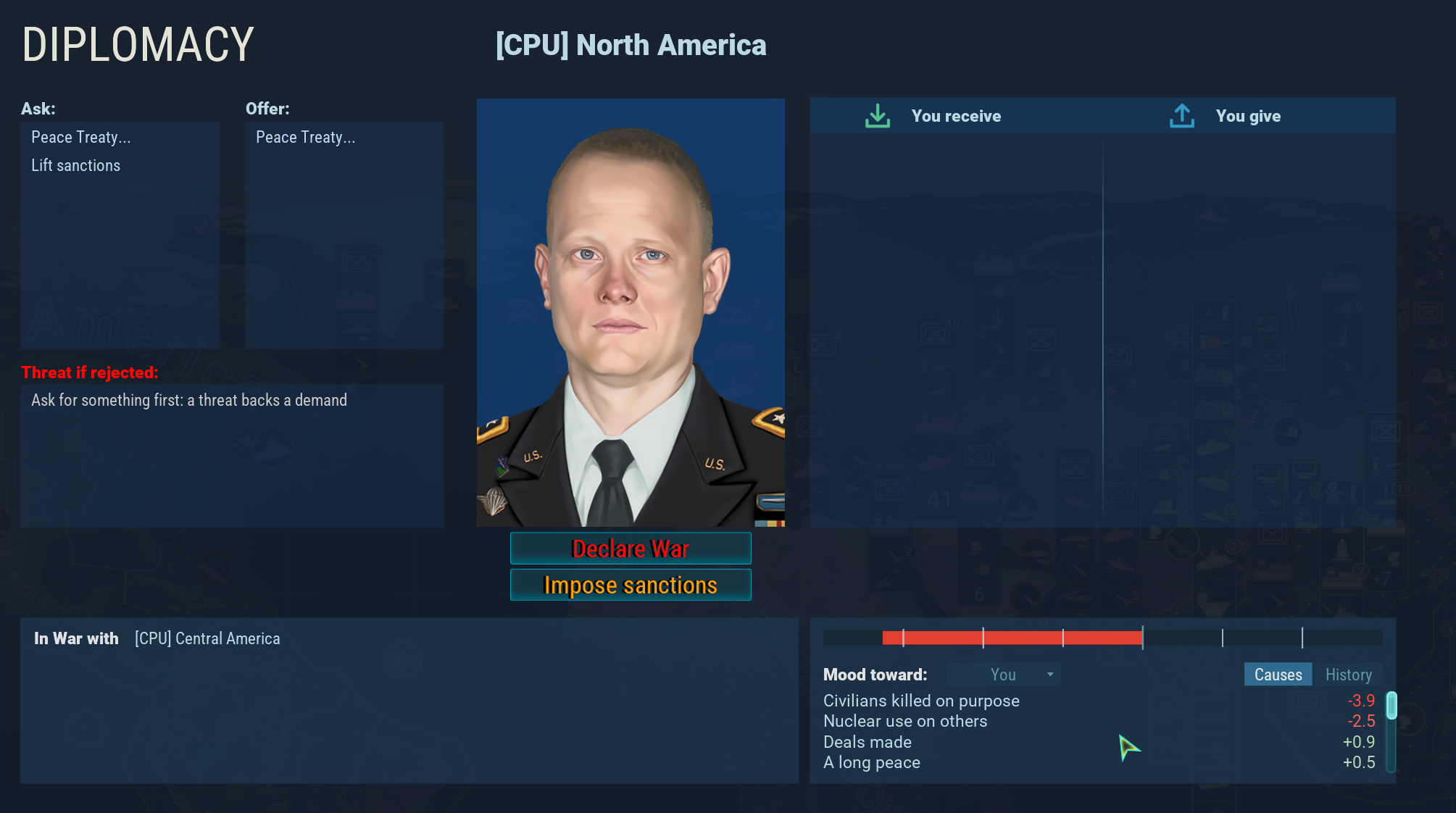
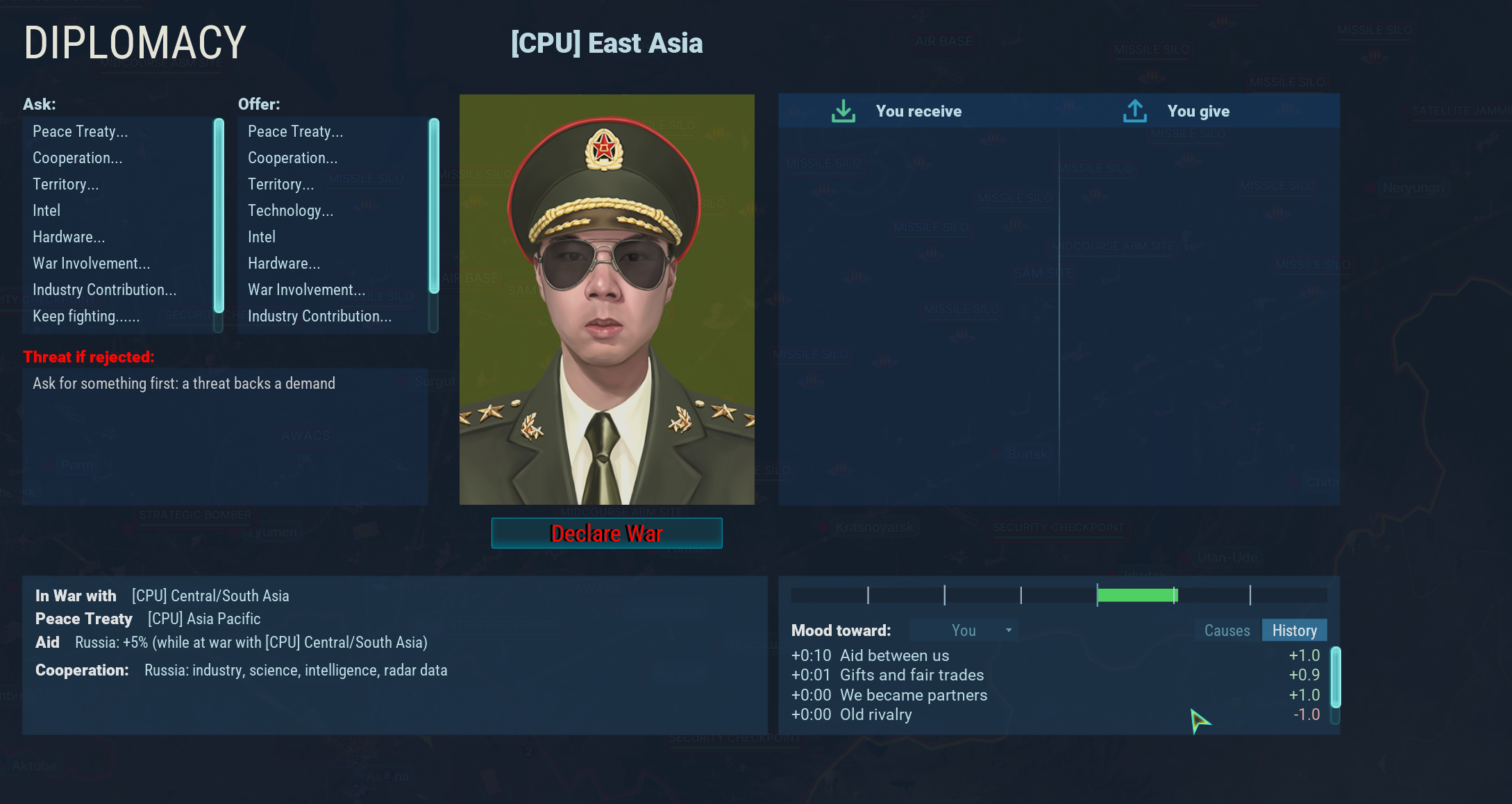
Every AI faction now has a mood toward every other faction, from hostile to warm. It moves with what happens between them: wars declared, land taken, nuclear strikes, deals made, gifts and fair trades, aid, promises kept or broken, even nuclear use against someone else. Old events fade with time, so an early quarrel matters less and less, but a nuclear strike on its cities is remembered much longer.
Each AI also gets a personality at the start of the game, the personality decides how hard a faction bargains, how readily it threatens and bluffs, when it reaches for nuclear weapons, how much civilian deaths outrage it, and how it talks.
The AI also learns from its wars. A faction that lost badly may fear you for a while, one that lost land wants it back, and one you could have finished off but spared remembers that too.
Talking to an AI
The deal screen still works the way you know it: ask, offer, send. What is new is most of what you can put in a deal, from aid and promises to sanctions and threats.
The biggest change is the new mood panel under the deal. It shows how the AI feels about you, with the reasons behind it and a history of what changed it, so you can see why it says no before you send anything. How the AIs feel about each other is their own business, unless you spy on them: the espionage action "Reveal diplomatic relations" opens it up, and the spy network behind it takes time to build.
Send a deal, and the AI explains its answer in words, or makes a counter-offer with its own terms. It values every item by what it is worth to it at that moment, and a lot of beta feedback went into those values:
- Land for a ceasefire has limits. A losing AI pays with the land that is really at stake, not with half its country.
- Technology is priced by rivalry and by spread. An AI that dislikes you charges more, and a technology half the world already has sells cheaply.
- A fight on two fronts counts. When you negotiate peace, the AI takes into account the other wars both sides are fighting.
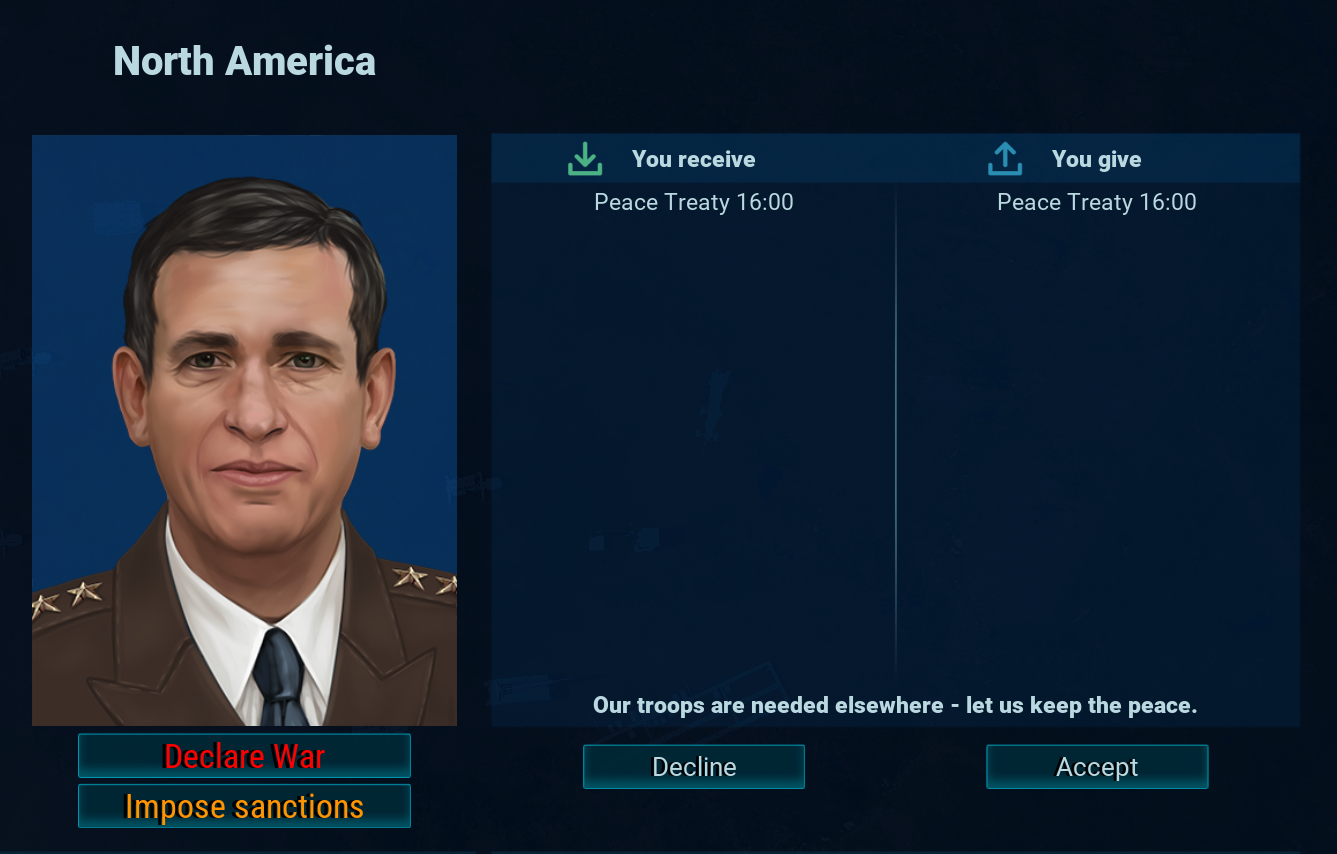
- A gift is always welcome. Offer something and ask nothing back, and even an AI with a grudge accepts it.
Partners and alliances
Partnerships now need a reason, such as a common enemy, and the AI looks for partners worth having. An alliance that loses its purpose doesn't last: an AI partner with no common cause left announces that it is leaving, and then leaves. Every new member makes an alliance harder to join, so the world doesn't split into two giant blocs early on. And a faction that grows to hold too much of the world's economy finds its allies uneasy. They warn it first, and if it keeps growing, they leave.
Partners now become permanent allies by lasting friendship rather than by time: the mood has to stay high long enough, and the relations panel shows how much longer it has to hold.
Allies help each other. An AI sends aid, intelligence or units to a partner at war, and it remembers who helped it when it needed it. Allies also get leverage of their own: you can ask your own ally to stop its war, and back the request with two threats that exist only between allies, "End our cooperation" and "Leave the alliance". The longer the alliance and the warmer the friendship, the more the second one hurts.
Proxy wars
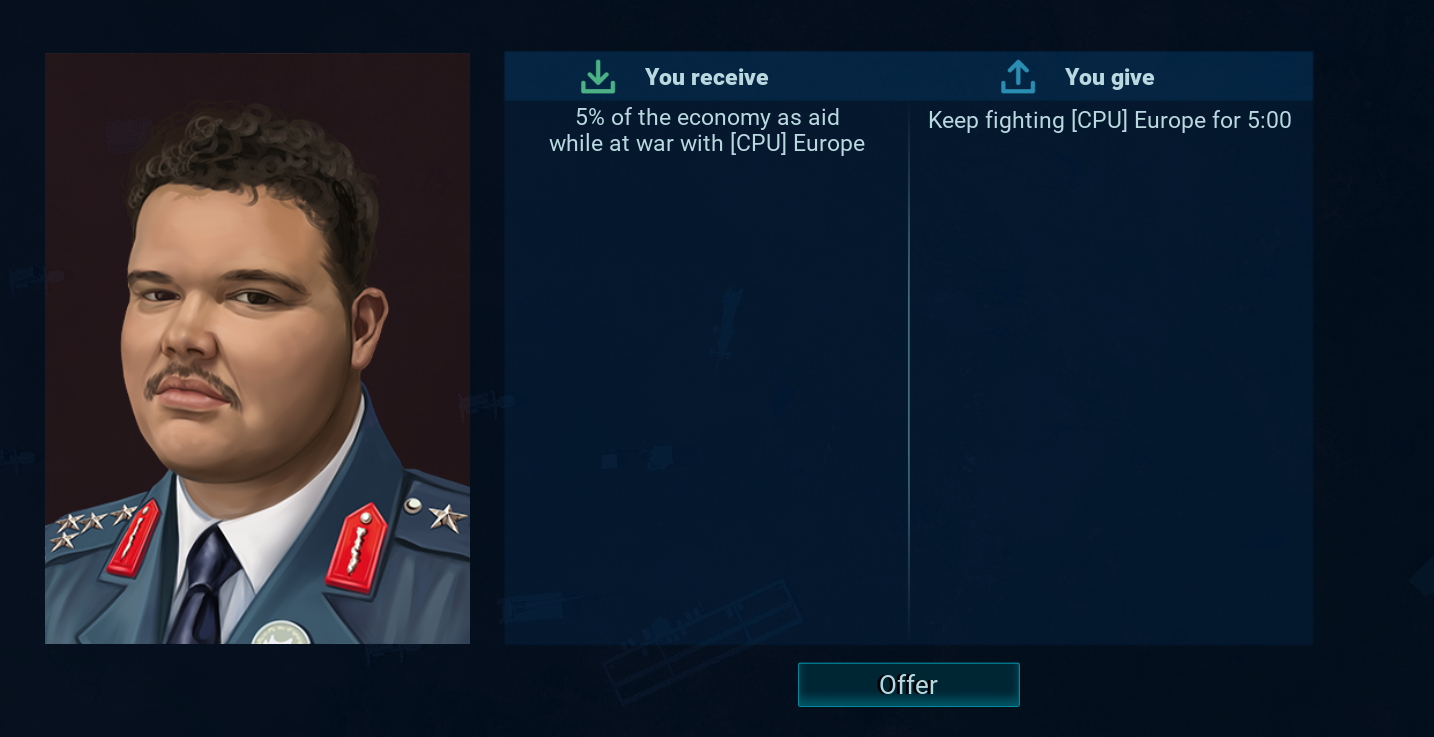
Not every faction that cares how a war ends wants to fight in it. Aid is a new deal item: a share of your economy paid to another faction for a fixed time, until cancelled, or while it is at war with someone. The AIs use it too: they sponsor whoever is fighting their rivals. The rival notices, and arming its enemies costs you its goodwill.
- Around it are new items to make and end proxy wars:
- Stop arming asks a sponsor to stop its aid to your enemy.
- Stop a war asks a faction to end its war with someone. The enemy has to agree too, and the AI asks it before answering you.
- Keep fighting is a promise to keep a war going for someone else's benefit for a set time.
Promises
Several of the new items are promises rather than transfers: keep fighting, stop arming, aid with terms, spare civilians, sanctions, and, from a player's suggestion, Stop covert operations. The game watches every promise. Breaking one costs you trust with the faction you gave it to, and makes your promises worth less to everyone afterwards. The AI accepts a few good excuses, such as a much stronger faction threatening it, and not many more. The AIs are held to the same rules: an AI that breaks its word pays the same way.
The covert promise is broken when one of your spec-ops teams or bomb trucks is caught on the other faction's land. A bomb truck caught with a nuclear charge on board is a much worse breach.
Threats and counter-threats
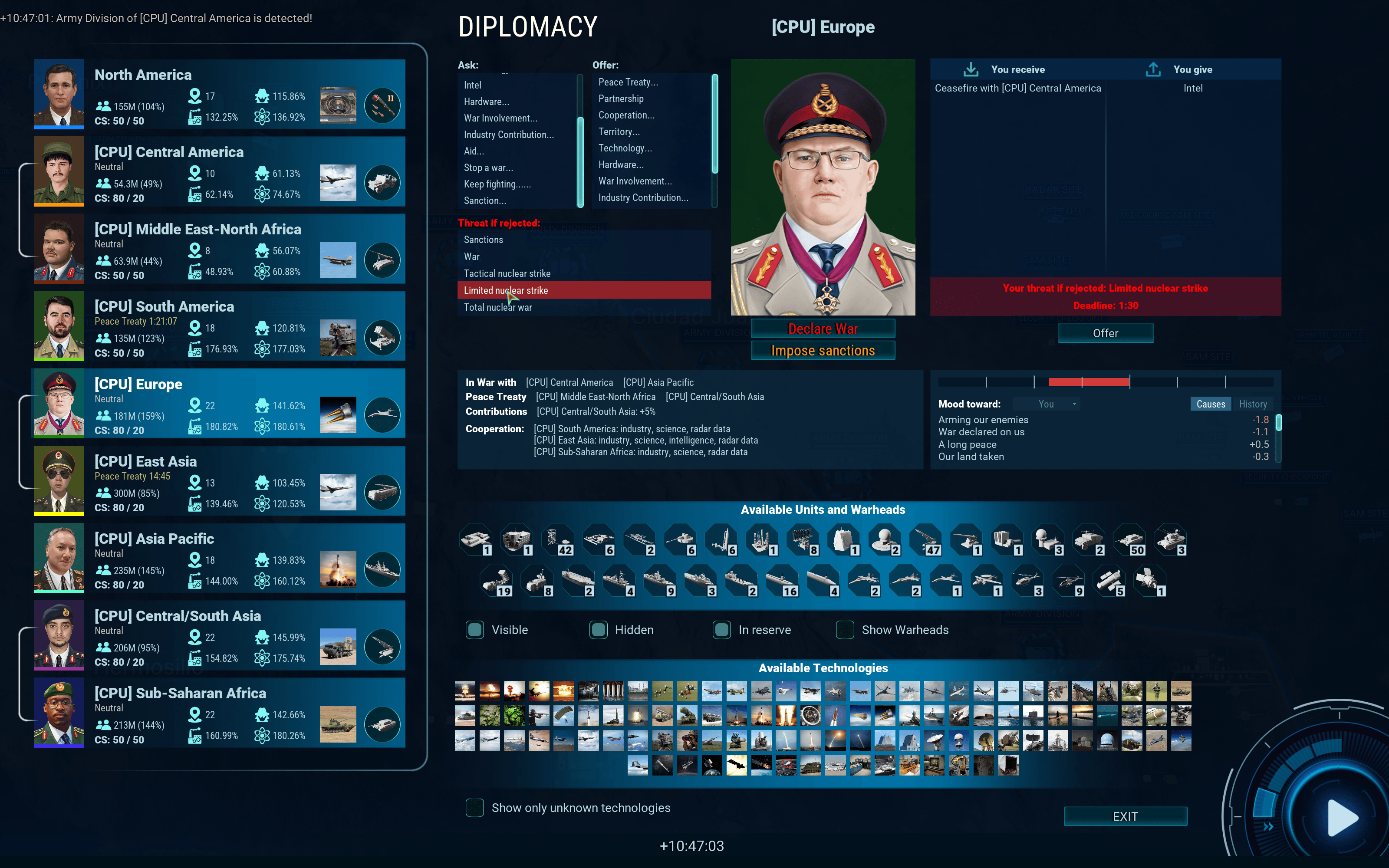
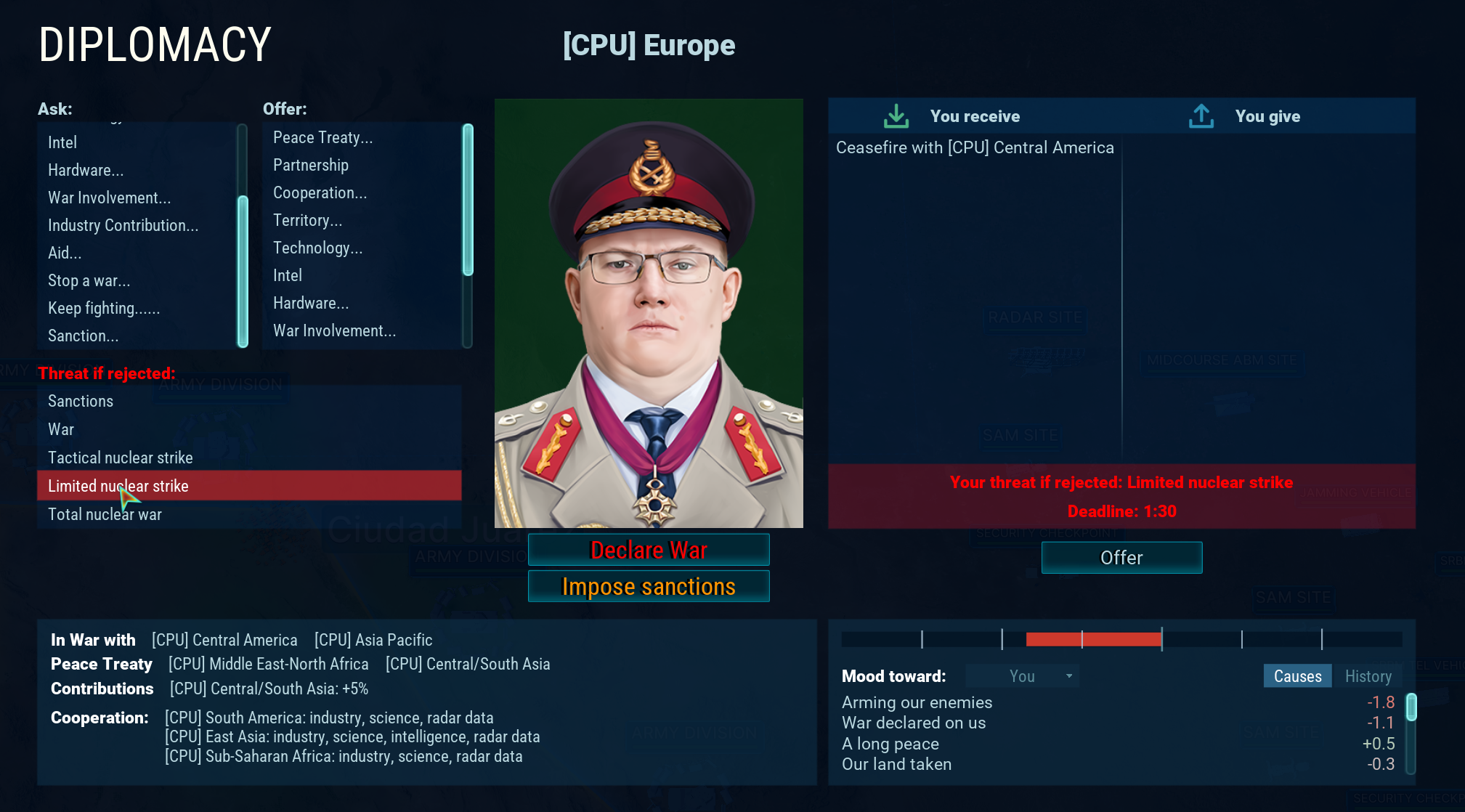
Under the Ask and Offer lists is a third list: Threat if rejected. Back your demand with sanctions, war, a tactical nuclear strike, a limited nuclear strike or total nuclear war. Only threats you could actually carry out are offered.
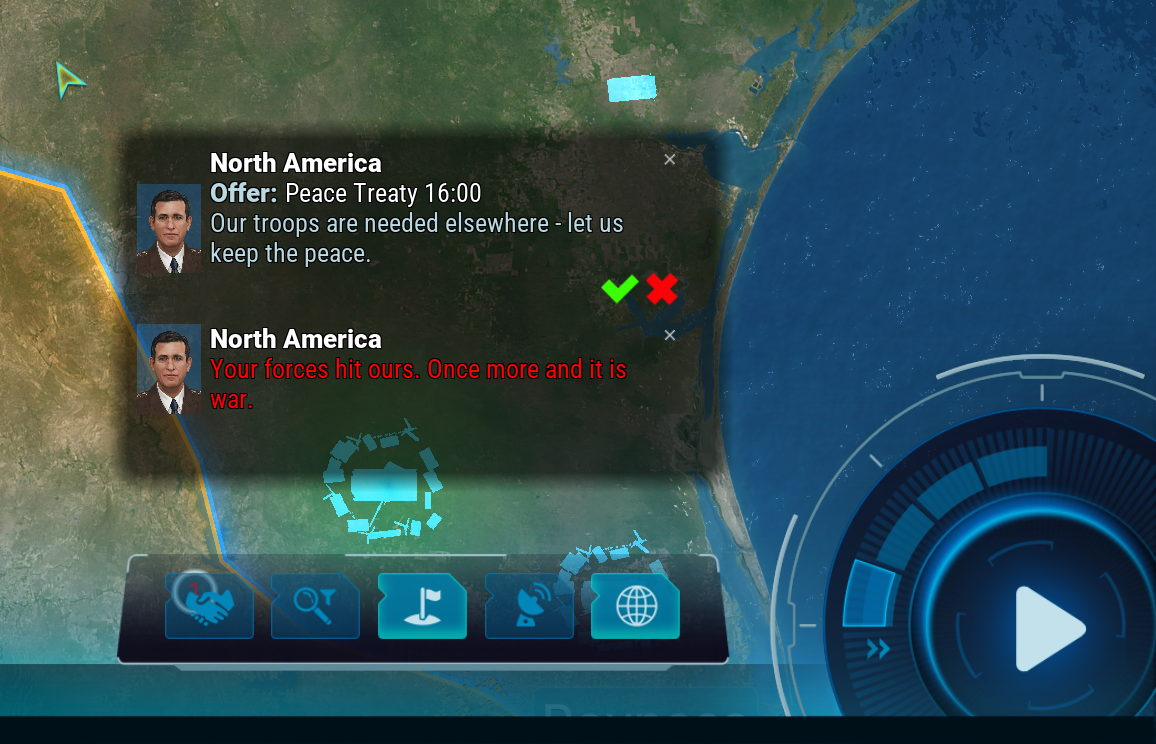
When an AI threatens you, you can answer with a counter-threat: what you will do if it carries out its threat. The AIs counter-threaten as well, a threatener facing a credible counter-threat may back down.
Every faction, you included, builds a record of threats carried out and threats not carried out. The AI weighs your next threat by that record, by what you can actually do to it, and by whether you look ready to do it. Its answers tell you how seriously it takes you.
Some AIs bluff, and you can call it. Giving in has value as well: a faction that accepted your demand under threat counts on being left alone, and attacking it afterwards costs you with everyone.
Restraint and escalation
Nuclear weapons are the top of a ladder, and the AI climbs it one step at a time: conventional weapons first, then chemical ones, then tactical nuclear weapons against military targets, and only then strategic strikes and cities. How readily it takes the next step depends on its personality and on what its enemy has already used. On top of that, it has learned some more:
- A threat carried out is one strike, not a free hand. When an AI makes good on a nuclear threat, it fires a limited number of warheads and then offers peace again.
- Nobody goes nuclear at once. Even the most trigger-happy personality waits a while into a war before its first nuke, unless the enemy has already used nuclear, chemical or biological weapons on it.
- Stop firing, and the AI stops too. If you stop using a weapon level against it, an AI that isn't losing goes back to its normal restraint after a while. Wars can cool down without a treaty.
- Launch on warning. The AI reacts when it sees nukes coming, not when they land. A nuke seen heading at its cities is treated as a strike on its cities, so a first strike at a nuclear power gets an answer before the warheads arrive.
Infamy
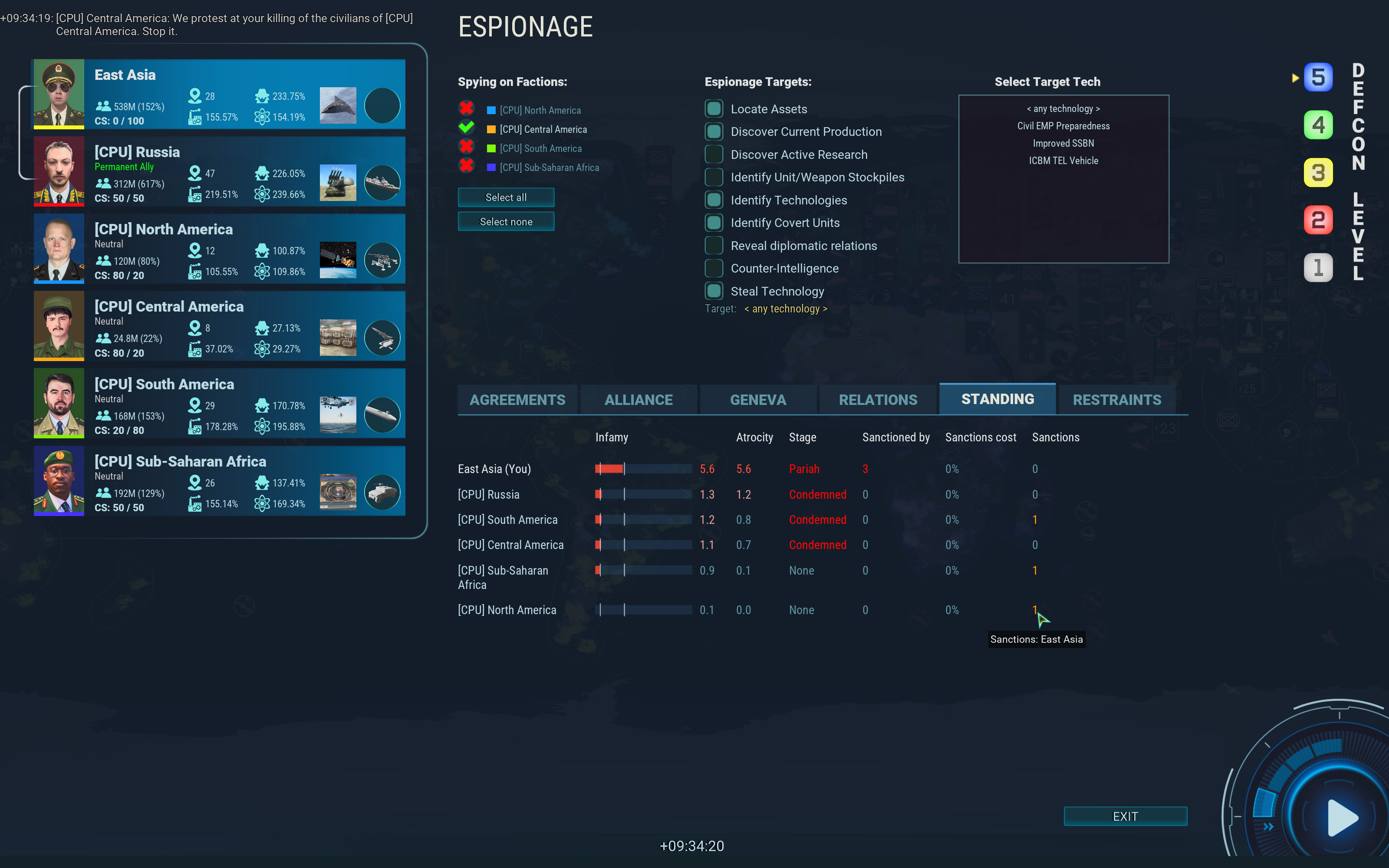
Every faction now has infamy: a public record of how it fights. It grows with civilian deaths, much more when the killing is deliberate, with cities struck on purpose, with inhumane weapons such as biological agents and salted or cobalt fallout, and with nuclear use, more for bigger yields. Chemical weapons count too, but lightly. Infamy fades with time, so a faction that stops can recover.
How a faction reacts depends on its personality: a humane faction is outraged by what a ruthless one shrugs off, and the victims remember it most of all. Infamy brings a faction through three stages:
- Condemned: AIs make no new partnerships with it and send it no gifts.
- Sanctioned: at least one faction sanctions it.
- Pariah: its AI partners leave, and a war on it costs the attacker no goodwill.
The AI is judged by the same rules. Its armies may massacre the people of a city they occupy when they truly hate its owner, and then the world answers it as it would answer you.
Sanctions
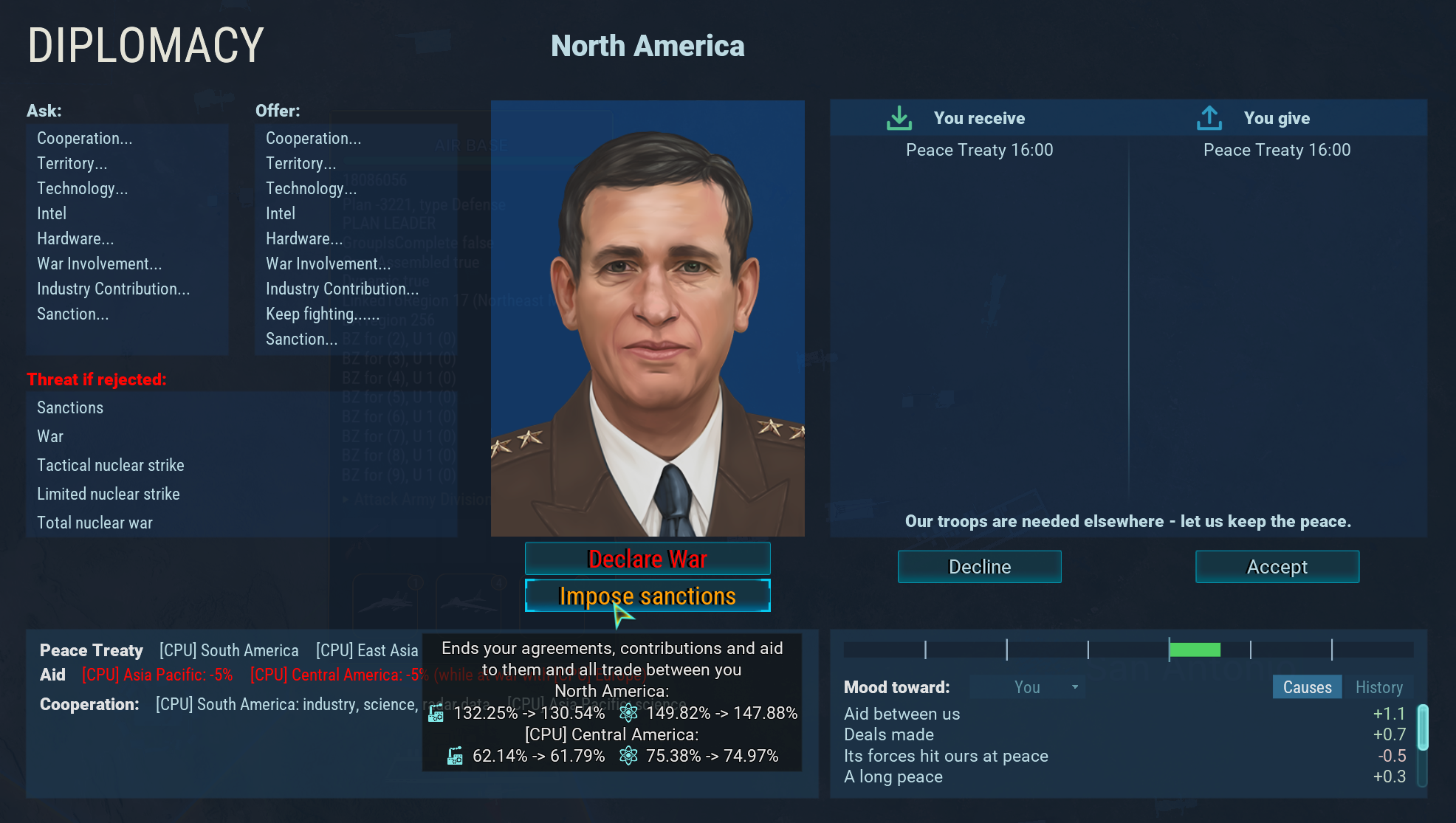
A sanction is something one faction does to another, for any reason. Next to Declare War on the deal screen is a new button, Impose sanctions. It ends your agreements, contributions and aid to the target and all trade between you. No treaty is broken and no war starts. The target also loses production and science: the more of the world's economy sanctions it, the more it loses, and a pariah loses most. Sanctions cost the sanctioner a little too.
Sanctions are also a lever in deals:
- Sanctions as a threat level, the mildest one.
- Sanction... in the Ask list asks a faction to sanction someone, and in the Offer list promises that you will, for a set time.
- Lift sanctions asks for, or offers, an end to them.
Your own faction's window
Select your own faction, and its window has three new tabs:
- Relations shows every AI's mood toward you at once, each as a bar with its biggest reasons, so you can see who is warming to you and who is turning against you.
- Standing lists every faction with its infamy, how much of it was deliberate, its stage and who sanctions it. Infamy is public: everyone sees the same list.
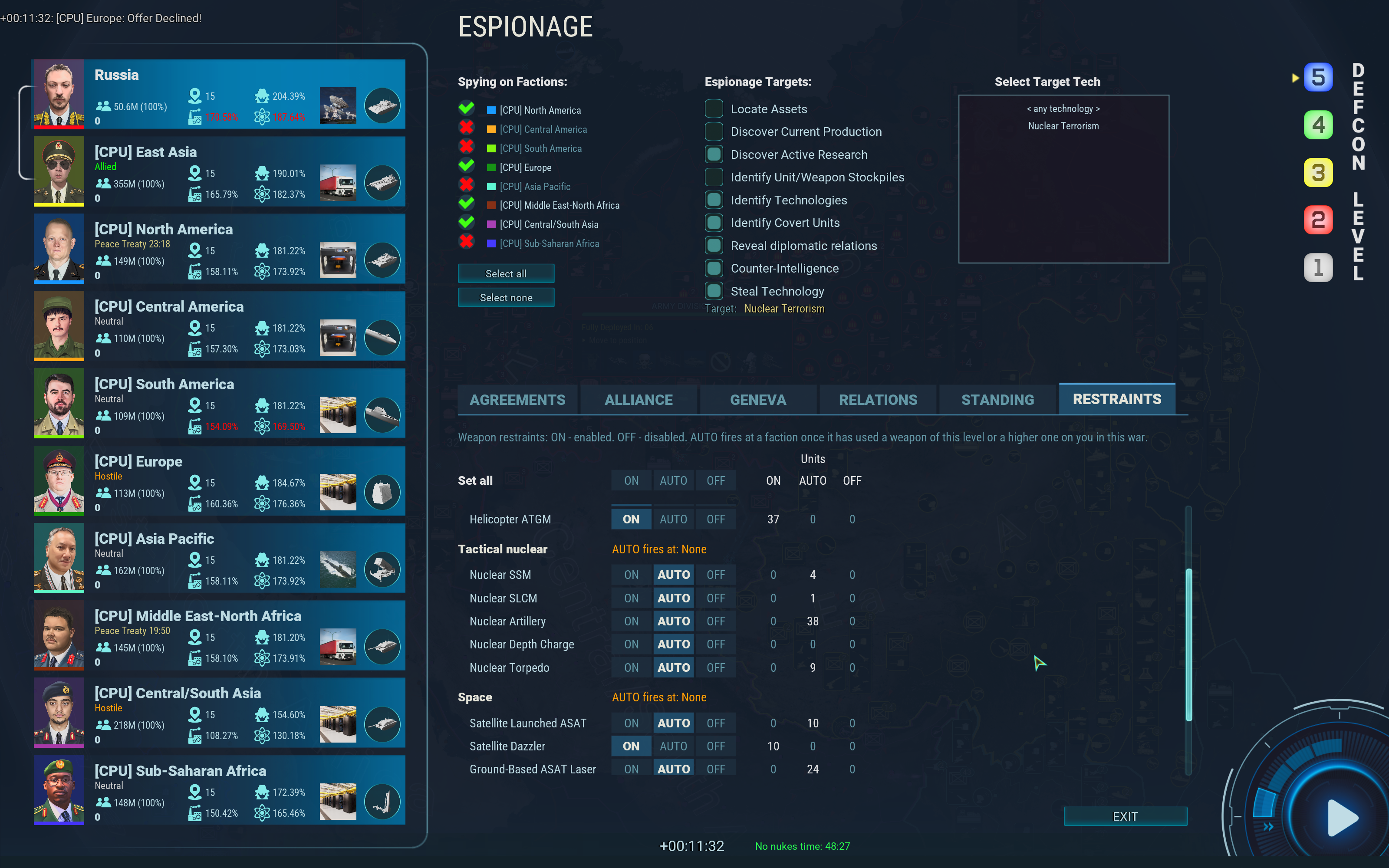
- Restraints lists your switchable weapons by escalation level and sets them to ON, OFF or AUTO, all at once or group by group. Each group shows which factions AUTO is already free to fire at.

Words, not numbers
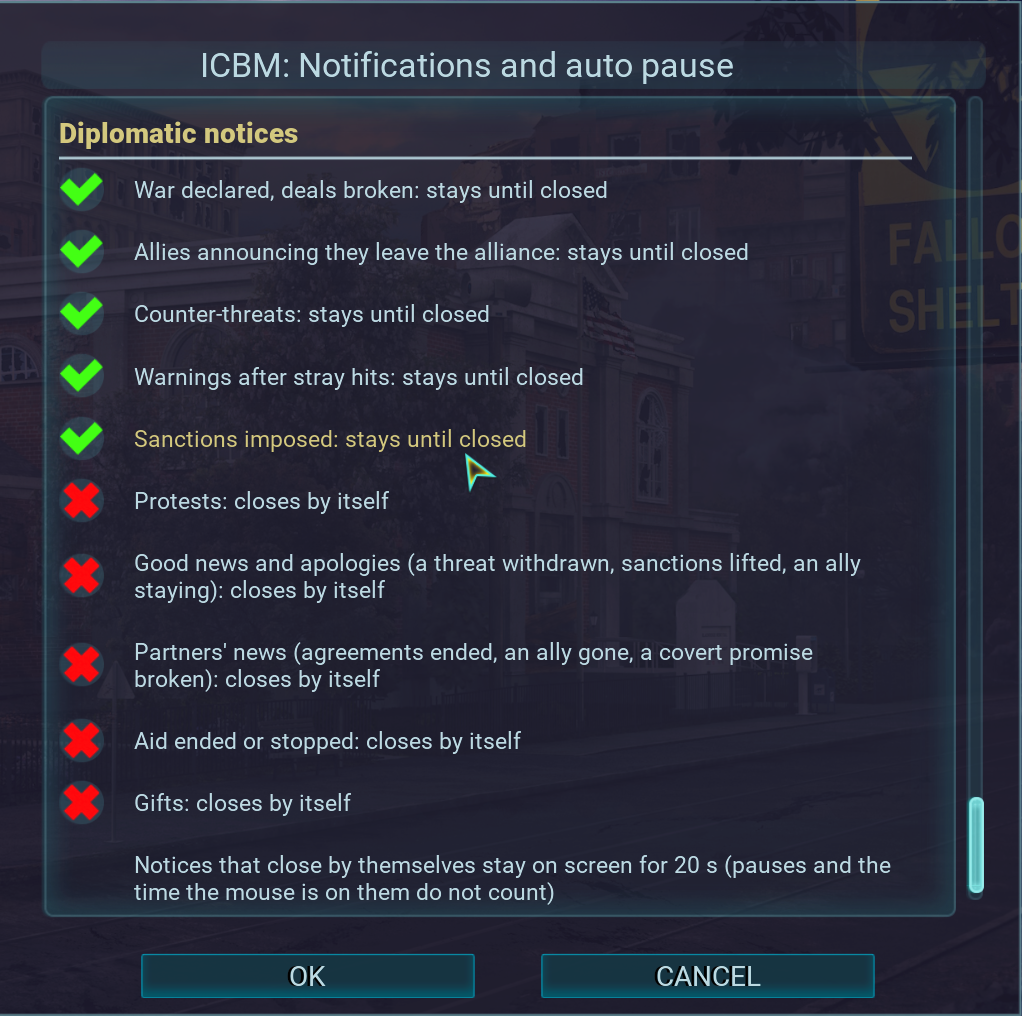
Every AI answer now comes with its reason in words, and most reasons have several wordings that depend on the speaker's personality. Notices tell you what happens between you: protests, warnings after a stray hit or an apology for one, allies leaving, sanctions imposed, aid thanked or ended. Each group of notices can be set to appear only in the Journal, to close by itself, or to stay until you close it.
What's next
These are plans, not finished features, and they may change:
- Nuclear limits: a deal to keep a war below a level, such as no cities or no nukes at all, with a real price for breaking it, and third parties that can ask both sides for one.
- Defence pledges and a nuclear umbrella: a public promise that whoever attacks a faction will have to deal with you too.
- An espionage rework.
Anyone who owns the game can join the Open Beta by selecting the Beta build in the game's properties on Steam. For diplomacy, the best test is a full game: talk to the AIs, make deals and threats, break a promise or two, and see how they answer. If an AI says or does something that makes no sense, make a save and share it with us on the Open Beta Discord channel. Many of the changes above started as exactly such a save.
A special thank you to everyone taking part in the Open Beta. Your saves, reports and ideas shaped this update more than anything else. The promise to stop covert operations, the limits on land given for a ceasefire, fairer prices for technology, asking your own ally to stop its war and the notice settings all started as a player's report or suggestion, and so did many smaller fixes. An AI this complex could not be tested without you, and your help has been invaluable.
Thanks for all your support.