Saar Offensive:
https://en.wikipedia.org/wiki/Saar_Offe ... er%201939.

Disposition of French forces
The Saar Offensive was a French ground invasion of Saarland, Germany, during the early stages of World War II, from 7 to 16 September 1939. The plans called for roughly 40 divisions, including one armored division, three mechanised divisions, 78 artillery regiments and 40 tank battalions to assist Poland, which was then under invasion... by attacking Germany's understrength western front.
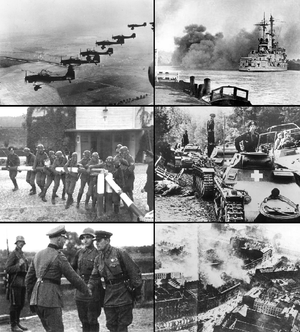
Picture Description: Luftwaffe bombers over Poland; Schleswig-Holstein attacking the Westerplatte; Danzig Police destroying the Polish border post; German tank and armored car formation; German and Soviet troops shaking hands; Bombing of Warsaw.
Resume'... Objective of the offensive
According to the Franco-Polish military convention, the French Army was to start preparations for the major offensive three days after mobilization started. The French forces were to effectively gain control over the area between the French border and the Siegfried Line and were to probe the German defenses.
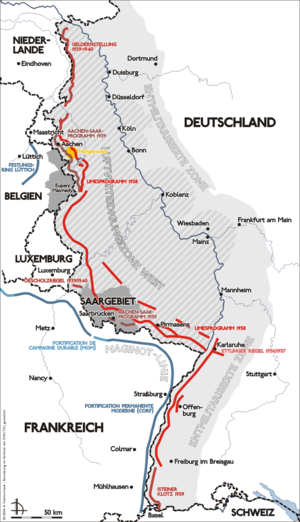
The Siegfried Line featured more than 18,000 bunkers, tunnels and tank traps.

[Tank Traps] Dragon's teeth near Aachen, Germany, part of the Siegfried Line.
A French offensive in the Rhine valley began on 7 September, four days after France declared war on Germany. The Wehrmacht was engaged in the attack on Poland and the French enjoyed a decisive numerical advantage along the border with Germany.
Aftermath
The Polish Army general plan for defense, Plan West, assumed that the allied offensive on the Western Front would provide a significant relief to the Polish front in the East
[Plan West] Plan Zachód (Plan West) was a military plan of the Polish Army of the Second Polish Republic, for defence against invasion from Nazi Germany. It was designed in the late 1930s.
https://en.wikipedia.org/wiki/Plan_West
After the German annexation of parts of Czechoslovakia and changes of borders, Polish planners revised the plan with the expectation that a main thrust would originate from Silesia through Piotrków and Łódź towards Warsaw and Kraków.[3] The Polish planners correctly predicted the direction of most German thrusts, with one crucial exception: they assigned low priority to a possible deep, flanking, eastward push from Prussia and Slovakia, but that push was assigned high priority in the German plan (Fall Weiss).
The plan assumed that Polish forces would be able to hold for several months but would be pushed back by the German numerical and technical superiority, which was estimated to be two or three to one.[1][2] Then, the Western Allies (France and the United Kingdom), obliged by the Franco-Polish Military Alliance and the Polish-British Common Defence Pact), would launch an offensive from the west, which would draw enough German forces away from the east to allow Polish forces to launch a counteroffensive.
Concluding Statement "Das-Finale-Verdict!!!":
At the Nuremberg Trials, German military commander Alfred Jodl said that "if we did not collapse already in the year 1939 that was due only to the fact that during the Polish campaign, the approximately 110 French and British divisions in the West were held completely inactive against the 23 German divisions."[11] "General Siegfried Westphal" stated that if the French had attacked in full force in September 1939 the German army "could only have held out for one or two weeks.

Jodl in 1940
***Chief of Operations Staff
of the Armed Forces High Command***