United Kingdom
The war in the West is over, although partisan groups have already formed in an attempt to disrupt our control of Britain. We have therefore garrisoned several infantry units and some obsolete tanks to deal with this threat, as and when it appears. The remaining American Fighters and Bombers have fallen from the sky from lack of fuel, as we have captured all airports, however there is some limited nuisance from long ranged bombers operating out of Iceland. Having achieved total control, it has allowed us to divert all air resources, as well as the AA that was based in France and Germany to the Eastern Front. Many of these AA have been upgraded to 88’s, so that they can also adopt an anti tank role if required.
Our surface fleet, after undergoing significant costly repairs, is now steaming for Gibraltar and will assist Rommel to recapture North Africa from the Americans.
North Africa
An incredibly bitter fight saw our forces pushed back from the hills to the plains directly outside Tunis. Many of our forces were annihilated. Rommel himself was almost killed when his Panther unit was attacked by American Rangers in the hilly terrain. The combination of the American infantry’s strong anti armour weaponry in the hilly terrain, combined with the Sherman Tanks strong anti infantry guns have decimated our forces. If it weren’t for the support of both the Regia Marina and Luftwaffe, Tunis would have fallen long ago. We have achieved total air supremacy, which has allowed us to finally halt the American advance. This has been an incredibly costly front in terms of resources expended and lives lost. However we are now confident that the main assault has been stopped and we will soon adopt an offensive posture.
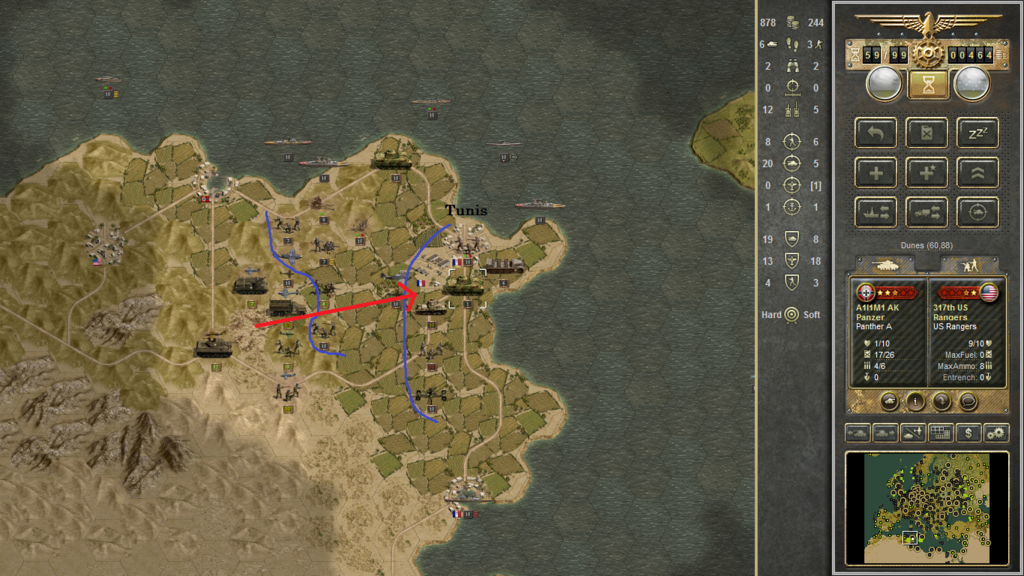 The Allied drive on Tunis has decimated many of our units. Notice Rommel’s Panther tank brigade just South of Tunis on 1 strength, after being almost annihilated in the battles around the hills. The blue defensive line around the hills was broken in the South, resulting in the last defensive line being hastily formed in the plains around Tunis by the remaining tanks and AA units.
In the West, our artillery bombards the British defences at El Alamein, with little effect. However we have taken advantage of the bad winter weather to fly Paratroopers behind the British defences. Combined with 2 infantry units that have flanked around from the South, we are hopeful of catching the British artillery unprepared. In front of the defences, we have positioned several fast armoured units, ready to take advantage of any breakthrough once we have punched a hole through. However, without air or naval assistance, it will be difficult nut to crack.
Eastern Front
After fighting off sporadic attacks in Summer and Autumn, our forces concentrated for a limited counterattack. In a reverse of the prior two winters, it was the Germans and not the Russians who launched an offensive as the snows fell. Taking advantage of the iced over rivers, our forces were able to avoid the Russian defences at each bridge crossing and instead attack them from the side or behind. Surprisingly, apart from the defences at each bridge crossing, there were relatively few other Russian units in the area. We have come to the conclusion that the Russians have been bled dry of troops and have now ordered a full offensive across the entire Eastern Front.
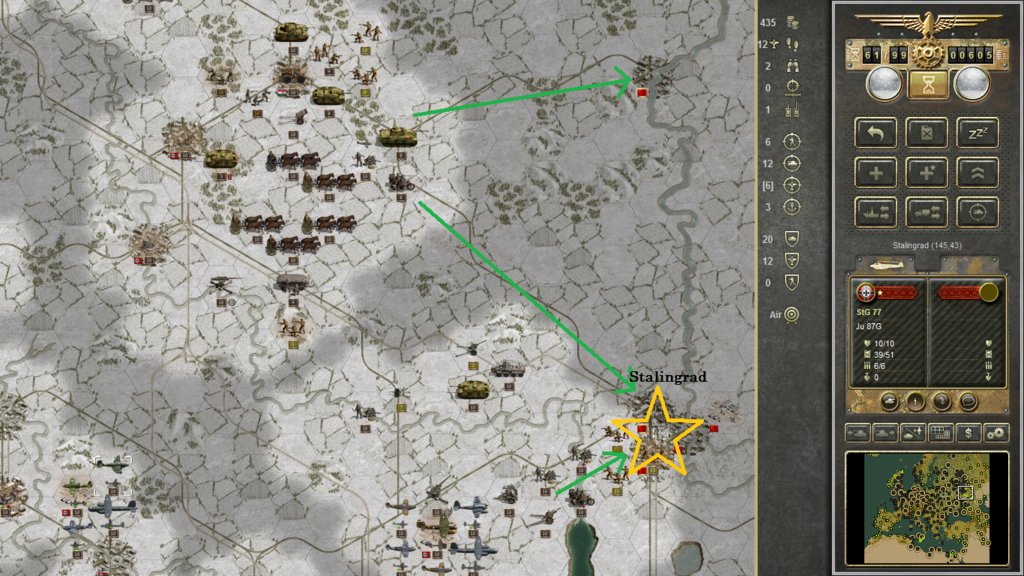 Army Group Centre pushes towards the Volga, whilst Army Group South is attacking Stalingrad. Further South, our forces have taken Novogrod and will circle round to attack Stalingrad from the South, as well as advancing towards the oilfields.
War Economy
Army Group Centre pushes towards the Volga, whilst Army Group South is attacking Stalingrad. Further South, our forces have taken Novogrod and will circle round to attack Stalingrad from the South, as well as advancing towards the oilfields.
War Economy
All Panzer III units were upgraded to the new Panther variant in the Autumn of 1943. Combined with the significant costs of repairing our surface fleet and the desperate effort of reinforcing our units around Tunis, this led to our reserves being bled almost dry for the first time during the war. In a cost saving effort we have recruited local green reinforcements for many of our units, as well as forgoing some of the more expensive upgrades. As the surface fleet is now fully repaired, we expect to again start accruing surplus funds (at the lowest point in late ’43, my prestige was less than 200!).
Outlook
Russia looks on the brink of collapsing, although there is sure to be significant resistance at major cities, such as Stalingrad. Also, given the vast distances involved, it will take time to move our troops up to the ever expanding front lines. We therefore don’t expect Russia to be finally defeated until the end of ’44.
Once the German surface fleet arrives in North Africa, we should be able to easily defeat the Americans there and claim it for Germany. We estimate this will be achieved by the summer of ’44. Of more concern are the strong defences at El Alamein, which are seriously hindering our efforts to break through. And if we break through, there is still a long way to reach the oil fields in the Middle East. We will therefore divert the air forces currently at Tunis to assist in this effort. However we consider that we will not be able to reach the oil fields in the Middle East until the end of ’44 (and that’s assuming we are able to crack the defences at El Alamein).
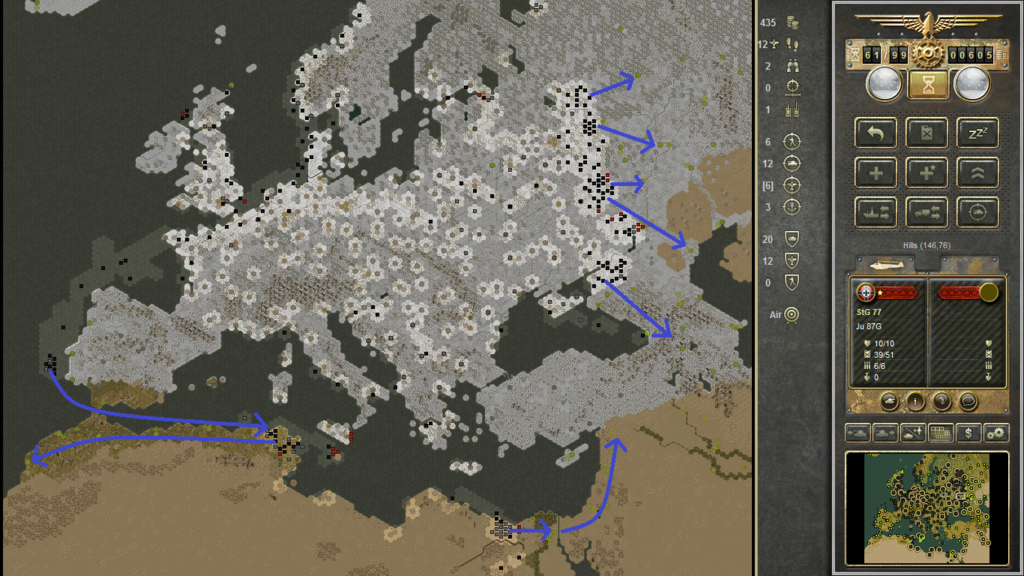 Our forces will advance on all fronts with the aim of winning the war by the end of ’44. It is hoped that the arrival of the German surface fleet in the Mediterranean will add significant impetus to the efforts to retake North Africa and advance towards the Middle East.




 Good job!


