

1946 Insider Articles
Moderator: Panzer Corps 2 Moderators

Re: 1946 Insider Articles
I really like the atomic in action clip, but I have a question about the aircraft adjacent to the explosion. Would they not be affected by the blast being so close? I realize the bomb is probably of a small yield, but I think they might be affected in some small way, if not by shock wave, EMP maybe. Maybe too difficult to model.

Re: 1946 Insider Articles
I am a big fan of the modification level of Panzer Corps 1. Is there also a new way to mod the game with the new upgrade. For now Panzer Corps 2 isnt modify - no tutorials for new 3d models, terrain graphics, sounds etc. Even though it was announced: https://www.slitherine.com/forum/viewtopic.php?t=102778 "Modding the game’s Unreal Engine assets (unit models, terrain graphics, UI etc.) is also possible, but the process if more difficult. We’ll describe it in the next guide. Stay tuned!"
By the way, a blatant lie - since the essential files for this were all encrypted, and cannot be modified in the mod directory...
Why is there nothing?
By the way, a blatant lie - since the essential files for this were all encrypted, and cannot be modified in the mod directory...
Why is there nothing?
-
Retributarr
- Colonel - Fallschirmjäger

- Posts: 1416
- Joined: Wed Jun 04, 2014 7:44 pm
Re: 1946 Insider Articles
Oil Refineries on the U.S. West Coast during WWII
Bombardment of Ellwood
https://en.wikipedia.org/wiki/Bombardment_of_Ellwood

The Ellwood Oil Field and the location of the Japanese attack.
The Japanese government, concerned about President Roosevelt's radio speech scheduled for February 23, 1942, ordered a Japanese submarine to shell the California coast on that day.
Date February 23, 1942
Location Ellwood, California, Santa Barbara Channel, Pacific Ocean
Result United States oil refinery damaged
***Big Inch Pipelines of WW II***
https://aoghs.org/petroleum-in-war/oil- ... -big-inch/
“Without the prodigious delivery of oil from the U. S. this global war, quite frankly, could never have been won.”
The final weld on the “Big Inch” was made in July 1943, just 350 days after construction began. “Without the prodigious delivery of oil from the U.S. this global war, quite frankly, could never have been won,” proclaimed historian Keith Miller.
“Besides, without the outstanding cooperation of the Petroleum Administration for War with the numerous oil companies of America, World War Two very likely would never have been won by the Allies either,” Miller explained in a 2002 lecture at George Washington University, Washington, D.C.
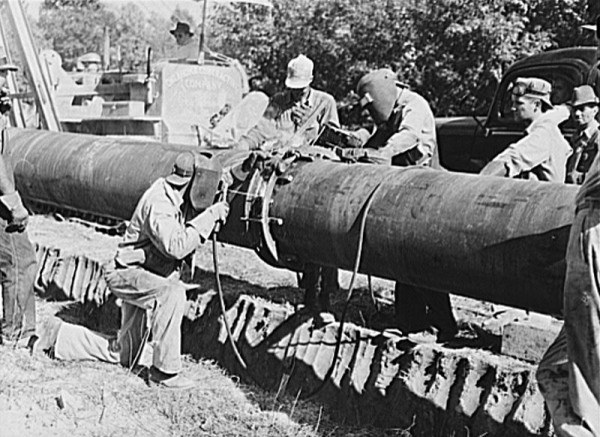
Welding a section of the Big Inch pipe by the “stove pipe” method in 1942. Courtesy the Library of Congress, U.S. Farm Security Administration/Office of War_ 24 inches in diameter pipeline
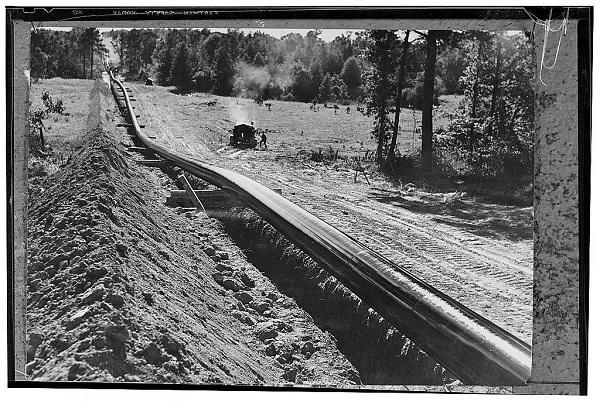
The Big Inch was completed just 350 days after construction began.
“A ditch four feet deep, three feet wide and 1,254 miles long was to be dug from Longview (Texas) across the Mississippi River to Southern Illinois and then east to Phoenixville, Pennsylvania, with lines from there to New York City and Philadelphia,” explained the Texas State Historical Association.
U.S. oil became indispensable for laying runways, manufacturing of synthetic rubber for tires, creating lubricant for guns and machinery and the distilling into gasoline (particularly at 100-octane levels) for use in trucks, tanks, jeeps, and airplanes.
Bombardment of Ellwood
https://en.wikipedia.org/wiki/Bombardment_of_Ellwood
The Ellwood Oil Field and the location of the Japanese attack.
The Japanese government, concerned about President Roosevelt's radio speech scheduled for February 23, 1942, ordered a Japanese submarine to shell the California coast on that day.
Date February 23, 1942
Location Ellwood, California, Santa Barbara Channel, Pacific Ocean
Result United States oil refinery damaged
***Big Inch Pipelines of WW II***
https://aoghs.org/petroleum-in-war/oil- ... -big-inch/
“Without the prodigious delivery of oil from the U. S. this global war, quite frankly, could never have been won.”
The final weld on the “Big Inch” was made in July 1943, just 350 days after construction began. “Without the prodigious delivery of oil from the U.S. this global war, quite frankly, could never have been won,” proclaimed historian Keith Miller.
“Besides, without the outstanding cooperation of the Petroleum Administration for War with the numerous oil companies of America, World War Two very likely would never have been won by the Allies either,” Miller explained in a 2002 lecture at George Washington University, Washington, D.C.
Welding a section of the Big Inch pipe by the “stove pipe” method in 1942. Courtesy the Library of Congress, U.S. Farm Security Administration/Office of War_ 24 inches in diameter pipeline
The Big Inch was completed just 350 days after construction began.
“A ditch four feet deep, three feet wide and 1,254 miles long was to be dug from Longview (Texas) across the Mississippi River to Southern Illinois and then east to Phoenixville, Pennsylvania, with lines from there to New York City and Philadelphia,” explained the Texas State Historical Association.
U.S. oil became indispensable for laying runways, manufacturing of synthetic rubber for tires, creating lubricant for guns and machinery and the distilling into gasoline (particularly at 100-octane levels) for use in trucks, tanks, jeeps, and airplanes.