Page 1 of 6
Conformation
Posted: Mon Dec 08, 2014 9:02 am
by titanu
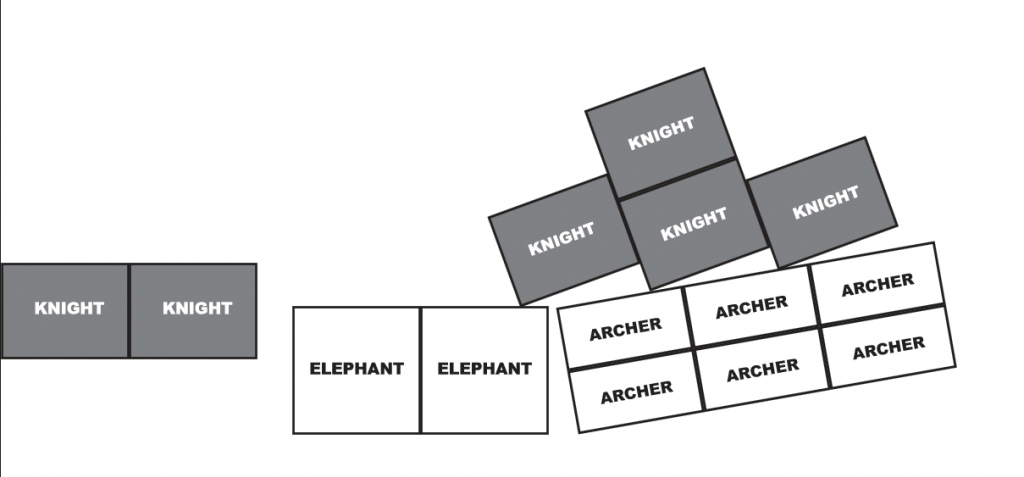
At the Northern league yesterday this situation arose:
The grey knights charged into an Indian bow unit and the elephants beside them. The question is about conformation:
1) Should the knights move across to the right so the three knight front rank is in contact with the three bow bases? Thus they break contact elephants.
2) Let us assume that no conformation took place. When it comes to the Indian turn should the three archer bases conform to the three knights bases and the elephants become an overlap?
Re: Conformation
Posted: Mon Dec 08, 2014 9:41 am
by grahambriggs
1. No. You must conform, if at all, to the enemy bases in contact. If the enemy were lined up, that would be elephant, archer, archer. Since they are not lined up, the Kn can't conform.
2. No. Again, you must conform to the enemy bases in contact. So the archers and elephants all shift to the right and you end up with the elephant base locked with it's knight, two archer bases locked with theirs and overlaps on either end.
This is a common error. people read the "by the minimum move possible" or whatever it says and want to move the bases the shortest distance but they forget the conform is to the enemy bases in contact.
Re: Conformation
Posted: Mon Dec 08, 2014 1:37 pm
by zoltan
As Graham notes the 'slide by the shortest distance to conform' rule is a 'tie breaker' that only applies where two bases are in contact with one enemy base.
So in the OP because the enemy BGs are not lined up with each other the knights are not permitted to conform and as positioned in the diagram they face the prospect of a double overlap.
However, it looks to me (Digital p.79) that the knights are still permitted to expand their rear rank base to either flank (to reduce one overlap) as stepped formations are specifically permitted when matching an existing enemy overlap.
Re: Conformation
Posted: Mon Dec 08, 2014 6:11 pm
by ChrisTofalos
As a player involved in play in the original post I've no arguments about the comments made. I just wish the ruling made in the game had followed Graham Briggs' advice!
However, had the conformation been correctly applied it would have left two Knight bases within a base width of the right hand elephant; one facing the elephant and the other the archers. These two knight bases would, therefore, be disordered. Four dice would normally be thrown with disorder reducing this to three.
My question is, with dice reduction, does each knight base treat each different frontal opponent separately? That is, the knight v elephant has two dice to roll and, as two dice cannot be reduced under the 'one-in-three' rule, still throws two. And, similarly, the knight v archer still throws two dice. That would mean there is no effect at all from disorder by the elephant.
OR, do the four dice for the two elephant disordered knight get reduced to three, with the one dice being used against one opponent and the two against the other. If the latter, how do you decide which knight uses two and which uses one?
Chris
Re: Conformation
Posted: Mon Dec 08, 2014 7:55 pm
by petedalby
FWIW I agree with Graham's comments on conforming as well.
OR, do the four dice for the two elephant disordered knight get reduced to three, with the one dice being used against one opponent and the two against the other. If the latter, how do you decide which knight uses two and which uses one?
I believe this one is correct. Read Pages 99 & 100.
Since the number of dice are equal in this situation my understanding is that you can choose where you lose the dice. You'll probably be better off with 1 vs the EL and 2 vs the Archers.
Re: Conformation
Posted: Tue Dec 09, 2014 10:56 am
by titanu
ChrisTofalos wrote:... I just wish the ruling made in the game had followed Graham Briggs' advice!
Chris
As the umpire involved here I would make two comments:
1) Grahams advice came afterwards and hence could not have been followed.
2) The was nothing stopping the players from reading the relevant section in the rules and picking up the 'in contact' wording. This was all I did and missed it.
I think it is often a knee jerk reaction to call for the umpire rather than reading the rules.
Re: Conformation
Posted: Tue Dec 09, 2014 12:27 pm
by prb4
As the other player involved.
I actually thought the conformation should have been as it was ruled. I didn't even think it would be a tricky decision since it was fairly straight forward.
Since it was instantly a controversial situation it seemed pragmatic to call for an umpires ruling to avoid a long rules discussion during the game.
I don't actually think the ruling changed the game significantly, it might have done but probably wouldn't have. The MF would still have lost, the elephants would still have dropped cohesion for seeing the rout and in all probability have lost to the knights.
Still, we have all learned something and I will remember this for next time,
- Conform to the base in contact
- If two bases in contact conform by the shortest distance
Simples......
Peter
Re: Conformation
Posted: Tue Dec 09, 2014 1:17 pm
by grahambriggs
I'd add that this particular rule is one that even some very experienced players misread. I've had it in several games with the early persians where lancers are desperately keen to not conform into the centre of the immortals and thus fight 4 bases against 8 in melee, so put in a significant wheel when charging but can't quite avoid contacting the middle bases.
I think the reason it's confusing is that if the elephants and archers were lined up in a tidy line and the knights charged head on they would contact all three archer bases and the elephant base and would then probably have conformed to the archers. So it feels incorrect that if they're almost tidy but not quite something else happens, despite being what the rules say - a bit counter intuitive.
Doubly unfortunate as it's often the case that the lancers are trying to charge soft squishy target A and minimise contact with nasty hard target B!
Re: Conformation
Posted: Wed Dec 10, 2014 7:17 pm
by zoltan
@Graham - do yoi agree that the knights can still expand their rear rank base to match an existing overlap?
Re: Conformation
Posted: Thu Dec 11, 2014 3:29 am
by gozerius
Graham, I still can't believe that after all these years, you still reject the diagrams in the rules that show exactly how bases conform. Bases in contact conform with enemy by the shortest move necessary. A base does not have to conform frontally to the base they were originally in contact with, though they may not break contact with it. So while it is true that the knights cannot conform to the archers in this situation without breaking contact with the elephant, it is not true that they are considered fighting the elephant except as an overlap. Each base fights the base they would conform to by the shortest move necessary. Then in white's phase the archers would conform by the shortest move necessary to line up against the knights and the elephants would conform as an overlap. Insisting that bases only conform with the base they originally contact creates all sorts of geometrical headaches and is not supported by the examples of play in the rules. Remember, a picture is worth a thousand words, visually demonstrating that which may be too cumbersome to explain. So the authors could have given a lengthy explanation on just what is meant by "by the shortest move necessary", or they could draw a picture. They chose to illustrate exactly what they meant, with text, so there should be no confusion.
Insisting that bases that cannot conform must fight the base they are touching is against the spirit of the rules that states that they fight the enemy they would conform to if there were room.
Re: Conformation
Posted: Thu Dec 11, 2014 7:34 am
by petedalby
Graham, I still can't believe that after all these years, you still reject the diagrams in the rules that show exactly how bases conform. Bases in contact conform with enemy by the shortest move necessary. A base does not have to conform frontally to the base they were originally in contact with, though they may not break contact with it.
AFAIK there are only 2 diagrams in the rules on conforming - both appear on page 78. These appear to support Graham's view.
Page 77 - "At the start of the manoeuvre phase, the active player's BGs already in close combat with enemy
must unless otherwise stated below or physically impossible) pivot and/or slide bases by the minimum necessary to
conform to the enemy bases in contact:"
I've added the bold and underline for emphasis. You say:
A base does not have to conform frontally to the base they were originally in contact with
Where does it say or demonstrate that?
Re: Conformation
Posted: Thu Dec 11, 2014 9:49 am
by grahambriggs
zoltan wrote:@Graham - do yoi agree that the knights can still expand their rear rank base to match an existing overlap?
I see no reason why the rear base cannot feed in at one end or the other.
Re: Conformation
Posted: Thu Dec 11, 2014 10:47 am
by philqw78
I agee with Gozerius here. Conforming to bases in contact by shortest move means that they make the shortest move without breaking contact, even if this now becomes only corner to corner. It also stops surrounding BG being pushed around to make room, and anything not in contact that is pushed is moved by the minimum, which to me seems sensible.
There was a long thread on this from version 1 somewhere
Re: Conformation
Posted: Thu Dec 11, 2014 11:30 am
by philqw78
Here's the conclusion
The rules say: "At the start of the manoeuvre phase, the active player‟s battle groups already in close combat with enemy must (unless otherwise stated below or physically impossible) pivot and/or slide bases by the minimum necessary to conform to the enemy bases in contact".
The key being that you conform to the enemy bases that are in contact by using the minimum necessary move.
As others have pointed out, "conform" means either to front edge contact or as an overlap for a friends who is in front edge contact.
Who wrote that I wonder, well I know but he'll just whinge about quoting him on something he's decided to change his mind about because he's forgotten how to read the rules

I do look forwards to another admission to add to the bottom of my signature block since I should really delete Richard's
Re: Conformation
Posted: Thu Dec 11, 2014 12:37 pm
by grahambriggs
gozerius wrote:Graham, I still can't believe that after all these years, you still reject the diagrams in the rules that show exactly how bases conform. Bases in contact conform with enemy by the shortest move necessary.
I don't reject the diagrams, however part of the problem is that the diagrams don't cover every situation. Particularly, they don't tell you what happens when it's important as to which BG conforms first, and they don't properly cover when one charge hits two enemies. The diagram at the top of page 93 is especially problematic as it shows a situation where the end result is not a conformation to the enemy bases in contact (the one in the middle is left alone!)
The rules don't say that bases in contact conform. they say battlegroups conform to the enemy bases in contact, or an overlap position and to do so pivot/slide bases by the minimum possible.
Each base fights the base they would conform to by the shortest move necessary.
It doesn't quite say that though, you've left out an "if". What p92/3 says is they continue to fight in an offset formation with the same
number of bases counting as "in front edge contact" as if they had conformed. And that if two bases would conform to the same enemy base then the one which has the shortest distance to conform fights it. The diag at the top of page 93 shows a unit that would slide over but can't and says which bases fight (albeit that it doesn't explain why they don't slide in the other direction as the way it is written that conforming BG is not conforming to the enemy bases in contact). The problem is with the "if the bases would conform" bit. There are two "ifs" in play here. If the elephants weren't there, the kn base would conform to the archers. But if the archers weren't there it'd conform to the elephants. But what the rules do say is you must conform to the enemy bases in contact. If the kn base touching the elephants were to were to have conformed to the archers then there would be the enemy elephant base in contact that has no-one conformed to it. Which is not what the rules say.
Then in white's phase the archers would conform by the shortest move necessary to line up against the knights and the elephants would conform as an overlap. Insisting that bases only conform with the base they originally contact creates all sorts of geometrical headaches and is not supported by the examples of play in the rules.
Oh, sorry, I'm not saying that that is why the elephants are moved in. The General Movement rules (P40) tell you that movement is made by individual BGs (or BLs). Hence, you move one, then the other. There are tow possible ways to play this, with the same outcome:
1. A sensible player will move the elephants first. There's no overlap position to move to at this stage so they'll go to front edge contact with the kn. then you conform the archers. If you do the archers first, it would end up as you describe.
2. You could say that neither BG can fit in against that kn base on the end to start with so if the archers conform to their right since they can't go left (can't shift friends in contact with enemy). and that means the elephants also pivot/slide to the right
I'll grant you that elements of this are debatable, which is why it's often an umpires call. Invoking the "spirit of the rules" can often be problematic. But as an umpire I'd take the spirit to be "you charged the blasted elephants, so somewhere there is sir somebody facing tusks. Don't expect him to be able to wriggle sideways and fight the chap in a loincloth"
Re: Conformation
Posted: Thu Dec 11, 2014 12:44 pm
by grahambriggs
philqw78 wrote:Here's the conclusion
The rules say: "At the start of the manoeuvre phase, the active player‟s battle groups already in close combat with enemy must (unless otherwise stated below or physically impossible) pivot and/or slide bases by the minimum necessary to conform to the enemy bases in contact".
The key being that you conform to the enemy bases that are in contact by using the minimum necessary move.
As others have pointed out, "conform" means either to front edge contact or as an overlap for a friends who is in front edge contact.
Who wrote that I wonder, well I know but he'll just whinge about quoting him on something he's decided to change his mind about because he's forgotten how to read the rules
I do look forwards to another admission to add to the bottom of my signature block since I should really delete Richard's
Perhaps you'd be so kind as to point out how that contradicts what I've said in this thread?
Re: Conformation
Posted: Thu Dec 11, 2014 12:57 pm
by philqw78
Here
grahambriggs wrote:I'd add that this particular rule is one that even some very experienced players misread. I've had it in several games with the early persians where lancers are desperately keen to not conform into the centre of the immortals and thus fight 4 bases against 8 in melee, so put in a significant wheel when charging but can't quite avoid contacting the middle bases.
I think the reason it's confusing is that if the elephants and archers were lined up in a tidy line and the knights charged head on they would contact all three archer bases and the elephant base and would then probably have conformed to the archers. So it feels incorrect that if they're almost tidy but not quite something else happens, despite being what the rules say - a bit counter intuitive.
Doubly unfortunate as it's often the case that the lancers are trying to charge soft squishy target A and minimise contact with nasty hard target B!
Re: Conformation
Posted: Thu Dec 11, 2014 1:28 pm
by grahambriggs
I wonder if there's a bit written in invisible ink? I can't see a contradiction there. Gozerius' points were that:
- he believe the knights should fight the earchers in melee and the elephant is an overlap.
- he believes that when the indians conform it's archers with an elephant overlap
I think the elephants get more action than that. Because if the knight were able to conform to the archers they'd break physical contact with the elephants entirely - not even corner to corner.
And it's confused by the fact that the words in the text of the rules don't match what the diagrams say.
For example, even in the most straightforward head on charges, say 4 base cavalry units we often see 4 dice each at impact and then the charge conforms a little bit so that each sid has an overlap. But actually, the written rules say conform to the enemy bases in contact or an overlap to them. So we've done that for one base but not the other. But the diagrams clearly say to do it that way for head on charges. It's a shame they don't show these offset and angled situations where the touching of bases is different.
Anyway, since when did Gozerius being correct, if he is, make it sensible for you to add to a tagline. what's it goign to say? "Johnny come lately"?, "I agreed with Gozerius"?
Re: Conformation
Posted: Thu Dec 11, 2014 1:59 pm
by philqw78
This bit
Graham wrote:I'd add that this particular rule is one that even some very experienced players misread. I've had it in several games with the early persians where lancers are desperately keen to not conform into the centre of the immortals and thus fight 4 bases against 8 in melee, so put in a significant wheel when charging but can't quite avoid contacting the middle bases.
Intimates a conform would be towards the centre in this situation since, like the rules, the explanation is not completed
I do like your idea of conforming the hardest troops first when you are the active player so they don't end up in overlap.
Re: Conformation
Posted: Thu Dec 11, 2014 2:53 pm
by grahambriggs
philqw78 wrote:This bit
Graham wrote:I'd add that this particular rule is one that even some very experienced players misread. I've had it in several games with the early persians where lancers are desperately keen to not conform into the centre of the immortals and thus fight 4 bases against 8 in melee, so put in a significant wheel when charging but can't quite avoid contacting the middle bases.
Intimates a conform would be towards the centre in this situation since, like the rules, the explanation is not completed
Well I think you have to. If you contact the two central files of a four file wide BG then the rule clearly says your BG conforms to the bases in contact. The "or an overlap" doesn't help you as you can't overlap the two central files.
I seem to remember is the run up to V2 it was suggested that some of the diagrams needed work but that didn't get done. I suppose they could have tweaked the words a bit and done little harm to fit in a bit better - maybe by saying either conform to the bases or be an overlap against one of them. I blame Terry Shaw