Page 1 of 1
Rout and Evade situation with Fresh Enemy Contact to Front?
Posted: Sun Nov 09, 2008 6:56 pm
by BrianC
Hey Guys,
I am doing some solo gaming to get ready for my next game and ran into this rout situation that I was hoping I could get some comments on.
The situation is that the Roman HF is broken and routing directly to its board edge. The Gaul cavalry want to destroy this BG and move on an intercept course. They performa a charge in the impact phase as indicated below but do not get a side charge due to location.
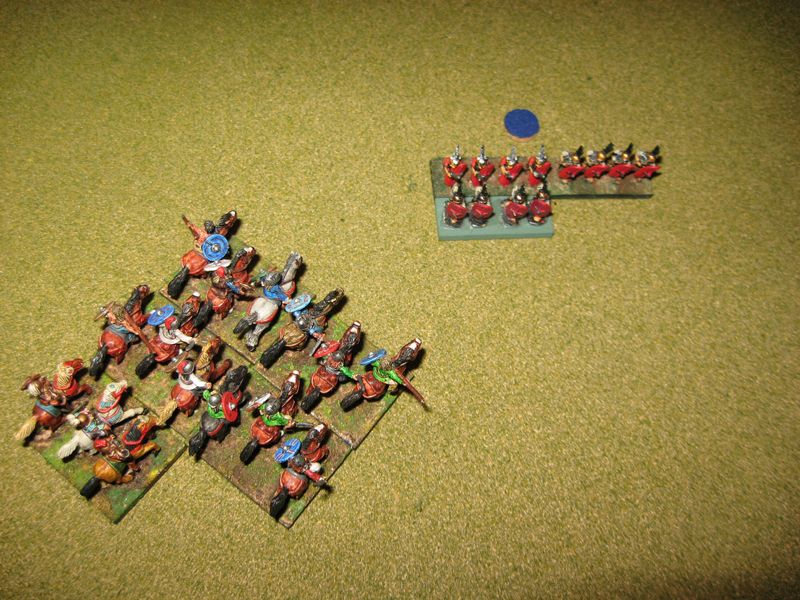
Below is the end of the charge.
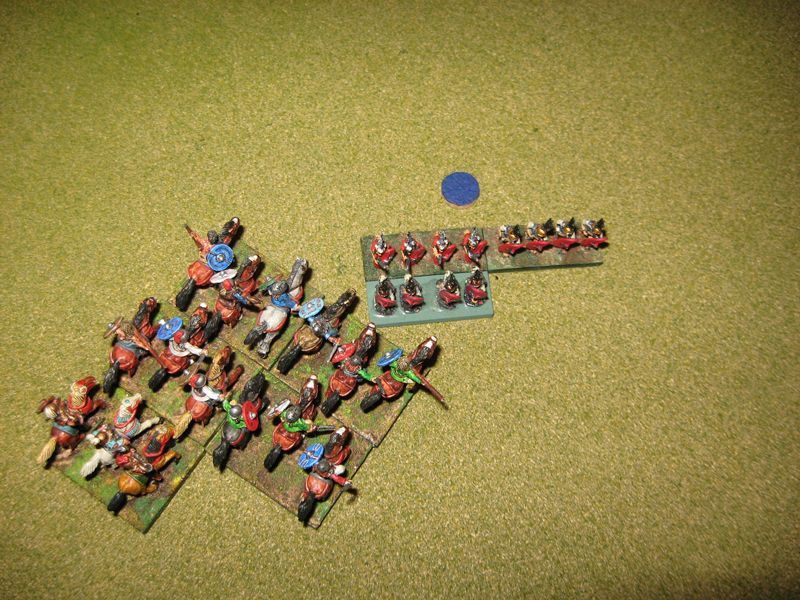
In the maneuver phase the cavalry conform to the routers as below.
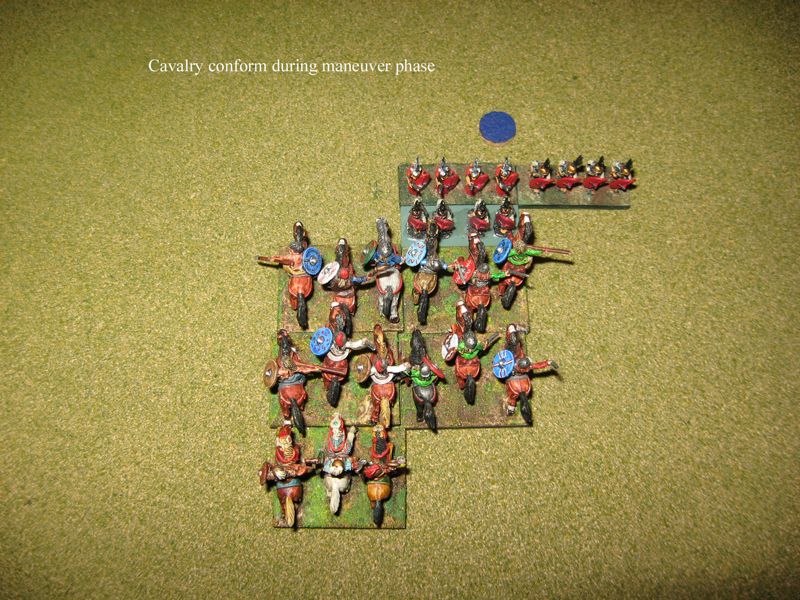
Since there can be no combat, the HF in the JAP now evade per rules on page
67. They shift 1 base width to their left and roll a VMD since they are in contact and perform their move as shown below
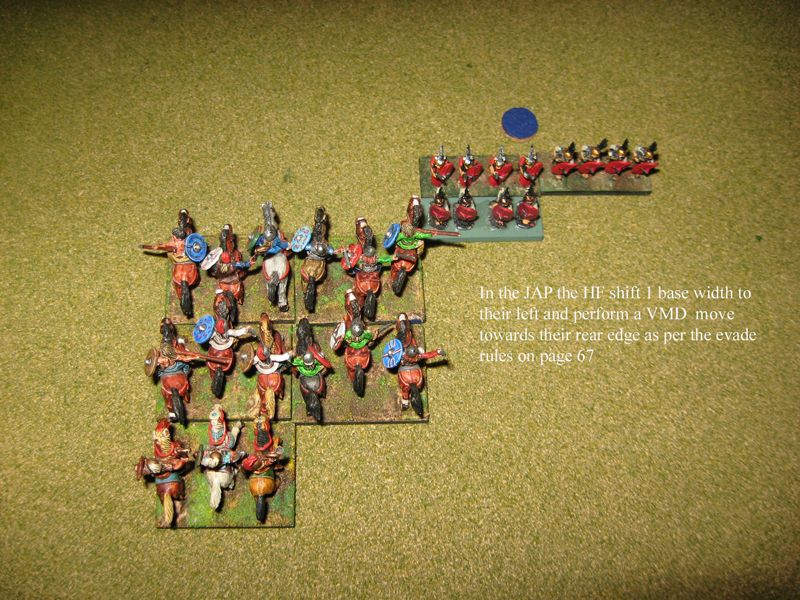
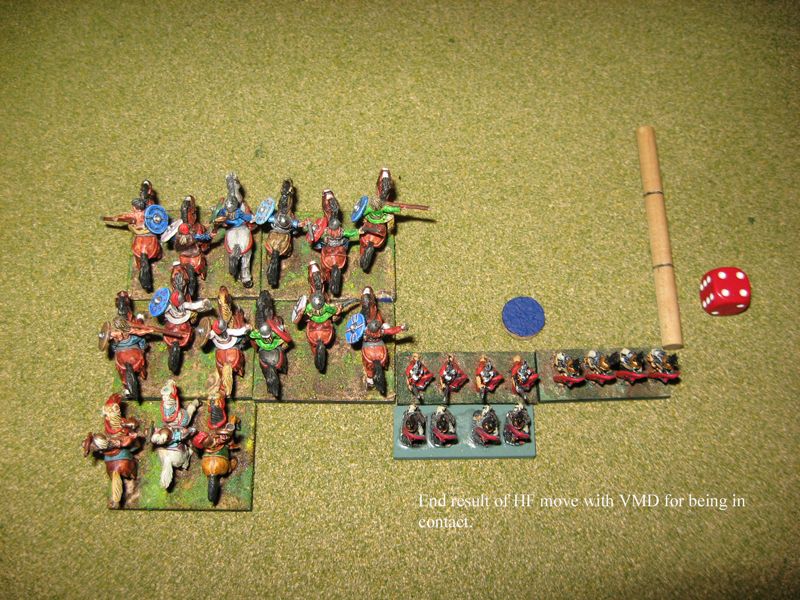
The only option left for the cavalry is to wheel to pursue.
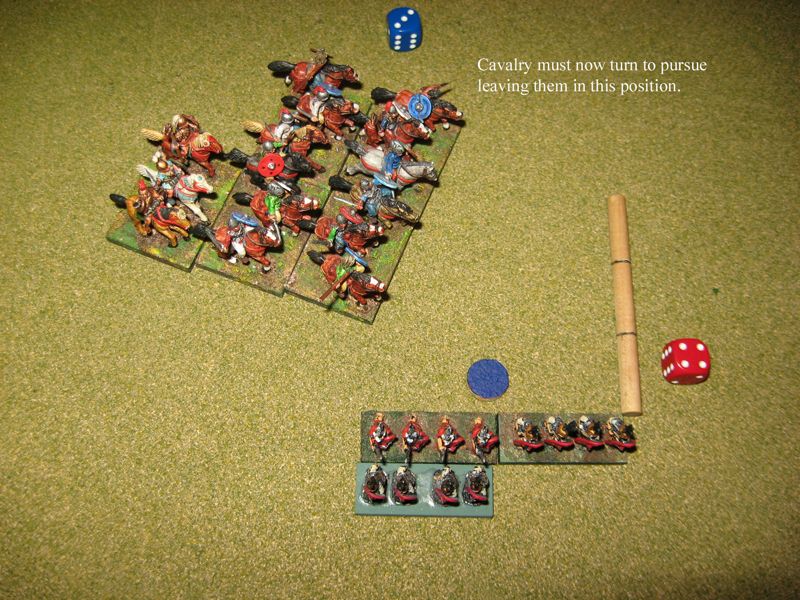
In the above situation the cavalry are actually worse off then when they started. Given the mentioned game mechanics it looks like the cavalry missed the HF and moved past them and now they must turn around to try to contact them again. I don't think this is a good representation of what should happen.
My big question is, is can the HF who are now in contact frontal contact still rout? I would like to think that the rules for evading don't allow a BG to evade if they are in contact to their front such as this example. I think the evade rules are meant to avoid contact.
Can someone shed some light on this type of situation for me?
Thanks
Brian
Posted: Sun Nov 09, 2008 7:42 pm
by jre
A broken BG routs directly away from an enemy in contact, so they would turn back in the direction they came. If the cavalry stays in contact the HF would lose a base and keep running away, rather than towards their edge.
José
Posted: Sun Nov 09, 2008 9:25 pm
by david53
jre wrote:A broken BG routs directly away from an enemy in contact, so they would turn back in the direction they came. If the cavalry stays in contact the HF would lose a base and keep running away, rather than towards their edge.
José
I too thought a Broken unit charged would automaticly move away from the charging BG in the direction charged, hope this makes sense.
Dave
Posted: Sun Nov 09, 2008 10:33 pm
by BrianC
david53 wrote:jre wrote:A broken BG routs directly away from an enemy in contact, so they would turn back in the direction they came. If the cavalry stays in contact the HF would lose a base and keep running away, rather than towards their edge.
José
I too thought a Broken unit charged would automaticly move away from the charging BG in the direction charged, hope this makes sense.
Dave
Hi Guys,
Thanks for the fast replies. Logically it does make sense that it would move directly away from a threat it is now in contact with. But I could not find anywhere in the rules that covered this situation, all it said was that a routing BG must move as evaders do to not contact enemy BGs etc. But after I went through the above exercise, I thought the results seemed a little silly. So Any contact with a fresh enemy in this way is treated as an initial rout away from the enemy in question.
Thanks again
Brian
Posted: Sun Nov 09, 2008 11:05 pm
by SirGarnet
It is much simpler than you think. You don't charge the routers - you move to contact them to pursue them or better yet move to cut off their rout. A routing BG that cannot bypass enemy in its path using the mechanics on p67 is destroyed (p108 bullet 1). They can contract their frontage one base width to bypass you, so if in your manoeuvre phase you get any part of your cavalry in front of their left-hand file (on the right of the photo) they can't bypass you and are lost when they are unable to rout in the JAP.
Posted: Sun Nov 09, 2008 11:18 pm
by jre
You can charge broken units, and actually it is a good mission for LH and LF once the lines are engaged and there is little skirmishing to be done. You charge, conform, and nothing happens till the joint action phase, when the broken units rout away (p. 107, routers in contact with the enemy). If the pursuer keeps in contact, you kill one base, and what is more important, you make sure there will not be any rally if your troops are within 6 MU.
Blocking the rout is faster, but harder to position accurately.
You cannot simply move in contact with the enemy, even if they are broken, except in one particular case, so charging is the best way.
José
Posted: Sun Nov 09, 2008 11:59 pm
by BrianC
MikeK wrote:It is much simpler than you think. You don't charge the routers - you move to contact them to pursue them or better yet move to cut off their rout. A routing BG that cannot bypass enemy in its path using the mechanics on p67 is destroyed (p108 bullet 1). They can contract their frontage one base width to bypass you, so if in your manoeuvre phase you get any part of your cavalry in front of their left-hand file (on the right of the photo) they can't bypass you and are lost when they are unable to rout in the JAP.
Actually blocking the path probably would have been better if planned in advance. In another thread in routing I was told that a routing BG must move directly towards its edge with no wheeling allowed. So all you need to do is block 2 files and the routing BG is destroyed as it cannot wheel to help it bypass, it can only shift over 1 base width.
In this case there were no commanders near by so I could have left the routers to rout off the board and still receive the attrition points, but I was curious as to what the game logic was as I am sure this will come up in future games where the routers are closer to the main line and commanders. I am seeing how much havoc even 1 BG in behind your opponents line can cause.
Brian
Posted: Mon Nov 10, 2008 11:40 am
by shall
The rules encourage the use of MTD troops to wipe out enemy. I find I use LH for this often. Good to see others doing this - especailly useful for getting rid of high grade troops who may otherwise rally.

2 RULES MATTER:
1. If you
block their path so they cannot get past under the evade options they are removed (see bottom right of page 100). This is often the best way to kill them off - consider them dispersed beyond recovery as they run in all directions.
2. If you
contact routers (and you can charge them), you do not fight any melee but immediately create a routing BG with pursuers. There is no fight nor any need to confrom. See page 107 on routers - "broken troop with enemy in contact at the beginning of thie phase (JAP) more dirctly away from the enemy in contact...". So with this rule you bounce them away in a certain direction then pursue them and take a bse of if you keep in contact.
Si
Posted: Mon Nov 10, 2008 2:58 pm
by BrianC
shall wrote:The rules encourage the use of MTD troops to wipe out enemy. I find I use LH for this often. Good to see others doing this - especailly useful for getting rid of high grade troops who may otherwise rally.
2 RULES MATTER:
1. If you
block their path so they cannot get past under the evade options they are removed (see bottom right of page 100). This is often the best way to kill them off - consider them dispersed beyond recovery as they run in all directions.
2. If you
contact routers (and you can charge them), you do not fight any melee but immediately create a routing BG with pursuers. There is no fight nor any need to confrom. See page 107 on routers - "broken troop with enemy in contact at the beginning of thie phase (JAP) more dirctly away from the enemy in contact...". So with this rule you bounce them away in a certain direction then pursue them and take a bse of if you keep in contact.
Si
Hi Si,
Thanks for the info above, extremely helpful. I knew that there was no combat but I assumed that you still conformed in the maneuver phase. But to be honest I like that you don't because it should be the routers who conform to the chargers and good order troops rather than the other way around. And by that I mean if there is fresh armoured cavalry charging routers from left to right, would the routers not try to evade the new threat rather than continue on their merry way? I like it.
And I can see the power in pursuing good quality troops. You basically force them off the table. The downside is that what ever BG is pursuing could be out of the battle but if its LH or LF this could be their main job. And if you can herd 2+ BGs off at the same time even better.
Thanks again,
Brian
Posted: Mon Nov 10, 2008 4:55 pm
by shall
And I can see the power in pursuing good quality troops. You basically force them off the table. The downside is that what ever BG is pursuing could be out of the battle but if its LH or LF this could be their main job. And if you can herd 2+ BGs off at the same time even better.
Exactly. The rules are set up to ecnourage a realistic use of skirmishers that rarely comes out in rules : to pursue and wipe out demoralised enemy troops before they have a chance to regroup. LH especially are excellent at finishing a job well done by their heavies.
Si