Page 1 of 1
Artillery Limber/unlimber and Fire
Posted: Sun Mar 25, 2012 7:10 pm
by david53
Hi There
Tried looking for it today in the game but could'nt find were it says
a. artillery can move and then unlimber
b. artillery can limber and move and not unlimber till next go
Dave
Re: Artillery Limber/unlimber and Fire
Posted: Sun Mar 25, 2012 8:17 pm
by hazelbark
CRT and Formation change.
Would have been nice to be easier to find. But once you know....
Re: Artillery Limber/unlimber and Fire
Posted: Mon Mar 26, 2012 6:42 am
by david53
So not very bright me but is this whats ment:
You move limbered artillery 6mu or 10mu and then pass a CMT to unlimber? looking at the CMT chart not seeing the words I would need?

Re: Artillery Limber/unlimber and Fire
Posted: Mon Mar 26, 2012 8:00 am
by Chasseur
Hi,
Moving artillery is one move. It is a simple move (if using combination of forward move and wheeling).
Unlimbering is one move. Also a simple move.
Normally you only do one or the other in a turn.
However, if you moved the limbered artillery and stayed more than 6MU from enemy units, you can try to unlimber as a second move that turn. But only if the Artillery's Division Commander has a spare Command Point (CP). Then if you spend the CP you get to attempt a second move (this is toward the bottom of the CMT). If you pass the test, then you can unlimber the artillery as a second move.
Similarly you can limber as your first "move" and then use a CP to attempt to take it somewhere (as your second move that turn) as long as you are more than 6MU from any opposing units and successfully pass the CMT.
If the Artillery is unlimbered when the Firing phase occurs (or defensive fire in the Assault phase), then it can fire at a valid target. It does not matter how many turns ago that it unlimbered. If it is unlimbered it can fire. If it is limbered it cannot.
Remember that firing is before moving, so if you unlimber in your turn, you won't have a chance to fire until the next firing phase, which will be in your opponent's upcoming turn.
Hope that clears it up.
Cheers,
John Shaw
Re: Artillery Limber/unlimber and Fire
Posted: Mon Mar 26, 2012 9:45 am
by david53
It does thank you.
Dave
Re: Artillery Limber/unlimber and Fire
Posted: Mon Mar 26, 2012 11:07 am
by CLAVDIVS
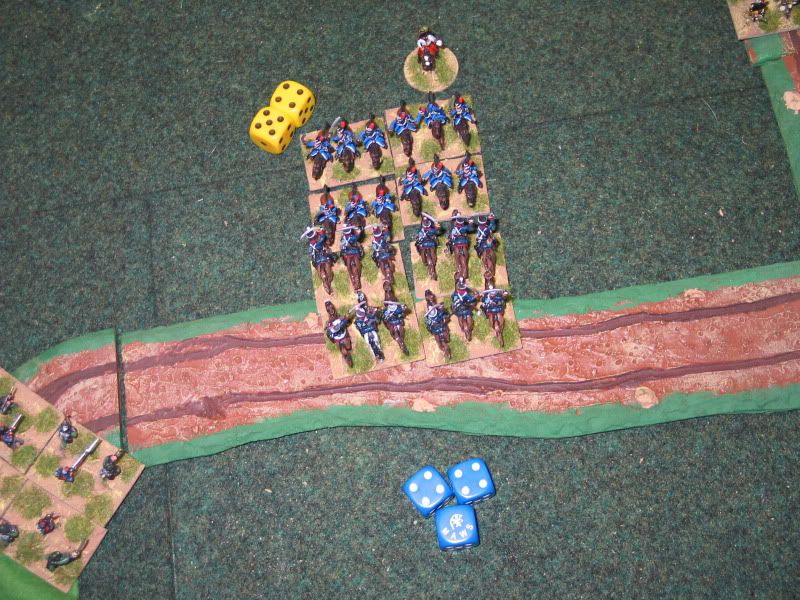
In this photo the yellow dice unit assulted in the assult phase yesterday we could not work out what happens next? do both units retire and drop 1 cohesion to disordered?
Re: Artillery Limber/unlimber and Fire
Posted: Mon Mar 26, 2012 1:29 pm
by Chasseur
Hi,
1. First you apply any Cohesion losses. (I assume the swan dice is a 1?).
Both sides scored 2 hits which result in 1 Cohesion loss for each (See "Effects of Combat Hits" table).
So both Cavalry units are now Disordered.
2. Then you work line-by-line down through the "Combat Resolution" table:
Neither is Broken, so ignore those results.
Neither is Wavering, so ignore those results.
The Non-active player's Cavalry is Disordered AND in contact, so they retire. See the Outcome Moves table, on the line Cavalry "In contact with enemy".
Look under the "Disrupted" column (which should actually read "Disordered") and the Non-active player's Cavalry must retire D6 + 2. The Active player's cavalry halt and cannot pursue (this is on the same line of the Outcome Moves table).
3. The next line on the Combat resolution table reads "Active player Retires units in contact AND Disordered". But because there is no unit in contact with the Active player's Cavalry any more, the Active player's cavalry stays where it is. It has won the ground and seen the other Cavalry off.
4. At the end of the Combat phase, both Cavalry units become Spent, because they have taken at least 1 hit in combat (see page 69).
Hope this clears it up. It may seem a lot at first reading, but once you have done it a few times it is really quick.
What it also means is that in the event of a combat where both sides end up on the same Cohesion level, the Non-active player will retire, so it favours the assaulter. Just as well, because defensive fire will often stop an assault from happening in the first place.
Cheers,
John Shaw
Re: Artillery Limber/unlimber and Fire
Posted: Mon Mar 26, 2012 2:57 pm
by CLAVDIVS
Hi John,
NO the MAWS is a 6 on the dice so the non-active player as 3 hits blue dice and the active player as done only 2 hits yellow dice this is in the assault phase
Re: Artillery Limber/unlimber and Fire
Posted: Mon Mar 26, 2012 3:06 pm
by CLAVDIVS
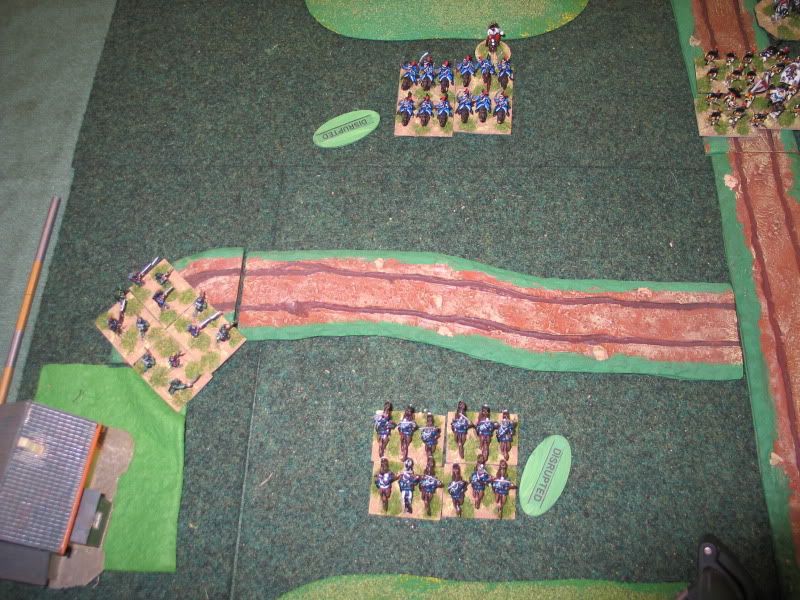
So this is not the outcome the unit with the ADC should have stopped where it was?
Re: Artillery Limber/unlimber and Fire
Posted: Mon Mar 26, 2012 6:05 pm
by BrettPT
The attacker yellow dice unit should not have retired (attackers win draws), and in fact should have pursued, unless it decided to try not to and passed a CMT. (disordered cavalry CMT not to pursue).
Cheers
Brett
Re: Artillery Limber/unlimber and Fire
Posted: Mon Mar 26, 2012 9:07 pm
by Chasseur
Hi.
1 .
CLAVDIVS wrote:Hi John,
NO the MAWS is a 6 on the dice so the non-active player as 3 hits blue dice and the active player as done only 2 hits yellow dice this is in the assault phase
Both 2 hits and 3 hits only cause 1 Cohesion loss, so they both end up Disordered as you did.
2. You need to remove a base from each unit at the end of the combat round as they are both Spent.
3. Brett, My immediate reaction was the same as yours - that the yellow dice unit will pursue unless they choose not to (and pass a CMT). But the Combat Resolution table has "Non-active player: Retires units in contact and
Disordered. Active player: Halt - No pursuit". This is a change from the play test version, where the "Active player: Halt - No pursuit" wording did not exists.
TERRY, is this a deliberate change? Or is this wording that crept in by mistake? This new wording means that you can never pursue Disordered troops

Regards,
John Shaw
Re: Artillery Limber/unlimber and Fire
Posted: Mon Mar 26, 2012 10:35 pm
by BrettPT
Chasseur wrote:3. Brett, My immediate reaction was the same as yours - that the yellow dice unit will pursue unless they choose not to (and pass a CMT). But the Combat Resolution table has "Non-active player: Retires units in contact and Disordered. Active player: Halt - No pursuit". This is a change from the play test version, where the "Active player: Halt - No pursuit" wording did not exists.
Nice spot, sorry I must rember to read the rules before posting based on assumptions from the play-test versions

The rules do indeed make it clear that there is no pursuit against opponents who retire disordered (there is an exception for disordered cavalry passing through squares).
Cheers
Brett
Re: Artillery Limber/unlimber and Fire
Posted: Tue Mar 27, 2012 3:20 am
by hazelbark
Chasseur wrote:Moving artillery is one move. It is a simple move (if using combination of forward move and wheeling).
Unlimbering is one move. Also a simple move.
Normally you only do one or the other in a turn.
However, if you moved the limbered artillery and stayed more than 6MU from enemy units, you can try to unlimber as a second move that turn. But only if the Artillery's Division Commander has a spare Command Point (CP). Then if you spend the CP you get to attempt a second move (this is toward the bottom of the CMT). If you pass the test, then you can unlimber the artillery as a second move.
I see what you are saying. But is a formation change a move? It is an action during the movement phase, but is it meant to be allowed in this way? Not trying to be pedantic, but other english rules authors may argue such.
I see lots of references to "move or formation change". Or being the concered point.
p 37 top left starts the 2nd move talk I think.
Is there anything clearer (like an author posting here?) that says the 2nd move can be a formation change?
Re: Artillery Limber/unlimber and Fire
Posted: Tue Mar 27, 2012 7:28 am
by Chasseur
Hi,
A formation change is counted as a "move". For example, p.38 last dot point "A unit can turn to face any direction but otherwise remain stationary and in the same formation."
Also THE COMPLEX MOVE TEST (CMT) chart on the Quick Reference Sheet "A change of formation or facing while otherwise stationary".
As you suggest, it may have been clearer if the word "Activity" or "Maneouvre" was used for the collective of movement, change of formation and change of facing in the rulebook.
The 2nd move can be any activity, whether that be movement, change of facing or change of formation.
But if the 2nd move type is classed as a Complex move, then you may have to spend 2 Command Points and take 2 CMTs.
The first CP is spent to attempt the 2nd move. If you fail, you still expend the CP and the unit does not do a second activity. You stop testing there.
If you passed, then you carry out a simple activity straight away with that unit. If instead you want your second activity to be complex, then you must expend a CP and then perform the appropriate Complex Move Test.
Cheers,
John Shaw
Re: Artillery Limber/unlimber and Fire
Posted: Tue Mar 27, 2012 7:50 am
by Chasseur
Hi Brett,
Nice spot, sorry I must rember to read the rules before posting based on assumptions from the play-test versions
Me too. I was reading the rules over the weekend and realised I had explained a couple of minor things wrong to a new player on Friday night. At least the mistakes were in his favour, so I don't feel so bad. And I have contacted him so he doesn't keep the wrong ruling in mind.
Now all I have to do is keep remembering to pay a CP if the Corps Commander wants to move voluntarily.
Cheers,
John Shaw
Re: Artillery Limber/unlimber and Fire
Posted: Tue Mar 27, 2012 7:44 pm
by hazelbark
Chasseur wrote:
A formation change is counted as a "move". For example, p.38 last dot point "A unit can turn to face any direction but otherwise remain stationary and in the same formation."
Also THE COMPLEX MOVE TEST (CMT) chart on the Quick Reference Sheet "A change of formation or facing while otherwise stationary".
As you suggest, it may have been clearer if the word "Activity" or "Maneouvre" was used for the collective of movement, change of formation and change of facing in the rulebook.
I see what you are saying but that section doesn't seem definiative to me especially as it is under a headline that says "all other changes of formation and facing have the following restrictions:"
Page 36 last sentence. "Some moves or changes in formation may..." That implies they are two separate things.
Again I don't care which way. But in the "other FOG books" something described as a term (advance) is different than others. Now other FOG books aren't precedent. But the argument there is the word means something specific. Here it would mean specific and general depending. Would like to get a standard from the author because either way is pretty important.
If allowed that means I can move up with infantry and if i CMT i get a formation change like to square. Or the reverse. Come out of square and rush somewhere.
Or advance and turn into skirmisher or the inverse.
It increases flexiblity a lot if permitted.
Re: Artillery Limber/unlimber and Fire
Posted: Fri Mar 30, 2012 7:48 pm
by hazelbark
Nudge Author.
Can the 2nd move be a formation change?
Re: Artillery Limber/unlimber and Fire
Posted: Sat Mar 31, 2012 9:57 am
by terrys
The 2nd move can be of any type at all:- Formation change/unlimber/cross an obstacle etc.
To make a 2nd move both must be entirely outside 6MU of the enemy
The 2nd move is always complex and will require a CP to be used.
If the move is also complex, 2CMTs must be passed (and 2 CPs used).
Re: Artillery Limber/unlimber and Fire
Posted: Sun Apr 01, 2012 1:49 am
by hazelbark
terrys wrote:The 2nd move can be of any type at all:- Formation change/unlimber/cross an obstacle etc.
To make a 2nd move both must be entirely outside 6MU of the enemy
The 2nd move is always complex and will require a CP to be used.
If the move is also complex, 2CMTs must be passed (and 2 CPs used).
Merci.
