Page 1 of 1
Lurkio - New greens - Romano Byzantine
Posted: Fri Mar 04, 2011 10:56 am
by list_lurker
First pics of the greens for the Early Byzantine infantry
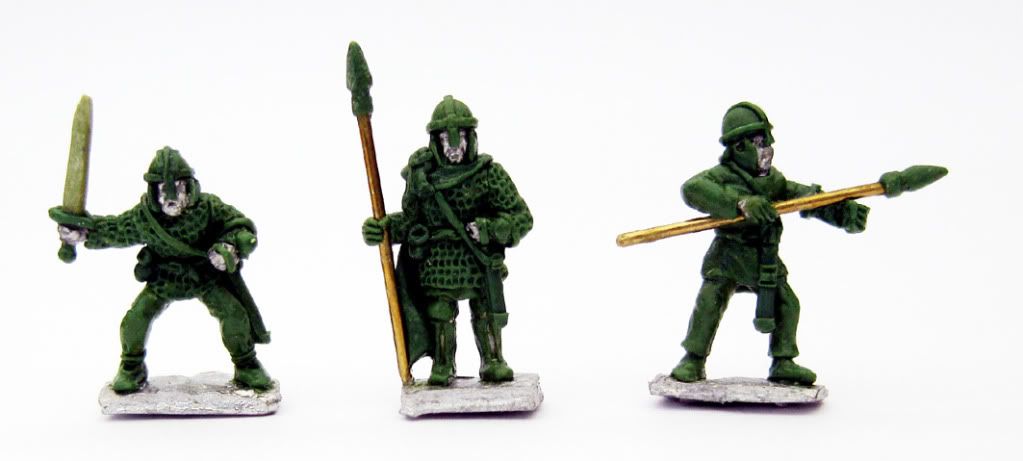
Slingers
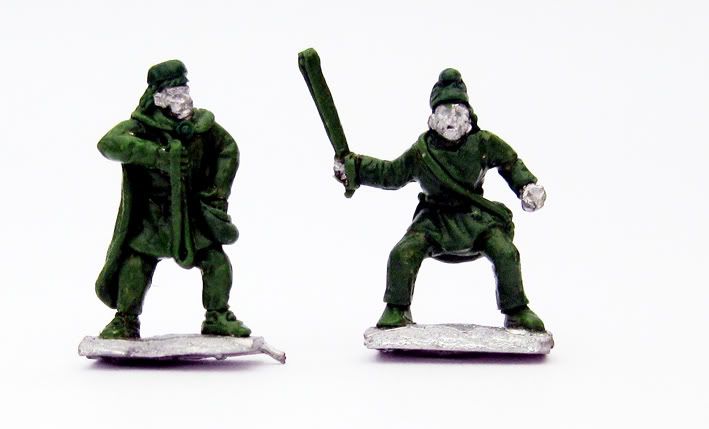
Archers
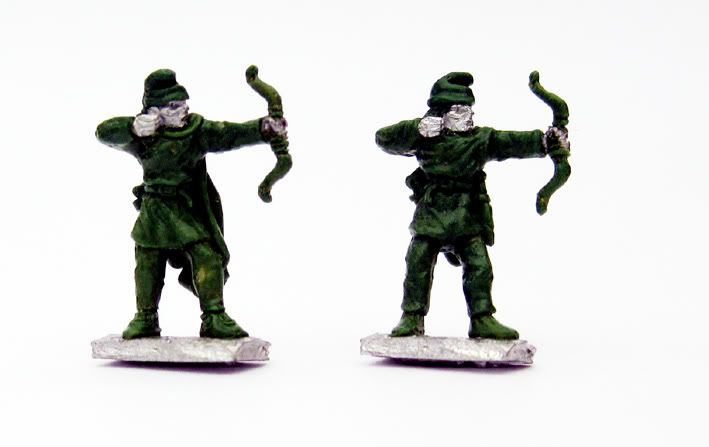
thanks
Simon
Posted: Fri Mar 04, 2011 12:06 pm
by Delbruck
Simon
Are you going back to the traditional method of casting cavalry, seperate horse and rider? Forgive me, but I can't say I was exactly pleased with break at the waist Sassanids, especially the lancers. Perhaps a good idea in theory, but difficult to put into practice. In any event, one of the reasons for splitting at the waist was so horse archers wouldn't be shooting to the side.
For horse archers, if you must split at the waist I prefer a completely seperate horse (like Khurasan). But Essex seems to have a hair amount of sucess with their one piece horse archer castings (for shooting to the front). Horse archerss not shooting cound be cast normally (seperate horse & rider).
Essex and Battle Honous also cast figures shooting at about a 3/4 pose with good results. A third alternative for armored horse archers is to cast them with a mixture of hand weapons (perhaps including some holding bow in left hand but not shooting).
Despite above comments, I look forward to your future releses

Hal
Posted: Fri Mar 04, 2011 12:18 pm
by list_lurker
Hi Hal,
thanks for the comments. The reason that we did split at the waist was to give a greater variety of poses and body swaps. We could do a one piece casting for riders and cavalry. It would mean more economic production moulds. But there wouldn't be the variety... pros and cons. You are the first person to not like the split that I have spoken to.
What exactly did you find problematic?
Simon
Posted: Sun Mar 06, 2011 10:41 pm
by Jilu
Might be good to make 'open' hands as Mirliton does and make separte swords so we can add spears or swords or banners.
Posted: Sun Mar 06, 2011 11:50 pm
by deadtorius
My guess would be the problem that affects all lead figs in multiple parts, the two molds will shrink at different rates so although sculpted to fit over time the finished product does not fit the way it was intended with odd gaps or not a good fit. I find some thicker super glue will fill the gaps and holds the parts well.
Posted: Mon Mar 07, 2011 9:15 am
by list_lurker
I guess the question is whether people actually want more options/variety in 15mm? or just simple castings?
'open' hands
personally I don't like open hands. The BAU casualty rate is far too high. If I've got to do some work to glue a spear in then I would like to only do this once. Drilling is a PITA I agree, so a small pain upfront compared to years of running repairs
Posted: Mon Mar 07, 2011 3:13 pm
by Strategos69
list_lurker wrote:I guess the question is whether people actually want more options/variety in 15mm? or just simple castings?
Actually that question deserves a poll (why not creating one here?). I have seen two types of "customers". There are those who do play often and miniatures are more like pieces in a board and thus they prefer the ones that are easier to transport, that do not break in parts and easier to paint. In fact I have seen some people advocating for embeded shields on the miniatures. There are others (I include myself) who prefer having more options of customization, who might use the miniatures for dioramas or take miniatures from different times to use them as proxies of non available ones. For example, the fact that Xyston produces miniatures without both shields and spears has let me to put my infantrymen as Campanian cavalrymen.
Posted: Mon Mar 07, 2011 3:22 pm
by list_lurker
Posted: Mon Mar 07, 2011 3:50 pm
by Strategos69
I am voting!

Posted: Mon Mar 07, 2011 5:18 pm
by Delbruck
Hi Hal,
thanks for the comments. The reason that we did split at the waist was to give a greater variety of poses and body swaps. We could do a one piece casting for riders and cavalry. It would mean more economic production moulds. But there wouldn't be the variety... pros and cons. You are the first person to not like the split that I have spoken to.
What exactly did you find problematic?
Simon
Simon,
Ok, to the nuts and bolts. My main problem is with the catapharcts. These have the arms very close to the body. This causes a few problems:
1) One of the two figures has his left hand BELOW the breakpoint of the figure making joining difficult.
2) The closeness of the left and right arms make the upper body very small, making a pin vice more difficult to use (as there isn't much to hold on to).
3) In addition, the small upper body (to me) makes the whole figure look out of proportion.
From a wargamers perpective I see the advantages of an armored horse archer figure split at the waist, but I am not sure about lancers.
Hal
Posted: Mon Mar 07, 2011 5:37 pm
by Delbruck
BTW,
There are only two options listed on your poll question, but clearly there are four options for cavalry:
1) The traditional method of completely seperate horse and rider. Spear/lance may be cast onto to the figure as desired (although personally I prefer a notched hand like Xyston and some Old Glory, in orders to add a wire spear).
2) One piece casting including both horse and rider. Usually, very tricky to cast and can make the figure look one dimensinal. Again, cast spear is optional.
3) Two piece casting, with legs attached to horse and a seperate upper body.
4) Three piece casting: seperate horse, lower body, and upper body. I think I have only seen this done by Khurasan in 15mm.
All options have there advantages and disadvantages.
Hal
Posted: Tue Mar 08, 2011 12:03 am
by peteratjet
Delbruck wrote:BTW,
4) Three piece casting: seperate horse, lower body, and upper body. I think I have only seen this done by Khurasan in 15mm.
Hal
Venexia do this too. See their 1400-1700 Ottomans
Posted: Tue Mar 08, 2011 10:18 am
by list_lurker
Thanks for taking the time to reply Hal. Its good to get constructive criticism even if it is hard to hear!

1) One of the two figures has his left hand BELOW the breakpoint of the figure making joining difficult.
Ok I'll take this a bug - and will look to correct going forward
2) The closeness of the left and right arms make the upper body very small, making a pin vice more difficult to use (as there isn't much to hold on to).
The arms being close was a deliberate choice to facilitate a better point of contact for the lance and also make drilling a little easier by not having a hand 'out on a limb'. As it turns out the metal that we used for casting was quite hard, and available detail much finer, so might have been able to get away with it. Which is why some of the new stuff does have integral weaponry.
3) In addition, the small upper body (to me) makes the whole figure look out of proportion.
OK I'll take a look at this
1) The traditional method of completely separate horse and rider. Spear/lance may be cast onto to the figure as desired (although personally I prefer a notched hand like Xyston and some Old Glory, in orders to add a wire spear).
2) One piece casting including both horse and rider. Usually, very tricky to cast and can make the figure look one dimensional. Again, cast spear is optional.
3) Two piece casting, with legs attached to horse and a separate upper body.
4) Three piece casting: separate horse, lower body, and upper body. I think I have only seen this done by Khurasan in 15mm.
1 Notched hand vs drilled. I guess you takes your money... I think that drilling might be more work upfront, but does make for a sturdier bond. Also notched hand always lose the end of the fingers, as the mould deteriorates leaving a much shallower ‘cup’ (bad bond). Separate rider does have more casting problems as invariably the legs will be in a different plane that the arms.
2 Seems to be popular in the poll so far. Maybe I’m missing the point how much work people want to invest? Maybe for 15mm folks do just want functional ‘tokens’? Leave the modelling to the 28mm crowd
3 Obviously got its problems!
4 3 piece casting for 15mm, even I feel that is too much work! Are there positive advantage to this?
Posted: Tue Mar 08, 2011 12:10 pm
by Strategos69
list_lurker wrote:
1 Notched hand vs drilled. I guess you takes your money... I think that drilling might be more work upfront, but does make for a sturdier bond. Also notched hand always lose the end of the fingers, as the mould deteriorates leaving a much shallower ‘cup’ (bad bond). Separate rider does have more casting problems as invariably the legs will be in a different plane that the arms.
2 Seems to be popular in the poll so far. Maybe I’m missing the point how much work people want to invest? Maybe for 15mm folks do just want functional ‘tokens’? Leave the modelling to the 28mm crowd
3 Obviously got its problems!
4 3 piece casting for 15mm, even I feel that is too much work! Are there positive advantage to this?
It seems that the poll is reflecting a quite divided opinion. I would say that it is the trade off between getting very good looking miniatures and a fast ready to play army. I missed in that poll some people's opinion why they prefer simple pose static miniatures.
Regarding the question, my miniatures are 99,9% of the time on the shelf so I prefer nice looking and some variety within uniformity of an army. Thus I usually combine different manufacturers to get that feeling, but I do not feel that as necessary when there are options of customization. The good thing about miniatures with shields detached, for example, is that you can try more dinamic poses with slight changes onto the miniatures. In fact, as I have seen recently, it seems that 15mm for World War II might move towards hard plastic miniatures, which offer many possibilities of conversion and the simple single pose some other players prefer. Not as nice as metal, but interesting.
http://theplasticsoldiercompany.co.uk/i ... ath=1_2_19
Posted: Tue Mar 08, 2011 12:42 pm
by list_lurker
It wouldn't surprise me if we see some 15mm ancients in plastic before too long. But I hope they don't just downscale the models from 28mm casting, otherwise we'll end up with figures like those PSC 15mm, who look a bit like a bar of soap after its been left in the water for too long!

What would surprise me if it would be just for anything other than Romans and Gauls. Perhaps the circle will be complete after , what 40 years?, and we can go back to using plasticene and banana oil for convesions
Posted: Tue Mar 08, 2011 4:58 pm
by Delbruck
1 Notched hand vs drilled. I guess you takes your money... I think that drilling might be more work upfront, but does make for a sturdier bond. Also notched hand always lose the end of the fingers, as the mould deteriorates leaving a much shallower ‘cup’ (bad bond). Separate rider does have more casting problems as invariably the legs will be in a different plane that the arms.
By notched, I am referring to the small guide at the top of the hand for ease of drilling. I believe you have this.
As far as I can see there are three methods for attaching spears/lances/pikes:
1. cast on (used by the majority)
2. open hand (with added cast or wire spear)
3. Closed hand, usually notched at the top for drilling.
I prefer drilling. I usually replace cast on spears. But I know many who hate to drill.
Open hand castings have two problems. The hold on the spear isn't that good, and the hand needs to be very well formed in order to accept a spear. This is usually ok in 28mm but problematic in 15mm.
Hal
Posted: Tue Mar 08, 2011 5:17 pm
by Delbruck
3 piece casting for 15mm, even I feel that is too much work! Are there positive advantage to this?
Only for horse archers.
But if one was already doing seperate horses perhaps it may not be that much extra work. Khurasan does shooting riders split at the waist, and loading riders (middle figure) as single piece, all with seperate horses.
Perhaps one of the keys to designing figures split at the waist is to make sure the area of the joint is kept as simple as possible.
