@Rudankort's comments
Rudankort wrote:I think that the ability to revive your units between the scens is good for casual players. For hard-core veterans we may need the ability to switch that off. But a casual player will be punished enough for losing elite unit by the fact that a) it is removed from action till the end of the scen, b) he will need to buy costly elite replacements for it to bring it from strength 0 to strength 10.
That sounds like a fair assessment. My only request is that this option be a campaign 'setting' and not a 'toggle'.
In the same way that once you start a campaign, you cannot decide to turn supply, weather, fog ON or OFF in the middle of a campaign scenario, this option should also exist.
Rudankort wrote:That sounds like artillery is useless in its current incarnation?
They are all but useless, literally. Like one step up from 'useless' in that they are extraordinarily inefficient. I won't say more here, because you saw and responded on this in the Suppression Artillery topic.
Rudankort wrote:Actually, they should be immune. If you have seen them ambused, and it was not because a pioneer unit walked into previously unspotted enemy, it sounds like a bug.
After further playtesting, I apparently was wrong, they are immune. I got confused because I was using a pioneer in his half track transport to attack, and that attack was susceptible to AMBUSH. However, I also found upon playtesting that pioneers are right down there with artillery in being near useless. So what I did was give myself 10,000 prestige, and I bought nothing but pioneer infantry.
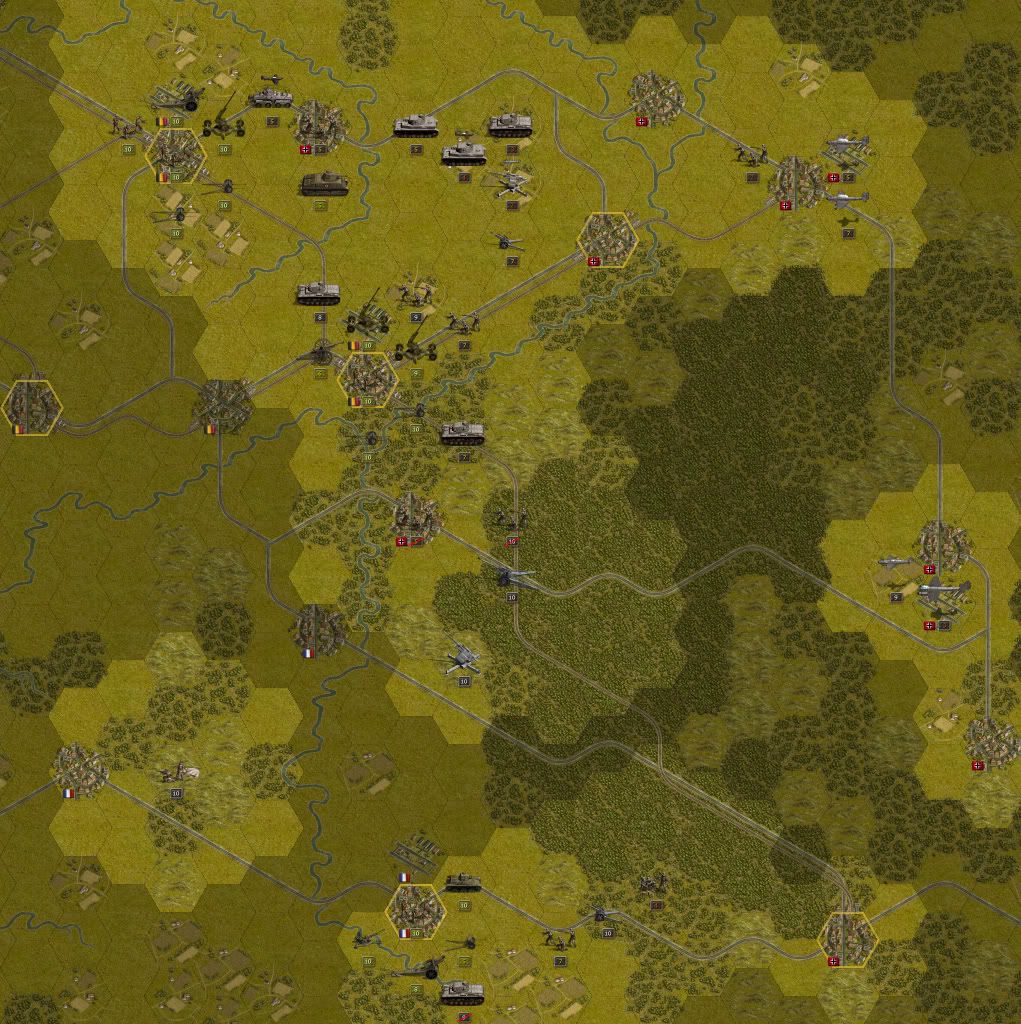
This is how far I got in Norway before I ran out of prestige.
Northern front:
http://img101.imageshack.us/img101/5889/northg.jpg
Southern front:
http://img291.imageshack.us/img291/4112/southn.jpg
That's what 10k (Ten Thousand) prestige worth of pioneers looks like after 13 turns of Norway. The Norway example is especially important, because it almost entirely consists of combat suited for engineer duty: fighting entrenched infantry in difficult terrain that lacks artillery/tank/air support.
Part of the problem is evident in the South picture. 4 to 4 combat odds. A unit that costs 490+transport vs a unit that costs 30, and they have even odds in the battle prediction, which with bad RNG can actually be worse for me. So ask yourself, does the 1 pioneer have enough
ammunition, time, and plain RNG luck to fight 10+ times as many infantry units?
Rudankort wrote:So, looks like AAs are not all that weak in the game after all?
That is a very dangerous sentiment. I would interpret it more like because AA guns are so strong, they are incredibly weak.
The AI likes AA guns. AA guns shred aircraft, but are near useless against ground assault. I don't buy an air heavy core (and save a mountain of prestige in doing so), but the AI still has lots and lots of AA guns.
And it isn't necessarily that AA guns are so 'strong' is the problem, it's that aircraft are just so damn
expensive. Basic replacements on an air unit, mid scenario, are crippling. Elite replacements, well you might as well just give up because you've shot your own foot. I know for a fact I like to exaggerate to get my point across, but this is one time where I'm actually not exaggerating.

45 prestige to bring a 4 to a 10. If that fighter had significant experience, he's now crippled, but hey at least it was cheaper than a fresh fighter for 300.
180 prestige to bring it to an elite 10.
One hundred eighty. That's a PZ IVD and a half! Or I accept my crippled air unit cannot contribute to the remainder of the scenario and is only good for reducing entrenchment. Say if it was a 3 star or higher, this is a lose/lose decision.
Rudankort wrote:It is an interesting observation, I did not expect that such playing style would have a benefit, considering that the number of core slots is limited and it is much cheaper to replace a unit than to buy a new one (and it would even preserve 30% of experience if you give it green replacements). Why it is better to lose so many units (1 per turn

)?
You're right, it is cheaper to get normal replacements. "Limited core size" is a bit of a misconception though.
Say my core is limited to 20 units and I have 5 AUX units on the map.
I lose and replace 8 (including killing a core slot, replacing that slot, killing it again, replacing it again) of those 20 core units over the course of a scenario, how big was my core? On the map at any one time? 20. Actually though? It's 28. Those potential 8 may be less experienced units, but they gain massive flexibility. I can 'morph' my infantry unit into a tank if I need a tank, but more than just that, I can teleport the potential unit across to map(within deploy restrictions) to where I might really NEED a tank.
Compound this problem with the fact you cannot replace dead AUX units, I actually want to kill and replace certain expendable core units and I'm more inclined to want to preserve my irreplaceable AUX units. Why? Because if I lose a core unit, the maximum amount of units I can have on the map does not change, it's still 25. If I lose an AUX unit, I cannot put a new unit on the map after that unit dies, I'm reduced to 24. The logic is solid, but how perverse is that?
However, as in previous PG titles, the game isn't just fighting the enemy, you're fighting the clock. Also, remember all that prestige I saved by not having a large and experienced air force? Paying off huge dividends.
I have a crippled infantry unit near an enemy city.
One turn to retreat.
One turn to reinforce. Add MORE turns if I want to also bring it to 100% ammunition. Add MORE turns if I overstrength it as well.
One or two turns to get back to the front, depending how fast the rest of my units are advancing.
Absolute minimum two turns downtime. Realistic downtime is more like 4 or even 5 turns.
And that two turns is really lenient too, because it assumes you: Moved(1turn), reinforced(1turn), and then on the third turn, there was an enemy close enough for that infantry unit to walk up to and fight. If the front is moving that slow, you're probably in trouble (or fighting for something like London).
OR
I have a crippled infantry unit near an enemy city.
I suicide him, using up defensive artillery ammo, defensive unit ammo, and eat one level of entrenchment too.
In the same turn I suicide, I can buy a brand new replacement.
The following turn, my new unit is ready for action, and can engage in combat at a full 10 strength.
Potentially zero turn downtime. Realistic downtime is more like 1 or 2 turns, depending on city spacing on the map.
Why zero? I had an infantry unit attack, consume enemy ammo, and die in turn 5. I also bought his replacement on turn 5. In turn 6, that 'core slot' is a unit that is in position and ready to attack.
Think of it like this:
I have a 0 star infantry unit I give replacements to, he's done.
I lose a 0 star infantry unit. When I buy a new 0 star infantry unit he(compared to the strength of the original unit): gains full ammunition, gains full fuel, can potentially
teleport across the map to a new crisis area (following deployment restrictions), and all it costs me is some extra prestige and a reset on unit experience.
That's a $%^&ing steal.
In all the scenarios we've seen thus far, cities are more than plentiful, it's not a big deal to deploy a unit that can reach the front in one or two turns.
Considering how the AI luvs to flood the field, it's imperative that speed be an utmost priority. It's the difference between fighting a single infantry unit in a city VS two ATG, two artillery, two AA, and the infantry unit in the city. I can fight that battle and win, but it takes so much time and resources, if I fight that battle for every single city? Forget it, game over Norway style.
Plus, if I rush two infantry units in trucks adjacent to an enemy city, one will probably die, but the other is still alive and prevents unit purchasing.
As for everything else you wrote, I don't have any particular responses for what you said to boredatwork that wasn't already covered in my reply to him.
 Right now, impossible is the highest difficulty setting in the game, and I always thought that such setting should be like Nightmare in Doom - a real challenge for hardcore players. So thanks for feedback, we'll make that level more difficult.