Page 1 of 3
intercept and evaders
Posted: Fri Jan 28, 2011 1:58 am
by fatismo
Just want people opinion on how we are doing evaders and interceptions.
1. Chargers declare charge and charge direction.
2. Possible interceptors move, straight ahead up to there intercept range.
3. Evaders roll VMD but before they move we move the original chargers up to where they would contact the evaders to see if they have contacted the interceptors, including bases stepping forward past evaders that could contact interceptors.
4. If they do hit interceptors, then finish the evaders move and then move the chargers into contact with interceptors.
5. If they dont hit the interceptors, then move interceptors back to original position and finish moving evaders. Now roll VMD for the chargers, and finish their charge move.
Examle:
__HHH
LLL
_MMM
H=HF L=LF M=MF
Below M charge L, H move behind L to intercept, L evade but havn't been moved yet.
__HHH
LLL
_MMM
Having reached position of evaders M now steps to see if it would contact interceptors
__HHH
LLL_M
_MM
If M contacts H then evaders finish evade and M completes contact with H
LLL
__HHH
_MMM
Hope this makes sense
Posted: Fri Jan 28, 2011 10:05 am
by petedalby
I'm not sure that I understand your post correctly.
It appears the HF cannot intercept as they are screened by their own LF?
It might be simpler to post a photo?
This link should take you to some simple instructions on how to do that courtesy of Hammy.
viewtopic.php?t=4600
Posted: Fri Jan 28, 2011 10:32 am
by philqw78
Is it supposed to look like this?
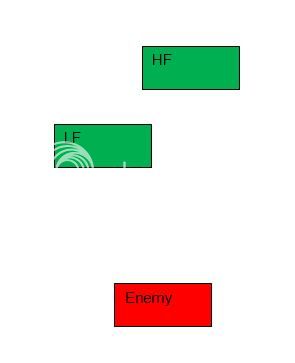
For the intercept the question would IMO depend on if the charge would reach the HF after any evade, without VMD.
Enemy declare their charge. At least one element of the enemy would step forwards if the LF stood and there was something to hit.
The HF declare their intercept. This goes as far forward as the rear of the LF. The HF move.
Next the LF evade rolling a VMD. Go through the HF and get away.
This creates the conundrum. If the HF is not in normal charge reach of the evaders the intercept could not have happened as they are not now in the path of the charge. A VMD is not rolled. So ?
If the HF are in normal charge reach, IMO, there is no problem with this intercept as they are in the path of the charge.
Posted: Fri Jan 28, 2011 12:32 pm
by Polkovnik
Surely the HF can't intercept here because they are blocked by the LF ?
Posted: Fri Jan 28, 2011 12:34 pm
by philqw78
Thats the problem where I need the rule book. Does step forward count? Perhaps not as the end position without them there is the front edge of the LF.
I put the drawing up so it looked better, easier to understand. Until the OP replies I don't even know if its a correct representation.
Posted: Fri Jan 28, 2011 6:58 pm
by zoltan
Something like this?
1. MF declares a charge on LF
2. HF decides whether or not to make an intercept charge. Because the MF "attempts to charge through the (2 MU) ZOI of a battlegroup that is not itself the subject of any charge this turn..." (p62), the HF may intercept up to the position of the LF
3. LF VMD and evade
4. MF VMD and pursue. The MF may/may not smack into the HF depending on their VMD
If the HF was further back (i.e. over 6 MU) from the MF, then the MF would not be attempting to charge through the HF's ZOI. In this case the HF would not be entitled to intercept and the MF's VMD would be irrelevant as by defintion the furthest distance the MF could go is 6 MU. As the HF are over 6 MU away, the MF would not be charging through the HF's ZOI.

Re: intercept and evaders
Posted: Fri Jan 28, 2011 7:22 pm
by gozerius
[quote="fatismo"]Just want people opinion on how we are doing evaders and interceptions.
All assumptions about whether a BG can intercept are based on whether the "potential" interceptor can move into the path of the charging BG prior to the movement of any evading BG, and if it is not itself a target of the charge. Your example seems to show a BG of HF behind a BG of LF. In such a position, it cannot cross the path of the charging BG because the path does not extend through the LF. Nor does it extend past the LF unless there is another enemy BG which could be reached by stepping forward. You cannot claim to be intercepting by moving to a position that is reachable by the charger stepping forward, if the charger would not have to step forward. Nor can you claim to be eligible to intercept based on evaders moving out of the way.
Posted: Fri Jan 28, 2011 10:31 pm
by fatismo
Thanks for photo zoltan that's exactually what im talking about. The enemy must step forward unless they are lights therefore they enter the HF intercept area
Posted: Fri Jan 28, 2011 10:39 pm
by fatismo
I would have thought you were right but as I have explained it was how it was interpreted at the last Worlds although I wasn't there 3 NZ friends were
Posted: Fri Jan 28, 2011 11:21 pm
by ShrubMiK
What gozerius said.
Fatismo, this bit doesn't really represent the actual situation:
>The enemy must step forward unless they are lights therefore they enter the HF intercept area
The rules are quite clear on when you step forward - and it must be into contact with enemy, not "into an intercept area".
So we have a temporal paradox - chargers could only step forward if an intercept occurs, and intercept can only occur if chargers step forward.
That seems a bit like arguing that we should be able to travel forward in time, becausealthough we don't know how to do it now, if we could do it we could go far enough into the future that we will reach a period when time travel has been perfected, so they can tell us how to do it

If that bit of airy hand-waving doesn't convince you
, let's come back to the fact that a BG that would be contacted by a charger stepping forward counts as a target of the charge, and is therefore not allowed to intercept, the rules are very explicit on that.
Posted: Fri Jan 28, 2011 11:44 pm
by dave_r
fatismo wrote:I would have thought you were right but as I have explained it was how it was interpreted at the last Worlds although I wasn't there 3 NZ friends were
An umpires call does not then create a legally binding decision.
Posted: Sat Jan 29, 2011 12:06 am
by hazelbark
dave_r wrote:fatismo wrote:I would have thought you were right but as I have explained it was how it was interpreted at the last Worlds although I wasn't there 3 NZ friends were
An umpires call does not then create a legally binding decision.
You mean beyond that game...or even moment. For that individual case it does.
Posted: Sat Jan 29, 2011 12:26 am
by philqw78
ShrubMiK wrote:...........something we talked about 2 years ago.........
Still confusing
Posted: Sat Jan 29, 2011 12:29 am
by fatismo
Chargers declare charge. HF are not in range so not a target of charge. Interceptors are moved. Now they are in a position to be stepped forward into. As this is order of sequence as I understand it. As the ruling at worlds was made by those who made/moderate the rules if figure that's the correct interpretation
Posted: Sat Jan 29, 2011 12:41 am
by philqw78
fatismo wrote:Chargers declare charge. HF are not in range so not a target of charge. Interceptors are moved. Now they are in a position to be stepped forward into. As this is order of sequence as I understand it. As the ruling at worlds was made by those who made/moderate the rules if figure that's the correct interpretation
They are not in the path of the charge at declaration. So no. The umpire may have been wrong. Ask Martin Wirt.
Posted: Sat Jan 29, 2011 1:31 am
by fatismo
Page 54 move chargers forward until a legal contact is made. If it now possible to get more chargers into contact they step forward.
Well no legal contact was made because lights evaded. So no step forward. So no intercept possible????
Confused? Yes I am
Posted: Sat Jan 29, 2011 1:41 am
by dave_r
fatismo wrote:Page 54 move chargers forward until a legal contact is made. If it now possible to get more chargers into contact they step forward.
Well on legal contact was made because lights evaded. So no step forward. So no intercept possible????
Confused? Yes I am
I think that sums it up rather well.
Posted: Sat Jan 29, 2011 5:32 am
by zoltan
At this year's Worlds in NZ, if I am asked to rule on this matter my ruling will be:
To be able to make an intercept move, the potential interceptor must be within the "normal" charge reach of the charger (i.e. not within a step forward or plus VMD move).
Posted: Sat Jan 29, 2011 1:30 pm
by dave_r
zoltan wrote:At this year's Worlds in NZ, if I am asked to rule on this matter my ruling will be:
To be able to make an intercept move, the potential interceptor must be within the "normal" charge reach of the charger (i.e. not within a step forward or plus VMD move).
A sensible approach I think.
Posted: Sat Jan 29, 2011 1:44 pm
by petedalby
At this year's Worlds in NZ, if I am asked to rule on this matter my ruling will be:
To be able to make an intercept move, the potential interceptor must be within the "normal" charge reach of the charger (i.e. not within a step forward or plus VMD move).
Good call