Early Modern Portuguese army
Posted: Thu Sep 23, 2010 5:22 pm
The Early Modern Portuguese society was a society prepared for war, where every able bodied male citizen was supposed to be prepared and equipped for violence. Depending on his income, a man was supposed to supply several pieces of equipment, ranging from simple javelins to arquebuses, from a simple leather head protection to proper helmets and other defensive equipment.
Although the king controlled most aspects of the military apparatus, the nobility still performed many of its old duties, namely the raising of military contingents made either of paid (professional) soldiers or vassals, this including the household (servants, etc.). Personal connections were very important and it was common for a commander to prefer the services of kin or friends as lesser commanders. Experience, however, was not discarded so “old” soldiers were often promoted or sought after for advice.
Throughout the whole XVI century every king, from D. Manuel I to D. Sebastião, tried to implement a system of Ordenanças in which every men were supposed to have certain pieces of equipment (javelins, spears, pikes, swords, crossbows of arquebuses, depending on the person’s income) and every “Concelho” (county) was supposed to raise companies lead by local men. So, in a way, while still adopting a Medieval sense of duty towards the king (the military service, as an obligation, was not paid), these Ordenanças would create a very Modern militia or citizen army, not a standing army but a reserve from which the king could easily raise one.
These Ordenanças, however, had at least two flaws:
Firstly, in the economic sense, this system overburdened the citizens as it was up to them, and not the State, to support the cost of their equipment. Moreover, military service was seldom paid, even to professional soldiers. And the status of these Ordenanças implied that men had to attend periodic musters (in the original Ordenanças, or Regimento dos Capitães-Mores of 1570, these musters would take place every week!), an obligation that was opposed by every man.
Secondly, contrary to established aristocratic prerogatives, the captains of these companies (250 men strong divided in 10 “esquadras”) were chosen from among the notable men in the villages, which meant that the old privileges of the nobility, stipulating that nobles should lead, would be phased out (many nobles lived outside their properties, in Lisbon, for instance). Likewise, people of different “conditions”, that is, of different social strata, opposed to be enrolled into the same company, lesser nobility, or “escudeiros” (squires) preferring to serve in the cavalry instead, even if they couldn’t supply a horse!
Therefore, it is only from 1570 onwards that D. Sebastião, unlike his grandfather D. João III, managed to implement a system of Ordenanças, adapted to the social situation of his time, and managed to raise 4 infantry “Terços” of 2000 men each.
So, for the most part of this period, the army was privately raised, each captain or noble being issued a letter allowing him to raise a company or even an host. The army remained a professional organism where personal links were more important than the obligation towards the State.
The best part of the Portuguese forces was made of “nobres” (nobles), “fidalgos” (lesser nobility) and “soldados” (professional soldiers), most of them expert swordsmen. Their swordsmanship was only equalled by their rashness: although few could stand against Portuguese in solo fights, organised enemies, such as the Dutch, could face and defeat them, in spite of their own losses. This deficiency was due to poor command (often given to inexperienced nobles due only to their social status), carelessness and sometimes an acute lack of training. It is also noteworthy that by mid-XVII cent. many of the soldiers were convicts and vagabonds sent from Lisbon's prisons.
The “casados” (married men) were a social group within the colonists (“moradores”) who were often married with native women. Together with the “mercadores” (merchantmen) they fought in times of need.
While the Portuguese dominion over their colonies was achieved through clear strategic thinking, technological innovations, decisive naval battles and the conquest or foundation of strategic cities such as Goa, Ormuz, Malacca, S. Salvador da Baía, Recife or Rio de Janeiro, the maintenance of the Empire was achieved through political gambling, conversions, matrimonial alliances and, most of all, “mestiçagem” (half-bread), a Portuguese specialty. This, however, didn’t happen in Morocco, deemed as a “land of war”, proper for the gentry and nobility who wished to become famous through deeds of arms.
In 1513, in penance for the killing of his first wife, Duque D. Jaime was sent by the king D. Manuel I to storm the rebellious city of Azamor. He paid from his own pockets a 15.000 strong army (13.000 foot, 2000 horses) and Azamor was taken in 2 days. The frescoes at the Ducal Palace of Vila Viçosa show pikemen and arquebusiers, light cavalry equipped with short lances and “adarga” leather shields, and "cavalaria acobertada" barded heavy cavalry, the Duque having his own halberdier guards.
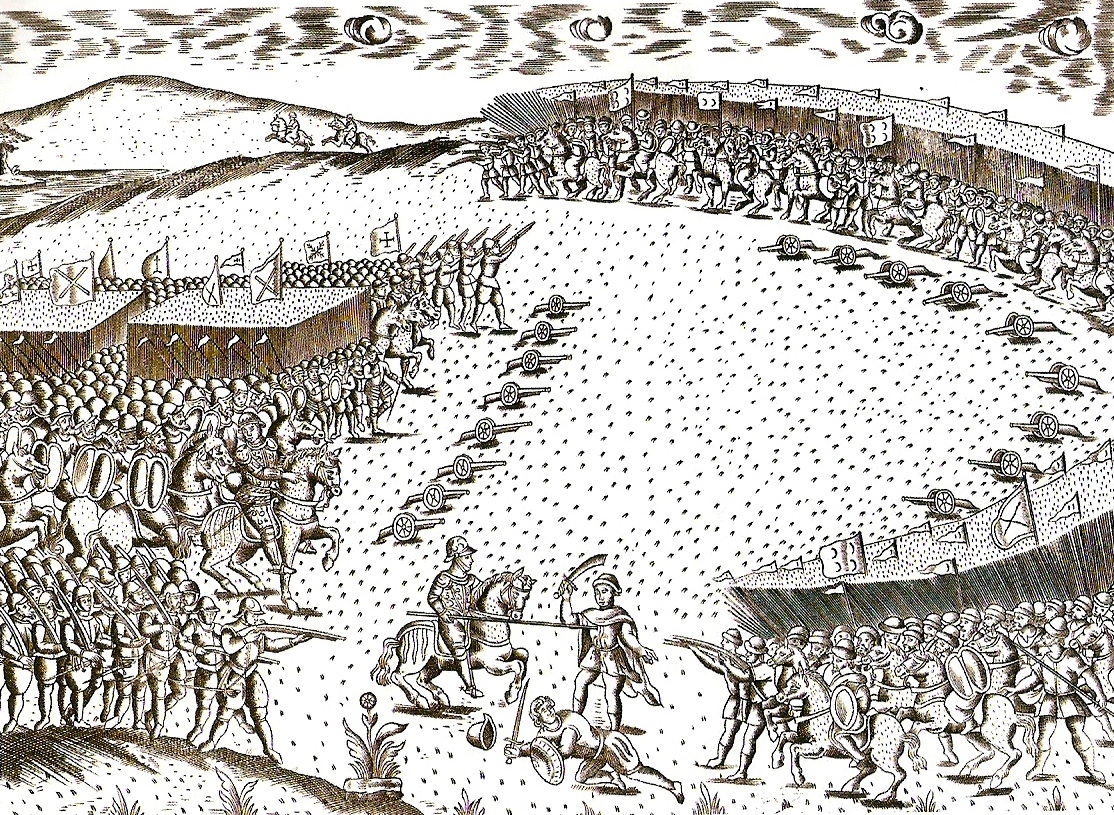
One year later, the Portuguese were driving into mainland Morocco. A battle ensued (the Battle of the Alcaides), where, according to sources, the Portuguese infantry adopted a formation equivalent to a “Tercio”, i.e., with pikemen in the centre and arquebusier corners and wings. The adoption of this formation at an early stage could be explained by the fact tthat Portuguese and Spanish cooperated in North Africa, and Portuguese contingents were often sent at Spanish request: for instance, in the naval aspect of that cooperation, at the storming of Tunis in 1535, Prince D. Luis of Portugal led the Portuguese contingent whose biggest ship – requested by Charles V himself - was the S. Joao Baptista “Botafogo”, a huge galleon armed with some 366 artillery pieces.
As this cooperation had been happening for ages, one shouldn’t find it strange that a “Tercio” formation has been adopted in 1514. This organisation was probably also used in mainland Portugal, but the only data we have after 1514 is from 1578 and 1580 (battle of Alcântara, Lisbon). Giving the adoption, even at an earlier stage, of contemporary infantry formations, one may be led to believe that the metropolitan army, like most Western Europe, followed Spanish military lines.
However, if the adoption of modern tactics is to be postulated, in terms of military and social organization, Portugal remained a backward Nation. Since the Ordenanças where resisted by every social strata, the military system remained the privately raised companies, usually sent abroad - Brazil, India or Morocco - were fighting was a constant.
According to the Regimento da Guerra, by Martin Afonso de Melo, the Portuguese forces, at least in North Africa, tended to have a greater proportion of arquebusiers than pikemen: “(…) in each squadron they have two companies of arquebusiers, not counting on the arquebusiers present in each [standard] company (…) since we don't fight others than un-armoured men, we need only a small force of pikes, and we need more arquebuses, so that we can damage the enemy from a distance, and that's why I give each company of 300 men, 170 arquebusiers, and 130 pikemen, because when we make a squadron out of them, it can be surrounded with 3 lines [of arquebusiers], which is the best way, and it allows us to have free arquebusiers, since this is the thing that's more useful in Africa, and the one we use more often”.
Regarding the Empire, while some sieges took place during this period, most of the actions fought in Morocco, however, were cavalry skirmishes. The Portuguese fought in Moorish fashion, using short lances and “adarga” shields and the tactics of hit and run of old.
In the Orient, most of the actions fought by the Portuguese were either naval encounters or siege operations. Nonetheless some land battles and small actions also took place, such as, the defence of Cochim in 1504 and the battles against the Somalis in Abyssinia, who shaped the Horn of Africa as we know it today.
In 1639 Somali tribes under Ahmad ibn Ibrihim al-Ghazi, a.k.a. “Gran” (left-handed), invaded the country and defeated the Abyssinian army of Emperor Lebna Dengel Dawut. His successor, Emperor Gelawdewos, asked the Portuguese for help. As soon as he heard the news the Governor of India , D. Estevão da Gama realized the importance of the situation and sent his own brother, D. Cristovão da Gama, with a small expedition of "400 soldiers, very well armed and spirited, and with them [they had] more than 600 “espingardas” [arquebuses]." In a passage in Castanhoso's book the Portuguese are reported to have used lances against the Somali cavalry. The Portuguese Royal Flag was of carmine and white embroidered cloth with a red Cross of Christ while the captains had pennons of blue and white cloth with the same cross. In the presence of the dowager Queen, the Portuguese performed a military tattoo, changing formation several times, evolving into “caracole” formations and ending the show with an arquebus volley.
With the Abyssinian morale in their lowest and the Emperor's army scattered or simply in flight, it was the Portuguese who actually bore the brunt of the fighting. They were extremely successful but then, in late August 1542, a battle took place (Battle of Wofla) in which they were severely beaten by much larger Somali and Ottoman forces, including artillerists and janissaries. D. Cristovão was imprisoned, tortured and then behead.
Eventually, however, the Abyssinians recovered their spirit, their numbers grew and with the remaining Portuguese they managed to defeat the Somalis at Wayna Daga (near Lake Tana). The “Gran” was shot dead by the Portuguese who also slaughtered the remaining Ottoman janissaries. Therefore, the Portuguese are acknowledge to have saved Abyssinia from becoming a Muslim nation.
At the Dutch siege of Macau in 1622, African slaves were employed by the defending party with great success, as their ferocity made the Dutch loose their spirit. After the Portuguese surrender in Qishm their Arab auxiliaries were handed over to the Persian who promptly executed them.
In 1603 some thirty Portuguese soldiers and merchantmen led by Salvador Ribeiro de Sousa, later joined by 800 Portuguese volunteers and 1000 Burmese allies, defeated several larger Burmese armies in Pegu.
In Brazil the Portuguese fought both the Indians and, in 1624 and in 1630-45, the Dutch who were at war with the Habsburgs (at a time the Portuguese royal house). As the weak Portuguese forces were unable to stand up against the powerful WIC in open battle, they trusted instead in the "little war", devised by Matias de Albuquerque and managed by both the local Portuguese colonists and by the “Terços de homens pardos” (mulattos), “homens negros” (black men) and “índios” (Indians). This proved effective as the Dutch were not prepared to fight this guerrilla warfare "tropical style". In 1645, five years after the Restoration of the independence in Lisbon, the Portuguese colonists under Dutch domination revolted and soon after the Dutch were surrounded in their cities. The Portuguese crown also secretly dispatched some reinforcements despite diplomatic constrains. The WIC tried to quell the rebellion but in two separate battles at the Guararapes range, in 1648 and 1649, the Dutch were soundly defeated by much smaller but more mobile and better led Portuguese forces. As a consequence, Brazil was finally liberated in 1654.
The bulk of the Portuguese forces in Timor was actually made of Timorese warriors led by the mestiços Topazes or "Black Portuguese". An insignificant Portuguese garrison (a company) occupied the city of Lifau.
Likewise, as in Timor the small Portuguese forces in Africa were supplemented by native auxiliaries or allies such as the Catholic Congolese or the cannibal Jagas/Imbangala.
In Ceylon the Portuguese fought several pitched battles against some native independent kingdoms, especially against Kandy and Uva in the central part of the island. Each Portuguese "arraial" was made of some Portuguese companies and up to twenty times as much "lascarins" auxiliaries armed either with long spears or pikes or with bows and arquebuses. When fighting against the Sinhalese elephants the Portuguese used fire spears to frighten the beasts.
Regarding tactics, like I said earlier, many of the land actions were skirmishes with Moorish troops involving small light cavalry units where personal charisma and courage often determined the outcome of the fight.
In terms of weaponry, the Portuguese quickly adopter firearms ("espingardas" and "arcabuzes"), first of German and Bohemian origin, then Portuguese made. After 1511, Indian expertise was gradually employed to the extent that some of the highly appreciated craftsmen from Goa were sent to Lisbon to lend their mastery to that city’s Arsenal. By 1540 the crossbow had been completely abandoned, although it still figured in the Ordenanças of D. Sebastião (1570). The Portuguese also used spears and 4.80m long (at least) pikes, often reduced to half-pikes.
The Portuguese used light, breech-loading fast shooting artillery along with some heavier types. In Ethiopia the expeditionary Portuguese forces not only used 8 breech-loading guns but also used about 10 or 11 makeshift multi-barrel guns made of arquebuses tied together in a cart.
Main references:
Barata, Manuel Themudo; Teixeira, Nuno Severiano (ed.). Nova História Militar de Portugal, Lisboa: Círculo de Leitores, 2004, vol. 2
Barros, João de. Da Ásia, Décadas, Lisboa: Regia Oficina Tipográfica, 1778. Biblioteca Nacional, scanned on-line edition
Boxer, Charles Ralph. O Império Marítimo Português 1415 - 1825; Lisboa: Edições 70, 1992
Castanhoso, Miguel de (not. Neves Águas). História das cousas que o mui esforçado capitão D. Cristóvão da Gama fez nos Reinos do Preste João com quatrocentos portugueses que consigo levou, Mem Martins: Publicações Europa-América, 1988
Costa, João Paulo Oliveira e; Rodrigues, Vítor Luís Gaspar. A Batalha dos Alcaides 1514. No apogeu da presença portuguesa em Marrocos; Lisboa: Tribuna da História, 2007
Couto, Diogo. Da Ásia, Décadas, Lisboa: Regia Oficina Tipográfica, 1778. Biblioteca Nacional, scanned on-line edition
Coutinho, Lopo de Sousa. O primeiro cerco de Diu; Lisboa: Alfa - Biblioteca da Expansão Portuguesa nº 41, 1989
Daehnhardt, Rainer. Homens, Espadas e Tomates. Porto: Edições Nova Acrópole, 1996
Daehnhardt, Rainer. Espingarda feiticeira. A introdução da arma de fogo pelos Portugueses no Extremo Oriente/ The Bewitched gun. The introduction of the firearm in the Far East by the Portuguese . Lisboa: Texto Editora, 1994
Lemos, Jorge de. História dos cercos de Malaca, Lisboa: Biblioteca Nacional, 1982
Melo, Martim Afonso de. Regimento da Guerra in Provas da Historia Genealogica da Caza Real Portuguesa, 1744.
Monteiro, Saturnino. Batalhas e Combates da Marinha Portuguesa, Vol. II. Livraria Sá da Costa, 1ª Edição, 1991.
Mousinho, Manuel de Abreu (not. Maria Paula Caetano). Breve discurso em que se conta a conquista do Reino do Pegú na Índia Oriental, Mem Martins: Publicações Europa-América, 1990
Ribeiro, João. Fatalidade História da Ilha de Ceilão; Lisboa: Alfa - Biblioteca da Expansão Portuguesa nº 3, 1989
Although the king controlled most aspects of the military apparatus, the nobility still performed many of its old duties, namely the raising of military contingents made either of paid (professional) soldiers or vassals, this including the household (servants, etc.). Personal connections were very important and it was common for a commander to prefer the services of kin or friends as lesser commanders. Experience, however, was not discarded so “old” soldiers were often promoted or sought after for advice.
Throughout the whole XVI century every king, from D. Manuel I to D. Sebastião, tried to implement a system of Ordenanças in which every men were supposed to have certain pieces of equipment (javelins, spears, pikes, swords, crossbows of arquebuses, depending on the person’s income) and every “Concelho” (county) was supposed to raise companies lead by local men. So, in a way, while still adopting a Medieval sense of duty towards the king (the military service, as an obligation, was not paid), these Ordenanças would create a very Modern militia or citizen army, not a standing army but a reserve from which the king could easily raise one.
These Ordenanças, however, had at least two flaws:
Firstly, in the economic sense, this system overburdened the citizens as it was up to them, and not the State, to support the cost of their equipment. Moreover, military service was seldom paid, even to professional soldiers. And the status of these Ordenanças implied that men had to attend periodic musters (in the original Ordenanças, or Regimento dos Capitães-Mores of 1570, these musters would take place every week!), an obligation that was opposed by every man.
Secondly, contrary to established aristocratic prerogatives, the captains of these companies (250 men strong divided in 10 “esquadras”) were chosen from among the notable men in the villages, which meant that the old privileges of the nobility, stipulating that nobles should lead, would be phased out (many nobles lived outside their properties, in Lisbon, for instance). Likewise, people of different “conditions”, that is, of different social strata, opposed to be enrolled into the same company, lesser nobility, or “escudeiros” (squires) preferring to serve in the cavalry instead, even if they couldn’t supply a horse!
Therefore, it is only from 1570 onwards that D. Sebastião, unlike his grandfather D. João III, managed to implement a system of Ordenanças, adapted to the social situation of his time, and managed to raise 4 infantry “Terços” of 2000 men each.
So, for the most part of this period, the army was privately raised, each captain or noble being issued a letter allowing him to raise a company or even an host. The army remained a professional organism where personal links were more important than the obligation towards the State.
The best part of the Portuguese forces was made of “nobres” (nobles), “fidalgos” (lesser nobility) and “soldados” (professional soldiers), most of them expert swordsmen. Their swordsmanship was only equalled by their rashness: although few could stand against Portuguese in solo fights, organised enemies, such as the Dutch, could face and defeat them, in spite of their own losses. This deficiency was due to poor command (often given to inexperienced nobles due only to their social status), carelessness and sometimes an acute lack of training. It is also noteworthy that by mid-XVII cent. many of the soldiers were convicts and vagabonds sent from Lisbon's prisons.
The “casados” (married men) were a social group within the colonists (“moradores”) who were often married with native women. Together with the “mercadores” (merchantmen) they fought in times of need.
While the Portuguese dominion over their colonies was achieved through clear strategic thinking, technological innovations, decisive naval battles and the conquest or foundation of strategic cities such as Goa, Ormuz, Malacca, S. Salvador da Baía, Recife or Rio de Janeiro, the maintenance of the Empire was achieved through political gambling, conversions, matrimonial alliances and, most of all, “mestiçagem” (half-bread), a Portuguese specialty. This, however, didn’t happen in Morocco, deemed as a “land of war”, proper for the gentry and nobility who wished to become famous through deeds of arms.
In 1513, in penance for the killing of his first wife, Duque D. Jaime was sent by the king D. Manuel I to storm the rebellious city of Azamor. He paid from his own pockets a 15.000 strong army (13.000 foot, 2000 horses) and Azamor was taken in 2 days. The frescoes at the Ducal Palace of Vila Viçosa show pikemen and arquebusiers, light cavalry equipped with short lances and “adarga” leather shields, and "cavalaria acobertada" barded heavy cavalry, the Duque having his own halberdier guards.
One year later, the Portuguese were driving into mainland Morocco. A battle ensued (the Battle of the Alcaides), where, according to sources, the Portuguese infantry adopted a formation equivalent to a “Tercio”, i.e., with pikemen in the centre and arquebusier corners and wings. The adoption of this formation at an early stage could be explained by the fact tthat Portuguese and Spanish cooperated in North Africa, and Portuguese contingents were often sent at Spanish request: for instance, in the naval aspect of that cooperation, at the storming of Tunis in 1535, Prince D. Luis of Portugal led the Portuguese contingent whose biggest ship – requested by Charles V himself - was the S. Joao Baptista “Botafogo”, a huge galleon armed with some 366 artillery pieces.
As this cooperation had been happening for ages, one shouldn’t find it strange that a “Tercio” formation has been adopted in 1514. This organisation was probably also used in mainland Portugal, but the only data we have after 1514 is from 1578 and 1580 (battle of Alcântara, Lisbon). Giving the adoption, even at an earlier stage, of contemporary infantry formations, one may be led to believe that the metropolitan army, like most Western Europe, followed Spanish military lines.
However, if the adoption of modern tactics is to be postulated, in terms of military and social organization, Portugal remained a backward Nation. Since the Ordenanças where resisted by every social strata, the military system remained the privately raised companies, usually sent abroad - Brazil, India or Morocco - were fighting was a constant.
According to the Regimento da Guerra, by Martin Afonso de Melo, the Portuguese forces, at least in North Africa, tended to have a greater proportion of arquebusiers than pikemen: “(…) in each squadron they have two companies of arquebusiers, not counting on the arquebusiers present in each [standard] company (…) since we don't fight others than un-armoured men, we need only a small force of pikes, and we need more arquebuses, so that we can damage the enemy from a distance, and that's why I give each company of 300 men, 170 arquebusiers, and 130 pikemen, because when we make a squadron out of them, it can be surrounded with 3 lines [of arquebusiers], which is the best way, and it allows us to have free arquebusiers, since this is the thing that's more useful in Africa, and the one we use more often”.
Regarding the Empire, while some sieges took place during this period, most of the actions fought in Morocco, however, were cavalry skirmishes. The Portuguese fought in Moorish fashion, using short lances and “adarga” shields and the tactics of hit and run of old.
In the Orient, most of the actions fought by the Portuguese were either naval encounters or siege operations. Nonetheless some land battles and small actions also took place, such as, the defence of Cochim in 1504 and the battles against the Somalis in Abyssinia, who shaped the Horn of Africa as we know it today.
In 1639 Somali tribes under Ahmad ibn Ibrihim al-Ghazi, a.k.a. “Gran” (left-handed), invaded the country and defeated the Abyssinian army of Emperor Lebna Dengel Dawut. His successor, Emperor Gelawdewos, asked the Portuguese for help. As soon as he heard the news the Governor of India , D. Estevão da Gama realized the importance of the situation and sent his own brother, D. Cristovão da Gama, with a small expedition of "400 soldiers, very well armed and spirited, and with them [they had] more than 600 “espingardas” [arquebuses]." In a passage in Castanhoso's book the Portuguese are reported to have used lances against the Somali cavalry. The Portuguese Royal Flag was of carmine and white embroidered cloth with a red Cross of Christ while the captains had pennons of blue and white cloth with the same cross. In the presence of the dowager Queen, the Portuguese performed a military tattoo, changing formation several times, evolving into “caracole” formations and ending the show with an arquebus volley.
With the Abyssinian morale in their lowest and the Emperor's army scattered or simply in flight, it was the Portuguese who actually bore the brunt of the fighting. They were extremely successful but then, in late August 1542, a battle took place (Battle of Wofla) in which they were severely beaten by much larger Somali and Ottoman forces, including artillerists and janissaries. D. Cristovão was imprisoned, tortured and then behead.
Eventually, however, the Abyssinians recovered their spirit, their numbers grew and with the remaining Portuguese they managed to defeat the Somalis at Wayna Daga (near Lake Tana). The “Gran” was shot dead by the Portuguese who also slaughtered the remaining Ottoman janissaries. Therefore, the Portuguese are acknowledge to have saved Abyssinia from becoming a Muslim nation.
At the Dutch siege of Macau in 1622, African slaves were employed by the defending party with great success, as their ferocity made the Dutch loose their spirit. After the Portuguese surrender in Qishm their Arab auxiliaries were handed over to the Persian who promptly executed them.
In 1603 some thirty Portuguese soldiers and merchantmen led by Salvador Ribeiro de Sousa, later joined by 800 Portuguese volunteers and 1000 Burmese allies, defeated several larger Burmese armies in Pegu.
In Brazil the Portuguese fought both the Indians and, in 1624 and in 1630-45, the Dutch who were at war with the Habsburgs (at a time the Portuguese royal house). As the weak Portuguese forces were unable to stand up against the powerful WIC in open battle, they trusted instead in the "little war", devised by Matias de Albuquerque and managed by both the local Portuguese colonists and by the “Terços de homens pardos” (mulattos), “homens negros” (black men) and “índios” (Indians). This proved effective as the Dutch were not prepared to fight this guerrilla warfare "tropical style". In 1645, five years after the Restoration of the independence in Lisbon, the Portuguese colonists under Dutch domination revolted and soon after the Dutch were surrounded in their cities. The Portuguese crown also secretly dispatched some reinforcements despite diplomatic constrains. The WIC tried to quell the rebellion but in two separate battles at the Guararapes range, in 1648 and 1649, the Dutch were soundly defeated by much smaller but more mobile and better led Portuguese forces. As a consequence, Brazil was finally liberated in 1654.
The bulk of the Portuguese forces in Timor was actually made of Timorese warriors led by the mestiços Topazes or "Black Portuguese". An insignificant Portuguese garrison (a company) occupied the city of Lifau.
Likewise, as in Timor the small Portuguese forces in Africa were supplemented by native auxiliaries or allies such as the Catholic Congolese or the cannibal Jagas/Imbangala.
In Ceylon the Portuguese fought several pitched battles against some native independent kingdoms, especially against Kandy and Uva in the central part of the island. Each Portuguese "arraial" was made of some Portuguese companies and up to twenty times as much "lascarins" auxiliaries armed either with long spears or pikes or with bows and arquebuses. When fighting against the Sinhalese elephants the Portuguese used fire spears to frighten the beasts.
Regarding tactics, like I said earlier, many of the land actions were skirmishes with Moorish troops involving small light cavalry units where personal charisma and courage often determined the outcome of the fight.
In terms of weaponry, the Portuguese quickly adopter firearms ("espingardas" and "arcabuzes"), first of German and Bohemian origin, then Portuguese made. After 1511, Indian expertise was gradually employed to the extent that some of the highly appreciated craftsmen from Goa were sent to Lisbon to lend their mastery to that city’s Arsenal. By 1540 the crossbow had been completely abandoned, although it still figured in the Ordenanças of D. Sebastião (1570). The Portuguese also used spears and 4.80m long (at least) pikes, often reduced to half-pikes.
The Portuguese used light, breech-loading fast shooting artillery along with some heavier types. In Ethiopia the expeditionary Portuguese forces not only used 8 breech-loading guns but also used about 10 or 11 makeshift multi-barrel guns made of arquebuses tied together in a cart.
Main references:
Barata, Manuel Themudo; Teixeira, Nuno Severiano (ed.). Nova História Militar de Portugal, Lisboa: Círculo de Leitores, 2004, vol. 2
Barros, João de. Da Ásia, Décadas, Lisboa: Regia Oficina Tipográfica, 1778. Biblioteca Nacional, scanned on-line edition
Boxer, Charles Ralph. O Império Marítimo Português 1415 - 1825; Lisboa: Edições 70, 1992
Castanhoso, Miguel de (not. Neves Águas). História das cousas que o mui esforçado capitão D. Cristóvão da Gama fez nos Reinos do Preste João com quatrocentos portugueses que consigo levou, Mem Martins: Publicações Europa-América, 1988
Costa, João Paulo Oliveira e; Rodrigues, Vítor Luís Gaspar. A Batalha dos Alcaides 1514. No apogeu da presença portuguesa em Marrocos; Lisboa: Tribuna da História, 2007
Couto, Diogo. Da Ásia, Décadas, Lisboa: Regia Oficina Tipográfica, 1778. Biblioteca Nacional, scanned on-line edition
Coutinho, Lopo de Sousa. O primeiro cerco de Diu; Lisboa: Alfa - Biblioteca da Expansão Portuguesa nº 41, 1989
Daehnhardt, Rainer. Homens, Espadas e Tomates. Porto: Edições Nova Acrópole, 1996
Daehnhardt, Rainer. Espingarda feiticeira. A introdução da arma de fogo pelos Portugueses no Extremo Oriente/ The Bewitched gun. The introduction of the firearm in the Far East by the Portuguese . Lisboa: Texto Editora, 1994
Lemos, Jorge de. História dos cercos de Malaca, Lisboa: Biblioteca Nacional, 1982
Melo, Martim Afonso de. Regimento da Guerra in Provas da Historia Genealogica da Caza Real Portuguesa, 1744.
Monteiro, Saturnino. Batalhas e Combates da Marinha Portuguesa, Vol. II. Livraria Sá da Costa, 1ª Edição, 1991.
Mousinho, Manuel de Abreu (not. Maria Paula Caetano). Breve discurso em que se conta a conquista do Reino do Pegú na Índia Oriental, Mem Martins: Publicações Europa-América, 1990
Ribeiro, João. Fatalidade História da Ilha de Ceilão; Lisboa: Alfa - Biblioteca da Expansão Portuguesa nº 3, 1989