Troop Notes:
General:
“elite” formations: In 1592 students and clerks passed for elite troops by virtue of their scholarly credentials, but were useless so General Yi Il left them behind and took only his 60-man bodyguard cavalry when sent south to take command against what appeared to be just another pirate raid. (See Hawley 148-49.)
During the Imjin War, national hero Admiral Yi Sunsin compared the Ming, coming from 10,000 li away and willing to fight to the death, with Koreans: “Among our Korean people, out of every ten there are eight or nine faint-hearted persons as against one or two lion-hearts.” (DHST 195) The regular infantry were generally poor – an ill-trained and often unmotivated mob of those unable to evade or buy their way out of service. When leaders withdrew on the field, the troops were liable to flee, but they could respond to good leadership. Monk soldiers and Righteous armies, however, were motivated.
Koreans were described in the 19th C as “poor soldiers in the open field” by Griffis, but “their courage is sublime, they fight to the last man and fling themselves on the bare steel” behind walls. It was similar in the Imjin War in defense of fortified towns and forts. This is reflected in the classification for crossbow BGs behind fortifications as Average.
Ming and Korean armies were generally willing to fight the Japanese head-on in defence and assault of towns and on the field, although the Ming also exhibited frequent caution and a desire to avoid unnecessary losses.
Both sides saw firearms as critical to Japanese success – teppō with greater effective range and penetrating power than Korean bows and arrows. Japanese tactics were standard - approach in three bodies in line abreast, each with shot in front and melee troops in the rear ranks. A rapid advance was punctuated by volleys of musketry (and light artillery fire if available) used to disrupt the enemy, and was followed by a charge led by the close combat troops who moved forward from behind the shot. This proved sufficient to rout opposing Korean infantry in the field. Archers were present in varying (and declining) numbers with Japanese formations but were outshot by Koreans and rate little mention from the Allied side. Siege assaults were also prepared with fire.
The Ming countered with their own firepower, based on a large artillery train of pieces of various sizes from very light to heavy. Allied commanders recommended making a rapid charge on the Japanese between volleys, but facing volley by ranks and rapid reloading it would be hard to avoid taking fire. I found no mention that this tactic worked.
Korean army regular foot were always unarmoured, in white with black vests and hats. E.g., sample images at
http://www.swordsofkorea.com
The Ming-like Five Brigades System of army organisation was introduced in the late 1400s by King Sejo to counter the Jurchen. By the 16th century, the structure eroded and the capital armies and central forces no longer existed. The army was spread among garrisons manned, at least in the case of infantry, almost entirely by conscripts. The best troops were the northern frontier cavalry. [Of theoretical strength of 200,000 standing troops and 400,000 reservists, it is estimated there were only a few thousand battleworthy troops in 1592. Hawley 112, DHST 72. Park article.]
The pre-war army’s infantry disintegrated in the initial campaign, though some returned to service, and the best cavalry was largely wiped out at the Chungju disaster and following battles. One source states army (I believe this excludes the navy) fighting strength probably did not exceed 25,000 at any time during the Imjin War, and was often much less (not counting guerrilla bands). Turnbull (SI 109) says an estimated 22,200 irregulars and 84,500 regulars “shouldered the burden of resistance” in the 7 months before Ming intervention in Jan 1593. This appears a very generous tally, but is not necessarily inconsistent with the fighting strength given above, as many were unfit, deserted, or turned to banditry – in any event, the main army could at the most optimistic estimate of numbers muster a force of 20% of that total before the battle at Chungju.
After the initial Japanese invasion wrecked the regular army, the Five Brigades System was replaced by the new Sogo system starting in late 1593 (completed by 1597).
The regiment-level FOGR battle group sized formations were yong under the Sogo system, and had been bu under the Five Brigades system.
The sogo reorganisation was under Ming tutelage and the model of the southern (Zhejiang) Ming infantry schooled in Qi Jiguang’s methods of fighting “Japanese” wo-k’ou pirates. The southern infantry proved mokre effective against the Japanese than northern forces (largely cavalry) who previously campaigned against mounted Mongol and Jurchen tribesmen and also suffered greatly from loss of horses in Korean conditions. In recognition of success, China rotated in more southern troops during the campaigns. The actual classification of these Chinese troops and analogous Korean infantry is a question discussed below. Although the transition meant that bu and yong formations existed at the same time, the 1594-1596 truce period saw no more than skirmishing on the peninsula so the list assumes for convenience a changeover date in 1594 (had there been no truce, the transition probably would have been expedited with Ming aid).
Sogo: The sogo organisation had two elements. First, the Military Training Agency (Hullyŏn Togam) was established in September 1593 to train the professional standing “three skills army” (samsubyŏng). The Ming early on had advised using mixed formations of archers with spearmen and swordsmen. The new Korean system sought to build units based on the triad of squads of each of musketeers, bowmen, and close combat “killers” (salsu) (including swordsmen and spearmen in equal proportions) within each company based on General Qi’s principles. Second, the sogo provincial armies took the same approach for organizing the conscripts serving on rotating duty in the provinces. (War and Peace in Premodern Korea, Park 5-7)
Big question of how to classify Qi’s formation, whether original Mandarin Duck, his revised northern version, or the adaptations in later decades in China and Korea. The right formation and classification depends on how the Wo-k’ou pirates and the later Japanese are ultimately represented. The purpose was to use coordinated multi-rank formation to negate enemy swordsmanship, and win through bringing various weapons to bear, including firearms. My thoughts so far other than HW include Spearmen with Pistol (weak at 1 per 2 bases, but providing the firepower element of the original Mandarin Duck and a Foot POA), Spearmen front rank and missile behind, and, for the 1590s version, HW or Spearmen flanked by archers and arquebus on either side (somewhat Elizabethan, with protection only if the close combat troops are HF, and providing less protection to Bow than to Shot in terms of POAs). I think maybe this deserves a separate thread where Mandarin Duck can also be explained.
Ming and Koreans both used short swords for horse and foot. Chinese and Koreans often commented on longer reach and effectiveness of Japanese swords and spears. Use of southern Chinese and Koreans trained in anti-Wo-k’ou tactics was a response.
Swords issue: There are frequent specific references to Korean fear of Japanese swords or Japanese katanas, particularly when facing a Japanese charge, usually coupled with reference to their greater length. This makes some sense at face value, but swords were secondary weapons for the Japanese, the Samurai’s principal weapon being the yari and the non-missile fighting ashigaru using the pike-like nagaeyari. Clearly, length was a tactical advantage, but I wonder if it is always swords being referred to. There may be a translation issue around words like “blades” or “steel” or other non-technical terms that suggest a mistaken conclusion. This does appear to be the case in another source and context regarding the Wo-k’ou pirates and Chinese where references to swords being raised and lowered in unison make little sense, while the reference being to drilled use of yari makes sense. Whatever the case, Swordsmen will suffice, paired with Impact Foot for Samurai.
Guard cavalry/Korean regular cavalry/Korean light cavalry/nomads:
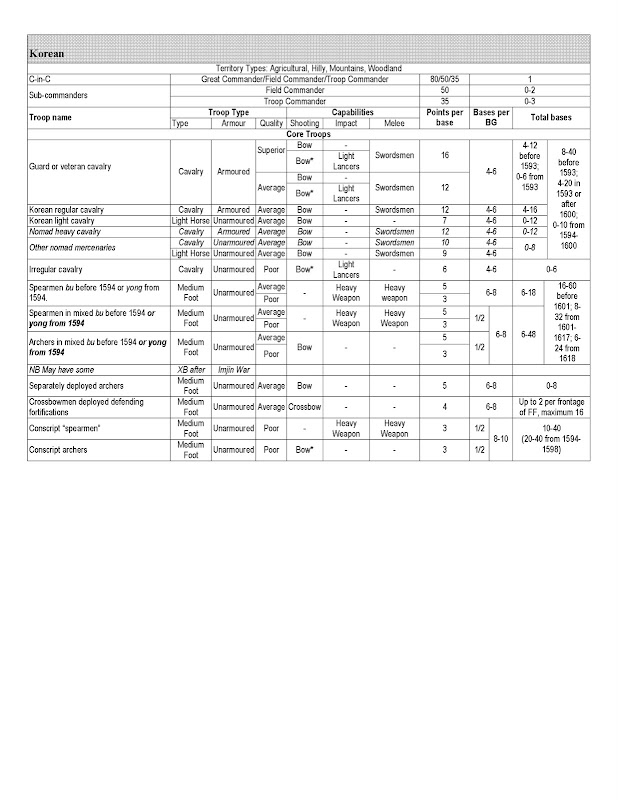
Guard cavalry is a misnomer, the formal structure of capital-based “guard” formations having degraded to a garrison-based approach with the best cavalry on the Jurchen frontier, but these confident veterans are still appropriately superior.
Korean armoured cavalry in this period operated as horse archers against the Jurchen (same as Ming). All had bows for mounted archery. As many as a third were armed with lances, corss-bladed spears, swords, maces, tridents, and other polearms, or the distinctive Korean flail. Korean cavalry were overconfident before fighting the Japanese. Translated descriptions indicate “charges” and a bloody fight using intense horse archery making little impression on the Japanese infantry. Use of the teppō at long range and in concentrated volleys negated the effectiveness of Korean cavalry tactics (Swope).
I’m confident the veteran horse found occasion for shock charges at times, but I don’t find support for lancers classification; however, the list below allows for that alternative view (but not for opportunistic splitting between interpretations). Battle losses, shortage of fodder and grazing, and competing Ming demands for horses and supplies, as well as limited flat terrain in the south, meant Korean horsemen never regained their pre-1593 strength or tactical significance.
The cavalry was the pride of the army up to 1592, but the cavalry allowances for 1593 on are generous for non-historical list balance and flavour reasons – they can look good.
Nomad cavalry: Since they basically duplicate Korean types, I didn’t scale this down over time. Open question how many of these were used in the early 16th century vs. later. I saw a reference to negligible numbers of Mongols at Chungju, but suspect the unification of the Jurchen across the border meant these would be more of a factor in the early 15th and dry up by the early 17th century.
I doubt the irregular cavalry would be lancers but with the reasonable Bw* it may make it worth taking on an outing at times.
Korean Missile Weapons:
16th century Korea relied on the bow as its national weapon; archery expertise was the hallmark of military skill, a point of pride among the elite Yangban military class and the scholarly elites and the ambition of the lower classes. Like the Ming, they used arrows with fire, poison, or small explosives.
Korean archery outranging Japanese may have been due to the firing tube invented by the Koreans, allowing a shorter, lighter arrow to be shot farther, as well as the advantages of the composite bow and the decline of archery quality along with the Japanese shift to guns. (Hawley)
Crossbows were displaced by handguns in the field but continued in use in fortifications (as restricted in the list) and aboard ship, then became more common again after the Imjin War as skilled bowmen became scarce with the adoption of firearms.
Weapons capabilties may reflect a mix of weapons and circumstances. From 1593 the Koreans aggressively imported and manufactured all manner of firearms, including thousands of teppō copies which were available by 1597 and 1598, so muskets were available to some units. Re-equipment continued into the 17th century. By the Battle of Sarhu in 1619, the Korean force of 13,000 present in aid of the Ming army was reported to have at least 10,000 musketeers (unfortunately hindered by wet weather, they were swept away by the Manchu charge after an initial volley).
Artillery:
The Koreans were proud of their artillery, until the Imjin War heavy banded cannon and mortars without mobile carriages, used in ships or fixed defences, and some primitive handguns and very light pieces. The Koreans apparently had 50 Ming light artillery at Chungju in 1592 but did not know how to use them, but a few rocket launchers they were able to use (so the list is generous in allowing 2 Light Artillery prior to 1593). Korea showed no interest in the teppō before the war, but, impressed by the effect of Japanese teppō and light guns and the panoply of Chinese firepower, Korea made vigorous efforts from 1593 to make or acquire numerous lighter weapons, including small arms, rockets, very light and light guns, and devices such as grenades and the repeating crossbow. Their firearms were a mix of old and new Korean, Ming, Portuguese and Japanese-style equipment.
The Hwacha (firecart) used effectively at the siege of Haengju in 1593 was a honeycomb-like frame on a wooden cart that could be pushed into battle and fire a volley of 100-200 explosive or non-explosive rockets.
Artillery was classified as (heavy cannon to light) chonja (heaven), chija (earth), hyonja (black) and hwangja (yellow), mortars with their own terminology. “Victory mark cannon” were commonly used very light guns of 0.3 to 0.6m in length and around a one inch bore. Their Imjin War innovation of a fused delayed-action iron shell called the pigyok chincholloe (“flying-striking-earthquake-heaven-thunder”) shot from a mortar was effective at killing and panicking unwary Japanese.
An effective tactical approach for the Allies was to use terrain, ambush, and fortifications for an advantageous position, with trained Korean archers on the wings and Ming heavy guns in the center of a position. DHST 166. The Japanese were impressed by the numerous Ming artillery and this was one reason for them to avoid pitched battle and use their advantages in ambush and siege warfare (including skill at devastating sorties) to bleed the Allies. DHST 157
Li Rusong, Ming commander of the army intervening in January 1593, distributed his artillery equally to his units when organizing his forces prior to the recapture of Pyongyang. Reportedly he had over “2000 cannon” on pack animals or carts (which must include all pieces from a few heavy to numerous man-portable guns). We can assume this distribution was imitated by the Koreans for their regular troops – I think not for the ŭibyŏng and sungbyŏng irregulars. DHST 152
Korean Infantry Weapons:
Korean “Spearmen” used a mixture of conventional spears (shorter than the pike-like Japanese nagae-yari), halberds, tridents, swords and similar weapons. Korean polearms were heavier and wider in blade than naginata, resembling a glaive. (SI 129) The mix continues to be classified as Heavy Weapon – the question is whether this should change for the sogo infantry.
Korean Pikes? I doubt it (although they possibly copied from the Japanese late in the Imjin War). My theory for reconciling references in DBR to the Japanese being impressed by and possibly copying Korean long spears with Japanese reference to, and mocking of, Korean spears as “short” in the 1590s (and not finding other support for Korean pike-like formations in the late 16th century), is that perception was a matter of timing since the yari began roughly five feet long and lengthened over time to a long spear and then the 5m nagae-yari pike of Hideyoshi’s national army.
Special Troops: Use the Korean name or the English term?
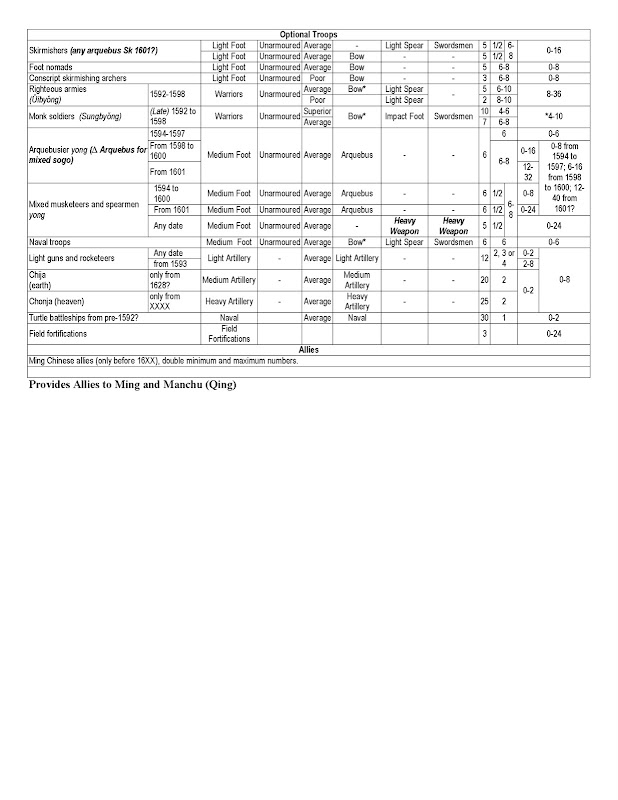
Ŭibyŏng were “volunteers” with more dedication than the regulars, usually aggressively led by monks or local leaders with initiative, and occasionally some military talent. They were variously equipped and used both archery and melee combat.
Persecuted by the Confucians, Buddhist monks nonetheless rallied to defend Korea against the Japanese in monk soldier units (sungbyŏng) and led other ŭibyŏng. They showed dauntless courage and willingness to take losses as shock troops in the van of an attack, fighting unarmoured with bow, spear and other weapons. Superior Impact Foot Swordsmen Warriors best represents their role and effect, but an average option is included for affordability and represents a force of monk soldiers diluted by other volunteers or fresh recruits. The date is 1592 but they did not see action in the first few months of the invasion. My understanding is that the Korean term is better translated as monk soldiers rather than warrior monks.
Naval Troops. Naval and land forces and commanders were part of the same command strucuture, and sailors were soldiers who served aboard ship. A commander was an admiral if commanding ships, a general if commanding on land. Naval troops saw action in fighting on the coast and offshore islands, usually but not always in immediate proximity to their ships (so taking Naval is not required). Korean Korean sailors wore sea-blue uniforms with black felt hats and used a wide variety of weapons including swords, spears, tridents, battle axes, maces, scythes, grappling hooks and irons, and great bows with large arrows, fire arrows, and darts, some with a range of four hundred yards. They also used crossbows and even pistols for ranged warfare.
Naval units: The most notable example of naval bombardment and landings in conjunction with land combat was at Sunchon in 1598, and it is essential that players be able to get their turtle battleships on the table..
Notes re FOGAM List carry-over: To-bang and Tae-bak had been outlawed in the 1400s as part of the elimination of private armies, and I don’t find any reference to “soldiers” in the 16th century, nor to any actual elite regular infantry formations that saw combat in the Imjin War. In the long peace since the foundation of the dynasty, the hereditary army system eroded. The yang-ban elite class that had formed the officer corps came to regard itself as exempt from universal service, and others who could pay to avoid service did so (roughly one-third of the population was slaves, also exempt). Those unable to escape or evade service remained.
Note: The dates for the archer/spearmen and shot/spearmen reductions in numbers are somewhat arbitrary, but the last one is set in 1618 to precede the Battle of Sarhu in 1619 at which a force primarily of shot was fielded.
Special Restrictions:
 [/img]

 So any thing that would help would be appreciated - nothing special needed, just an overview of the fighting saying how the ships were invoved would be great.