Page 1 of 2
Caroline Imperialist
Posted: Thu Mar 04, 2010 3:12 pm
by nikgaukroger
The list notes have:
In 1534 a new ordinance organized the Spanish infantry into the famous Tercios. These were an evolution of the Colunelas but increased dramatically in size. Tercios comprised 10 companies (each of 300 men) in Italy (8 Pike companies and 2 Arquebusier companies) and 12 Companies in Flanders (10 Pike and 2 Arquebusier). “Pike” companies also included a proportion of arquebusiers.
And Richard askes:
Is this is fact based on evidence from the Duke of Alba’s army in the later period? Should the Flanders companies be (each of 250)? If the information for the difference between Italian and Flanders tercios comes from the later period, should it in fact be stated in this list at all – can we be certain that the policy carries back to the earlier period?
Any comments? I'll check the rather useful Tercio website to see what that says.
Additionally:
Celadas were well-equipped light cavalry, used to attack enemy skirmish formations and isolated units of missile foot.
Richard asks:
As light horse they won’t have much luck against MF Arquebusiers because they will only get half dice. If they should be able to beat them, maybe they need the option to be Cavalry.
A Cavalry option sounds sensible to me - any objections?
Lastly Richard asks whether the Jinetes, Celada and Mounted Arquebusiers should have an Unarmoured option.
Posted: Thu Mar 04, 2010 7:06 pm
by robertthebruce
The list notes have:
In 1534 a new ordinance organized the Spanish infantry into the famous Tercios. These were an evolution of the Colunelas but increased dramatically in size. Tercios comprised 10 companies (each of 300 men) in Italy (8 Pike companies and 2 Arquebusier companies) and 12 Companies in Flanders (10 Pike and 2 Arquebusier). “Pike” companies also included a proportion of arquebusiers.
And Richard askes:
Is this is fact based on evidence from the Duke of Alba’s army in the later period? Should the Flanders companies be (each of 250)? If the information for the difference between Italian and Flanders tercios comes from the later period, should it in fact be stated in this list at all – can we be certain that the policy carries back to the earlier period?
Any comments? I'll check the rather useful Tercio website to see what that says.
I took this information from the Tercio website, and from other Spanish text that says that the Tercios in Flanders were composed by 12 companies but this text don´t talk about dates.
I just done a deeper research, And Richard you are right, the early tercios were composed by 8-10 companies with 300 mens each. The most of them were composed by 10 companies, only some Old Tercios from Italy were composed by 8 companies.
I also think that some smaller tercios can be allowed:
Pikes 8-6 Bases
Arquebus- 8-6-4 Bases
Celadas were well-equipped light cavalry, used to attack enemy skirmish formations and isolated units of missile foot.
Richard asks:
As light horse they won’t have much luck against MF Arquebusiers because they will only get half dice. If they should be able to beat them, maybe they need the option to be Cavalry.
A Cavalry option sounds sensible to me - any objections?
Sounds right to me, Celadas can be a cavalry option, altough their main role were light horse.
Lastly Richard asks whether the Jinetes, Celada and Mounted Arquebusiers should have an Unarmoured option.
Ok for the Jinetes, but not for Celadas, In fact I has added them as armoured because I though that could be hard to believe in a heavily armoured light horse, but here you are them:

Celada means "Hidden face" in english, in reference to their helmet.
Posted: Thu Mar 04, 2010 10:21 pm
by robertthebruce
And guys, take 1534 for the Tercios origin.
Yes, the Germans men at arms could be Horse in the list.
Stradiots, I´m not sure if they should have the Cavalry option, the spanish ever talks about them as light cavalry, but maybe they talks about their armour just like they talks about their own Jinetes and Celadas.
Blurb
Posted: Fri Mar 05, 2010 12:40 am
by xavier
I would re-write the first paragraph of the blurb as follows (a little bit longer, but I find it really interesting in order to really understand how was it possible that so many territories happened to be under a single crown)
Charles of Ghent was the grandson of King Fernando II of Aragon and Queen Isabel I of Castile by maternal line, and of the holy Roman Emperor Maximilian I and the Duchess Mary of Burgundy by paternal line. This meant he was the heir of four of the main European dynasties of the late 15 - early 16 century: the Trastámaras of Castile and Aragon, the Habsburgs of the Archduchy of Austria and the Valois of the Duchy of Burgundy.
At the death of his father Philip I in 1506 he inherited the Burgundian territories as Charles (French) - Karel (Dutch) V. The Castilian crown was nominally kept by his mother Juana, but having been declared insane, his grandfather Fernando II of Aragon exerted the regency. Only a year before, Fernando II had remarried with Germaine de Foix hoping to father a new privative heir for the Crown of Aragon and so separating again Aragon and Castile, but he died in 1516 without having succeeded. Therefore at his death Charles inherited not only the Castilian crown from his mother, but also the Crown of Aragon from his grandfather, becoming Carlos I of Castile and Aragon. Finally, at the death of his grandfather Maximilian I in 1519, he inherited his Austrian possessions as Karl V and managed to be elected Holy Roman Emperor defeating the other candidate, Francis I of France, with the precious support of the extremely wealthy Fugger family.
Together with the Castilian territories in the Americas and the Philipines, all this European possessions conformed such a vast empire that it was often described as one where the sun never sets.
Posted: Fri Mar 05, 2010 1:52 am
by Ghaznavid
As the list is meant to cover the armies in Germany and especially those seen at SE (i.e. along the Ottoman borders) as well as those in Spain/Italy/Netherlands I see a couple of problems with the list as is:
- Woodland missing from the terrain types.
- Way to many Spanish LH. They are rarely mentioned in Germany and the continuing need to hire Hungarian, Moldavian, Polish, etc. LH to counter that of the Ottomans suggest there weren't nearly enough to do the job. This also leeds to the conclusion that there should be an option for such Eastern LH.
I suggest adding the 'special campaign' bit from the German states while limiting the numbers of Spanish LH available in Germany.
(Also were there that many Spanish LH operating in the Netherlands?)
- There should not be any mandatory Colunella foot in Germany as they weren't always present (as opposed to later years where there always seems to be a Tercio or two in the mix), OTOH the number of Landsknechts available seems to low for armies based on/in Germany.
- Spanish Arquebusiers Companies - should probably Spanish or Landsknecht (or simpler don't label them at all).
- Classing the Burgundian MAA as Average from the start of the list seems harsh, they probably deteriorated over time, but an instant downgrade after the Death of Maximillian seems a bit over the top.
- Possibly not enough medium Artillery for Landsknecht based armies during the later period of the list.
- Might need an Hungarian ally or direct inclusion of Hungarian troops after 1527. I have to check on that.
Posted: Fri Mar 05, 2010 2:24 am
by xavier
Ghaznavid wrote:As the list is meant to cover the armies in Germany and especially those seen at SE (i.e. along the Ottoman borders) as well as those in Spain/Italy/Netherlands I see a couple of problems with the list as is:
- Woodland missing from the terrain types.
- Way to many Spanish LH. They are rarely mentioned in Germany and the continuing need to hire Hungarian, Moldavian, Polish, etc. LH to counter that of the Ottomans suggest there weren't nearly enough to do the job. This also leeds to the conclusion that there should be an option for such Eastern LH.
I suggest adding the 'special campaign' bit from the German states while limiting the numbers of Spanish LH available in Germany.
(Also were there that many Spanish LH operating in the Netherlands?)
- There should not be any mandatory Colunella foot in Germany as they weren't always present (as opposed to later years where there always seems to be a Tercio or two in the mix), OTOH the number of Landsknechts available seems to low for armies based on/in Germany.
- Spanish Arquebusiers Companies - should probably Spanish or Landsknecht (or simpler don't label them at all).
- Classing the Burgundian MAA as Average from the start of the list seems harsh, they probably deteriorated over time, but an instant downgrade after the Death of Maximillian seems a bit over the top.
- Possibly not enough medium Artillery for Landsknecht based armies during the later period of the list.
- Might need an Hungarian ally or direct inclusion of Hungarian troops after 1527. I have to check on that.
That's true. The current list version is mainly focused in Italy and Spain.
Spanish LH maxima can easily be reduced to half (or even less?) in Germany by adding a simple * plus comments on the troop notes.
Same for Colunela foot.
And we need to add optional eastern LH, available in Germany or the east frontier only...
Posted: Fri Mar 05, 2010 2:49 am
by robertthebruce
I agree.
Some coments, the number of Spanish LH represent this cavalry in Spain and africa (8-12 bases) and Germany and Flanders (4 Bases)
But It´s true, some comment about it can be added to the list.
German foot must be increased in Germany, in Mulhberg, there was 8.000 spanish men in Tercios and 16.000 landsknechts.
There was 900 hungarian horses and 21 artillery pieces too.
Thanks Karsten, the Spanish authors usually forget the foreing troops and it´s not easy to find any information about them.
Posted: Fri Mar 05, 2010 2:58 am
by Ghaznavid
Hmmm, looks like I'm not he only "Owl" around here.

Posted: Fri Mar 05, 2010 3:03 am
by robertthebruce
Hi Karsten, I´m a few ill tonight, it´s not easy to sleep with stomach ache

And the order of battle of Mulhberg show 800 herreruelos too, I didn´t included them in the list, could them be German reiters??
Posted: Fri Mar 05, 2010 3:23 am
by Ghaznavid
robertthebruce wrote:Hi Karsten, I´m a few ill tonight, it´s not easy to sleep with stomach ache
And the order of battle of Mulhberg show 800 herreruelos too, I didn´t included them in the list, could them be German reiters??
Uh.
I hope you get well soon then.
As for the herreruelos I'm afraid you overestimate my Spanish. Google suggests pistol armed mounted? If so I think Reiters would cover them just fine.
Afraid I've only a rather short narrative of the battle at hand, the only notable action by mounted it cites is Hungarian and Spanish hussars, supported by heavy mounted from Neaples (probably MAA) surrounding and capturing the opposing commander (most likely covered by his personal guard, although that isn't clear), Elector Prince Johann Friedrich I. of Saxony.
Posted: Fri Mar 05, 2010 8:29 am
by rbodleyscott
Richard asks:
As light horse they won’t have much luck against MF Arquebusiers because they will only get half dice. If they should be able to beat them, maybe they need the option to be Cavalry.
A Cavalry option sounds sensible to me - any objections?
Sounds right to me, Celadas can be a cavalry option, altough their main role were light horse.
Lastly Richard asks whether the Jinetes, Celada and Mounted Arquebusiers should have an Unarmoured option.
Ok for the Jinetes, but not for Celadas, In fact I has added them as armoured because I though that could be hard to believe in a heavily armoured light horse, but here you are them:
Celada means "Hidden face" in english, in reference to their helmet.
I am afraid I find it very hard to buy the depicted Celadas as any sort of LH as represented in FOG.
Are you sure you are not just following their contemporary description as "light horse" without considering that this may mean something different in FOG from what it did contemporarily? i.e. Perhaps they were only light by comparison with gendarmes?
Moreover, if they are to be classified otherwise, or have that option, I think they should probably be Horse rather than Cavalry. Being cavalry costs 1 point more than Horse and conveys no advantage to lancers as (being shock troops) they cannot evade anyway. Also they would get -1 on CT when shot at by firearms.
They look to me like Horse, Average, Armoured or Heavily Armoured, Light Lancers, Swordsmen.
What part of their role would this misrepresent?
(The lance itself looks "heavy" but their role is to be "light").
Celadas
Posted: Fri Mar 05, 2010 10:08 am
by xavier
Spanish sources of the period always talk about three kinds of mounted troops: gendarmes, mounted arcabusiers and light horse.
The light horse include both celadas and jinetes, many times mentioned together, which led some authors to wrongly think that they were actually the same.
Troop descriptions focus the main difference into the type of spear used (trusting vs. coach), rather than on armour, altough it's true that celadas sometimes wore heavier armour (we have to be cautious with images, since we're not 100% sure if they depict celadas or gendarmes in unbarded horses...).
What we lack is what is actually the most important thing for us: clear documentation about their actual role in battle.
From what I read, my understanding is that celadas could operate in the gaps between the massive infantry units chasing enemy skirmishers and sometimes helping to give the "coup de grace" to already weakened enemy units.
LH grading is enough for the first role, while horse grading might be needed for the second one.
The more I think about this, the more I see celadas as Armoured LH / Armoured or Heavily armoured horse.
Xavier
Posted: Fri Mar 05, 2010 1:47 pm
by robertthebruce
Richard, I know it´s not easy to believe that the celadas were LH, as Xavi says, all the spanish resources talks about them as ligh Horse.
Other picture, here they can be seen in the battle of St Quintin:
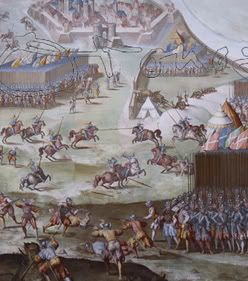
David
Posted: Fri Mar 05, 2010 2:16 pm
by rbodleyscott
robertthebruce wrote:Richard, I know it´s not easy to believe that the celadas were LH, as Xavi says, all the spanish resources talks about them as light Horse.
I realise this, but the meaning of the term "light horse" is not the same in every period of history, though it has a specific meaning in FOG. However many times sources call them "light horse" it does not necessarily mean they are FOG LH if they did not operate like FOG LH.
On the other hand, they do seem rather dispersed in the second picture (if - which itself is questionable - that can be taken as an indication of the normal battlefield formation) so giving them the option to be LH does seem reasonable.
Posted: Fri Mar 05, 2010 7:05 pm
by nikgaukroger
robertthebruce wrote:
I also think that some smaller tercios can be allowed:
Pikes 8-6 Bases
Arquebus- 8-6-4 Bases
I'm going to put them as 6-8 bases of each of pikemen and arquebusiers with a total size of 12-16 required. If we allow 4 bases of arquebusiers we can end up with them not counting as tercios which, IMO, would be odd for this period - leave that for Alba's tercios going to Flanders in the Early Spanish Imperila I think.
Posted: Fri Mar 05, 2010 7:12 pm
by nikgaukroger
Ghaznavid wrote:As the list is meant to cover the armies in Germany and especially those seen at SE (i.e. along the Ottoman borders) as well as those in Spain/Italy/Netherlands
Would it be sensible to cover the armies facing the Ottomans in the next book - which is the one with Ottomans in and will need to include a mid to late C16th Habsburg army anyway.
Or would the SE armies of this period be so similar (with the points made here) that we would just repeat the list in effect?
Posted: Fri Mar 05, 2010 7:13 pm
by robertthebruce
I'm going to put them as 6-8 bases of each of pikemen and arquebusiers with a total size of 12-16 required. If we allow 4 bases of arquebusiers we can end up with them not counting as tercios which, IMO, would be odd for this period - leave that for Alba's tercios going to Flanders in the Early Spanish Imperila I think.
I suggested the number of 4 for the aquebusier only because the some of the Tercios Nuevos were organized with 25% of arquebusiers at the begining, but really this did not long too much, and probably they has more arquebusiers when were deployed in battle.
Posted: Fri Mar 05, 2010 7:18 pm
by nikgaukroger
Ghaznavid wrote:
As for the herreruelos I'm afraid you overestimate my Spanish. Google suggests pistol armed mounted? If so I think Reiters would cover them just fine.
Afraid I've only a rather short narrative of the battle at hand, the only notable action by mounted it cites is Hungarian and Spanish hussars, supported by heavy mounted from Neaples (probably MAA) surrounding and capturing the opposing commander (most likely covered by his personal guard, although that isn't clear), Elector Prince Johann Friedrich I. of Saxony.
So it looks like we need some Hungarian hussars in this list to cover this.
Suggestions please.
I'm guessing that "Spanish hussars" will be Jinetes or Celadas.
Posted: Fri Mar 05, 2010 7:20 pm
by nikgaukroger
robertthebruce wrote:
German foot must be increased in Germany, in Mulhberg, there was 8.000 spanish men in Tercios and 16.000 landsknechts.
There was 900 hungarian horses and 21 artillery pieces too.
I have added the list notes:
"Minima marked * does not apply to armies in Germany." - *ed the Colunela minimum.
"Armies in Germany must have more Landsknecht, Walloon and Flemish infantry battle groups than Colunela or Tercio battle groups."
How does that sound?
Posted: Fri Mar 05, 2010 7:33 pm
by Ghaznavid
nikgaukroger wrote:Ghaznavid wrote:As the list is meant to cover the armies in Germany and especially those seen at SE (i.e. along the Ottoman borders) as well as those in Spain/Italy/Netherlands
Would it be sensible to cover the armies facing the Ottomans in the next book - which is the one with Ottomans in and will need to include a mid to late C16th Habsburg army anyway.
Or would the SE armies of this period be so similar (with the points made here) that we would just repeat the list in effect?
Good question. A separate list would be similar, but with some unique elements and varying availabilities of the various troop types (especially after Hungary is split between the Ottomans and the Habsburger in 1527). It can be done all in one list, although it might complicate an already not very simple list. A separate list would have a bit of "sameness", though (but probably less so then some say some mongols lists in FoG:AM) and might be ok, given the theme book approach.
The big question is probably the Habsburgian Netherlands as I'm afraid neither the current list nor one for the Hungarian/Austrian border with the Ottomans would really cover the armies there.