Page 1 of 1
Crusading ideas
Posted: Wed Mar 03, 2010 7:16 am
by BlackPrince
The Norwegian Crusade like most visitors to the Holy land arrives at Acre. Travelled on to Jerusalem and picked up a few relics in the bazaars followed by dip in the Jordan River. On the way back to the boats stop off and help out at the siege. The siege of Sidon as far as I know did not involve a field battle so it does not meet your criteria to be added as an ally.
You are right that all Western European Armies comprised of the same basic building blocks; Knights, Defensive Spear and Crossbows. Though most armies had small differences, and a bit of variety that is not reflected in the Crusader army list.
The second crack at Egypt was by Louis IX in 1249, it was the best organised and prepared Crusade the French forces numbering between 15,000 to 25,000 sailed directly from France to Egypt. The army that fought the river crossing battle at Mansurah was a Feudal French army supported by the Crusaders. At a critical point in the late battle on sunset was the Constable arrived with the King’s unmounted Crossbowmen and screened the Knights forcing the enemy to disengage. Clearly the French had household troops present.
Prior to leaving on the Third Crusade the 3000 Welsh archers and spearmen took the cross in 1188 but due to the two year delay in leaving the actual numbers were a lot less. Richard I wanted to take Welsh and English archers and the Clergy recruited them. Another example of the colour of the English army on the Third Crusade is from Norman Housley’s Fighting for the Cross;
Observers were astonished by the number of robbers, highwaymen and murders who took the cross at Usk in 1188.
Richard has the crime rate in your neighbour been little low for the past 1,000 years?
Keith
Posted: Tue Mar 09, 2010 12:24 am
by BlackPrince
Richard I sailed to the Holy Land with a fleet of more than100 transport ships of which he paid 2/3 of the cost for each boat to transport the English contingent for the Third Crusade. While some of these ships would be carrying horses, supplies and hanger-oners it would still leave a lot of space soldiers.
Philip Augustus of France paid for the transport of his personal retinue and mates of 650 Knights and 1500 sergeants. The rest of the French contingent made their own way to the Holy Land.
Posted: Tue Mar 09, 2010 7:46 am
by rbodleyscott
Thanks Keith
Posted: Wed Mar 10, 2010 2:16 am
by BlackPrince
Picture and legend from Early Blazon at
www.earlyblazon.com
Commander- in-chief : Richard.
1st battalion: Templars
2nd battalion: Bretons and Angevins knigths
3rd battalion: Poitevins knights under Guy de Lusignan
4th battalion: Normans and English knights with the royal standard
5th to 11th battalion: French knights from France and Syria and miscellaneous small contingents from other lands. French under the duke of Burgundy.
12th battalion: Hospitallers
(pink coloured rectangles) Infantry
(red coloured rectangles) Archers and crossbowmen
Baggage / resting infantry
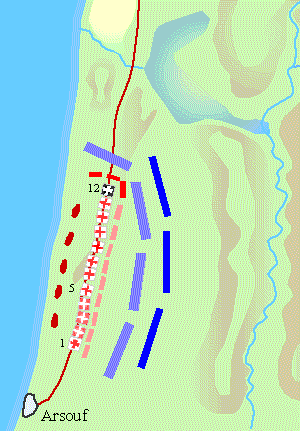
From “fighting for the Cross” by Norman Housley about the Battle;
Their (crusaders) western flank was protected by the Mediterranean and the English ships, and their vulnerable baggage train proceeded alongside the sea. It was sheltered from attack by the main army, whose divisions were in turn shielded by a force of infantry marching on the army’s eastern flank. This force suffered the most from enemy harassment, so Richard alternated periods of service in this unit with breaks that were spent marching with the baggage train. The system worked.
Richard’s skill is shown as firstly he recognised the need the give units a break from the constant harassment. Secondly that he could up units out of the line and swap them over without causing total confusion it is remarkable for so called Feudal Medieval army. The infantry’s performance shows considerable skill which is not available with the undrilled spearmen and crossbowmen the Later Crusader army list. If Crusader army was allowed to use the mercenary spearmen and crossbowmen that both the English and French army list of this time have it allows this type of action. While there would have been some undrilled infantry present there would have had to have been a considerable amount of drilled troops for this to work. The use of Archers and Crossbowmen in the rearguard makes sense from a tactical point of view also demonstrates they could be rely on to turnabout easily to either shoot at the enemy or catch up with the rest of the army.
[/img]
Posted: Wed Mar 17, 2010 4:16 am
by BlackPrince
From Gabrieli, Arab Chronicles of the Crusades, 56-9
“24 July 1148 the Muslims challenged them to fight, and the battle began. The army from Damascus had large numbers of auxiliaries; experienced Turkish storm-troopers, the citizen militia and volunteers fighting for the Faith. After a fierce struggle the Franks, superior in numbers and equipment, overwhelmed the Muslims, seized the water supplies and encamped in the gardens surrounding the city. They closed in on the city walls, coming up closer than any army in ancient or modern times had ever been.”
It would appear that during the second crusade there was a reasonable size field battle at the siege of Damascus. This means you need to allow for the German and French armies. The English fleet of between 164 to 200 ships sailed from Dartmouth in 1147 for the Second Crusade though they all help out at the siege of Lisbon some then continued on to the Holly Land. These English crusaders can be accounted for it the French army list options.
Personally I would keep the Later Crusader as is except removed the Third Crusade campaign option and rename the list something like The Kingdom of Jerusalem and the Outremer. The list is fine for the Crusader armies outside the major Crusades and is suitable for all their battles including the cock up at Hattin. For the Second, Third, seventh crusades and the odd occasion such as the Battle of al-Buqaia. Where a large contingent of French turn up;
From Wiki
While Shirkuh campaigned in Egypt, Nur ad-Din mounted an offensive in Lebanon. Following Latin policy, King Amalric took an army to support his northern vassals, Bohemund III of Antioch and Raymond III of Tripoli. Fortuitously, a large group of French pilgrims led by Hugh VIII of Lusignan and Geoffrey Martel, the brother of William IV of Angoulême, joined the king of Jerusalem. In addition, Konstantinos Kalamanos, the governor of Cilicia brought his Greek warriors to assist the Crusaders. Nur ad-Din was no match for such a formidable combination of enemies and his army suffered a defeat. Both Muslims and Franks were impressed by the fighting qualities of the Byzantine soldiers.[4] The negative result of al-Buqaia only made Nur ad-Din more keen for revenge.[5]
I feel creating another list perhaps called European Crusader with the common pieces of the Feudal English, Feudal French, Imperial German and Later Crusader army lists. Then add same optional troops types form each list to give it the nationalistic favour would do more justice to the Crusaders.
Posted: Wed Mar 17, 2010 8:59 am
by rbodleyscott
BlackPrince wrote:It would appear that during the second crusade there was a reasonable size field battle at the siege of Damascus. This means you need to allow for the German and French armies.
In what way would these differ from the troops in the Crusader list? (Which is, in fact, meant to cover such contingents).
My view is, not at all, in terms of troop classifications. All the little twiddles in their home lists are usually minority types that would be unlikely to be sufficiently numerous in a crusading force to justify the inclusion of even a minimum sized battle group.
It is not our policy to provide spurious "flavour" when it isn't historically justified.
So what do you think is missing from a historical representation of those contingents? The only thing that I can immediately see is that there should be a provision for them to be treated as ally contingents.
Posted: Thu Mar 18, 2010 4:43 am
by BlackPrince
Below is the Imperial force composition for the Third Crusade though this army never made it to the Holy Land. Conrad’s army which made it to the Holy Land for the Second Crusade and was at the siege of Damascus numbered only 20,000 but the force mix would been simular.
downloaded from
www.earlyblazon.com 1/2
Imperial Army, 3rd Crusade, by Mark Benton
Frederick Barbarossa,
Knights- 4,200
Junkers, Ministriales, Sergeants, and other heavy cavalry- 17,000
Foot sergeants (Swabian swordsmen, Burgundian spearmen, Lowland archers) -
perhaps as many as 50,000
Non-combatants and support troops- 10,000
Those that joined later
Conrad Otto, duke of Bohemia and Moravia
Godfrey, duke of Lower Lorraine
Henry III, duke of Limburg and his son eldest son and heir Waleran
Otto II von Henneberg, bishop-prince of Speyer
Rogier de Waurin, bishop-count of Cambrai
Louis von Thuringen, landgrave of Thuringia
Leopold von Babenburg, duke of Austria and Styria
Perhaps as many as 800 knights, 3,400 other cavalry, and 12,000 infantry
Based on the foot sergeants making up 75% of the army it means Conrad had 15,000 infantry at Damascus consisting of Swabian swordsmen, Burgundian spearmen, Lowland archers or in FoG terms 60 bases not all of which are undrilled Defensive Spearmen.
Richard this part answers your one of questions but I have realised I have been arguing this arse about it is not the Crusaders who should have allies or extra troops added to their army list but they should be allied to a major European Crusading country. See my next post for more details.
Posted: Thu Mar 18, 2010 4:45 am
by BlackPrince
The Second Crusade consisted of 20,000 Germans and 15,000 French.
The Third Crusade consisted of 15,000 English, 4,000 French
The Seventh Crusade consisted of 15,000 to 25,000 French
All these Crusades one of the European rulers took a leading role in the Crusades and really the Crusader States were allies. As the Crusaders provided advice during the Council and had an influenced in the direction of the Crusade but once the combined armies took to the field the European ruler largely took control. So maybe each of the European army lists should have a campaign option for the Crusade where leader played the pivotal role and allow the army list to have a Later Crusader Ally. For example;
The Third Crusade the Early Plantagenet English army list should have a Third crusader campaign option of Later Crusader and Feudal French allies.
This would be a minor change and save the hassle of rewriting an army list and the can of worms it may open. The changes could even go out as part of errata.
Posted: Fri Apr 23, 2010 6:32 pm
by Berserk27
BlackPrince wrote:The Second Crusade consisted of 20,000 Germans and 15,000 French.
The Third Crusade consisted of 15,000 English, 4,000 French
The Seventh Crusade consisted of 15,000 to 25,000 French
All these Crusades one of the European rulers took a leading role in the Crusades and really the Crusader States were allies. As the Crusaders provided advice during the Council and had an influenced in the direction of the Crusade but once the combined armies took to the field the European ruler largely took control. So maybe each of the European army lists should have a campaign option for the Crusade where leader played the pivotal role and allow the army list to have a Later Crusader Ally. For example;
The Third Crusade the Early Plantagenet English army list should have a Third crusader campaign option of Later Crusader and Feudal French allies.
This would be a minor change and save the hassle of rewriting an army list and the can of worms it may open. The changes could even go out as part of errata.
Hello I'm berserk and I'm french,
I think for the seventh crusade, the later crusader list is good and the best historical choice: (source "armies and ennemies of the crusades" WRG very goog book)
Frankish army was composed of a number between 20.000 and 40.000 crusaders.
- 1800-2500 french knights
- 5000 archers (in english when you said "archer" it is just bowmen or bowmen and crossbowmen?)
- 400 achaian knights
- 200 english knights
and 700-1000 templars, hospitaller, cypriot and syrian frankish knights
During the Mansourah Battle, the bedouin attacked the moslem baggage, the bedouin allied list is an credible option..
The footmen were on the other side of the river and couldn't partcipate at the battle. but i think it is the spearmen troop oif the list?
Posted: Fri Apr 23, 2010 7:57 pm
by philqw78
Berserk27 wrote:
Hello I'm berserk and I'm french,
Best introdustion ever. Couldn't concentrate to read the rest of the post. F Brilliant.
I'm going to have to post this on the main forum
Posted: Fri Apr 23, 2010 8:52 pm
by Berserk27
philqw78 wrote:Berserk27 wrote:
Hello I'm berserk and I'm french,
Best introdustion ever. Couldn't concentrate to read the rest of the post. F Brilliant.
I'm going to have to post this on the main forum
I said this to explain the english mistakes....
Thank you for your wonderful comprehension!
Posted: Fri Apr 23, 2010 11:57 pm
by philqw78
Berserk27 wrote:philqw78 wrote:Best introdustion ever.
I said this to explain the english mistakes....
Thank you for your wonderful comprehension!
I can't spell either
Posted: Sat Apr 24, 2010 12:00 am
by philqw78
The only bit I could translate was "Les chevaliers anglais" Which means "knights that are so bad they do not count as having lances".
Posted: Sat Apr 24, 2010 8:52 am
by Berserk27
The english knights during the battle of the Mansourah were very good...
They followed Robert d'Artois with the templars in the city of Cairo where they perished one after the other.
In my army list, they are "Lancers Swordmen troops". And finally at that time they spoke French ...

No reason to class this knight other than lancers

Posted: Sun Apr 25, 2010 9:31 am
by ShrubMiK
>They followed....<snip>...where they perished one after the other.
Without more information, that sounds more like meaning "they were rubbish, but too stupid to realise it"
Posted: Sun Apr 25, 2010 10:45 am
by Berserk27
Ok ;
We are in 1250, Louis IX and is frankish army are captured the city of Damiette and they want fight the egyptian (the master of Jerusalem in this time).
But they are a big probleme, between Cairo and Damiette, an arm of the Nil...
During severals weeks, the frank try to build a dam but the egyptian with bowmen and napphatum break the frankish project.
But a egyptian (or bedouin) knows a passage to trought the Nil by foot. And the frank buy this information.
The tomorrow, The Vangard commanded by Robert d'Artois trought in first the nil and must wait the rest of the army.
But he doesn't want follow the order and he attacks and suprises the egyptian army in their baggage. The battle is won.
But he wants follow the rest of mamluk army who escape to Cairo.
The legend said: A deaf knight pull by briddle Robert d'Artois and he can't hear the order. The templars must be follow the chief of vanguard for not be seem as cowards (with English knights i think).
In the city, fights is very hard for the knight, the egyptian soldiers cut the retreat and throw many object from the housetops.
Finally just four knights of the Vanguard witch Guillaume de Sonac master of templars, escape from Cairo....
The seventh crusade is lost....
Posted: Wed Aug 25, 2010 4:07 am
by BlackPrince
John of Joinville mentions at the battle a company of dismounted crossbowmen arrive at the river crossing and their shooting drives of the Mamluks and saves the day then everyone heads for Cairo. What I have not been able to work out does John mean infantry foot crossbowmen or genuine mounted crossbowmen who happen to dismount for this battle. I think it is the latter and using a European list for the big Crusades rather than the Later Crusader list would be a better and more accurate option which is were I disagree with RBS.[/list]