Page 1 of 1
(Greek tactics ?) Fascinating duos
Posted: Wed Feb 04, 2026 8:43 am
by Athos1660
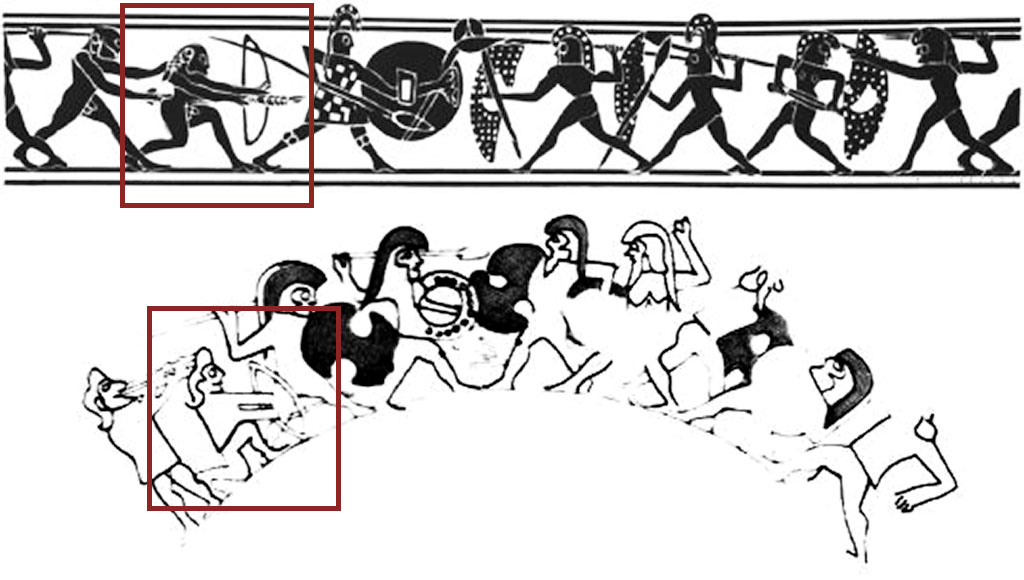
Archaïc/Classical Greek vase painting show fascinating duos of 1 Heavy/Medium man and 1 Light man, such as:
- 1 hoplite and 1 archer
- 1 cavalryman and 1 Light Javelin/Archer Horse
- etc.
fighting as a duo during battles :


Vase painting is Art, not documentaries. However...
Re: (Greek tactics ?) Fascinating duos
Posted: Wed Feb 04, 2026 4:59 pm
by MVP7
Definitely interesting groupings. Do you know what time period the painting are from? They could be depicting Troyan or Persian wars using local and contemporary arms and armors, similarly to how renaissance or early modern art might depict biblical events with people dressed and equipped in the then contemporary (15th-17th century) style.
Re: (Greek tactics ?) Fascinating duos
Posted: Wed Feb 04, 2026 5:49 pm
by Athos1660
Looks like Attic black-figure pottery ca. 550-480 BC.
Some see those duos as an Hoplite (mounted or not) and his hyperetes, a man by whom the hoplite was accompanied when he took the field, and who carried the luggage, the provisions and the shield of the hoplites (Xen. Cyrop. 2.1, § 31) and who served as light troop (on foot or mounted).
About the Classical Greek warrior types up to 480 BC, R. Nelson writes in Armies of the greek and persian wars 500-350 BC : "From vase painting, it appears that archers were postionning between the hoplites in the phalanx, and fired from a partial shelter of the hoplite's shields, normally in a kneeling position."
... most likely before the infantry lines met, then they would move away the phalanx (?).
Re: (Greek tactics ?) Fascinating duos
Posted: Wed Feb 04, 2026 8:58 pm
by Ray552
Thanks for posting these, reminded me of Ajax the Great and his half-brother Teucer in the Iliad.
Re: (Greek tactics ?) Fascinating duos
Posted: Thu Feb 05, 2026 5:10 pm
by MVP7
Athos1660 wrote: Wed Feb 04, 2026 5:49 pm
Looks like Attic black-figure pottery ca. 550-480 BC.
Some see those duos as an Hoplite (mounted or not) and his hyperetes, a man by whom the hoplite was accompanied when he took the field, and who carried the luggage, the provisions and the shield of the hoplites (Xen. Cyrop. 2.1, § 31) and who served as light troop (on foot or mounted).
About the Classical Greek warrior types up to 480 BC, R. Nelson writes in
Armies of the greek and persian wars 500-350 BC : "From vase painting, it appears that archers were postionning between the hoplites in the phalanx, and fired from a partial shelter of the hoplite's shields, normally in a kneeling position."
... most likely before the infantry lines met, then they would move away the phalanx (?).
Thanks. I recall reading that early (i.e. Greek dark ages) Hoplites carried javelins (might have been R. Nelson's book) but later increasingly focused on just their core role of heavy infantry. It wouldn't seem impossible that the missile capability would have been augmented and gradually replaced by archers mixed in the formation before likely(?) being removed entirely from the phalanx to the separate light infantry element.
I imagine it would have been pretty difficult to have light infantry shooting and maneuvering inside a tight classical hoplite formation with all the large shields in the way and the integrity of the formation being of utmost importance to the outcome of the battle (unlike the sporadic arrows).
On the other other hand, assuming the 6th/5th century BCE timing of the painting, they could be fictional depictions of Troyan war/Iliad (where archers are prominents) or it could be contemporary to the Greco-Persian wars, depicting Sparabara/Immortals but in the Greek style that the artisan would be familiar with.
Does anyone know what those pointy hats the archers and one of the cavalrymen wear are? Were they used by the Greeks or are they specific to some other group? If you look at the kneeling archer in the middle picture, he's wearing pants and patterned fabric that seem more Persian (or Scythian) than Greek.
Here's an interesting article from the site Ancient World Magazine:
https://www.ancientworldmagazine.com/ar ... nt-greece/
The article has a picture of older paintings from the late 8th and early 7th centuries BCE. Definitely seems like mixed archers would have been a part of Greek formations in the Homeric period but did the practice continue into the Classical period?
Re: (Greek tactics ?) Fascinating duos
Posted: Fri Feb 06, 2026 6:09 am
by Athos1660
Oh ! It is easy to make up dozens of nice hypothesis giving opposite answers to your questions. It's been done by scholars for more a century :
- from Agnes Plassart's paper in 1913 about the Athenian archers,
- to the model of Hoplite combat from Hans van Wees’s school (see here, from 21’53) ‘based on more individual combatants and less on this homogeneous block of hoplites fighting. In their view, the battle was the sum of single combats happening along the front line rather than just a tight mass that jammed itself into the enemy. Massed along with them in battle there would be along with the hoplightes there would be light troops archers and even cavalary can sometimes come together in this sort of swirling mass of a motley crowd. Their combat would take place over a extended period of sort of hit and running groups coming together fighting and pulling apart and um intermingled with all kinds of other troops.’
Anyway, prior to this, there is a very annoying question : Can we trust what we can see on Greek vase painting as being a faithful representation of what actually happened in real life ? Experts are sceptical.
Re: (Greek tactics ?) Fascinating duos
Posted: Fri Feb 06, 2026 6:17 am
by Athos1660
There is also the Lion Hunt Dagger blade (Grave Circle A, Mycenae, 16th century BC) :

Re: (Greek tactics ?) Fascinating duos
Posted: Fri Feb 06, 2026 4:21 pm
by fogman
Pre-modern artistic production (with a defined market/for a patron) obeyed particular canons. Military historians often ignore, or are ignorant of, those canons.
"As has been demonstrated in various studies of the iconography involved, battle-scenes in Attic vase-painting are definitely not illustrations of real events, nor scenes ‘drawn from every-day life’,as was often assumed in the 19th century and is still believed by certain scholars today."
"The images in Attic vase-painting constitute a stable system, something in the way of a graphic language, in which many details possess a well-defined meaning comprehensible for the beholder. In this figurative code of the Archaic period the heroic status of a character was conveyed via his hoplite attire. In order to convey the image of the companions of the main hero - the heroes of second rank, such as his armour-bearers - images of non-hoplite soldiers were used. The non-hoplite soldier, who had to be easily distinguishable from the main hero-hoplite, was usually depicted in the guise of a lightly armed archer dressed in special attire, which modern scholars take to be Scythian."
Askold Ivantchik
"'Scythian' Archers on Archaic Attic Vases: Problems of Interpretation"
in Ancient Cilvilizations from Scythia to Siberia 12(3-4):197-271