Page 1 of 3

AAR - Joe (Axis) vs Ronnie (Allies) w/BJR (Allied Eyes Only)

Posted: Sat May 02, 2009 5:36 pm
by rkr1958
Joe (Axis) versus Ronnie (Allies)This AAR will be written from my (the Allied) point of view and will be played using CEaW version 1.12 with the BJR mod w/tweaks applied. The tweaks include: (1) Port of Cherbourg move from directly north of the city to the hex southwest of it, (2) A New House rule requiring a leader be deployed in a capital of each major European Country (i.e., Britain, France, German, Italy & USSR) one turn after activation, (3) Moved the British motorized unit from Southampton to south of Birmingham, (4) Added a garrison in Southampton, (5) Added a garrison northeast of London, (6) Changed the at start PP’s to Germany and Britain: 70, France, Italy and Russia: 40 (to offset the cost of the having to buy a leader for the capital) and (7) new "Country.class" file that prevents the Axis oil from dropping below -1 during the Allied turn.

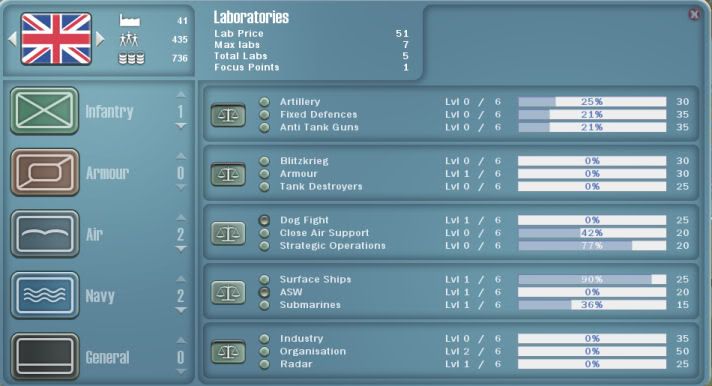
September 1, 1939. Poland Invaded. UK builds research lab #1 (Navy with focus in ASW). (UK.Lab(1)=Navy->ASW(1))

September 21, 1939. Poland conquered. Denmark Invaded.

October 11, 1939. Denmark conquered.

November 20, 1939. Holland invaded and conquered. UK.Lab(2)=Air->DF(1)

December 10, 1939. Belgium invaded and conquered. French navy hits German tank corps on the coast and knocked of two steps. UK.Lab(3)=Inf(1), USA.Lab(1)=Navy->ASW(1), and USSR.Lab(1)=Inf(1).

December 30, 1939. German attack on France Begins in earnest. UK.Lab(4)=Navy->ASW(2).

April 8, 1940. Paris will fall next turn. No doubt about it. UK.Lab(5)=Air->DF(2).

Posted: Sat May 02, 2009 5:39 pm
by rkr1958
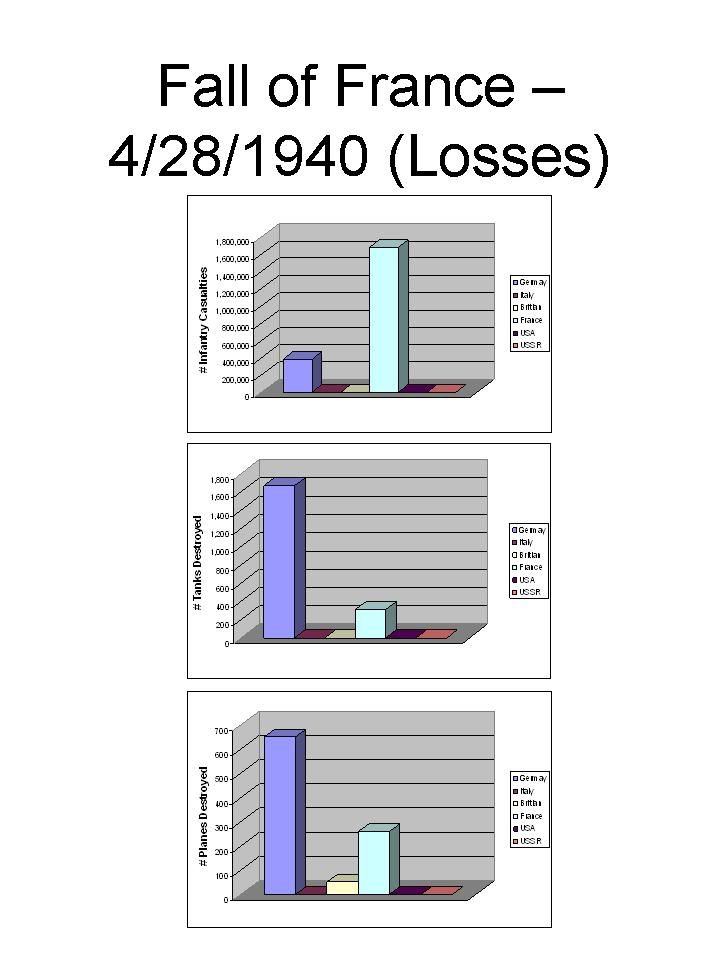
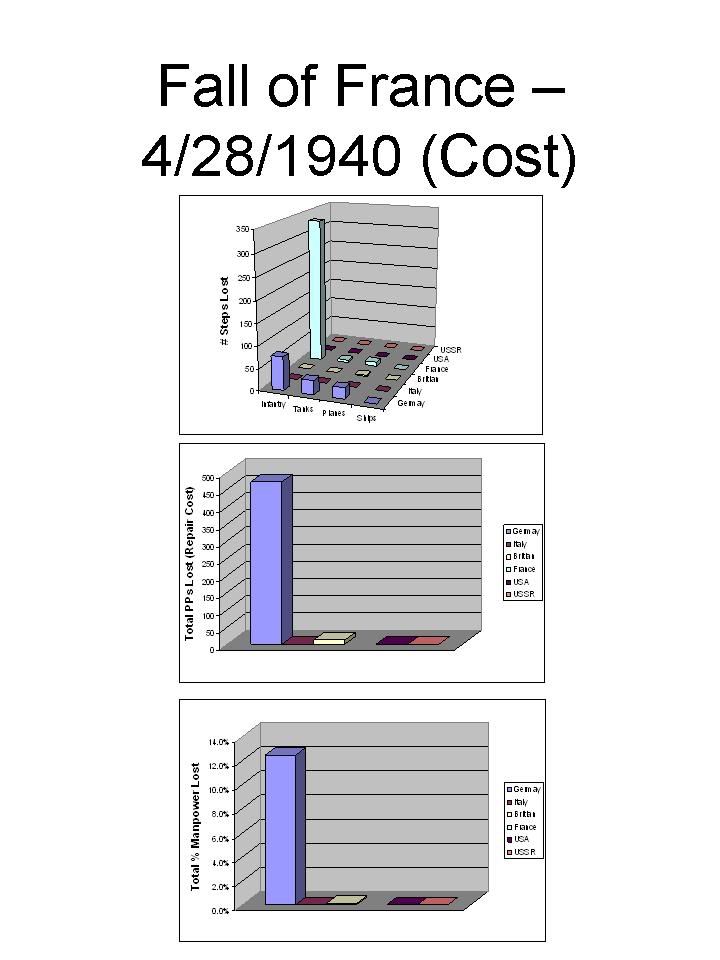
April 28, 1940 Paris falls and France surrenders. I really waned to hold out until May but Joe is relentless on the attack. Picture 1 shows the casualties and Picture 2 the cost summaries for the war up to now. Repair cost for the step losses that the Germans have taken since the start are estimated at 472 PPs and 12.5% manpower. Note that manpower can go above 100% what this 12.5% manpower loss means is that the German manpower level at whatever level it is right now would be 12.5% higher than it is now.

Image
Picture 1. Casualties Through April 28, 1940

Image
Picture 2. Estimated Repair and Manpower Cost for Casualties Through April 28, 1940

Re: AAR - Joe (Axis) vs Ronnie (Allies) w/BJR (Allied Eyes O

Posted: Sat May 02, 2009 5:57 pm
by raffo80
rkr1958 wrote:Joe (Axis) versus Ronnie (Allies)This AAR will be written from my (the Allied) point of view and will be played using CEaW version 1.12 with the BJR mod w/tweaks applied. The tweaks include: (1) Port of Cherbourg move from directly north of the city to the hex southwest of it, (2) A New House rule requiring a leader be deployed in a capital of each major European Country (i.e., Britain, France, German, Italy & USSR) one turn after activation, (3) Moved the British motorized unit from Southampton to south of Birmingham, (4) Added a garrison in Southampton, (5) Added a garrison northeast of London, (6) Changed the at start PP’s to Germany and Britain: 70, France, Italy and Russia: 40 (to offset the cost of the having to buy a leader for the capital) and (7) new "Country.class" file that prevents the Axis oil from dropping below -1 during the Allied turn.

9/1/1939. Poland Invaded. UK builds research lab #1 (Navy with focus in ASW). (UK.Lab(1)=Navy->ASW(1))

9/21/1939. Poland conquered. Denmark Invaded.

10/11/1939. Denmark conquered.

11/20/1939. Holland invaded and conquered. UK.Lab(2)=Air->DF(1)

12/10/1939. Belgium invaded and conquered. French navy hits German tank corps on the coast and knocked of two steps. UK.Lab(3)=Inf(1), USA.Lab(1)=Navy->ASW(1), and USSR.Lab(1)=Inf(1).

12/30/1939. German attack on France Begins in earnest. UK.Lab(4)=Navy->ASW(2).

4/8/1940. Paris will fall next turn. No doubt about it. UK.Lab(5)=Air->DF(2).
Why these rules:
- leader in each capital?
- why adding garrisons to UK? they have already a lot...

And a question: 472PP damage to germany is a lot. how did you make that?

Posted: Sat May 02, 2009 6:11 pm
by rkr1958
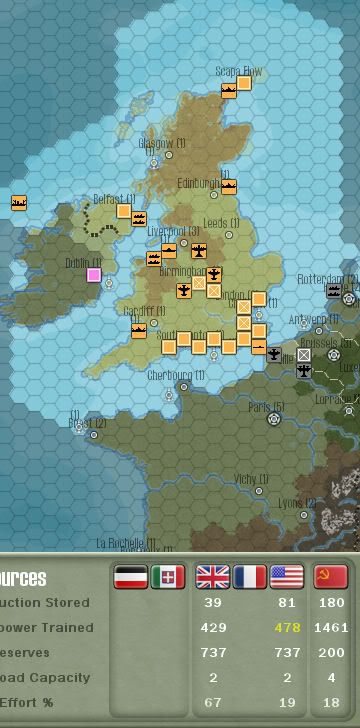
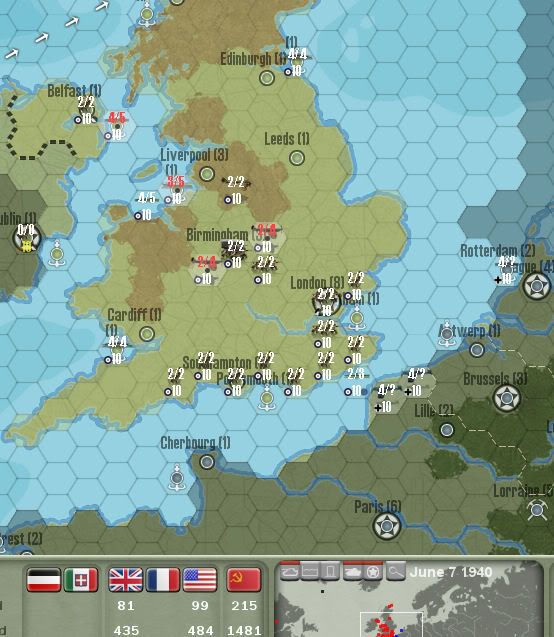
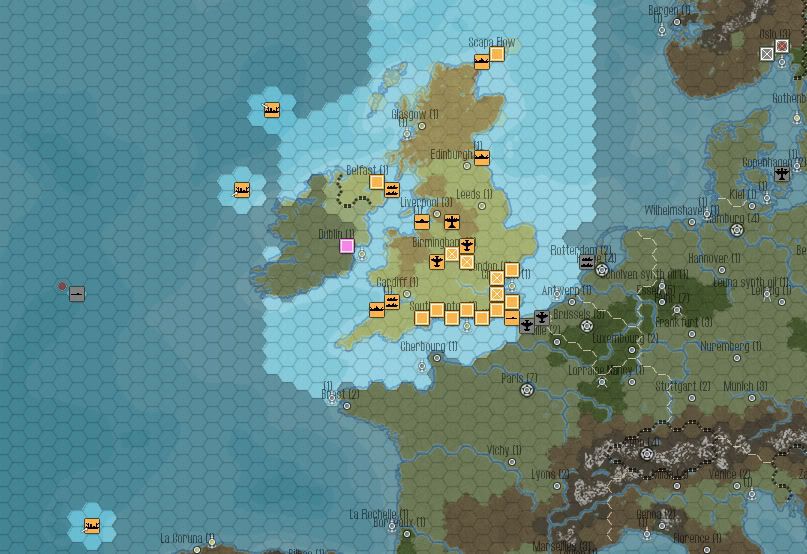
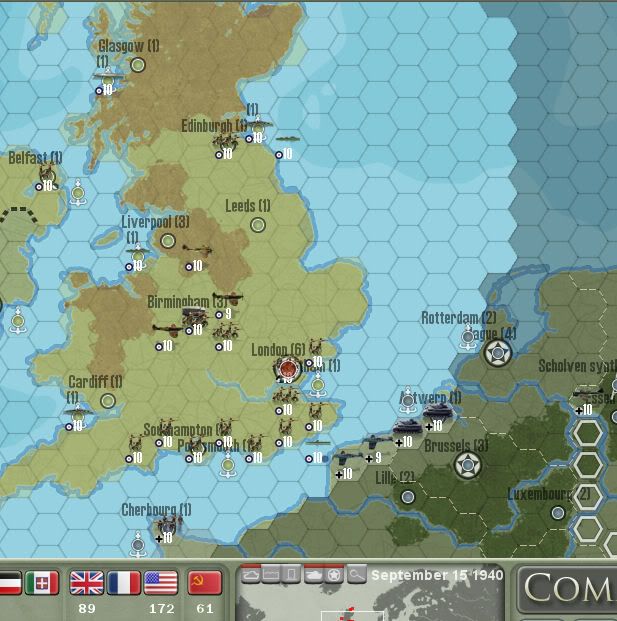
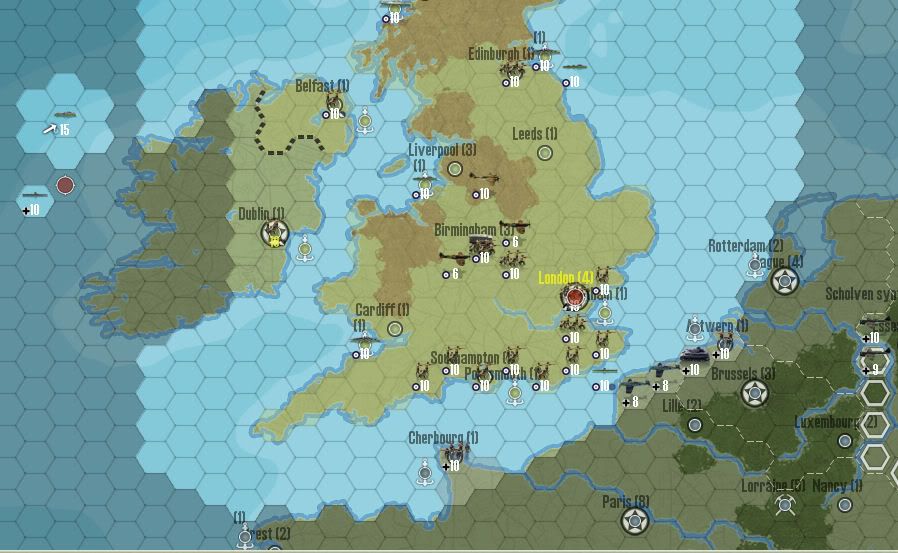
May 18, 1940 No action. Egypt entered the war. The British are bracing themselves for a possible Sea Lion. They know that the Germans will have an advantage in the and will try to target the Royal Navy in order to inflict casualties on both the RN and RAF. In defense against Sea Lion the British have built and deployed an additional two infantry corps and they have their sub holding the choke point two hexes south of Chatham (i.e., port southeast of London). The decision was made to move the two UK BB fleets position in Portsmouth and Chatham out of harms way from Axis air strikes. If Joe decides to execute Sea Lion I was resist with the goals of: (1) holding out as long as possible and (2) inflicting as many losses on the Germans as I can with two overriding objective of preserving the Royal Navy and Royal Airforce. This doesn't mean that I won't avoid losses to these units, or even the loss of a naval unit or two, but under no circumstances can I afford losing the capability of either of these services. Also, I will take a passive strategy in the Egypt will the goal of keeping the Axis out of the Iraqi oilfields. This means, if he attacks into Egypt, delaying him long enough until I can safely wrt/defending against Sea Lion reinforce this theater. One thing I can't defend right now are my convoys. They're own their own. I don't know who this quote is originally from but, "He who defends everything defends nothing."

Image
Picture 3. UK Sea Lion Defense (in progress).

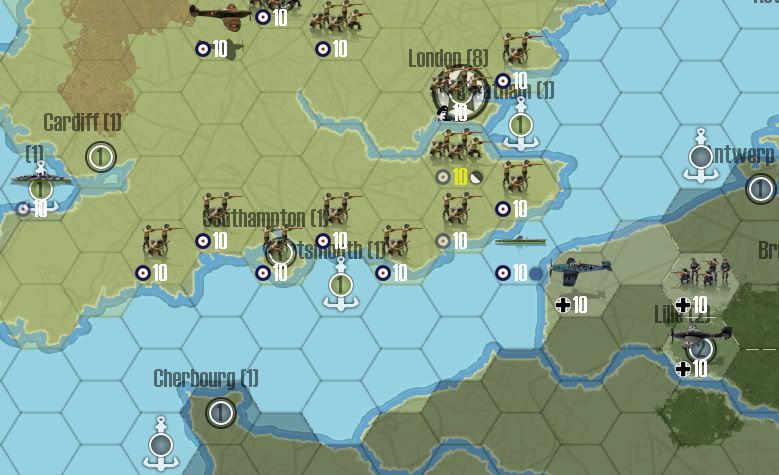
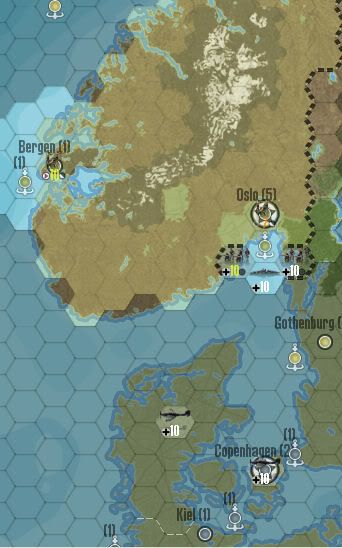
Picture 4, which is a zoom of Picture 3, shows off some of the tweaks currently under evaluation to the mod. Specifically, moving the port of Cherbourg and the UK leader in London. By the way, that's Monty who's in overall command of the UK home defense forces. Note the UK sub on patrol and holding the east Channel choke point.

Image
Picture 4. Potential BJR Mod Tweaks

Re: AAR - Joe (Axis) vs Ronnie (Allies) w/BJR (Allied Eyes O

Posted: Sat May 02, 2009 6:19 pm
by rkr1958
raffo80 wrote: Why these rules:
- leader in each capital?
- why adding garrisons to UK? they have already a lot...
To improve the efficiency of UK home guard units to better defend against Sea Lion. We moved the port of Cherbourg to prevent the tactic of a unit loading on a transport next to this port when this port is occupied and skipping the channel and winding up next to the English coast on the same turn. This allowed for the unit to invade the same turn that it was loaded.

Note that the leader requirement also applied to France, which did have a leader before it's fall. Also, note the fall date for France that this really have a big (if any) impact on the Battle of France, which is what we wanted. Additional garrisons were added to help the UK defensive position against Sea Lion without increasing their offensive capability. These garrisons along with the others represent the huge home guard force that Britain assembly in 1940 to protect against German invasion.
raffo80 wrote:And a question: 472PP damage to germany is a lot. how did you make that?
I developed a spreedsheet that converts the casualties tracked by CEaW into step losses by infantry, armor, air and ships. I then used the CEaW repair cost (i.e., 60% of the build cost) and manpower cost (i.e., 100% of the build cost) for repairs of these steps to derive the PP and MP estimates.

Re: AAR - Joe (Axis) vs Ronnie (Allies) w/BJR (Allied Eyes O

Posted: Sat May 02, 2009 7:59 pm
by raffo80
rkr1958 wrote:
raffo80 wrote: Why these rules:
- leader in each capital?
- why adding garrisons to UK? they have already a lot...
To improve the efficiency of UK home guard units to better defend against Sea Lion. We move the port of Cherbourg to prevent the tactic of a unit loading on a transport next to this port when this port is occupied and skipping the channel and winding up next to the English coast on the same turn. This allowed for the unit to invade the same turn that it was loaded.

Note that the leader requirement also applied to France, which did have a leader before it's fall. Also, note the fall date for France that this really have a big (if any) impact on the Battle of France, which is what we wanted. Additional garrisons were added to help the UK defensive position against Sea Lion without increasing their offensive capability. These garrisons along with the others represent the huge home guard force that Britain assembly in 1940 to protect against German invasion.
raffo80 wrote:And a question: 472PP damage to germany is a lot. how did you make that?
I developed a spreedsheet that converts the casualties tracked by CEaW into step losses by infantry, armor, air and ships. I then used the CEaW repair cost (i.e., 60% of the build cost) and manpower cost (i.e., 100% of the build cost) for repairs of these steps to derive the PP and MP estimates.
it's ok, i just meant...472PP lost by germany is a lot. I just meant is quite an achievement for Allies.

Posted: Sat May 02, 2009 8:01 pm
by rkr1958
June 7, 1940. The UK got the following (and critical) tech upgrades this turn: Dog Fight Level 1 and ASW Level 1. They upgraded all four fighter units (two in the Med) from level 2 to level 4 and both CVs (one in the Med) from 3 to 5. Also, the DD fleet docked in Belfast got an upgrade from 4 to 5. These upgrades are significant as the Allies have intercepted German communications about an "Operation Eagle", which appears to be an operation designed to degrade the RAF and Royal Navy in preparation for "Operation Sea Lion". Allied intelligence services have determined with high confidence that Operation Sea Lion is the German plans for the invasion and conquest of England. Thus, the technology advance in dog fighting is a welcomed event.

Image
Picture 5. Critical Tech Upgrades

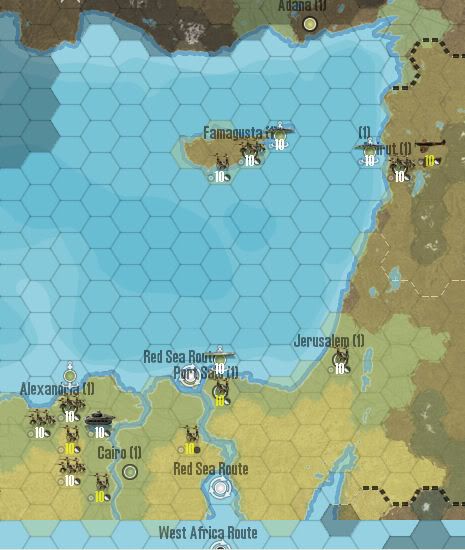
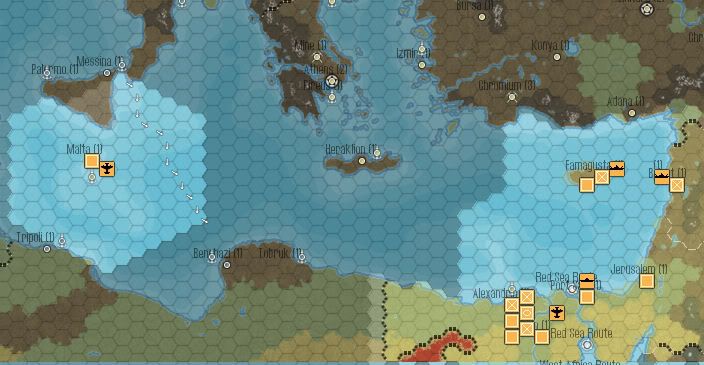
Italy joined the war this turn. Commonwealth forces in the eastern Med are headed to take up defensive positions just west of the Suez Canal. They have not arrived at their final defensive position. Note that they have also reinforced the defense on the island of Cyprus. While holding and keeping open the Suez Canal is a goal for this force the overriding objective is to keep the Middle Eastern oil fields out Axis' hands. A commander for this force is need. However; this need (in terms of PPs) must be balanced against the needs for the defense against Sea Lion / Eagle and for increased investment in research. Again, the Allied convoys must be left to fend for themselves. By the way, a German u-boat flotilla attack one of my convoys this turn.

Image
Picture 6. Commonwealth Eastern Med Defense

The UK ended this turn with a reserve of 41 PP's. This is lower than I would like. Even this has come at the price of having to delay the building of the two additional research labs that they could at the moment (if they had the PP's). Also this turn the USA.Lab(2)=Air->DF(2) and USSR.Lab(2)=Armor(1) each built an additional lab.

Image
Picture 7. UK Research Summary

Re: AAR - Joe (Axis) vs Ronnie (Allies) w/BJR (Allied Eyes O

Posted: Sat May 02, 2009 8:33 pm
by rkr1958
raffo80 wrote:it's ok, i just meant...472PP lost by germany is a lot. I just meant is quite an achievement for Allies.
Picture 8 is a summary of this cost for the five games, which I'm currently playing. I also included these data for my previous game with Joe, which we stopped to play this game and try out the new tweaks to the BJR mod.

Image
Picture 8. Fall of France Summary

Posted: Sat May 02, 2009 9:07 pm
by rkr1958
June 27, 1940. Germany invaded Norway this turn. The UK spent 2 PPs to reinforce the garrison defending Oslo from 4 to 7 steps. This investment will be worth it if it forces the Germans to use their air to finish him off. If this works it would keep one or both of his visible tactical bomber units away from Britain for one more turn. Norway is on their own. It's not worth risking RN or RAF units so that Norway might hold out a little longer or in the hope of bagging a German BB or DD fleet. Also, the Germans attacked one of my convoys but only with one u-boat flotilla. I'll bet you dollars to donuts that the other two u-boat flotillas are in the narrow waters between Norway and Denmark ready to ambush any UK naval units that foolishly ventured there. If that happened his two tactical bombers along with these u-boats would have a field day finishing them off. This is a case where the risk SIGNIFICANTLY outweighs any potential reward.

The UK built an infantry corps this turn and ended with 34 PPs. The UK has built 3 infantry corps over its at start forces. Also, the Brits are still in need for a commander of the Commonwealth forces in the eastern Med. This command will have to wait for now. The UK PP reserve needs to be built up in order to have a reserve to repair UK air (i.e., Operation Eagle), build additional infantry corps in case of Sea Lion and / or build a commander for the east Med if Jim decides to push there while he's got me tied up in England.

Image
Picture 9. Norway Invasion

Posted: Sat May 02, 2009 11:42 pm
by rkr1958
July 17, 1940 Norway fell; but , it looks like the Germans had to use one of their bombers to make it so. The only action by the Allies was an attack by the Malta fighter against the Italian fighter on Sicily. Even though the odds were 2:1 in favor of the Malta fighter, it lost 2-steps to the loss of 1 for the Italian fighter. Not the way I wanted it to turn out.

The UK ended its turn with 62 PPs. Below is the situation in the UK at the start of the turn. Notice that only one u-boat flotilla is active. Also, note that the convoys are not being escorted. I did move the DD in Cardiff out of port to make room there for the BB fleet. The DD was moved a little to the north.

Image
Picture 10. Conquest of Norway

Posted: Sun May 03, 2009 1:12 am
by OzHawkeye2
A good read. :D

Posted: Sun May 03, 2009 2:50 am
by rkr1958
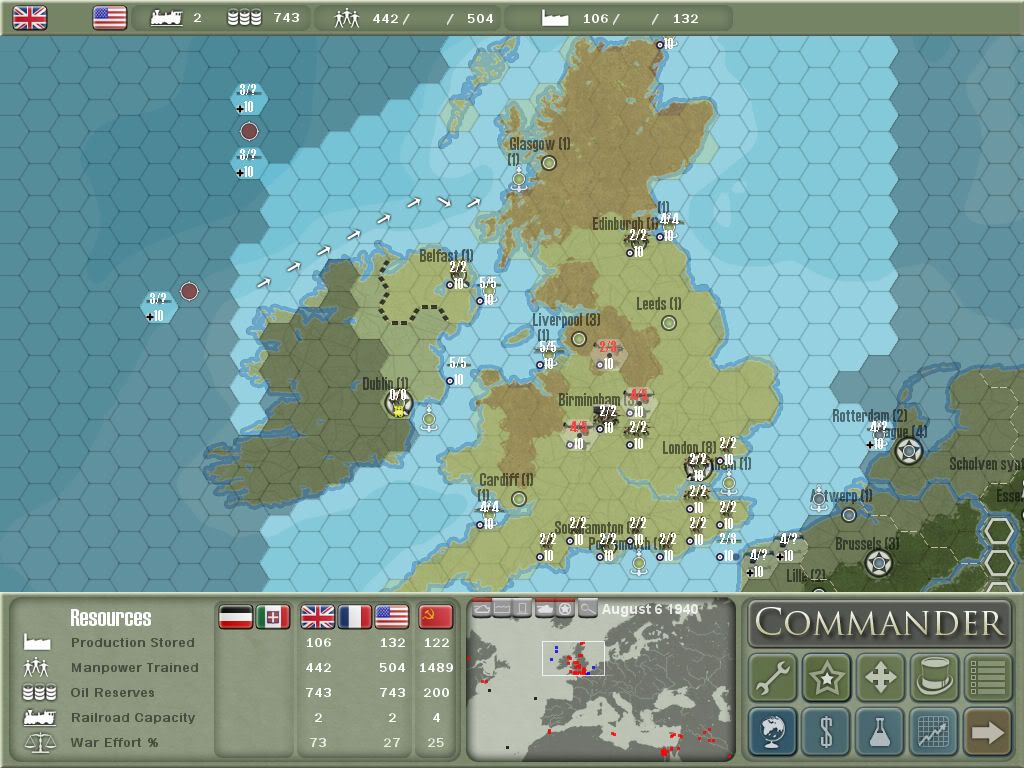
August 6, 1940. UK tech increase in Strategic Operations to Level 1 and started with 106 PP's. Three German u-boat flotillas attacked convoys this turn. They were identified (i.e., their unit name) as u-boat flotillas 1, 2 & 3, which are the three that the Germans began the war with. (Unless the Germans are being particularly devious and renaming their units to confuse the Allies. ) Assuming that the Germans haven't built and employed additional u-boat flotillas by now, or that they're being devious, this implies that German u-boats are probably not holding the west Channel choke points. The three known u-boat flotillas are two turns away from these choke points. Coupled this with the fact that the Germans haven't launched Operation Eagle (i.e., the Battle of Britain), Allied High Command estimates with high confidence that Sea Lion is unlikely for at least the next two turns.

The UK invested 50+ PPs in their six research lab, which was their first armor lab (UK.Lab(6)=Armor(1)). Also, they spent 17 PPs to upgrade the two fighter and strategic bomber units in England. In general and if possible I like to wait for multiple advances in tech for a given unit before upgrading. The advantage of this is that you only have to pay once for several upgrades. For each fighter unit I paid 6 PPs for the dog fighting level 1 upgrade and I just paid 6 PPs for strategic operations level upgrade. This cost me 12 PPs per fighter. If I had (or could) have waited I could have gotten both upgrades for 6 PPs per fighter. However; given the current threats the PPs spent for immediate and incremental upgrades are worth it. This upgrade from 4 to 5 gives my fighters a 20% tech advantage over their two German counterparts just across the channel. Thus, ~ 50 PPs were paid for the 6th research lab, 17 PPs for upgrading the air in England and 12 PPs to repair the two 2-steps lost by the Malta fighter last turn.

The fighter in Egypt was not upgraded this turn, but it may have to be soon based on the second picture. In this second picture British intelligence pick up movement of units for mainland Italy to Libya. At least one transported ground unit plus the fighter that was on Sicily last turn. British intelligence analysts are concerned that something is brewing in the eastern Med. While the eastern Med is without an overall commander this may have to change in a few turns depending on how things shape up there and around England.

Note that even though the risk of Sea Lion is reduced this could change quickly. Therefore; reinforcement of the eastern Med is not possible anytime in the near future. The British High Command have designated the Commonwealth forces in the eastern Med as the British 8th Army. Now all they need is a commander.

The UK ended their turn with 40 PPs and spent 66 PPs on worthy investments and upgrades.

Image
Picture 11. England

Image
Picture 12. Eastern Med

Posted: Sun May 03, 2009 11:02 pm
by rkr1958
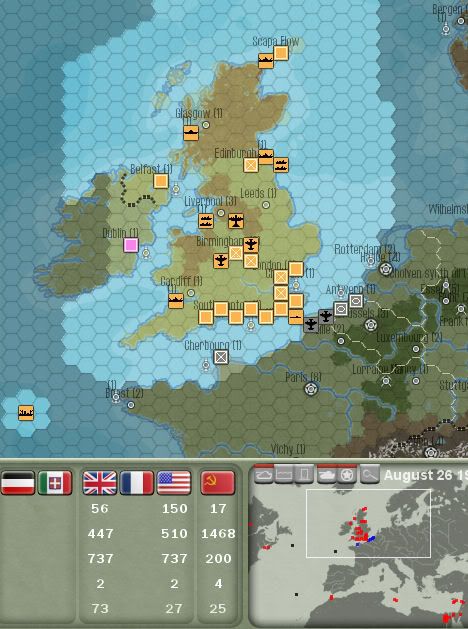
August 26, 1940. "Risk of imminent invasion" warnings went out all along the channel and southeast coasts of England. All armed forces were placed on "Highest Alert." All leaves canceled. England is bracing itself for Sea Lion. Why? The appearance of two armor corps at Antwerp and an infantry corps at Cherbourg and the absence of any u-boat activity this turn is why.

British intelligence estimates that the Germans are aware of the allied sub flotilla patrolling the east channel choke point. If his subs are to screen for an invasion to the east of this choke point (i.e., two armor corps +) then they would have to travel around Scotland. Potentially they could take up blocking position directly in front of the ports Scapa Flow and Edinburg. To mitigate this threat (slightly) the UK DD based at Belfast was move to the hex just southeast of Edinburg. Now if the invasion comes cross channel then German subs may already be in position and controlling the west channel choke points. Either way there will be a sub screen in place to block the Royal Navy's access to the amphibious transports. That much is sure!

If the Germans come then the goal is to hold out as long as possible and inflict maximum losses on the Germans while preserving the integrity and fighting capability of the Royal Navy and Royal Airforce.

All this begs two questions: (1) Have we done enough? (2) Or, is this a rouse to divert UK attention and resources from German intentions elsewhere?

Image
Picture 13. "Risk of imminent invasion!"

Posted: Wed May 06, 2009 4:46 am
by rkr1958
September 15, 1940. No Sea Lion! But Greece Invaded! Picture 14 shows the situation in England at the beginning of the Allied turn. The Luftwaffe strategic bombers hit London. RAF and German fighters clashed with both sides losing 1-step. UF 2 (u-boat flotilla 2) (not shown) attacked a British convoy west of Brest. But that wasn't where the most significant action occurred this turn. It occurred in Greece.

Image
Picture 14. Situation in England at Start of Turn

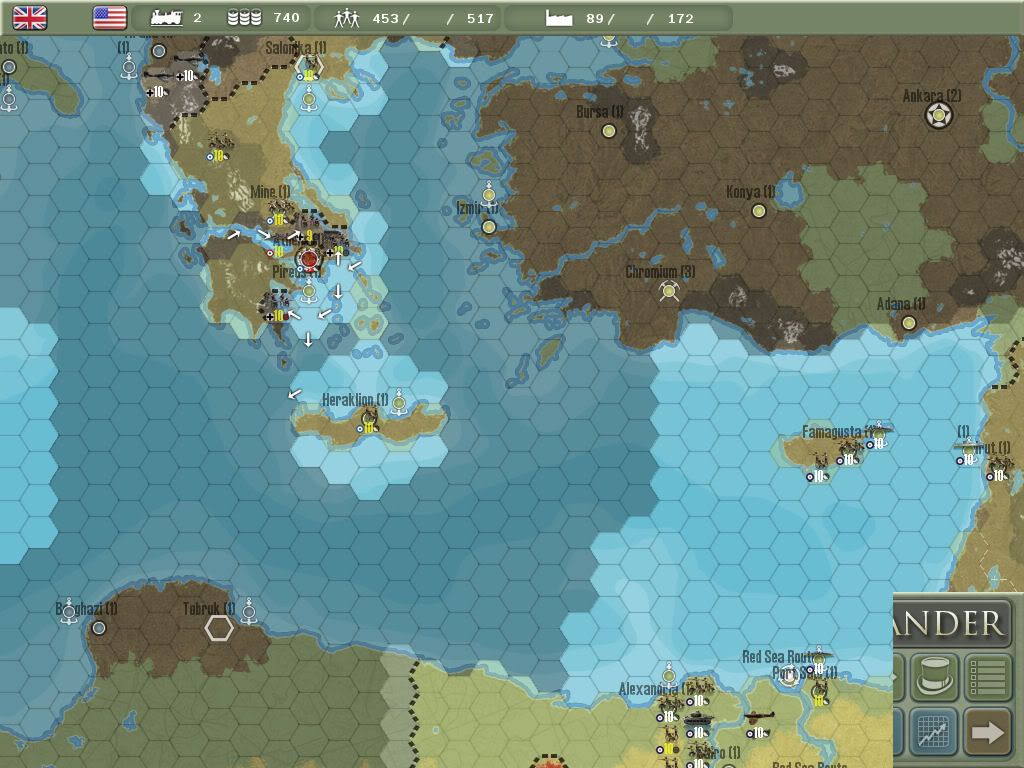
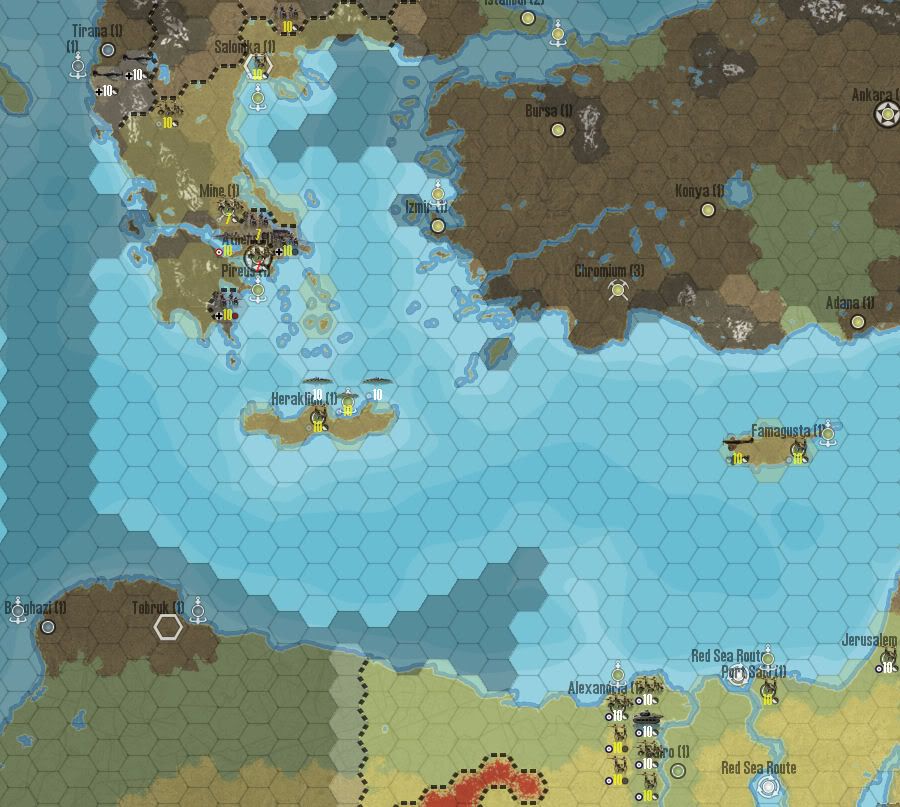
The Axis landed three German corps by amphibious invasion in Greece this turn. Two or the three corps landed where could attack the garrison in Athens this turn. The third was landed in Peloponnese, out of supply but able to attack Athens across the Gulf of Cointh next turn. The only visible Italian fleets were in the Gulf of Cointh shelling Athens and supplying the motorized and infantry corps attacking Athens. Picture 15 shows the situation in Greece at the beginning of my turn.

However; this invasion left a potential opening. No corps was sent to invade and secure the island of Crete. Crete is vitally important for the Axis as an airbase to help them counter any Allied advance from Egypt into Libya. Axis units on Create are NOT subject to the Malta supply limitations. Four Axis bombers based there support by three fighters in North Africa can hold off and inflict major damage on a numerically superior force. Even in mid to late 1942 when the Allies typically gain the initiative in the Med if they try to advance into Libya with too few air units then Crete can be used as a base to punish the Allies, drive them back into Egypt and delay the fall of North Africa by several months.

Image
Picture 15. The Situation in Greece at the Start of the Allied Turn.

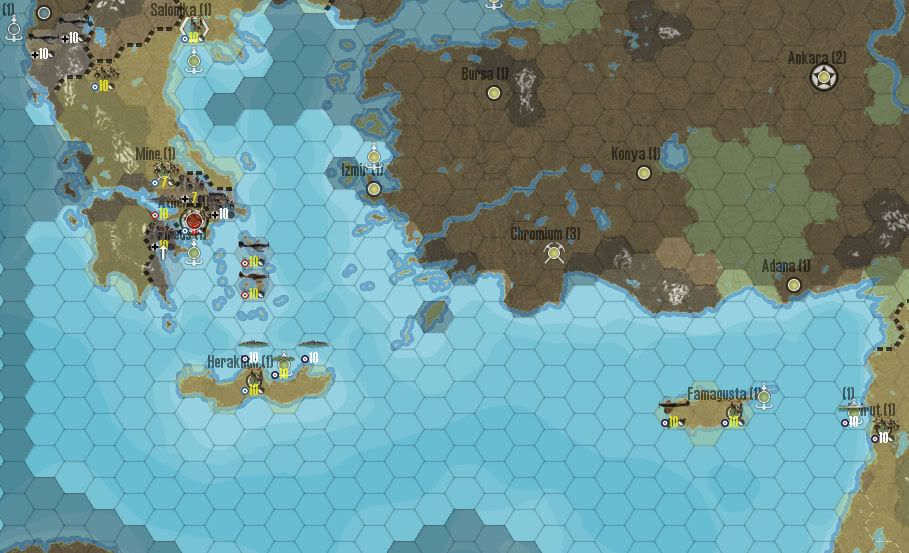
Was this opening a trap? Is there an Italian sub lurking next to Heraklion ready to attack any transport that tries to dock there? The second picture, taken at the end of the Allied turn, shows that it wasn't an obvious trap. The British sent their two BB fleets in the east Med to clear the way (i.e., uncover the Italian sub if it's there) for a infantry transport. No sub was found and the infantry corps based on Cyprus was sent to the port at Heraklion. The UK fighter unit in Egypt was staged to Cyprus in order to stage to Crete next turn.

The garrison defending Athens was reinforced by 3-steps up to 7 and the infantry corps north of Athens attacked the German infantry corps. Both lost 3-steps. The Greek corps in the north advance towards Albania and the air units there. However; it is unlikely that it'll be able to reach them before Greece falls.

If the Axis decides that they want Crete then the UK corps sent there along with the fighter unit won't be able to stop them. However; the objective of taking Crete is to force the Axis to expend resources and time to take it back. If they don't (which is considered highly unlikely) then that is a major gift. (Note, the infantry corps is expendable but the air unit is not. ) Every turn delayed is a turn closer to no Sea Lion. In fact, the Axis have two turns until it's winter in Europe. And the Germans have used up all three of the amphibious landing points meaning they'll have one next turn and two the turn after that. However; the Italians still have all three. But, with two German tactical bomber units in Albania supporting the Greece invasion and the German landing points down to zero this turn the probability of Sea Lion in 1940 has gone down drastically. Though, England will not relax and will not stand against Sea Lion until winter hits. Even then the threat doesn't go away. There's still time in the Spring (of 1941) for Sea Lion.

Image
Picture 16. The Situation in Greece at the End of the Allied Turn.

The USA and USSR build labs . USA.Lab(3)=Inf(1) & USSR.Lab(3)=Air->DogFight(1). The UK ended their turn with 51 PPs. They also upgraded both CV fleets (one in England & one in Syria) and the Malta fighter.

Posted: Wed May 06, 2009 10:22 pm
by rkr1958
October 5, 1940. News Headlines. Battle of Britain continues. RAF fighter losses excessive! Air Chief Marshal Hugh Dowding meets with Prime Minister Churchill and General Montgomery to discuss this. UK comes to the aid of Greece. Greece putting up valiant defense. First the bad and then the good, which outweighs the bad this turn.

The bad. Picture 17 shows the situation in England at the beginning of the Allied turn. UK fighters lost a total of 8-steps to 3 lost by the German fighters. This translates into 48 PPs to repair the fighters. The bright side is that both UK fighters are back to 10-steps to 8-steps for each of the two German fighters in France. German may try another round of strategic bombing next turn but hopefully the UK fighter losses will match the German fighter losses. Eventually Germany will have to stop to repair their fighters. However; a 48 PP hit to the UK economy is not good.

Image
Picture 17. Situation in England at the Beginning of My Turn

The UK reached level 2 in ASW. This is good; except for the 12 PPs I spend last turn to upgrade both UK CVs. I could have waited and got both this turn and last turns tech upgrades for 12 PPs. Now it's going to cost me another 12 PPs. I don't need to waste PPs like this. I need to be more careful. The only upgrade I did was the CV in the Med (for 6 PPs), which upped it from level 6 to 7. I choose this upgrade because the Med CV is more likely to be needed in the next few turns than the CV in England. I don't anticipate a naval battle in the Med but I spent the 6 PPs for the CV tech upgrade as insurance. Still I hate wasting 12 PPs like that!

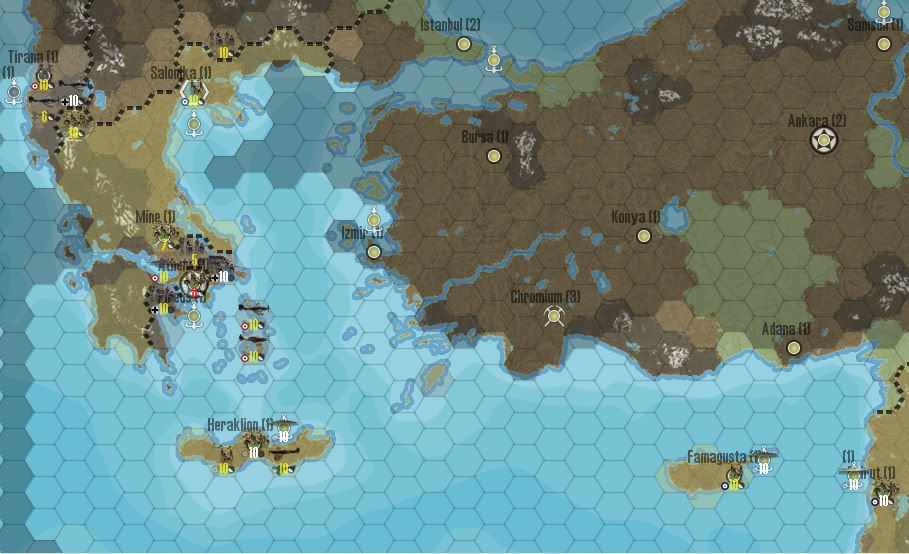
Now the good. Picture 18 shows the situation in Greece at the start of my turn. Not only did Greece hold out; but, the garrison in Athens only lost 1-step with everything that the Germans could throw at it. The UK spend 6 PPs to reinforce it up to 8-steps (1 higher than the end of last turn). Additionally, the UK infantry corps landed on Crete, a UK fighter staged to Create and a UK BB fleet based at Crete's port. The Greek infantry corps north of Athens attacked the German infantry corps and knocked it down to 5-steps without any step losses to itself. But the best of all, with the exception of Greece holding out, was that the Greek infantry corps in the north crossed into Albina, attacked one of the German bomber units there and knocked off 4-steps! Those Greeks know how to fight! Hopefully they can hold out for another turn. Even if they don't the Germans will have to deal with the UK presence on Crete. Picture 19 shows the situation in Greece at the end of the Allied turn.

Image
Picture 18. Greece Holds!

Image
Picture 19. The Greek Army Fights Back! Inflicts Significant Damage to Bomber Unit!

Posted: Fri May 08, 2009 2:10 am
by rkr1958
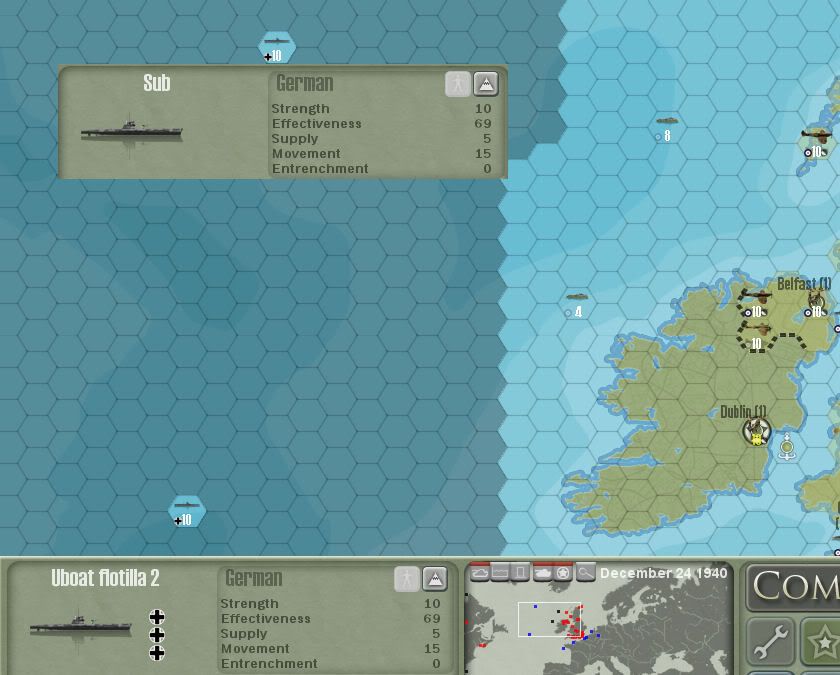
October 25, 1940. Greece Falls! Huns Invade Yugoslavia! Winter in the Atlantic. German U-boats Sinking Merchant Ships at Will.
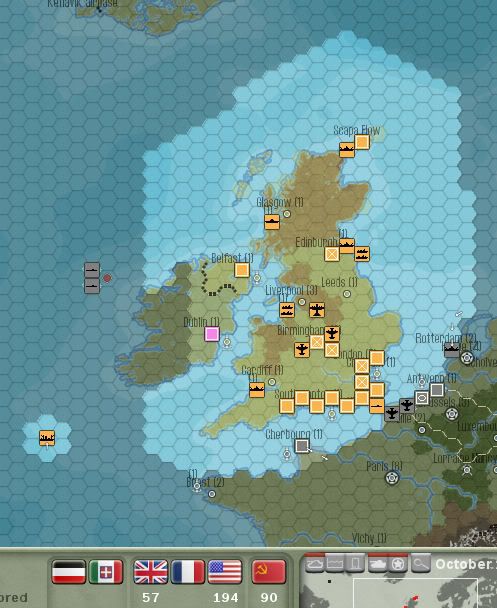
Before I get into the major events this turn I’d like to cover a tactical error I made last turn, which was not to stage the RAF strategic bomber to Northern Ireland to cover the convoy that UF-1 and UF-2 sunk this turn (Picture 20). If I had then I would have gotten one air attack at one of these u-boats. I noticed this error last night shortly after posting that turn. It was frustrating to know that I was going to miss out on this opportunity. If you review the Picture 19 (post above) from last turn it’s obvious that the German will likely attack the convoy, which is well within the 6 hex spotting range of UF-1. The lesson learned is that I need to be more careful about going through my checklist, which is (1) Check/assess for needed repairs, (2) Review research for potential of adding of new labs, new tech upgrades and upcoming tech upgrades, (3) Movement / combat / rail moves / transport, (4) Tech Upgrades, (5) New Builds, (6) Cycle through all units (i.e., Page Up / Page Down). Of course there items are not considered individually but must be considered in combination.

Image
Picture 20. UK at the start of the turn.

Greece Falls!
As well as the Greeks fought last turn and held out against the Axis they were overcome this turn by them. They lasted 60-days (2-months), which is more than I could have expected; especially given the good fortunate of occupying Crete and taking off 4-steps from a German tactical bomber unit, which translates into 26 PPs for repair.

Huns Invade Yugoslavia!
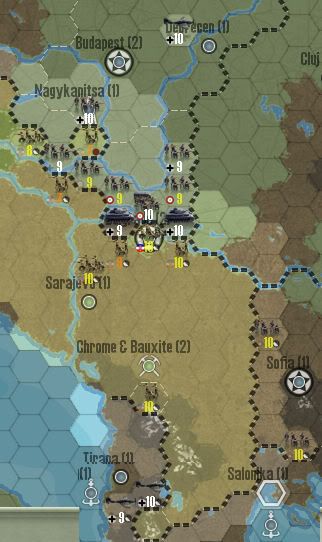
The Axis launched their invasion of Yugoslavia this turn. Three Yugoslavia units in the northwest counterattacks and took 1-step off a German infantry corps and 1-step off an Italian infantry corps. No units in or around Belgrade attacked. The UK paid 2 PPs to add 4-steps to the depleted garrison southeast of Belgrade bringing it up to 9-steps. The corps in Sarajevo was moved up to try to interfere with Axis movement west of Belgrade. The rationale for not attacking with these four units in and near Belgrade is the calculation that they are likely to cause more losses to the Germans on defense than by attacking. Also, attacking would have left them seriously depleted and would guarantee the fall of Belgrade next turn. Even so the odds are low that Belgrade can hold out next turn. The situation in Yugoslavia at the end of the Allied turn is shown in Picture 21.
Image
Picture 21. Yugoslavia at the end of the turn.

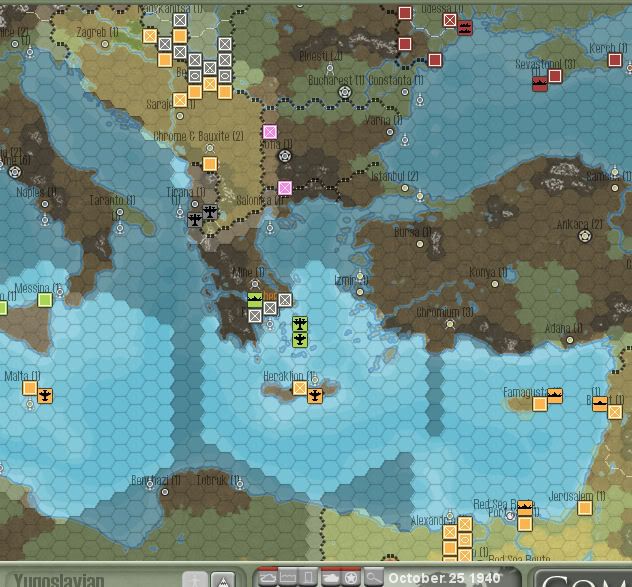
Picture 22 shows the situation in the Med at the end of the Allied turn. The fighter on Crete got a tech increased. The BB fleet was withdrawn to Egypt to get it out of harm’s way. The risk to the RAF fighter left on Crete shouldn’t be that great as long as there aren’t two Axis fighter units within range. I can’t image the Axis leaving Create alone so I expect another fighter or two to show up within the next couple of turns.
Image
Picture 22. The Med at the end of the turn.

Winter in the Atlantic. German U-boats Sinking Merchant Ships at Will.
The arrival of November at the start of the next Axis turn means that England is safe from invasion for the next four months. As such, Britain used their PP reserve to built their seventh lab (UK.Lab(7)=General->Industry(1), reinforce a depleted garrison in Yugoslavia and to upgrade the tech level of their fighter unit on Malta. The UK began the turn with 57 PP’s and ended it with -6.
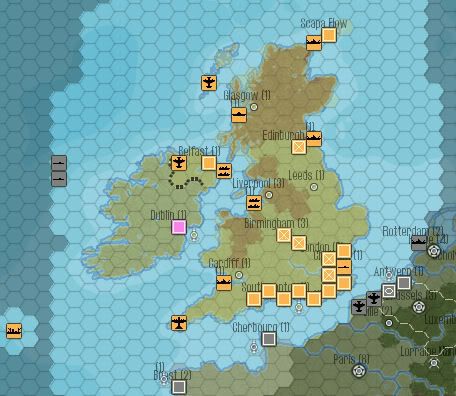
Image
Picture 23. UK at the end of the turn.

In the area of research the UK switch to balance research in air (away from focus on dog fighting).

In both Pictures 20 & 23 note that the infantry corps that was in Cherbourg and one of the two tank corps that was in Antwerp have been replaced with garrisons. The staging of the RAF strategic bomber to the southwest tip of England, to cover the convoy nearby, also shows that Brest in occupied by a garrison. The implication is that Germany is transferring troops to the east and the Med.

The Germans elected to repair their two fighter units (which were at 8-steps each) instead of risking a bad air to air outcome with full strength UK fighters. So no air combat over England took place this turn, which was very much to my liking.

With no risk of Sea Lion for four months, the two UK fighter units were redeployed (i.e., withdrawn) from north of London to Northern Ireland and Outer Herbidies. This was done in the hopes of getting a chance to get an air attack of two against any German u-boats that venture too close to these bases.

Though the risk of Sea Lion come spring has diminished it's not gone. Even if all the channel ports are occupied by garrisons the Germans could still mount a "raid" on the southeast coast of England (close to London) with corps from ports not visible to allied air. I have no doubt that German subs are keeping a watch for any military transports leaving England and headed to North Africa. And if he were to pick up the transfer of one or both of my fighter units along with one or two ground corps then the Germans might give this raid a go. So the Brits plan to sit tight until the Germans are at war with Russia. And, they won't transfer the two fighter units to Egypt until German is at war with the USA. While this maximizes the Sea Lion defenses this leaves Egypt and the Suez Canal vulnerable. That's where the infantry corps and fighter on Crete come in. Hopefully the time it takes the Axis to dislodge them will delay the timing and execution of his North Africa strategy. The infantry corps on Greece is expendable (I will try to save it if I can) but the fighter unit is not. If and when he shows up with multiple Axis fighter units then it will high tail it back to Cyprus and then to Egypt. The primary goal in the eastern Med in the early game is to keep the Axis out of the Iraqi oil fields. While a pain, loss of the Suez Canal is acceptable to achieving this goal. That is, the British will not take a stand to save the canal. They will to save the oil fields.
Posted: Sun May 10, 2009 2:15 am
by rkr1958
November 14, 1940. Headlines: Yugoslavia Surrenders. Axis Troops Cross into Egypt. RAF Long Range Bombers Strike at German U-boats. UK Workers Vital to Britain’s Survival.

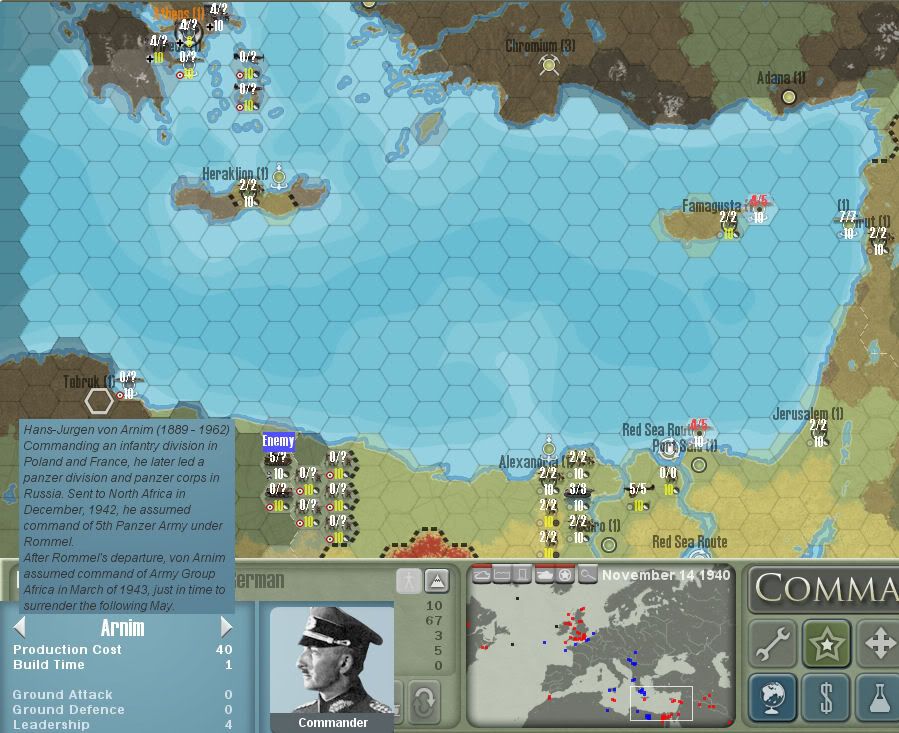
With winter in the Atlantic (November – February) comes safety for England against invasion. However; the situation in the Med is quite the opposite. Yugoslavia surrendered without any additional German losses inflicted. This means that the Axis airpower used to subjugate the Balkans can now be turned on the British corps in Crete and the Commonwealth forces in Egypt. Picture 24 shows Axis troops crossing the Egyptian boarder. The majority of the forces (seen) are Italian. But they’re backed by the extremely potent DAK tank corps led by the German General Hans-Jurgen von Amin. [In a strange twist of faith it was this General who took over the Africa Korps from Rommel in time to surrender it to the Brits. I don’t know if Joe chose him for this reason or not. If he did then you’ve got to admire his sense of humor.] UK military intelligence estimates that other quality German units are likely just behind these troops, and just out of range of UK reconnaissance aircraft.

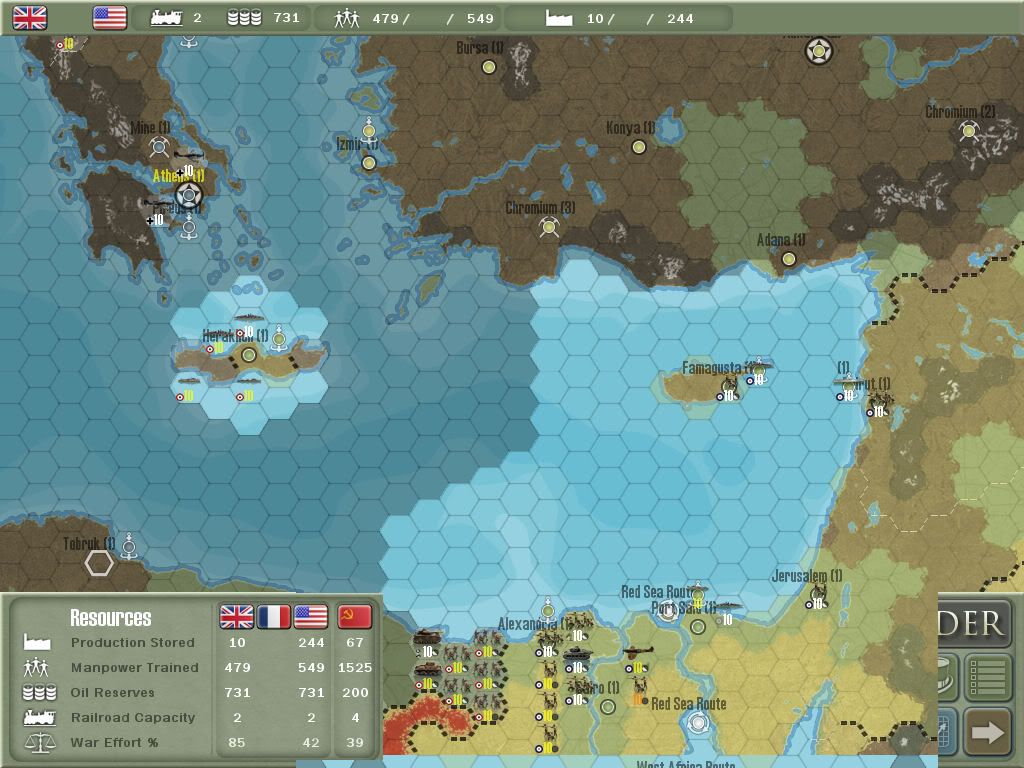
The highest priority build for the UK is a leader for Egypt. Alexander, who costs 55 PPs, will likely be given this command. The UK started the turn (see Picture 25) with 23 PPs, which is 22 PPs shy of what’s needed. Given the developing situation in Egypt, the Allies have probably two more turns to get a leader in place. Thus, they should be able to “build” Alexander next turn and deploy him the following one. Because of this critical situation no PPs were spent this turn.

Image
Picture 24. The Axis Move into Egypt (Eastern Med 11/14/40).

The two BB and one CV fleets based in the eastern Med will likely meet the Italian navy in combat soon (Picture 24). Note that the two BBs are eligible for a tech upgrade from level 4 to 5 at a cost of 9 PPs for both. This is second to Alexander in build priority. Other eligible tech upgrades include a BB at Gibraltar (5 PPs), 2 BB (9 PPs), 2 DDs (7 PPs), CV (6 PPs), sub (4 PPs) and strategic bomber (6 PPs) in England. This totals 37 PPs. The third build priority out of all this will be the sub and the fourth will be the strategic bomber.

Joe’s email for this turn included the statement, “London gets another reprieve from bombing runs.” My email back included the response, “Believe me that's ok with me. Those RAF fighter pilots will fight when challenged but they don't mind the rest!” What I suspect is that the two fighter units and two strategic bombers are being redeployed to the Med to support Axis operations against Create and Egypt. I wanted to give no hint of my suspicions in my response to Joe. But based on this and the Axis movement into Egypt I got the UK fighter on Crete (see Picture 22) “The Heck Out of Dodge” and back to Egypt. Two German fighters within range of Crete could easily inflict 6 or 8 steps of loss on the UK fighter. First, by attacking the corps on Crete with a bomber, in which case the UK fighter would intercept and then be counter intercepted by the first German fighter. Then, this would be followed up by an attack by a second German fighter against the UK fighter’s air base. Part of the fun of a PBEM game for me is the email exchange between players. What is said, what is hinted at and what isn't said. The email must be factual with respect to that turns events (e.g., u-boat attacked convoy, partisans appeared in Russia) but everything else is up to gamesmanship (e.g., Germany preparing for Sea Lion in spring, Axis have no interest in North Africa).

Also, this turn (Picture 25) the UK strategic bomber got a whack at UF-2 and knocked off 2-steps. This represent the first the first UK victory, as small as it is, in the Battle of the Atlantic.

Image
Picture 25. The UK and Several Units in Need of Tech Upgrades

Posted: Mon May 11, 2009 4:30 am
by rkr1958
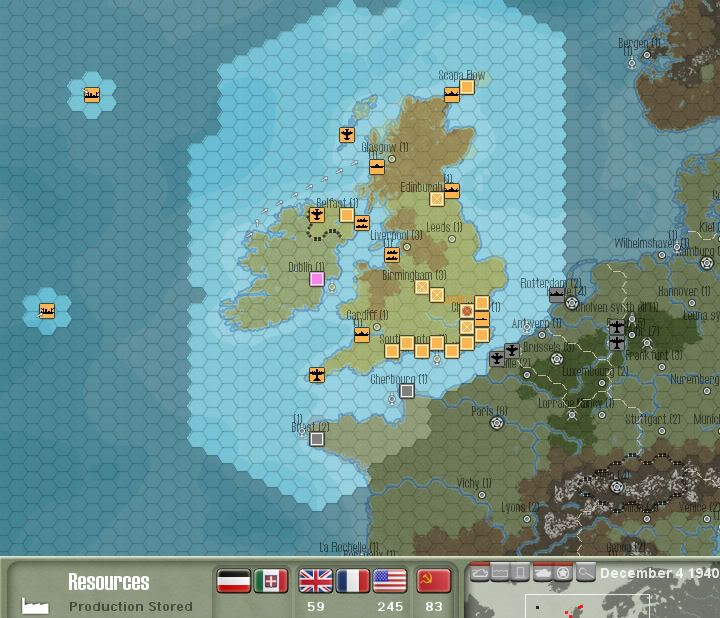
December 4, 1940. Headlines. Germany Resumes Bombing London. Axis Troops Continue Their Advance into Egypt.

Picture 26
clearly shows that my assessment was wrong that the Germans had likely redeployed their fighters and strategic bombers from France. The Germans resumed their strategic bombing of London. However; the RAF fighters were out of range and did not engage. The loss of PPs due to the strategic bombing is far less than the PPs needed to repair the UK fighters if I tried to contest this bombing.


Image
Picture 26. Germany Resumes Their Strategic Bombing of London (12/4/40)

The UK started its turn with 59 PPs, which were enough to buy Alexander, and upgrade the two BB fleets in the eastern Med from tech level 5 to 6. And speaking of the Med (Picture 27) the Axis continued their advance into Egypt. Also, the two Italian BB fleets and the DD fleet shelled the infantry crops on Crete to no effect. While it’s tempting to sorties the eastern Med UK fleet to attack the Italian navy the risk is too great. Tactical bombers in southern Greece could heavily damage or even sink a BB fleet. And fighters could seriously deplete the CV fleet. The infantry corps on Crete was stay put and the Commonwealth forces in Egypt will brace for impact with the advancing Axis forces. The garrisons are expendable but none of the corps are.

The UK ended its turn with -4 PPs.

The USA built its 4 lab, which was an armor lab (USA.Lab(4)=Armor(1)).


Image
Picture 27. Italians Shell Crete and Axis Continue Their Advance Into Egypt.

Posted: Mon May 11, 2009 5:59 am
by OzHawkeye2
Just a thought, but if you moved the fighter near Cairo a couple of hexes S/W he could set behind the southernmost garrison and form a complete double-defense line along Alexandria. This would force the Axis to have to blast through the line without any of the garrison troops retreating.

Posted: Wed May 13, 2009 4:27 am
by rkr1958
December 24, 1940. UK Defenders Evacuate Crete. Alexander Takes Command of British 8th Army.
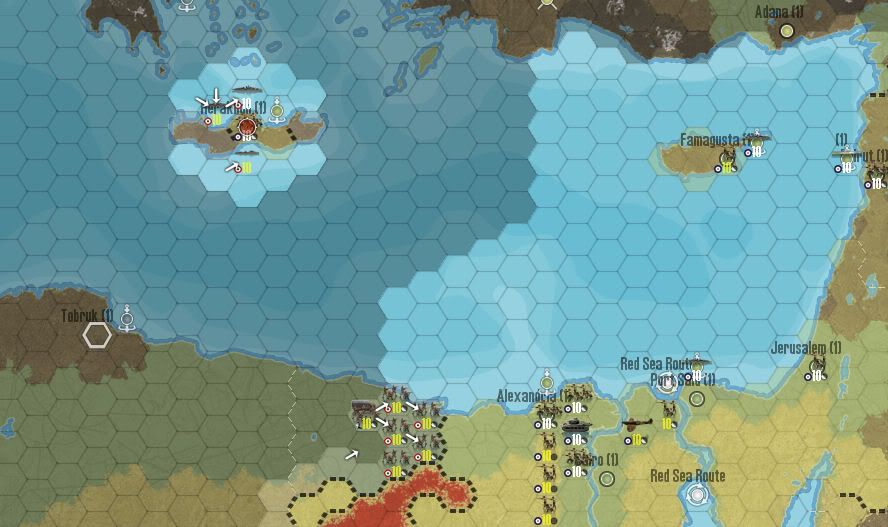
Under heavy air and naval bombardment the UK infantry corps on Heraklion, Crete was reduced to 2-steps (Picture 28 ). Fully expecting to run into the Italian sub the remnants of this corps was evacuated to Port Said. Now that Crete will soon be Axis the Brits must take care to keep all units more than 12 hexes away from the eastern most hex of the island and; thus out of air range of the German tactical bombers that are certainly to deploy there. This won't be a problem for the ground troops. Note that Alexandria is 13 hexes away and just out of Axis air range. That's why it best to build the Allied defensive line where I have it. Any further west and they could be pounded by Axis bombers on Crete.

General Alexander takes command of the British 8th army in the eastern Med just in time to meet the on coming Axis troops that will likely attack next turn. Alexander’s orders are to defend the Iraqi oil fields. He will hold the canal as long as possible but if it appears his forces are in danger of being overwhelmed he will retreat. Also, the Royal Navy is drafting an evacuation plan for the eastern Mediterranean fleet of 2 BB and 1 CV. If, or when, it looks like the Germans are closing in on Port Said this fleet will flee through the canal before it closes. If this evacuation happens then the Royal Navy drops below the minimum naval presence in the Med and the Malta Supply Rule is no longer in effect. However; these ships will reenter the Med four turns later via Gibraltar. The CV will base there and the two BBs plus the one currently based at Gibraltar will “patrol” next to Gibraltar on the Med side. This reinstate the Malta Supply Rule and this force will serve as the lead naval elements for Operation Torch in later summer or early fall of 1942. That is if the Axis don’t interfere with this plan.

The Germans continued their u-boat attacks (Picture 29). UF-2 and a “fourth” u-boat flotilla attacked. German u-boats are attacking and staying fairly close to England, which keeps the Sea Lion threat alive for the spring. The UK considered sending out the RN for convoy protection but decide against it because of the risk of loss and the risk of having it out of position come spring. If the German u-boat attacks were farther west then maybe but not will attacks this close to England.

The Allies sub got a tech upgrade and next turn will resume its patrol guarding the east channel choke point two hexes south of London.


Image
Picture 28. Remnants of UK Infantry Corps Evacuates Crete

Image
Picture 29. Fourth U-boat Flotilla Identified
OzHawkeye wrote:Just a thought, but if you moved the fighter near Cairo a couple of hexes S/W he could set behind the southernmost garrison and form a complete double-defense line along Alexandria. This would force the Axis to have to blast through the line without any of the garrison troops retreating.
Thanks for the tip. I considered it but felt that it would make my fighter unit too vulnerable to ground attack if either of the two south most garrison were destroyed. If fact, the hex behind the south most garrison would remain open and thus wouldn't be blocked from retreat even if I move the air unit to where you suggested. I did make a tactical error by waiting too long to move the garrison that's now next to Cairo up. I just plain overlooked moving it up, which was plain sloppy on my part. Also, the decision to occupy Greece deprived me of the other ground unit that would have completed my double defense line.