Why didn't the Russian Winter impact the Soviet Union the same way it affected Nazi Germany?
https://www.quora.com/Why-didnt-the-Rus ... zi-Germany
George Zhou, B.S Business, Carnegie Mellon University (2021)
Troops of the Soviet were also affected by the winter cold, just to a lesser degree. The main reasons why the Germans were hit harder than the Russians:
1. Soviet trucks and tanks run on diesel fuel, not gasoline. Gasoline tends to gum up in cold temperatures, so German tanks such as Panzer III and IV that ran on gasoline had numerous mechanical issues in the cold. Also, the wider tracks on the T-34 allowed it to traverse snow much better due to weight distribution, unlike German tanks.
3. German guns had a tendency to freeze and jam in cold weather.
Kelly La Rue, Veteran, small business owner, Master Electrician
The Germans didn't come prepared for winter. What cold weather gear they did have was inferior to the Russian gear. The Russians also devised ways to lubricate their weapons so they had fewer freezeups.
"German equipment wasn't designed to work in -30C environment.
A fatal flaw".
How did german equipment do in the russian winter?
https://forum.axishistory.com/viewtopic ... 9f7b98803f
by savantu » 21 May 2003, 21:45
As strange as it can be diesel engines work better at low temperatures.
The problem with petrol [Gasoline] was that you need it to evaporate in the carburetor. At -35 that doesn't happen...So you need to seriously heat up the engine.
A diesel engine injects the fuel at extremly high pressure so even if it is a gel it still works.
"Russian diesel fuel was "low paraffin"/arctic type, that could be used at low temperatures without the danger of turning to jelly (at the filters)".
Second , if memory serves russian V2 engines had a pre-heater
by ChristopherPerrien » 22 May 2003, 20:10
You can run a diesel engine a long time, they don't use nearly as much fuel as a gasoline motor when idling. A hot motor like this will heat up a tank and it's fuel, maybe not enough to keep the crew warm but hot enough to keep the tank operable. A diesel engine stays "happy" as long as its running.
The Germans could not do this with their gasoline tanks so they got cold,
so cold they would freeze to the ground and could not move or fire.
by Harri » 21 May 2003, 23:50
I agree that carburetor is the weak point in gasoline/petrol vehicles. There is always water in the fuel and it freezes easily in carburetor even if the temperature is well over 0 C. Alcohol is added to gas/petrol to prevent that water freezing at mild temperatures (+5 to -10 C). If the temperature is colder separate water freezes in fuel tanks and don't do any harm, until the temperature rises again: then there will be serious problems if alcohol was not used. Engines with fuel injection can do better in cold conditions and are easier to start.
Also pneumatic devices tend to freeze in cold. For example almost the whole 6.Pz.D was in troubles with its technically complicated PzKw 35(t) tanks near Leningrad in early winter 1941 when their pneumatic gear boxes and pneumatic systems froze. That was the main reason for their early retirement in winter 1942.
One not yet mentioned trouble is freezing of optical gear like sights and range finders. These very complicated usually mechanically used devices were among the first equipment to freeze and stop working in cold. Just one point why Finnish sniper Simo Häyhä didn't use optical sights during Winter War...
EFFECTS OF CLIMATE ON COMBAT IN EUROPEAN RUSSIA:
http://www.allworldwars.com/Effects-of- ... ussia.html
Cold reduces the efficiency of men and weapons. At the beginning of December 1941, 6th Panzer Division was but 9 miles from Moscow and 15 miles from the Kremlin when a sudden drop in temperature to —30° F., coupled with a surprise attack by Siberian troops, smashed its drive on the capital. Paralyzed by cold, the German troops could not aim their rifle fire, and bolt mechanisms jammed or strikers shattered in the bitter winter weather. Machine guns became encrusted with ice, recoil liquid froze in guns, ammunition supply failed. Mortar shells detonated in deep snow with a hollow, harmless thud, and mines were no longer reliable. Only one German tank in ten had survived the autumn muddy season, and those still available could not move through the snow because of their narrow tracks. At first the Russian attack was slowed with hand grenades, but after a few days the German prepared positions in villages and farmhouses were surrounded or penetrated.
The Germans held out to the northwest of Moscow until 5 December, and on the next day the first retreat order of the war was given. In the months of the offensive, German battalions and companies had dwindled to a handful of men. The Russian mud and winter had wrought havoc upon their weapons and equipment. Leadership and bravery could not compensate for the lowered fire power of the German divisions. The numerical superiority of the Russians, aided by climatic conditions, saved Moscow and turned the tide of battle. Hitler neither expected nor planned for a winter war.
By mid-December, when the first phase of the German withdrawal ended, 6th Panzer Division was located in Shakhovskaya to refit and receive reinforcements.
(Map 2) On Christmas Eve the 4th Armored Infantry Regiment, which had received replacements, was alerted to counterattack Russian forces that had broken through German positions on the Lama River west of Volokolamsk, in the sector of the 106th Infantry Division
MAP 2. Counterattack by 6th Panzer Division near Volokolamsk 28-29 December 1941.
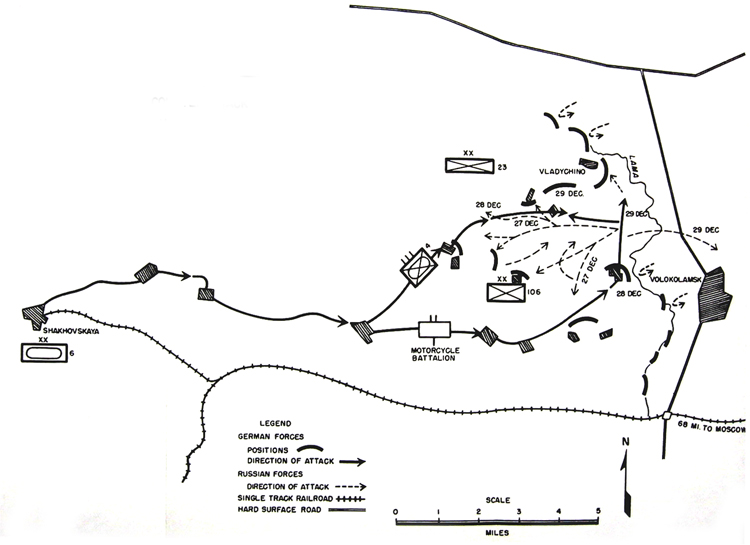
Detailed description of the winter conditions is covered here below this Map at the webpage.
http://www.allworldwars.com/Effects-of- ... ussia.html
Section III. Armored Forces
The principal shortcoming of German tanks was the narrow width of their tracks. Tanks sank deep into the snow, and because of then-limited ground clearance, ultimately became stuck. Russian tanks, particularly the T34, KVl, and KV2, were able to drive through deep snow because of their good ground clearance and wide tracks, and therein lay their special effectiveness in winter warfare.
After the first winter of the war, Germans started to use wide, removable tracks. These solved the problem of snow mobility, but tanks so equipped could not be moved on German railroad cars and were too wide to cross the standard German military bridge. Russian wide tank tracks were factory equipment; the broad gage of Russian railroads with their correspondingly wide flat cars eliminated the transportation problem.
Chapter 4. Russian Tactics
The Russians usually attacked along existing roads or on paths beaten down by their tanks. Frequently, the infantry followed close behind their tanks, using the trail made by the tank tracks. In other instances infantry worked its way forward in snow tunnels toward German positions, despite the heavy losses which resulted from such tactics. In mass attacks the Russians usually debouched from woods and burrowed their way through the deep snow as quickly as possible. Mowed down by machine guns, the first wave would be followed by a second attack which moved forward a short distance over the bodies of the dead before coming to a standstill. This was repeated by as many as ten waves, until the Russians bogged down from heavy losses and exhaustion or until the German defenses were penetrated.
Russian infiltration tactics were most effective in winter, because the German defense system, based on strong points, practically invited such tactics. The Germans were forced to adopt the strong point system of defense because they lacked sufficient forces to occupy continuous lines backed up by reserves. The Russians always sought to split and annihilate defending forces, and to this end cavalry, ski units, airborne troops, and, above all, partisans were used in great numbers.
Section II. Equipment Weapons
Maintenance of weapons is difficult in winter. German rifles and machine guns developed malfunctions because the grease and oil used were not cold-resistant.
Strikers and striker springs broke like glass; fluid in artillery recoil mechanisms solidified, crippling the piece. Light weapons had to be warmed in huts, and fires were lighted under the barrels of guns to get them back into action. Before suitable
lubricants were available, troops found an emergency solution in the removal of every trace of grease and oil from their weapons. In the south of Russia, the abundantly available sunflower oil was used as a lubricant. It is acid-free and cold-resistant.
PART SIX. CONCLUSIONS
Combat in European Russia was greatly influenced by climatic conditions. Large-scale operations and small unit actions were equally affected. The influence of climate was felt in every effort of the German military establishment, whether on land, over water, or in the air.
Climate is a dynamic force in the Russian expanse; the key to successful military operations. He who recognizes and respects this force can overcome it; he who disregards or underestimates it is threatened with failure or destruction.
In 1941 the Wehrmacht did not recognize this force and was not prepared to withstand its effects. Crisis upon crisis and unnecessary suffering were the result. Only the ability of German soldiers to bear up under misfortune prevented disaster. But the German Army never recovered from the first hard blow.
Later the German armed forces understood the effects of climate and overcame them. That victory remained beyond reach was not due to climate alone, but in great measure to the fact that the German "war potential was not equal to supporting a global war. The Wehrmacht was weakened by climatic conditions, and destroyed by the overpowering might of enemy armies.

 )
)


