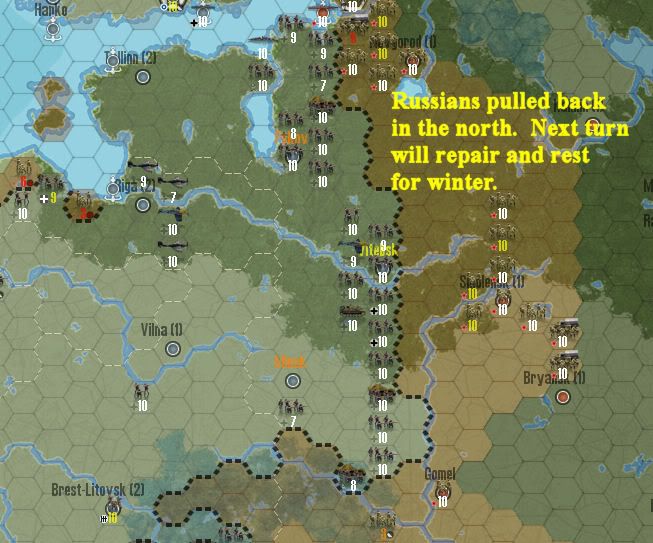
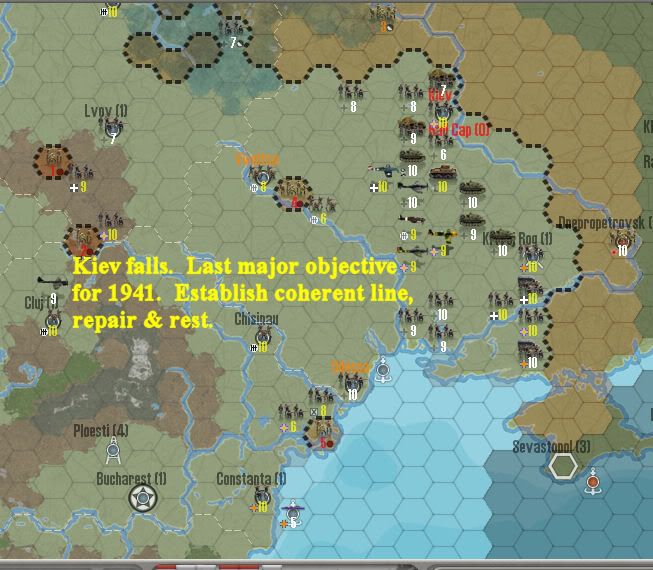
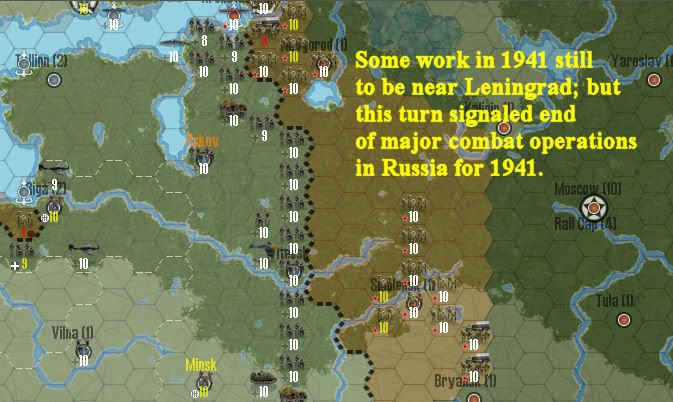
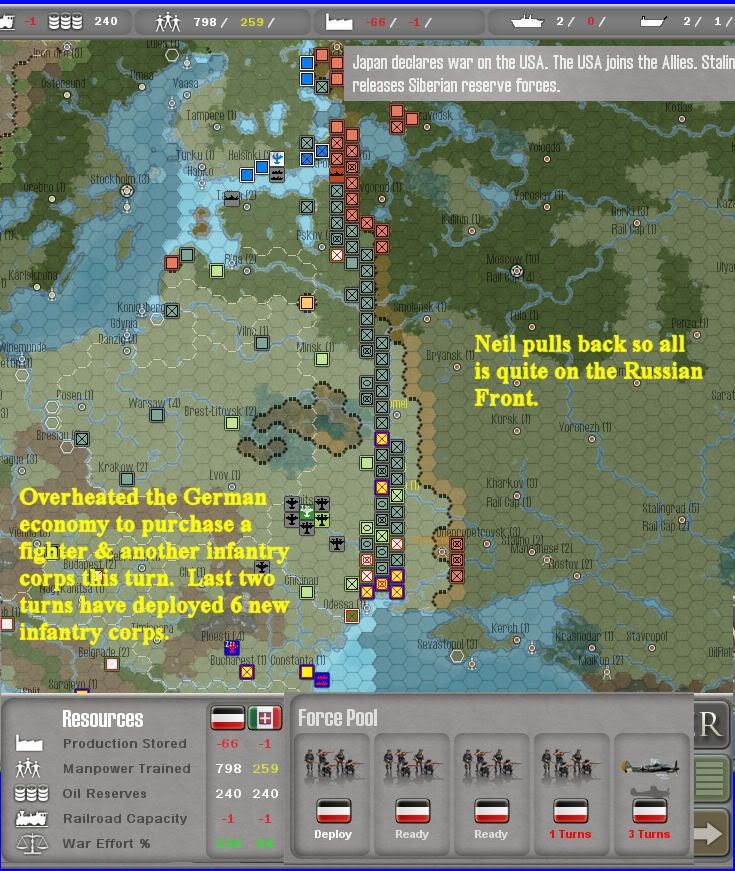
Neil pulled back the Russians in the center and the south. There's no way I'm going to chase them this close to winter. This turn marks the end of major combat operations in Russia for 1941. With the exception of mopping up and some action in northern Finland the priorities for the next couple of turns are to establish a coherent front line, repair and rest. Winter is coming.
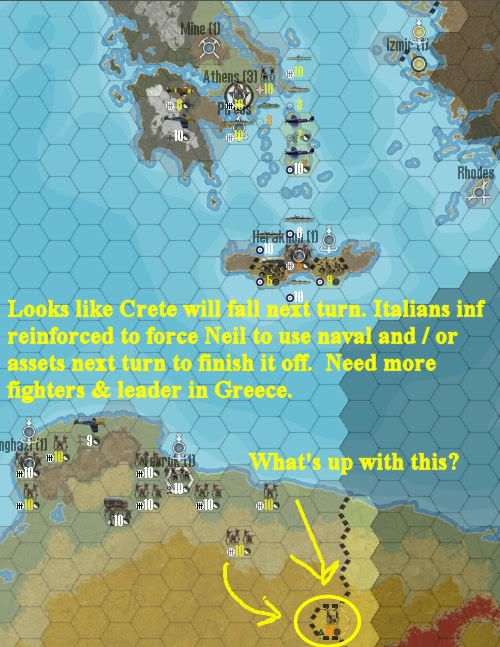
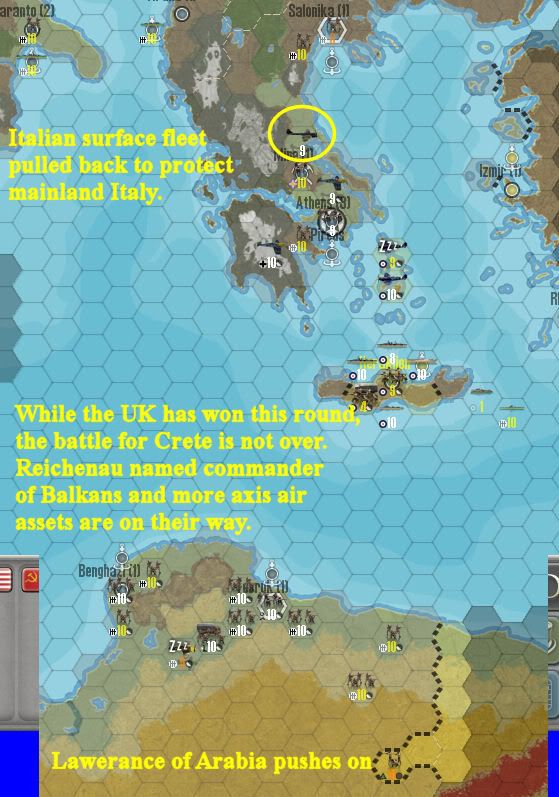
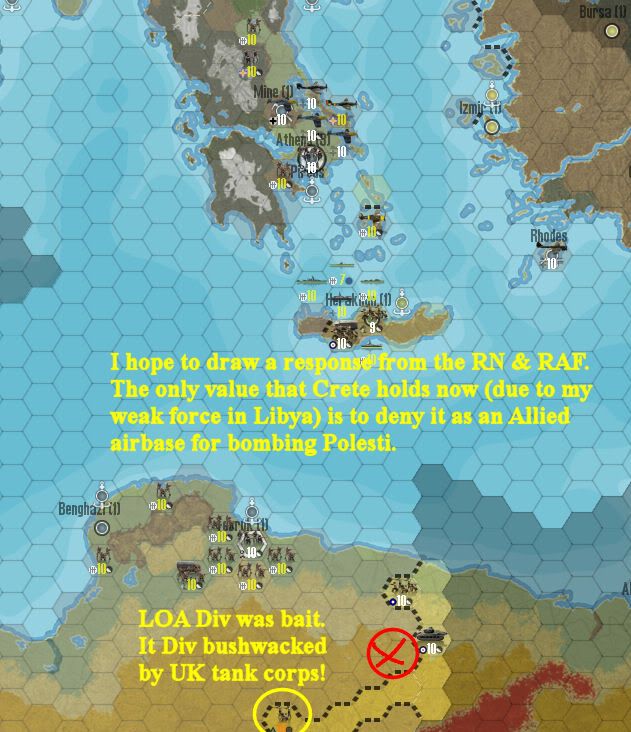
In the Med, it looks like Crete will fall next turn. One curious thing is a cheeky CW garrison heading into Libya from Egypt through the harsh desert. Who is this? Lawrence of Arabia?
Last turn the Germans built a fighter and infantry corps. This turn, they built two more infantry corps (the rest of the PP's were used for repairs) and the Italians built one infantry corps.
The weather was fair in Russia; but I only focused on mop up operations, which included the capture of Gomel, an attack near Leningrad on a Russia Mech (which I really want!) and in Finland.
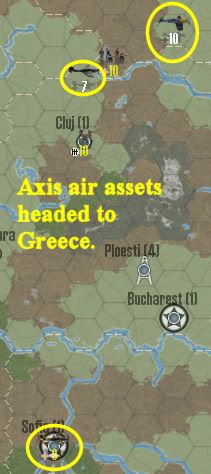
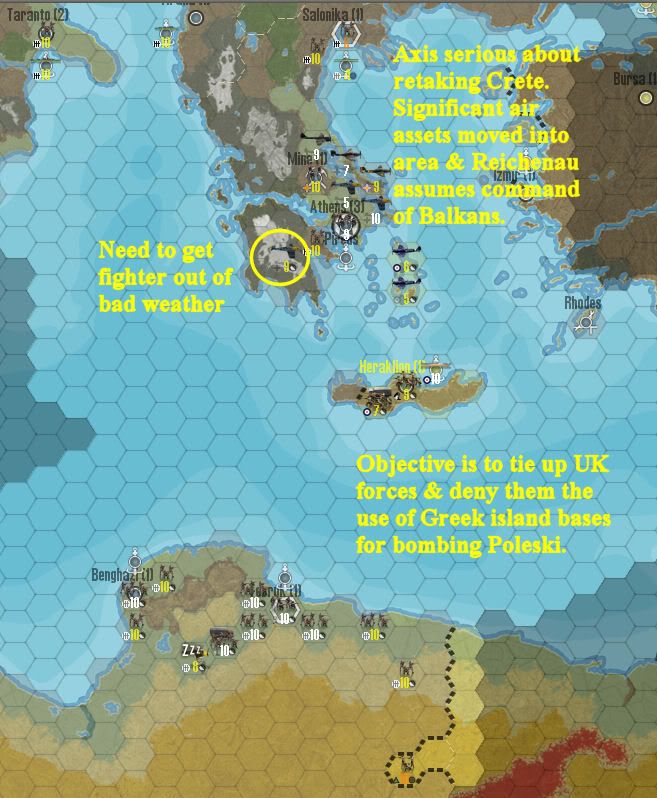
Heraklion fell and so the Brits now control Crete. However; the battle for Crete is not over. With fall and winter weather starting to set in over Russia a number of axis air assets are freed up and are (will be) transferred to Greece for action during the winter.
I can't remember the documentary's title exactly; but it something like "Wings over Europe" or "Clash of Wings over Europe". The thing that struck me was that struck me was that the Luftwaffe was overworked in the sense that they were being constantly redeployed to the area that needed air support. In effect; they had to pull double duty and this eventually caught up with them. I believe that this is accurately represented in CEaW - GS. As the axis player; I find myself constantly moving axis air around to the areas that I need air support. There are two reasons for this, which are PP's and oil. Even if I had the PP's to build all the bombers I wanted; I couldn't afford the oil to keep them all flying.
By the way, Lawrence of Arabia continues to push on in the Libyan desert.
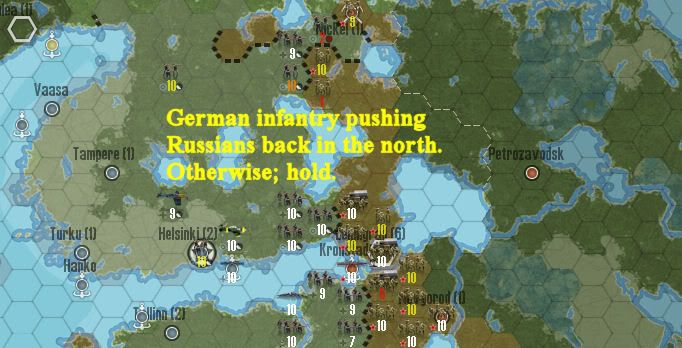
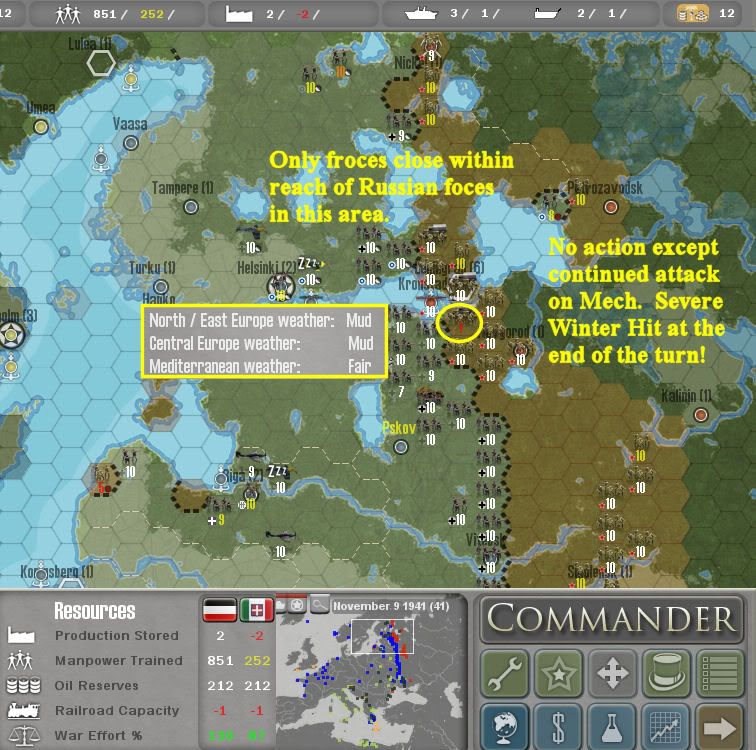
The turn started off with mud and rain so there was only one attack on the Russia front. I wanted that Russian mechanized corps near Leningrad but it held on at 1-step! Through the rest of Russia the focus was on move air assets out of the way, standing fighters down, resting and repairing units. It was a good thing because severe winter hit at the end of the turn. The only units within striking distance of the Red Army (and Air Force?) are the Force west of Leningrad and in Finland. Everywhere else there is a sufficient buffer.
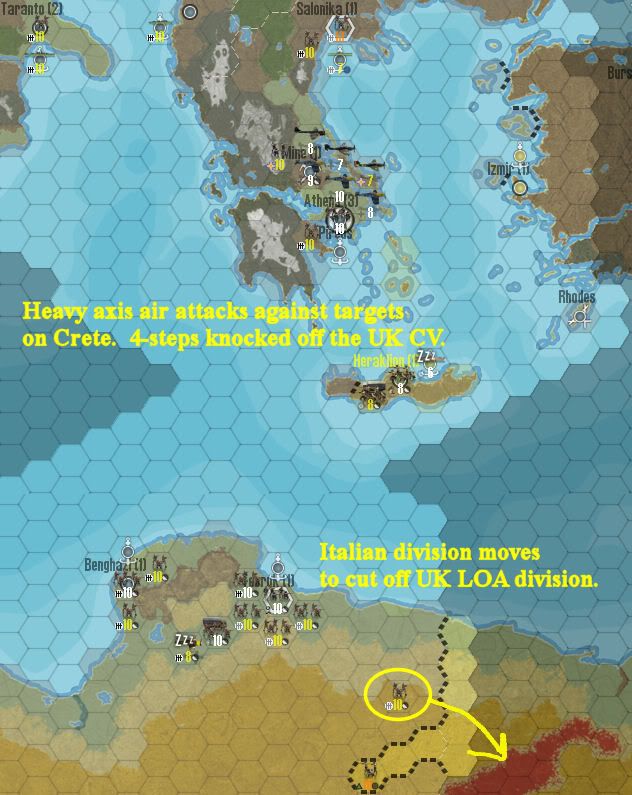
German air destroyed the 1-step Iraqi garrison that Neil landed on Crete. I also brought in significant air assets to retake Crete and tie up valuable UK air and / or naval assets.
The CW LOA (Lawrence of Arabia) division pushes on further west through the desert. The Italians dispatch a division of their own to deal with this threat. German military intelligence believes that the LOA division is bait to pull Italian and / or German corps into poor terrain so that they may become trapped by a UK push along the coast.
In Russia, Neil made a few attacks in the north and knocked off a few infantry steps. No big deal. The German tactical bombers were based in the Baltic States so they didn't suffer the severe winter efficiency hit. As a result, they hit the Russia Mech hard, which had been repaired back to 6-steps, knocking off 4-steps. A German infantry corps with yellow efficiency easily finished it off.
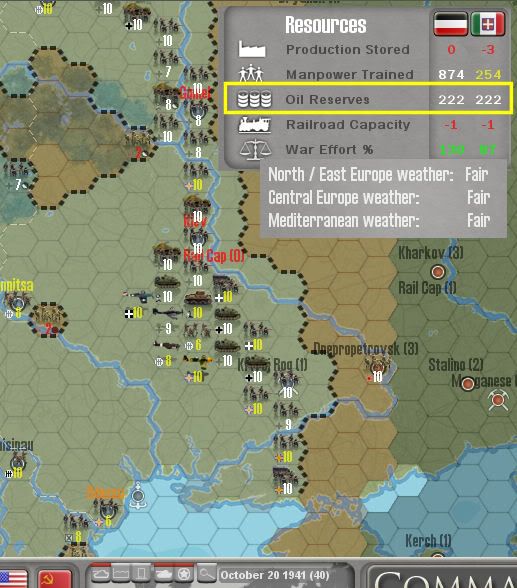
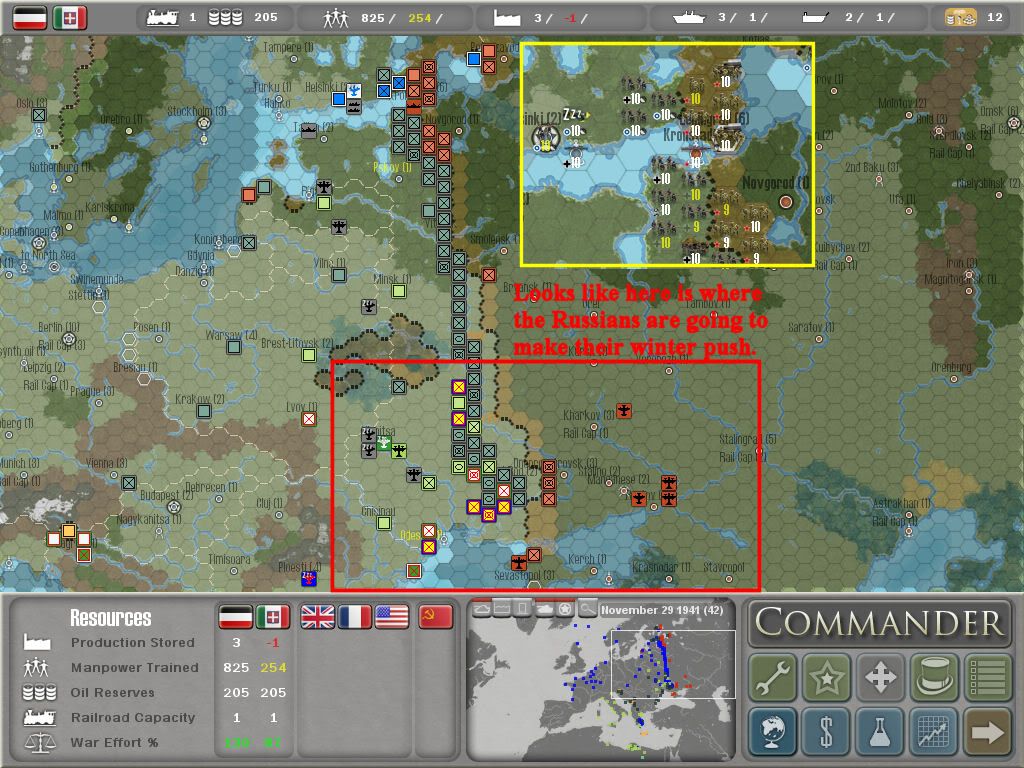
It looks like Neil's main thrust this winter will come in the south. I have strong forces there and will absorb his blows. I really need to stand down and start building up oil supplies for the Spring 1942 offensive. Axis oil finished at 205. Not good by any means this early in the game.
However; I can't let Neil know that his strategy is really draining my oil stockpiles. I need to play it coy. Also, I couldn't let a little oil stop me in the Med. Axis air hit targets on Crete very hard. Neil pulled the RAF back and left a CV there. I guess he's preparing to march into Libya from Egypt.
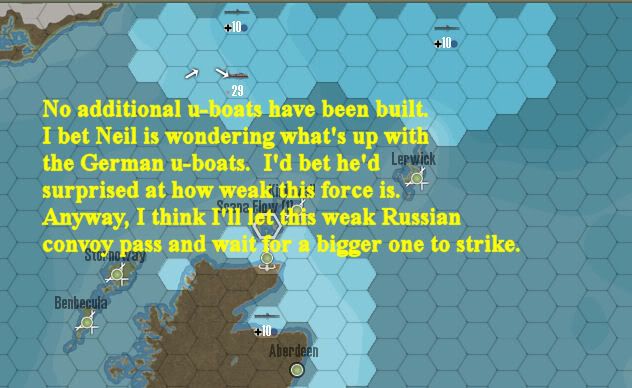
German u-boats reappear and spot a small Russian convoy. I'm going to let it pass and wait for a bigger target. It just occurred to me that I need to rename these u-boat flotillas so Neil doesn't guess that I haven't built any additional ones. I've never not built any u-boats this late in a game as the axis player. I really didn't intend to do this but this is just how this game has worked out for me. I know that tons of convoys are getting through to the UK.
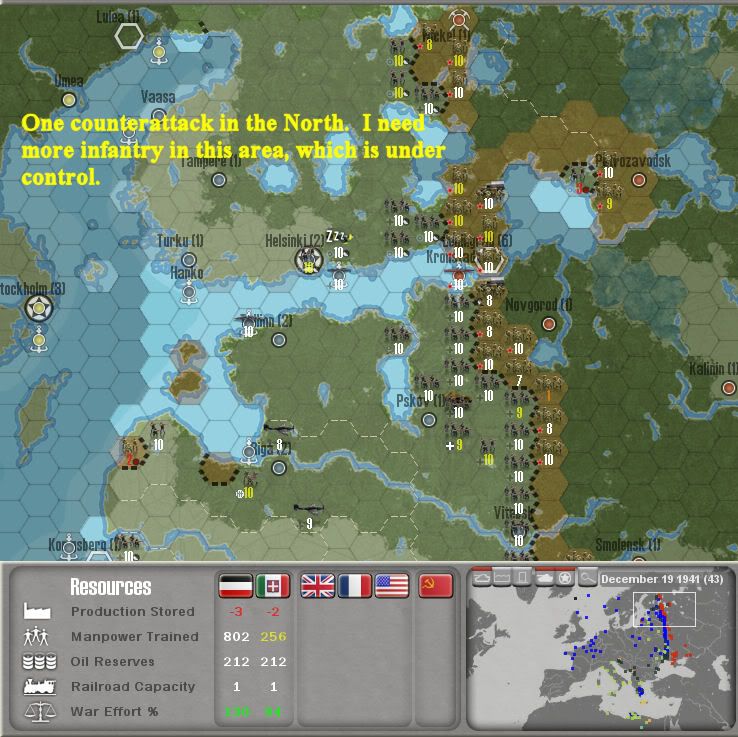
Neil launch a Russian offensive killing 4 German corps (two in the north and two in the south). No biggie. I even counterattack in the north against two weaken Russian infantry corps and get two greedy. I should have just attacked one because I wind up destroying neither and leaving one at 1-step.
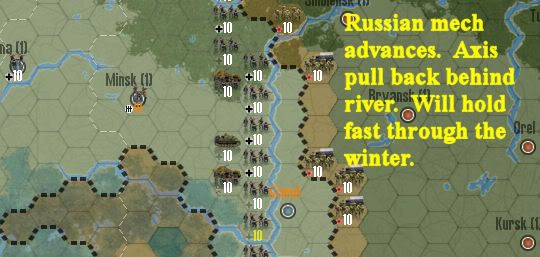
In the center I abandoned Gomel and pulled back slightly for the protection of a river line.
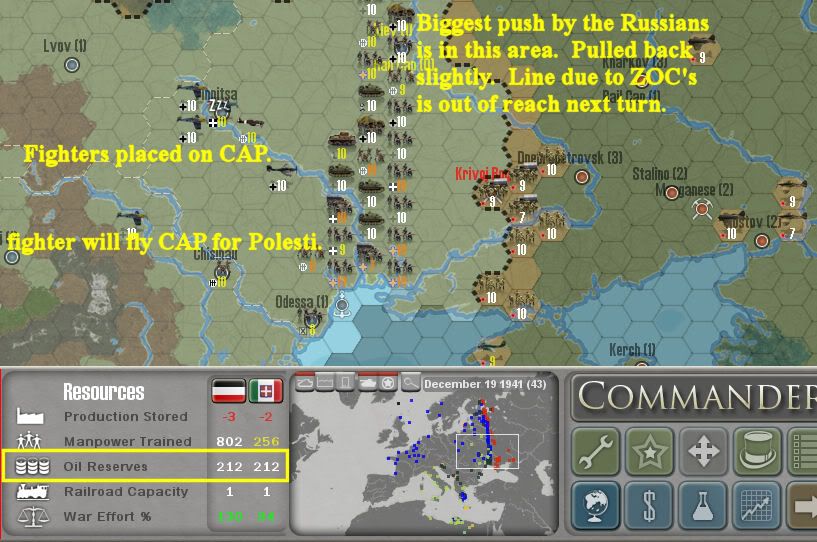
In the south appears to be Neil's major push. I pulled back the line and because of ZOC's he want be able to make contract next turn with my line, meaning he won't be able to attack. I also put my fighters there on CAP, primarily to make that pesky Russian strategic bomber pay for attacking Polesti. I plan to hold my ground and when spring hits, I will unleash my forces in the south with the objective to kill as many Russian units as possible (especially Mech). I don't really care about capturing Leningrad or Moscow; I just want to kill as much of his offensive potential as possible. With my oil stockpiles so low I feel next year will be the last chance I have to degrade Russian and UK offensive potential.
In the Med, the UK division "racing" to cut off the CW LOA division spotted what I must assume to be the lead element of a UK push into Libya. And if the Italian division can see him, he can see the Italian division. The Italian division will push on to cut off the LOA and maybe draw a reaction by the UK force(s) entering Libya.
I moved a German infantry corps next to Greece and sent the Italian sub to sweep next to Crete in preparation for moving amphibious corps next to the island next turn. My primary objective is no longer the retaking of Crete but is the diversion of UK air and naval assets away from the assumed UK push into Libya.
German military intelligence intercept and decoded the following two allied messages. Axis oil ended at 212 points, which is 40% below Neil's figure in his probe of my oil levels. Also, he seems confused by my lack of u-boat activity. My rule for responding to such probes in my return PBEM email is not to even acknowledge the probe(s). And that's exactly what I did. That's also my rule when someone surprises me or really hurts me in a turn. I've found it best to continue on without "reacting" one way or the other in my email.
Neil wrote:My ground units are pretty happy to stay [in Crete] though. I reckon all of this air activity must be hammering your oil - are you still over 350? he he he - not really expecting an answer but I think you're below 350 by now. Lets see how long you are prepared to trade oil for my PP's - my brits live to suck down your oil!
Neil wrote:I'm intrigued by the lack of SUB activity on your part. Still, I'll keep escorting in any event as you can pop up anywhere.
rkr1958 wrote:My rule for responding to such probes in my return PBEM email is not to even acknowledge the probe(s). And that's exactly what I did. That's also my rule when someone surprises me or really hurts me in a turn. I've found it best to continue on without "reacting" one way or the other in my email.
rkr1958 wrote:My rule for responding to such probes in my return PBEM email is not to even acknowledge the probe(s). And that's exactly what I did. That's also my rule when someone surprises me or really hurts me in a turn. I've found it best to continue on without "reacting" one way or the other in my email.
With the exception of picking off one German infantry corps in the North (just south of Leningrad), Neil pulled back in Russia. That's fine with me. I don't mind the breather there and to build up my oil. I did overheat the German economy to by a fighter and infantry corps and two repair the bombers in Greece.
In the Med, I moved two invasion transports next to Crete. My objective is to draw a reaction from the RN and RAF and to make Neil believe that I'm stronger in North Africa than I really am. Of course this last depends on how good his recon is and if he takes the bait in Crete. In reality because of my weakness in North Africa Crete has lost it's strategic value in countering the UK intrusion into Libya. However; it's value now is as bait and to negate it's use as an allied air base for bombing Polesti.
On a sad note, the Italian division courageously braving the harsh desert to cut off the CW LOA division was bushwached by a UK tank corps and destroyed.
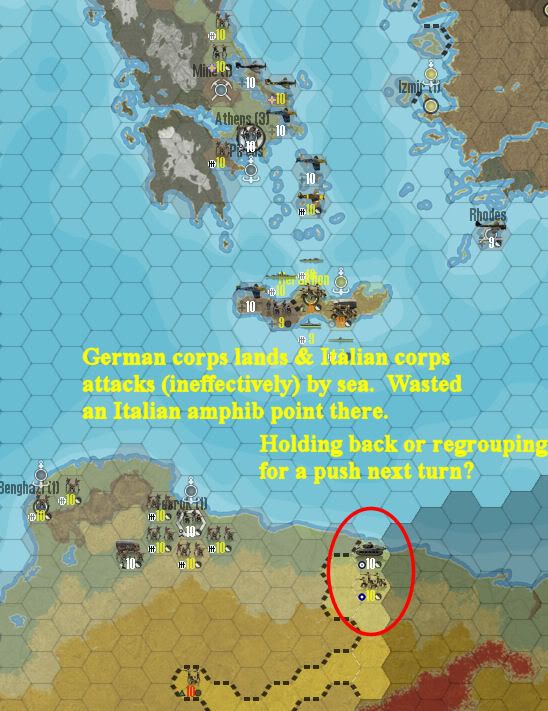
The German corps landed on Crete and the Italian corps (wasted) it's amphib point by attacking the target in Heralkin. The Brits have either stopped their advance into Egypt or regrouped this turn for a push next turn. I hope the former but fear it's the latter.
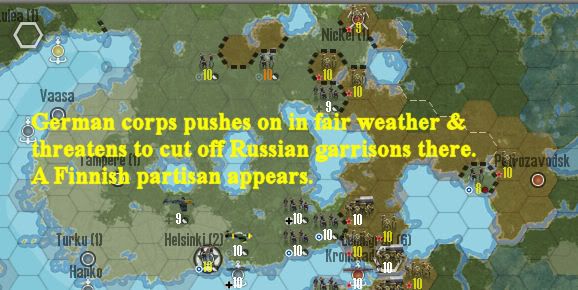
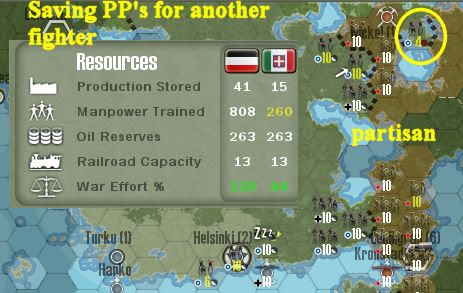
No action in Russia except for a partisan that popped up in the far north. If I didn't have winter movement restrictions the German corps slightly to the south could move and cut supply to those pesky Russian divisions there. As it is, the Finnish partisan has significantly complicated their movement.
Axis oil ended at 263. If I keep this up I can have a "whopping" 300 points at the start of the '42 Russian offensive. Whoppie ...
How is your French defence? The way things are going the Allies might even try a bold early landing with US (at least you got some luck with late entry:)) and (big production due to untouched convoys) UK forces.
trulster wrote:How is your French defence? The way things are going the Allies might even try a bold early landing with US (at least you got some luck with late entry:)) and (big production due to untouched convoys) UK forces.
Every city contains a garrison; even the low countries. However; the axis airforces in Greece are just one to two turns away.
Neil and I have decided to stop this game because of the massive changes that have been made to this beta version of GS since we started. In fact the changes are so massive that we, the GS development and test teams, are now calling this version GS v2.00a.
If there is interest in the "behinds the scene" look at a game being played with a beta version under test and with the every real risk that the game might have to be abandoned because of significant changes made during the beta phase Neil and I have agreed to restart the AAR with v2.00a.
By the way, here's the developers notes for the quite extensive GS v2.00a changes made thus far. I hope that you tell by the scope of the beta changes that we do take seriously the comments and suggestions of the general community and that we are constantly striving for more historical realism.
GS v2.00a (Beta Release)
In our attempt to maximize historical realism we have proposed a set of changes to GS that are now going through play test. Our definition of historical realism is NOT that the historical chain of events are, or must be, followed every game but that the option to follow the historical chain of events is as least as appealing as following other non-historical, but possible, events. For example, it had become standard practice for the allied player to invade Ireland and often Portugal to establish airbases to use for ASW. Also, it was becoming standard practice in some quarters for the axis player not to invaded Yugoslavia and Greece. While these are certainly valid and historically possible strategies these did not happen historically. We didn’t want the game to evolve to where historical options would never be chosen but to a point were it’s good strategy in some games to do so and in other games not to.
It was becoming common practice to use air units in ground defense roles. Because of the movement range of these units they were at times being deployed at speeds and distances that modern airmobile forces would envy. Also, they were often times holding up just as well or even better against ground attacks than normal ground units. While air units do have a significant number of ground troops that were historically used in infantry roles they had no where near the ability to hold as did regular infantry.
The biggest changes in v2.00 are contested amphibious invasions, elite units, airborne units and airdrops, updated experience level model, updated leadership model, allied aggression, tension in the Balkans and Eastern Europe, softer airbases, convoy movement updates, game updates including mechanic and a number of graphical (i.e., chrome) changes. To ensure maximum flexibility the implementation of these features are controlled through the general.txt file and may be configured as players desire.
Sometimes we can have different views of what's the goal of GS. I think we (the GS developers) share a common goal and that is to make GS a more historical WW2 in Europe simulation without scripting the players from 1939 to 1945. It means that the
players should be able to feel they're playing with the same constraints as the real WW2 leaders had, but they should have a chance to make different choices. This means we need to anticipate the outcome of possible ahistorical events that people would find credible. One is how USA would react to a German invasion of Canada. Another is how the Axis minor powers would react to still neutral Yugoslavia and Greece.
GS has no real diplomacy, but we have scripted the behavior of certain minor powers to simulate their behavior to certain events. Some people don't like that because they want the freedom to do what they like to. It's very hard to make a balanced game if players have full freedom to do anything they want. E. g. the Soviet armor blob strategy ruined game balance in CEAW. Some Axis players don't like they can't easily reach Omsk. I would rather say that it should be virtually impossible for the Axis player to get all the way to Siberia. Hitler's grand strategy was to reach the Urals and keep the Russians at bay there. He believed that Stalin would either be overthrown or the Russians would sue for peace before the Germans ever reach the Urals.
Since GS is supposed to be more historical than CEAW it means that the Axis IS supposed to feel the problems of being expanded around 1942-1943 and then slowly crumble until the Allies are in Berlin. I think GS is working quite well having that goal.
One great thing about the GS victory conditions is that you won't know who will win and at what level until Berlin has fallen. It means the Axis player has good reason to continue fighting till the very end. So both sides get a chance to excel both at the offense and defense. In CEAW many Axis players folded once their expansion was halted and the
Allies started to move in the direction of Berlin. These players knew the game was lost because they had fewer capitals than the Allies. So they folded. That meant many Allied players never had a chance to have fun doing Overlord, destruction of Army Group Center etc. For that reason alone I felt that CEAW was rather flawed. In order to win in
GS you need to be good at both attacking and defending. The game won't end prematurely until one side is sure of an ultimate victory.
We are telling you this so you know the ultimate goal we have with GS, i. e. to have a WW2 in Europe simulation game that's quite historical without steering players in a certain direction. So if we introduce new things then we have to answer the question: Are these changes compatible with the main goal of GS. If yes, then we should consider it, if no then it should be scrapped.
I. Contested Amphibious Invasions
Transports carrying infantry, mechanized or armor corps can now attack occupied coastal hexes. These attacks consume one amphibious invasion point and if the attacked unit retreats the invasion transport can land its parent unit. The attack strength of the invasion transport is independent of its parent unit and is weaker than the attack strength of a normal infantry corps. This attack strength represents brigade size marines and airborne units that make up the first wave of a seaborne invasion. The parent unit represents the second, third and subsequent waves that come ashore over the remaining 19 days of the turn assuming that the initial wave was successful in securing the beach (i.e., destroying the enemy unit or forcing it to retreat). Note however if the transport takes damage during the invasion attack it is the parent unit that suffers this damage.
An invasion transport that successfully clears a hex advances into it the same way a ground unit would. It does NOT unload and if you click off the unit before advancing you cannot advance or unload that turn. Note that an invasion transport could clear a hex and choose not to advance leaving that hex open for another invasion transport to land and attack. This action would use two amphibious invasion points. One for the transport that attacked and the second for the second transport that landed in an enemy controlled hex.
For those into equations here they are for how technology impacts transports:
attackVal, shockVal, qualityVal and flakVal are the current values for these variables and are passed to the methods in which the above equations are added.
The coefficients of these functions are controlled through the general.txt file in order to be able to tweak these functions as necessary. The general form for equations (a-c) is: val + (A*techSurfaceShips + B) / C and for equation d is: val + (A*techRadar + B) / C. The coefficients A, B & C are set separately for each of the four areas in the general.txt file.
II. Elite Units
German SS units were “elite” because they were both composed of more fanatical troops than regular army units and because they got priority on equipment, manpower and training. It was often the later that contributed to their “eliteness”.
Russian “Guards” units were the elite units in the Russian army. They achieved their elite status through extraordinary performance on the battlefield.
German units can be “upgraded” to SS units by renaming them to include SS, which a space either before or after, in their new name. This upgrade follows the rules of a technology upgrade where the unit cannot be adjacent to an enemy unit and will not be able to move the turn of the upgrade. The cost of the upgrade, however, is 15 PPs for armor, mechanized and infantry corps and 10 PP garrisons and is quite a bit more than a technology upgraded. The upgrade results in an increase of 1 in attack, defense, shock, quality and survivability. Also, the image or counter for the upgraded unit will change to a SS version of the image or counter. There is a limit on the maximum number of SS units in play at any one time, which is 0 (1939 – 1940), 1 (1941), 3 (1942), 5 (1943), 8 (1944) and 10 (1945).
Soviet units that achieve an experience level of 75 (i.e., level 3), or higher, are promoted to a “Guards” unit. Once promoted they will never lose that status unless completely destroyed. There is no cost for this promotion; however Guards units do get an increase of 1 in attack, defense, shock, quality and survivability. Also, the image or counter for the promoted unit will change to a Guards version of the image or counter. There is a limit on the maximum number of Guards units in play at any one time, which is 0 (1939 – 1940), 2 (1941), 5 (1942), 8 (1943), 12 (1944) and 16 (1945). When at this limit no more units will be promoted until the limit increases or a Guards unit is destroyed.
A German, or Russian, unit must be in supply level 4 (or higher) to be converted, or promoted, to an elite unit.
The 1942, 1943 and 1944 scenarios were slightly updated by adding some, but not many, Guards and SS units.
III. Airborne Units and Airdrops.
Airborne units are a subset of the elite units but have an advantage in which they can drop by air behind enemy lines or over water into empty hexes.
Airborne units can only be “built” by converting garrisons into airborne divisions. It costs 15 PP’s to convert a garrison into an airborne division. This conversion can only be done when the garrison is in supply level 5.
Infantry corps currently CANNOT be converted into airborne corps but that capability does exist and can be enable through the general.txt file.
Airborne divisions in addition to moving like regular infantry can also drop into unoccupied hexes. These drop hexes are indicated by a parachute symbols and this distinguishes them from the hexes that it can move to via normal movement. Paradrops cost 10 PP’s each and consume 4 oil points. They are subject interception by enemy fighters (so you better either have suppressed those fighters or have fighter escort to the drop hex available), subject to loss from flak form the landing hex and subject to random loss (0 to 3-steps) from the drop. So a drop into an unoccupied city or resource hex would subject the airborne division to loss from flak and the random loss due to an airdrop. Without fighter cover this would add loss from enemy fighter interception and would be a suicide drop for the division.
Airborne divisions cannot move but can attack and advance if successful on the turn they drop. However; these units while elite are divisions with lighter weapons than their infantry counterpart and cannot dislodge full strength enemy corps. Compared to garrisons, airborne divisions have +1 ground attack, +2 ground defense, -1 shock, +2 quality, +2 survivability, -1 anti-tank, -1 air defense and they have a movement of 3 (which is between 2 for a garrison and 4 for an infantry corps) and have a minimum of supply level 1.
The number maximum number of airborne divisions is a function of year and country. Only major powers can build airborne divisions.
You also have to think about the para units dropped can be intercepted and lose a lot of steps. After interception they can lose even more steps by landing. This means a para unit will quite damaged. So it will not become a defensive fortress that the enemy will struggle with destroying. E. g. a para division will have ground defense of 5 in 1944. That's definitely nothing to be really scared about. A para corps will have ground defense of 6. These units can be destroyed by enemy land units.
We have to ask ourselves WHY would players want to use para units? I can see three reasons for using them. One is to quickly reach areas at another continent. E. g. you can paradrop units to Norway or Crete and bypass an Allied naval blockade. With air
bombardment you can destroy the defender in Oslo or Heraklion and use the para to capture the city. So paras can be used to avoid dangerous naval operations, or support these naval operations.
Another reason to use paratroopers is to use them like in Overlord. You can drop them behind the hexes you intend to land in to prevent enemy units from killing your units at the beachheads. You sacrifice your paras to have a chance to break out from the beach head next turn. This is probably the most important reason to use paras and I think it will add to game playability to actually plan your invasions with paradrops as well. You can e. g. use them in operations like Market Garden to capture rear empty cities or choke points hoping that your land offensive will get to the area in time before the enemy can dislodge the para blocking the path for the enemy units.
The third reason to buy them is to bump garrisons and to some extent corps units to have a good defensive ground unit. Germany had many para units, but most of them were grounded. It meant they had the training as elite units, but lacked the paradrop capability. Many of these units were used to hold important cities like Brest.
Late in the war the garrisons are virtually useless because they rarely get tech upgrades. So enemy corps or armor units can almost destroy a garrison with one attack. Garrisons upgraded to paras, however, can be a good defensive unit to have.
IV. Experience Level
There have been extensive changes to how experience is lost and gained in order that units don’t lose experience so easily and that units attacking secondary and, usually, easy targets (e.g., naval bombardment) don’t gain experience at the same rate as if attacking their primary target (e.g., other ships).
Ground units. Ground units per attack gain 6 XP points for attacks on other ground units and 3 for attacks on air units. On defense they gain 4 XP points versus defense against other ground units, 4 XP versus defense against air and 2 XP version defense against naval. Ground units lose no experience for repair (i.e., reinforcement) at 8-steps or 9-steps and lose a flat 5 XP points per step; otherwise. For example, a ground unit is at 5-steps and repairs back to 10-steps. They would lose 5 + 5 + 5 + 0 + 0 = 15 XP points. The same unit at 3-steps, which repaired 5-steps back to 8, would lose 5 + 5 + 5 + 5 + 5 = 25 XP points.
GROUND_VS_GROUND_ATTACK_XP 6
GROUND_VS_GROUND_DEFENSE_XP 4
GROUND_VS_AIR_ATTACK_XP 3
GROUND_VS_AIR_DEFENSE_XP 4
GROUND_VS_NAVAL_DEFENSE_XP 2
Air units. Air units lose a flat 5 XP points per step repaired even at 8- or 9-steps.
Naval units. Naval units lose a flat 5 XP points per step repaired even at 8- or 9-steps.
NAVAL_VS_NAVAL_ATTACK_XP 6
NAVAL_VS_NAVAL_DEFENSE_XP 4
NAVAL_VS_AIR_ATTACK_XP 0
NAVAL_VS_AIR_DEFENSE_XP 4
NAVAL_VS_GROUND_ATTACK_XP 0
NATO images and unit icons for all countries at zoom level 3 will show a number of dots equal to the experience level for each unit.
V. Leadership
A leader attached to a garrison converts that garrison to a HQ unit that now has a movement of 3 (compared to 2 for a garrison). However; leaders attached to other corps have no impact on that corps’ movement.
The biggest changes made to leaders are that they have reduced ranges (quality – 2), cost about 15 PP’s each less and can now only be injured if the unit they are attached to is completely destroyed.
When you click on a leader the units possibly influenced by that leader are highlighted. If a unit is possibly influenced by only one leader then the quality of that leader increases the effectiveness of that unit. If a unit is possibly influenced by multiple leaders then the quality of the best leader is used. Therefore; there it no longer hurts a unit if it’s in range of an 8 quality and 2 quality leader. The 8 quality will be used.
The leader reassignment range has been increased from 10 to 25 and theleader max injured period has been decreased from 18 to 9.
VI. Allied Aggression.
Because of the isolationist attitude in the USA before entry in the war certain acts of UK or French aggression have an adverse impact on USA mobilization prior to their entry in the war. Also, an allied attack on Portugal at any time has an adverse impact on their neighbor Spain. Basically, an attack on Portugal would signal danger to Spain and move them close to Germany for their own protection.
Every declaration of war by Britain or France on a minor neutral country (e.g., Ireland, Portugal) prior to USA entry reduces the USA war effort by 5. Since, the USA is at industry level 2 the impact of this reduction is 6 (i.e., 1.2 x 5). After US entry, Allied DoW's on neutrals won't have any effect on the US war effort. The US will mobilize because they're at war. The US will regain any lost war effort immediately when they join the Allies. The reason is that they mobilize and the US public would forget about reluctance to enter the war since they're already at war.
An allied declaration of war against Portugal results in the transfer of 5 PPs per turn from Spain to Germany. These are from the Spanish lead mine traded to Germany for military equipment and training. This training and equipment is represented by Spanish units immediately getting the same as German tech level -2 or keeping their current tech if it's higher. Please notice that if the Germans get more tech later then the Spanish will NOT get that until the Allies DoW Spain as well and then only if the Germans pay for an upgrade of the Spanish units. So the tech received from Germany upon an allied declaration war against Portugal is a one time FREE upgrade to the German tech -2.
VII. Tension in the Balkans.
Because of the tension in Balkans between German axis minors and Yugoslavia or Greece these axis minors will defend their borders against these countries unless they are pacified (i.e., invaded) by Germany or Italy. Also, axis minors will activate earlier than expected if the axis invades the Balkans prior to their normal activation times.
Romania and Hungary will join the Axis the turn Yugoslavia is DoW'ed and Bulgaria will join the turn Greece is DoW'ed. So it's possible to speed up the activation of these countries by an earlier DoW. This means an axis player might declare war on Yugoslavia from Austria and Italy and rail reinforcements to Hungary and Romania on that turn (e. g. in August 1940). Remember that the countries joining will NOT move on the turn they join. So the player will probably need two turns to take out Belgrade. It also becomes more attractive to take out Greece from the north since a player can take out Yugoslavia in August / September and move adjacent to Greece to march to Athens in maybe September / October. Weather is always nice down there. A seaborne invasion of Greece was the only way to secure Greece early enough because a player never got through Yugoslavia in time.
One Hungarian and two Romania infantry corps are removed from their initial countries setup and will be spawned on the turn that the axis player declares war on Yugoslavia. If this never happens then these three infantry corps are assumed to be assigned to home defense until released in July 1943 (see 4).
Two Bulgarian infantry corps are removed for Bulgaria’s initial setup and will be spawned on the turn that the axis player declares war on Greece. If this never happens then these two infantry corps are assumed to be assigned to home defense until release in July 1943 (see 4).
The Axis minor units that were kept for protection against Yugoslavia and Greece will be released on July 1943 if they weren't released before from activating Yugoslavia and Greece. This simulates that the threat from Russia increases so these units might do more good protecting their borders against Russia than the borders against Yugoslavia and Greece. So a player won't permanently lose these units if they decide to never DoW Yugoslavia and Greece. Also remember that the units will spawn if the ALLIES DoW Yugoslavia and Greece.
VIII. Eastern Europe
Historical events in Eastern Europe that happened after the start of WW-II in Europe were represented by at-start positions of Russian and axis minor allied forces. These events will now happen with units and the map modified accordingly on the timeline that they happened historically.
Here are the turn events:
1. Turn 2: USSR into Poland
2. Turn 4: Winter war starts. No effect on map
3. Turn 11: Finland cedes Karelia. March 1940
4. Turn 15: Baltic states annexed. June 1940
5. Turn 16: Bessarabia annexed. June 1940
6. Turn 19: Romania cedes Transylvania and Southern Dobruja. August 1940.
Here are the codes changes:
• Changed the map and scenarios to have different at start borders and unit setups. Added the city of Kaunas and gave it 1 PP.
• Removed 1 PP from Tallinn to balance out.
• Moved units in Karelia to the prewar borders
• Moved Russian units out of Eastern Poland
• Made the Baltic countries neutral (conquered so nobody can attack them).
• Moved Russian units out of Bessarabia
• Changed the border between Romania and Bulgaria
• Added code so Russia will invade Eastern Poland at the end of turn 2 or when Poland surrendersAxis units in Eastern Poland is moved to Warsaw. Units that can't be placed adjacent to Warsaw will be added to the construction pool with delay as the build time.
• Added code to initiate the Winter War in Finland. No game effect.
• Added code to let Finland cede Karelia to Russia. Russian units move into Karelia.
• Added code to let USSR annex the Baltic States and move into these countries.
• Added code to let USSR annex Bessarabia and move into this area.
• Added code to let Romania cede Transylvania to Hungary and Southern Dobruja to Bulgaria
• Added code to not activate Romania unless Bessarabia is annexed.
• Added code to not activate Hungary and Bulgaria unless they've received Transylvania and Southern Dobruja
IX. Softer Air Bases when Used in a Ground Defense Role
It was becoming common practice to use air units in ground defense roles. Because of the movement range of these units they were at times being deployed at speeds and distances that modern airmobile forces would envy. Also, they were often times holding up just as well or even better against ground attacks than normal ground units. While air units do have a significant number of ground troops that were historically used in infantry roles they had no where near the ability to hold as did regular infantry.
The survivability for air units attacked by ground units or invasion transports is halved (rounded up) and caped at 5 (i.e., cannot exceed 5).
defenderSurv = min(ceil(A*defenderSurv/B), C)
A=1, B=2 & C=5 and are set in the general.txt file.
The survivability for air units attacked by destroyers or battleships is NOT halved but is caped at 5.
defenderSurv = min(defenderSurv,C)
C=5 and is set through the general.txt file (the same C as in 24).
X. Convoy Movement Updates
Convoy movement has been updated to include a random avoidance phase at the beginning of a convoy’s movement that will move the convoy 3 to 5 hexes in a random direction if the convoy is greater than 17 hexes from its final destination. This movement can either be in the direction of its destination (which would decrease the time it would take for it to get there), in the opposite direction or somewhere in between. The purpose of this is to make convoy movement less predictable in order to make it harder for the axis player to trap convoys.
XI. Game Updates
German Volunteers. There was a history of units composed of foreign volunteers that fought for Germany during WW-II.
Germany will get 1 free garrison in 1940, 1941, 1942 and 1944 and a mechanized corps in 1943. The mechanized corps consists of the SS Wiking Panzergrenadier division, SS Nordland Panzergrenadier division, the Estonian infantry division and some support troops from the Nordic countries. The corps was actually called III Germanic panzer corps, but mechanized corps is a better unit since the divisions were mechanized and not pure armor.
Port Damage. Ports that were captured were often damaged and had to be repaired before they became usable.
Captured ports are reduced to 0-stength, which means that they won’t be able to repair or upgrade naval units with red damage (0-1 strength).
Scorched Earth. The fighting in the east was brutal and without mercy. Both the Germans and Russians in retreat destroyed as much usable materials as they could over leaving them behind for the enemy to use.
Any Russian core city captured, or recaptured, will lose an additional 5-steps if above 5-steps or be reduced to 0-steps if at 5-steps or less. Damaged cities and ports regenerate at the rate of 1-step per turn.
1939 Initial Setups
Spain. Changed the 10-step Spanish fighter to 6-steps. Added a 4-step tactical bomber. Reduced the two 10-step DDs to 5-steps. One is deployed in the Atlantic and the other is in the Med.
USA. Added the leader Devers.
France. Included the ability to add a tactical bomber to France’s initial setup. However; this is NOT currently implemented in the GS v1.10e changes.
Greek setup. A 4-step DD is added.
Romania setup. The 5-step fighter was increased to 6-steps. The 10-step DD was reduced to 5-steps. A 4-step tactical bomber was added.
Transport Fog of War
You will no longer be able to know what unit is loaded on your opponent’s transport and vise a versa. This adds a more realistic element to the fog of war and makes transport protection and interdiction more realistic. Player’s are no longer required to rename their transports to hidden the unit type for their opponent.
The Atlantic Wall
Strasbourg on the Maginot is changed to city when France falls. This represents that material from the dismantling of this fort being is used in the construction of The Atlantic Wall. Brest and Nantes will be changed to fortresses in July 1942. Rouen, Calais (clear hex on the map) and Antwerp will be changed in July 1943. Rouen and Antwerp will be changed in July 1944. Cherbourg and Bordeaux will be in July 1944.
Map and Scenario Changes
Fredericton in Canada has been renamed to Saint John.
All units starting in Canada has Canadian in their name. Therefore; they will “unlock” the Canadian specific unit graphics.
The US Lend Lease destroyer has been renamed to include Canadian in the name and will also “unlock” the Canadian specific unit graphics.
Commonwealth Units and Leaders
The following British, or Commonwealth, units that are name or renamed will have their own country specific unit graphics. This allows players all over the world to easily customize their British forces by just including the following “key” in a unit’s name to “unlock” the country’s specific unit graphic for that country.
Canada or Canadian
Australia or Australian
India or Indian
New Zealand
South Africa or South African
Poland or Polish
Now players can also command UK/CW forces with a leader from their favorite CW country. Added the following CW leaders to the UK faction.
Bernard Freyberg, 1st Baron Freyberg (New Zealand) (1889 - 1963).
Guy Granville Simonds (Canadian) (1903 - 1974).
Sir Thomas Blamey (Australian) (1884 – 1951)
Harry D.G. Crerar (Canadian) (1888 - 1965)
Field-Marshal, Jan Christian Smuts (South African) (1870-1950)
Captain Kodandera "Kipper" Madappa Cariappa (Indian) (1899 - 1993)
Boleslaw Bronislaw Duch (Polish) (1885-1980)
Both CW units/ leaders are “chrome” and are functionally UK units/leaders. However; players can now customize the look and feel of the UK/CW forces to add a bit more flair, historical realism and / or national pride to their GS gaming experience.
Out of supply units. Non partisan units that have supply level 0 (i.e., out of supply) will lose 1-step per turn due to not having supply.
XP Dots. A unit’s experience level will be shown as a number of dots equal to its experience at zoom levels 2 and 3.
Entrenchment level. A units entrenchment level will shown at zoom level three by a colored dot, which color representing the level of entrenchment.
This may not be the best place to post this but I'll do so anyway. First I love all (or at least almost all) the changes you guys have made. But there are still a few things that I find unrealistic (and therefore unsatisfying) in the game. One of these has to do with how amphibious landings are conducted. While the changes you have already made and are proposing to make are huge improvements over the vanilla game there are still problems. One of these is that the procedure for invasion will undoubtedly remain the same as follows:
1. The invading player will move multiple units to coastal hexes adjacent to where he wants to invade. This is unrealistic as the number of potentially invading units is limited by the players transport capacity (which is not overly expensive to exceed) and not his invasion capacity. This would be like the Allies moving numerous corps adjacent to all the hexes from Brest to Antwerp.
2. The defending player on his turn will then move as many units as possible to block the invasion hexes. This, of course, means that you can't surprise anyone with an invasion (with the exception of the 1st turn of war).
3. The invading player on his turn then gets to decide which of his units are actually loaded on LSTs and landing barges, etc (and invades with them) and which are loaded on the Queen Mary, etc.
If possible, I would suggest the following:
1. Any unit moved adjacent to an enemy controlled coastal hex automatically consumes 1 amphib point. This would prevent a player from moving multiple units adjacent to an enemy coastline without paying a high cost.
2. Any unit consuming 5 or fewer naval movement points in a turn would be permitted to attack/invade that same turn.
I realize the problem with number 2 is that it means that the unit would not be susecptible to either naval or air attack so I am not happy with it, but I still believe it would be more realistic than the present system.






 Thank you for all the hard work you put into the mod.