https://alternathistory.com/yurij-pasho ... pritsepom/

https://alternathistory.com/yurij-pasho ... o-unikuma/
Moderators: Slitherine Core, Panzer Corps Moderators, Panzer Corps Design



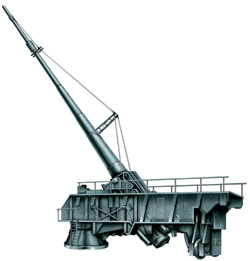
https://arsenal-info.ru/b/book/2169777125/24Initially, the Germans almost exactly copied the 356-mm long-range guns created back in 1917 with a firing range exceeding 62 km. In the picture shown, you can see the projectile of this powerful weapon.
Long-range artillery shells designed to shell the coast of England. This shelling had more symbolic than military significance.
Long-range artillery shells designed to shell the coast of England. This shelling had more symbolic than military significance.
The inscription under the drawing fully reproduces the signature made by the author of the article about the German artillery by the former Fascist Field Marshal Karl Rudolf von Rundstedt (we think the text does not need comment). A battery of such guns was installed in the Dieppe area and fired at the British coast.
On the night of August 19, 1942, the British landed in the specified area a fairly large landing force from parts of the Canadian division and several commando units, but despite the exceptional tenacity and bravery shown by the Allies (even according to the Germans), they were forced to retreat after 4 hours. Then something completely incomprehensible begins. All German reports triumphantly trumpet about 2700 prisoners and 700 British killed, and then briefly mention their losses — 200-300 people. And only a "modest phrase" was inserted into the book about the German coastal artillery: "The battery of super-heavy artillery guns of the Reserve of the Main Command, located west of Dieppe, suffered the most from the landing of the British, because the enemy temporarily managed to seize its firing positions." After this mention, the reports about the shelling of England from 14-inch disappeared. Victory has many parents, defeat is always an orphan.

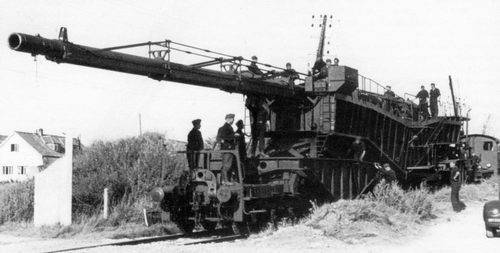

https://en.topwar.ru/38650-artilleriyskie-nabegi.htmlFor the shelling of Leningrad, the Finns used two 180-mm TM-1–180 railway installations (barrel numbers 86 and 102), captured in the summer of 1941 on the Karelian Isthmus.
Since November 1941, Finnish 180-mm railway installations from the areas of Kuokkala and Ollila have fired several times at unknown targets — Kronstadt, Leningrad? Post-war Finnish historians claim that their railway installations were ordered to shoot the battleship "Marat". But the trouble is, the battleship did not notice this.
After the war, Finnish historians claim that Finnish guns fired only at the forts of Kronstadt. But in most cases, there is no confirmation of this in our secret sources. That is, completely different targets were fired at in the city.
In addition to the railway installations in the village of Kellomyaki (now Komarovo), the Finns in December 1941 arranged a secret battery of 254/45 mm guns of the Obukhov Plant system. The firing range of the 235-kg projectile was 29.5 km.
From Kellomaki, 10-inch guns could shell the entire Kotlin, all the forts of the Kronstadt Fortress and the north-western outskirts of Leningrad.
Finally, in 1943, the Finns commissioned three TM-1-12 305–mm rail transporters captured on Hanko. By the end of the summer of 1943, the 3rd Railway Battery was formed from them. It is curious that the Finns made ultra-long 320-kg shells for them, which at an initial speed of 950 m/ s could fly at a range of 50-52 km. Such shells could hit not only the eastern outskirts of Leningrad and NIMAP, but even reach Kolpino. Rhetorical question: why did the Finns need such shells?
https://www.o5m6.de/Birgeria wrote: Wed Feb 01, 2023 3:24 pm About 2000 of the Commer Q4 sent to support the Red Army via the Lend Lease from 1942.
In the book "Camouflage of tanks of the Red Army" I found a mention that some of the tanks supplied to the USSR under lend-lease were withdrawn directly from combat units.Accordingly, they had not only factory, but also tactical designations of the British and American armies and various inscriptions made by the crew themselves. Out of respect for the allies, these inscriptions were not painted over. And there is also an example of Tetrarch tanks from the 151st Tank Brigade of the Red Army, which left the designations of the 9th Royal Lancers Tank Regiment of the 1st British Armored Division, from which they were withdrawn and transferred to the USSR. So, theoretically, the option of repainting white stars is possible, but it was not possible to find photos confirming this. And there were few cars withdrawn from combat units. The main part was sent to the USSR directly from factories and had only factory numbers. And as for the complete repainting, the cars delivered from the factories were repainted only during repairs, and those withdrawn from combat parts
http://wunderwaffe.narod.ru/Magazine/AirWar/45/12.htm

The Russians have kept the symbol of British origin ?
My bad. Changing them.